10 Humorous Christmas Stories Every Writer Should Study
You sit down to write a festive comic scene and, almost by reflex, reach for sleigh bells, mistletoe, a ruined office party, and a sentimental reconciliation. By the third paragraph, the decorations are doing more work than the characters. The funniest Christmas stories usually refuse that shortcut. They rely on tonal control, precise knowledge gaps, rigid relationship dynamics, or a voice so committed that even absurdity feels inevitable. The holiday setting supplies pressure, not the punchline.
The stories below work as a study guide for mechanisms, not as a list to skim before returning to your draft. Read the scenes as machinery. Track what each character believes, what each character knows, what they refuse to admit, and how the prose makes the collapse entertaining.
1. Flannery O'Connor's ‘A Good Man Is Hard to Find'
O'Connor's Christmas connection is indirect, but her Southern Gothic machinery belongs in any study of holiday comedy with teeth. The grandmother's conversational charm, social confidence, and self-image as a moral authority keep colliding with her choices. The humor comes from that gap. She believes she's performing refinement while the story keeps exposing vanity, manipulation, and fear.
That tonal dissonance makes the violence more disturbing and the comedy sharper. O'Connor doesn't turn the grandmother into a different person when the stakes rise. She preserves the same voice and lets circumstances strip away its protective polish. For writers, that's a consistency problem disguised as characterization.
A profile that records “grandmother is polite but selfish” isn't enough. Track what she believes about herself beside the evidence each scene supplies. Note her sentence rhythms, evasions, status claims, and the moments when her authority visibly weakens. The comic charge lives in those contradictions, and the story's Southern Gothic conventions give them a setting where charm and dread can occupy the same paragraph.
Practical rule: Track self-perception separately from observed behavior. Comedy often appears where the two refuse to match.
2. David Sedaris's ‘SantaLand Diaries'
Sedaris turns seasonal employment into a sustained comic narrative by refusing the superior narrator's chair. He's not standing above the Santa workers, shoppers, children, and corporate rituals with a raised eyebrow. He's trapped inside the machinery with everyone else, equally bewildered and occasionally complicit.
That makes the humiliation communal rather than cruel. The incidents accumulate instead of leaping through artificial escalation. A strange child, an exhausted colleague, or an absurd workplace demand becomes funnier because the narrator's emotional register stays stable: dry resignation mixed with genuine disbelief.
For a long comic manuscript, this is a scene-calibration lesson. Track whether the narrator is unreliable about facts or merely unreliable about emotional interpretation. Sedaris's perspective remains observant while his judgment keeps wobbling. If he suddenly becomes competent, morally superior, or perfectly composed, the comic contract collapses.
The same principle applies to recurring workplace or family scenes. Repetition needs variation, but the narrator's bewilderment must remain recognizable. A Christmas party can get worse without the protagonist becoming a new person every time the punchline needs help. If you're adapting a personal anecdote for short-form platforms, these TikTok storytelling formats are useful reminders that a sequence needs a recognizable narrative position, not just a pile of incidents.
3. O. Henry's ‘The Gift of the Magi'
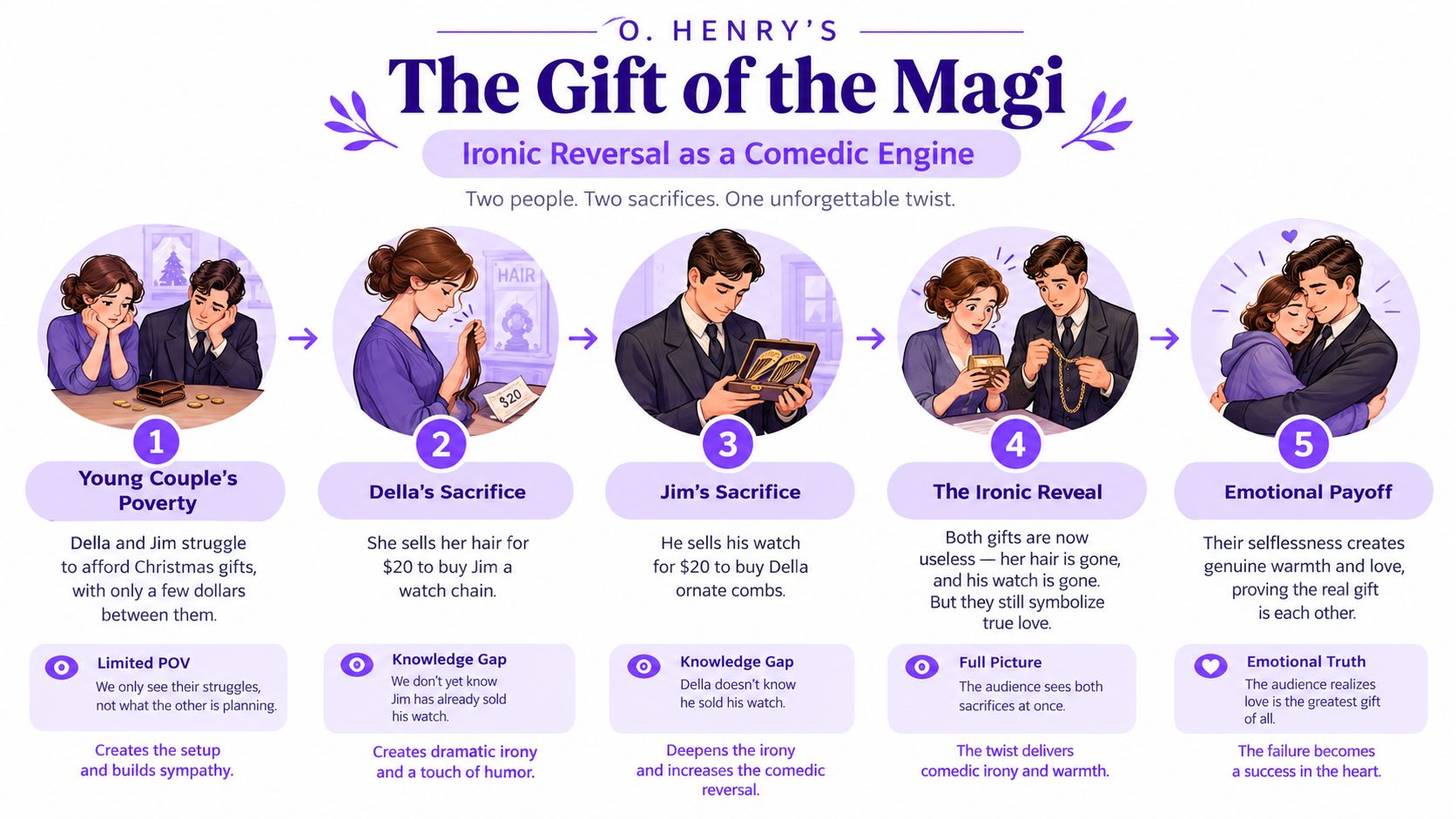
A married couple sacrifices the thing the other most wants, then discovers that the sacrifice has made the gift unusable. The setup sounds like a machine built for sentimentality, but O. Henry makes the reversal funny because the characters' motives are sincere. Neither spouse is foolish. Each acts intelligently with incomplete information.
That knowledge gap drives everything. The reader understands the approaching collision while the couple moves toward it with perfect emotional logic. The irony doesn't depend on a character knowing something and conveniently forgetting it. It depends on two people making generous decisions inside separate information bubbles.
The story is a compact demonstration of situational irony, and it deserves a knowledge timeline separate from the plot timeline. Record what Della knows, what Jim knows, and the exact point at which each decision becomes irreversible. If a later draft gives one of them information they couldn't possess, the payoff stops feeling inevitable and starts feeling rigged.
Study the structure visually as well as verbally.
“The characters don't need to be stupid for the irony to work. They need to be sincere, constrained, and missing the same piece of information.”
4. Christopher Moore's Absurdist Holiday Machinery
Christopher Moore's holiday fiction shows how absurdism works when the author refuses to wink. A supernatural premise becomes funny when the characters treat it as a practical problem. A vampire with mundane administrative worries is funnier when those worries remain genuine, not when the narrator pauses to announce that vampires and paperwork are an amusing combination.
That discipline matters over novel length. In an eighty-thousand-word manuscript, every recurring character needs a stable form of delusion, desperation, or philosophical certainty. The supernatural world needs rules, too. Absurdity only has force when the reader understands what counts as normal inside the book.
Separate the magic logic from the plot outline. Track what each character believes about the supernatural, then track how those beliefs affect speech, decisions, and alliances. Ensemble comedy breaks when one character starts borrowing another's voice or worldview just because the scene needs a faster joke.
A recurring cast also needs tone tracking. One character may respond to the impossible with irritated practicality, another with devotional awe, and another with opportunism. Preserve those differences across scenes. The collision between them generates the comedy. If everyone reacts with the author's preferred level of irony, the book becomes a group chat written by one person.
5. P. G. Wodehouse's Jeeves Stories
Wooster bursts in with a social disaster on his hands, mangles the facts, and somehow stays pleased with his own reasoning. Jeeves listens, offers a sentence so dry it could pass for weather, and calmly reveals that he understood the trap several moves ago. That exchange is the machine.
Jeeves and Wooster stay funny because the relationship barely budges. Jeeves is smarter, calmer, and politely subversive. Wooster is affectionate, impulsive, and magnificently wrong about almost everything that matters. For writers, the lesson is practical. A comic series can run on fixed character geometry if the pressure keeps changing.
Swap in a new aunt, a fresh engagement, a country house full of nerves, or a scheme with too many moving parts. The same dynamic spits out a different mess each time. Wooster misreads motives. Jeeves reads everyone too well. Comedy arrives from the gap between those two kinds of perception.
Series writers can treat consistency as an engine. Map the constants scene by scene: authority, knowledge, loyalty, and sentence rhythm. If Wooster starts sounding measured, or Jeeves starts flapping, the spell breaks.
“I rather fancy I have the situation well in hand, Jeeves.”
“Very good, sir.”
Series rule: Keep the character responses stable and change the external trap. That's how recurring comedy stays fresh without becoming arbitrary.
6. Miracle on 34th Street
The courtroom structure turns belief into evidence, which is a wonderfully hostile environment for Christmas magic. The humor emerges when legal procedure tries to process an irrational question. Different characters hold different versions of reality, and each must explain what they believe using a system that demands proof.
That creates several knowledge layers at once. The audience knows more than some characters, less than others, and may interpret Kris Kringle differently from the judge or the people questioning him. The story stays warm because each position has a sincere emotional or rational basis. Nobody exists merely to deliver the author's punchline.
A manuscript tracker should record each character's belief about Kris separately from what that character can prove. Then document the courtroom's procedural constraints. Testimony, objections, and decisions have to arise from the legal framework, not from the writer's need to stall the reveal.
The best comic moments arrive when characters articulate positions they'd rather keep vague. A private doubt becomes public argument. A practical person must defend an emotional truth. A supposedly rational process reveals its own limits.
7. Terry Pratchett's Hogfather
Pratchett gets enormous comic mileage from taking holiday mythology seriously enough to examine its machinery. Death investigating Christmas is funny because Death remains Death. The character doesn't become conventionally jolly to fit the season. His established voice, logic, and relationship to mortality collide with festive expectations.
That collision scales across the ensemble. Each character arrives with a distinct philosophical position, speech pattern, and knowledge state. The plot can throw them into the same absurd situation because readers already know how each one will interpret it. Comedy emerges from the collision, not from random eccentricity.
Large-cast holiday fiction exposes the limits of memory. A spreadsheet may record that two characters are enemies, but it won't necessarily preserve why one knows about the other's secret, whether that knowledge has changed, or how their speech should alter in public. Track voice, belief, relationships, and knowledge together.
The world needs a codex as rigorous as the cast. If belief creates reality, document how. If magic behaves differently under pressure, record the rule before the joke relies on it. Pratchett's absurdity feels effortless because the underlying system isn't loose.
**The joke lands because the world is ridiculous, not because the rules are.”
8. Kurt Vonnegut's ‘Harrison Bergeron'
Vonnegut takes an absurd political premise and follows it without softening the consequences. If enforced equality requires handicapping intelligence, beauty, strength, and grace, then the story shows what that system does in practice. The comedy appears in the gap between the stated ideal and the grotesque results.
The premise supplies external consistency. Characters behave according to the rules of their society, even when those rules are oppressive. Vonnegut doesn't need every character to undergo an intricate psychological arc because the system constrains the available choices. Predictability becomes the source of shock.
That's the core of satire as a narrative mechanism. Write down the world's governing assumptions, then test every major action against them. If a character suddenly behaves outside the system without a cause, the satire loses pressure. If the system's consequences appear only when convenient, readers see the author's hand.
The same method works in a Christmas story about compulsory cheer, corporate generosity, or a family that treats tradition as law. Establish the rule. Apply it fairly. Let the ridiculous result indict the rule.
9. Charles Dickens's ‘A Christmas Carol'
Scrooge has to be thoroughly Scrooge before the ghosts can make him funny, frightened, or redeemable. Dickens published the novella in London on December 19, 1843. The first edition consisted of 6,000 copies and sold out by Christmas Eve, within five days; by the end of 1844, the book had reached thirteen editions. The publication history matters because Dickens built a compact, giftable seasonal story around a comic miser whose transformation could carry serious social criticism.
Scrooge's comedy comes from the mismatch between his stated logic and his exposed reactions. He can argue that the poor should reduce the surplus population, then confront the human consequences of that abstraction. The ghosts don't replace his personality. They force his defensive logic into contact with what it excludes.
Track surface behavior separately from underlying motivation. Scrooge's voice remains recognizable while his beliefs shift. His transformation works because the story distinguishes a protective worldview from the needs and fears underneath it.
The book also demonstrates the durability of the mechanism. Within three months, at least eight stage adaptations had appeared, and scholarship records 357 plays, films, radio dramas, and television plays based on the story between 1843 and 1984, according to the Dickens adaptation archive. The premise survives because a rigid character, exaggerated visitors, and forced self-recognition can be relocated without losing their shape.
10. Roald Dahl's ‘The Wonderful Story of Henry Sugar'
Dahl's frame narrative proves that voice can carry comedy even when the underlying events become increasingly extraordinary. The narrator treats remarkable developments with conversational confidence and handles ordinary details with suspicious seriousness. That tonal mismatch makes the impossible feel both credible and faintly ridiculous.
The trick isn't just “use a distinctive voice.” It's maintaining the narrator's attitude toward the material. Is the narrator impressed, amused, horrified, dismissive, or suspicious? Track that attitude separately from plot events. A narrator can describe escalating stakes without changing their fundamental relationship to the story.
Voice slippage often arrives gradually. A chapter becomes more lyrical, a sentence grows more solemn, or a narrator suddenly explains a joke the earlier voice would have trusted the reader to catch. Dahl's consistency prevents that drift. The absurdity can intensify because the narrative stance stays put.
For a frame narrative or linked holiday collection, record vocabulary, sentence habits, degrees of intrusion, and emotional distance. The narrator's voice is not decoration laid over the story. It's the pressure that makes familiar material strange. A useful companion is this discussion of brand voice consistency, especially when a project includes multiple narrators or formats.
Comparing 10 Humorous Christmas Stories
| Item | Implementation complexity 🔄 | Resource requirements ⚡ | Expected outcomes 📊⭐ | Ideal use cases 💡 | Key advantages ⭐ |
|---|---|---|---|---|---|
| Flannery O'Connor, "A Good Man Is Hard to Find" | High, subtle tonal dissonance, regional voice | Medium, dialect research, scene-level logic tracking | 📊 Sustained dark comedy; precise tonal control ⭐ | Short fiction teaching voice-driven irony | ⭐ Teaches character-consistency as comedic engine |
| David Sedaris, "SantaLand Diaries" | Medium, maintain stable emotional register across vignettes | Low–Medium, authentic narrator voice, anecdote calibration | 📊 Accumulative, accessible humor; strong narrator rapport ⭐ | Personal essays, memoir-adjacent humor | ⭐ Vulnerability and steady bewilderment generate warmth |
| O. Henry, "The Gift of the Magi" | Medium–High, exact plotting and information control | Low, short-form plotting discipline, knowledge timeline | 📊 Precise ironic payoffs; emotional legitimacy ⭐ | Short stories relying on dramatic irony | ⭐ Demonstrates necessity of tracking characters' knowledge |
| Christopher Moore, Practical-magic adjacent | High, sustain consistent absurdist voices over long work | High, worldbuilding doc, voice profiles across length | 📊 Scalable absurdist comedy; ensemble coherence ⭐ | Comic fantasy novels, serialized absurdism | ⭐ Treats absurd premises seriously, enabling sustained humor |
| P. G. Wodehouse, Jeeves stories | Low–Medium, mechanical but exact relationship constancy | Low, patterned dialogue, relationship maps | 📊 Reliable episodic humor; repeatable comic formulas ⭐ | Series fiction with recurring duos | ⭐ Predictable dynamics that yield infinite variation |
| "Miracle on 34th Street", Davies | Medium, manage parallel knowledge states + legal structure | Medium, legal framework accuracy, testimony mapping | 📊 Belief vs. evidence comedy with emotional payoff ⭐ | Holiday novellas, structural-concept narratives | ⭐ Uses external systems (courtroom) to generate humor |
| Terry Pratchett, Hogfather | Very high, ensemble + rigorous world logic at scale | Very high, extensive worldbuilding and cast tracking | 📊 Thematic satire with sustained ensemble comedy ⭐ | Large-cast satirical novels, series worldbuilding | ⭐ World-consistency enables complex comedic collisions |
| Kurt Vonnegut, "Harrison Bergeron" | Medium, maintain philosophical/systemic consistency | Low, concise rule-documentation for premise | 📊 Sharp satirical impact from logical rigor ⭐ | Concept-driven short fiction and satire | ⭐ Premise-execution shows system-driven comedy |
| Charles Dickens, "A Christmas Carol" | High, track layered surface vs. underlying motivations | Medium–High, narrative frames, transformation mapping | 📊 Powerful emotional transformation with comic moments ⭐ | Novellas, moral fables with character arcs | ⭐ Demonstrates layered consistency enabling believable change |
| Roald Dahl, "Henry Sugar" | Medium, sustain intrusive narrator tone across frame | Low–Medium, track narrator attitude, vocabulary | 📊 Deadpan absurdity anchored by consistent voice ⭐ | Frame narratives, comic fables relying on tone | ⭐ Voice as primary comedic mechanism; understatement works |
Turn Holiday Laughs Into Something You Can Repeat
Pick one story from this list and reread a single comic scene with a notebook open. Mark what each character knows, what each character believes, and what each character says. Then note the exact point where the scene's pressure changes. You're not hunting for “funny lines.” You're locating the mechanism that makes the lines inevitable.
Draft a short holiday scene using that mechanism. Use dramatic irony from O. Henry, a fixed relationship dynamic from Wodehouse, a stubborn narrative voice from Dahl, or a system-driven premise from Vonnegut. Keep the borrowed machinery and replace the surface. No one needs another mistletoe collision unless the mistletoe is enforcing a legal obligation, exposing a carefully maintained lie, or threatening the family's inheritance.
For writers whose comic series run past 80,000 words, the problem becomes operational. Character profiles are static documents. Character tracking is a living record of knowledge, state, relationships, voice, objects, and events across scenes. Those are different tools, and confusing them is how a character learns a secret in chapter twelve that they somehow knew in chapter four, or how a dead relative wanders into the Christmas dinner because the manuscript remembers the emotional beat but not the body count.
Novelium's Character Tracker and World Codex extract and track those details across a manuscript. They help preserve the timing that makes holiday comedy work, draft after draft, without forcing you to flatten the voice or manage every continuity dependency from memory.
Novelium tracks character traits, knowledge states, relationships, events, timelines, and world rules across your manuscript, so comic setups don't collapse under continuity errors. Visit Novelium to check your draft locally, protect your work, and keep the jokes landing for the right reasons.