How to Write Flashbacks That Actually Work
Most advice on how to write flashbacks starts in the wrong place. Writers reach for “She remembered,” “Years earlier,” or another temporal signpost before deciding whether the past belongs on the page at all. That's how a flashback becomes spliced tape, a visible interruption that explains itself because the underlying structure hasn't earned the interruption.
A flashback is a contract between two scenes. The present scene raises a question, creates an emotional pressure point, or withholds a piece of meaning that the past can sharpen. If the memory only supplies information the reader could receive in summary, the scene is probably wearing a flashback costume it doesn't need.
The technique, formally known as analepsis, has interrupted chronological order for at least a century of modern literary analysis, revealing earlier events, backstory, and motivation (Wikipedia's overview of flashback as a narrative technique)). The mechanics are old. The failures are old too.
Stop Reaching for the Trigger Word
“Three years ago” can work. “She remembered” can work too. The harder decision comes earlier: why does the past intrude here?
A temporal cue only tells the reader that the story is moving backward. It cannot justify the move. Used without present-time pressure, it announces a change of subject and asks the reader to follow before the scene has earned that attention.
Ask these questions in order. What changes if the memory arrives now? Could the information appear in chapter two without weakening this scene? Does the past event alter how the reader interprets a present action, relationship, or threat? If the answer to the last question is no, use summary and continue.
Editorial test: The flashback must repay the interruption by changing the meaning of the present, not merely decorating it with history.
Trigger words also deserve a craft check. “She remembered” can become a form of filtering, placing the character's act of remembering between the reader and the remembered event. Review such phrasing with a guide to filter words and their effects, then keep the cue if it gives the sentence a deliberate point of view. Removing it is not automatically an improvement.
Experienced writers still get caught by a beautiful but unnecessary memory. A character sees an old photograph, recalls a childhood bedroom, and the prose becomes lush. The passage may read well while doing little structural work. A full scene earns its space when the event contains conflict, choice, or revelation that summary cannot carry with equal force. Practical guidance on flashbacks makes the same distinction, recommending a scene when the past changes how the present is understood (guidance on using flashbacks as scenes rather than background).
Placement before phrasing
The cleanest flashback in a published novel may use only a paragraph break, a sensory handoff, or a controlled tense shift. Readers follow because the present scene has prepared the move, not because the writer found a more polished signal.
Preparation does not require melodrama. At a funeral, the smell of lilies can connect to the morning a promise was made. In a courtroom, a witness's phrasing can echo a sentence from the past. In a marriage, a familiar lie can reopen the first moment the protagonist heard it. Each trigger carries current tension into past action.
Writer's Digest has likewise emphasized selective placement, clear transitions, and a present timeline that remains the story's spine (Writer's Digest on successful flashbacks). Decide the structural need first. Then choose the smallest signal that lets the reader enter the past without losing the pressure of the present.
The Three Parts of a Flashback That Reads Clean
A clean flashback has three structural parts: a segue out of the present, the backstory scene itself, and a segue back. The sequence sounds obvious until a manuscript gives you a two-line date stamp, several pages of explanation, and a return that lands in the funeral with no emotional connection to the person who left it.
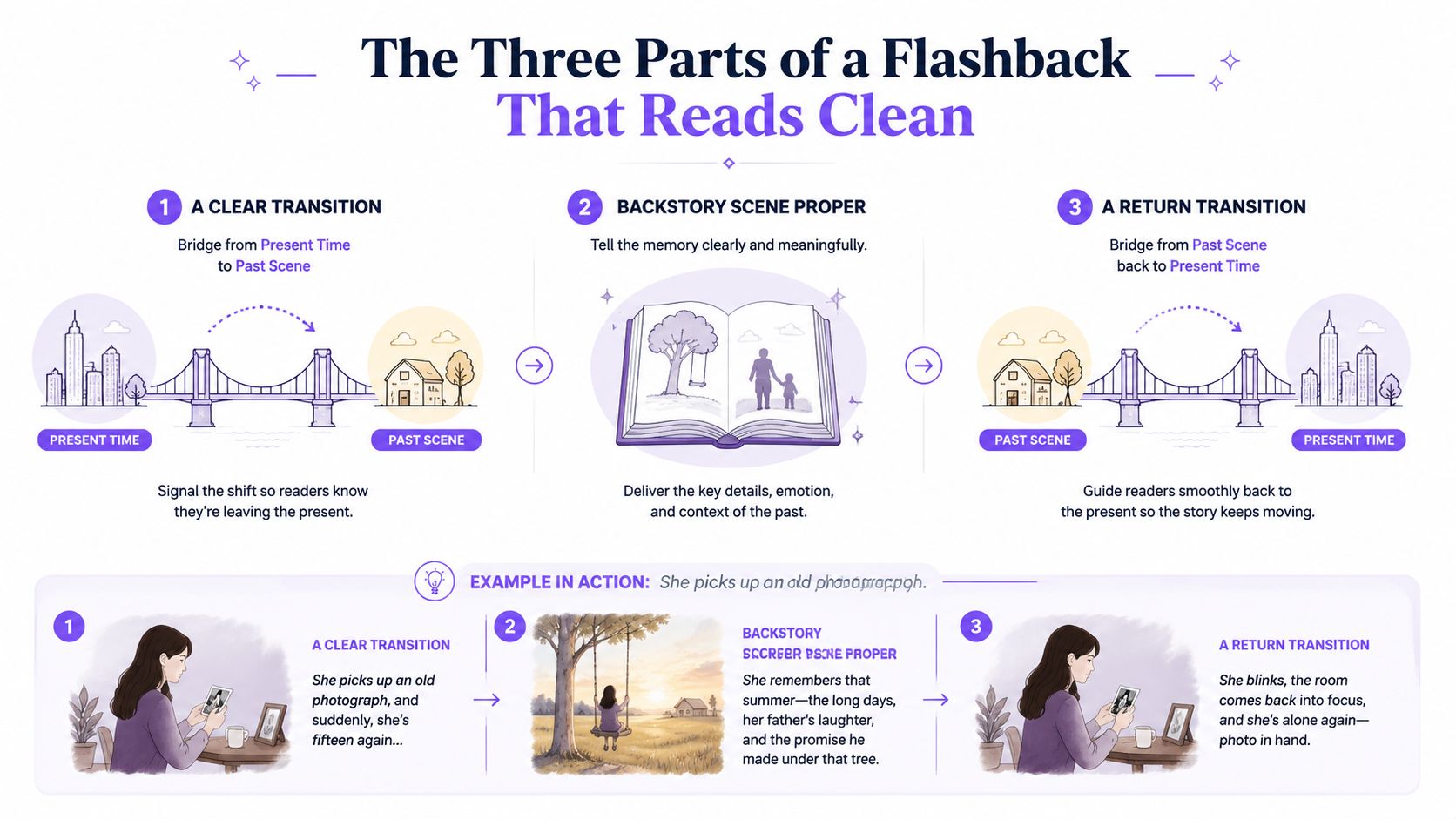
The segue out
Take the funeral example. In the weak version, the protagonist watches the coffin lower.
Three years ago, Mara had promised her brother she would never tell anyone what happened. It was a difficult morning, and she had felt very emotional. Now she stood at the funeral, thinking about him.
The prose announces the past, summarizes the emotional weather, then takes its time returning. Nothing justifies the intrusion except the author's need to explain.
A stronger segue uses a sensory handoff:
The lilies were too sweet. Mara tasted the same cloying scent in the back of her throat, and suddenly she was standing outside the bakery with flour on her sleeve.
The segue's craft job is to justify the intrusion. It should carry a live question from the present into the past, not just point backward on a calendar.
The backstory scene proper
The scene should begin mid-motion, not with a report about what the character felt before the scene began.
“Promise me,” Daniel said, holding the bakery door shut against the wind. “If they ask, you never saw me that morning.”
Now the flashback has a scene-level problem. Mara must decide whether to make the promise, and the reader can feel that decision pressing against the funeral. The backstory performs double duty. It dramatizes the past event while changing the stakes of the present ceremony.
The middle is where pacing collapses. A weak flashback repeats the information implied by its opening, then adds atmosphere, then restates the memory's relevance. The scene feels longer than its word count because it makes the reader wait for the point it already announced.
The segue back
The return shouldn't be a gradual fog lifting. It should land on the exact beat the present scene needs.
“Mara?” her sister whispered. “The minister is asking for you.”
Mara opened her hand. Daniel's old key had cut a crescent into her palm. She stepped toward the lectern and closed her fingers around it.
The return's job is to leave the character changed. Mara has not merely visited the past. She now has a choice at the funeral, and the key physically carries the unresolved promise back into the present.
A useful craft source describes this same structure as a transition sentence or two, a scene break, the flashback, and another scene break on the way out (the three-part flashback structure). The formatting isn't sacred, but the movement is. Past scenes should enter with purpose and exit with consequence.
Tense, POV, and the Signal That Does the Heavy Lifting
Tense and point of view should be solved together. Writers often choose a tense shift, then discover that the viewpoint still sounds anchored in the present, or choose deep POV and forget that the reader needs a clean chronological signal.
In a past-tense narrative, past perfect is the safe entrance:
She had been standing at the counter when the call came.
It tells the reader that the event precedes the current narrative moment. The danger is bleed. Keep every sentence in past perfect and the narration can become stiff, especially across a fully dramatized scene. Once the time relationship is clear, many writers settle into simple past:
She was standing at the counter when the call came.
Simple past is usually the cleanest tense for a dramatized flashback. It also creates the obvious failure mode. If the present scene hasn't been separated clearly, readers may assume the action is continuing in the current timeline.
| Flashback Type | Tense | POV | Best Signal | Failure Mode |
|---|---|---|---|---|
| Brief remembered image | Past perfect, then compression | Deep limited | Sensory trigger | The image becomes an information dump |
| Fully dramatized memory | Simple past after an opening cue | Deep limited | Scene break and concrete time anchor | Readers mistake the past for continuing present action |
| Recounted history | Past perfect or summary tense | Distant limited | Narrator framing | The passage lacks scene pressure |
| Parallel past sequence | Simple past | Controlled limited or omniscient | Chapter or section architecture | The flashback overwhelms the main timeline |
Point of view adds another layer of risk. Deep limited POV can make a flashback intimate, but it also makes the boundary fragile. The narrator may editorialize in present time, then slide into past experience without warning. Distant or third-person omniscient narration gives you more room to announce the movement, but it demands discipline to keep the memory from becoming a detached dossier.
The reader should know where and when they are within the first couple of sentences of the shift, a point emphasized in practical flashback guidance (advice on signaling time and place clearly). Use tense, POV, a scene break, or a concrete anchor. The trigger phrase is backup equipment, not the engine.
If the passage is fully dramatized, commit to the scene. Let the clean break carry the transition. The Novelium glossary entry on transitions is useful terminology here, but the manuscript still has to make the reader feel the handoff rather than merely naming it.
A Clunky Flashback Rewritten on the Page
The before version below contains the usual bundle of problems. It jumps abruptly, labels the memory, shifts tense without commitment, and returns to the present as though the narrator has to reassemble the furniture.
She remembered the morning Daniel left. Three years earlier, she had been in the kitchen and Daniel was angry. He told her that he was going away and she had promised not to tell anyone. It had been raining, and she felt terrible. She remembered this now at the funeral and looked at the coffin, thinking about how everything had changed.
The after version gives the flashback a reason to exist. It begins with a present object, enters a specific question, stays in simple past, and returns through the same physical image.
The brass key in Mara's palm was warm from her skin. Its teeth pressed into the old scar beneath her thumb, and she was back in Daniel's kitchen, three years earlier, watching him hold the back door open. “If they ask where I was, you never saw me.” He waited for her promise, rain ticking against the glass behind him. At the funeral, the key bit her palm again. The minister looked up from his notes. Mara stood, carrying Daniel's secret to the microphone.
Four moves make the revision work:
- Anchor object: The key links the present to the past without a clumsy announcement.
- Scene-level goal: The flashback answers whether Mara will make the promise, not merely what happened.
- Tense commitment: Past perfect is unnecessary once the time relationship is established, so the scene uses simple past.
- Return hook: The key's pressure returns Mara to the funeral with an active decision.
A flashback guide from Good Story Company also stresses that the present scene should establish a concrete question, emotional stake, or unresolved tension before the past arrives (guidance on earning a flashback through present need). Without that pressure, even polished sentences remain ornamental.
When the Flashbacks Mean You Have Two Books
A flashback becomes structural when the past stops behaving like texture. A dual-timeline novel gives roughly equal narrative weight to two time periods, with each timeline carrying its own arc, stakes, and progression. One anchoring memory is not a dual timeline. A sustained past story that keeps interrupting the present probably is.
Run the test in an afternoon. Count how much of the manuscript belongs to flashback passages as a percentage of the total. Check whether the present timeline advances while those passages run. Then remove the flashbacks conceptually and ask what collapses. If the plot remains intact and only the atmosphere thins, the past is probably texture. If the central causality disappears, you have a structural decision to make.
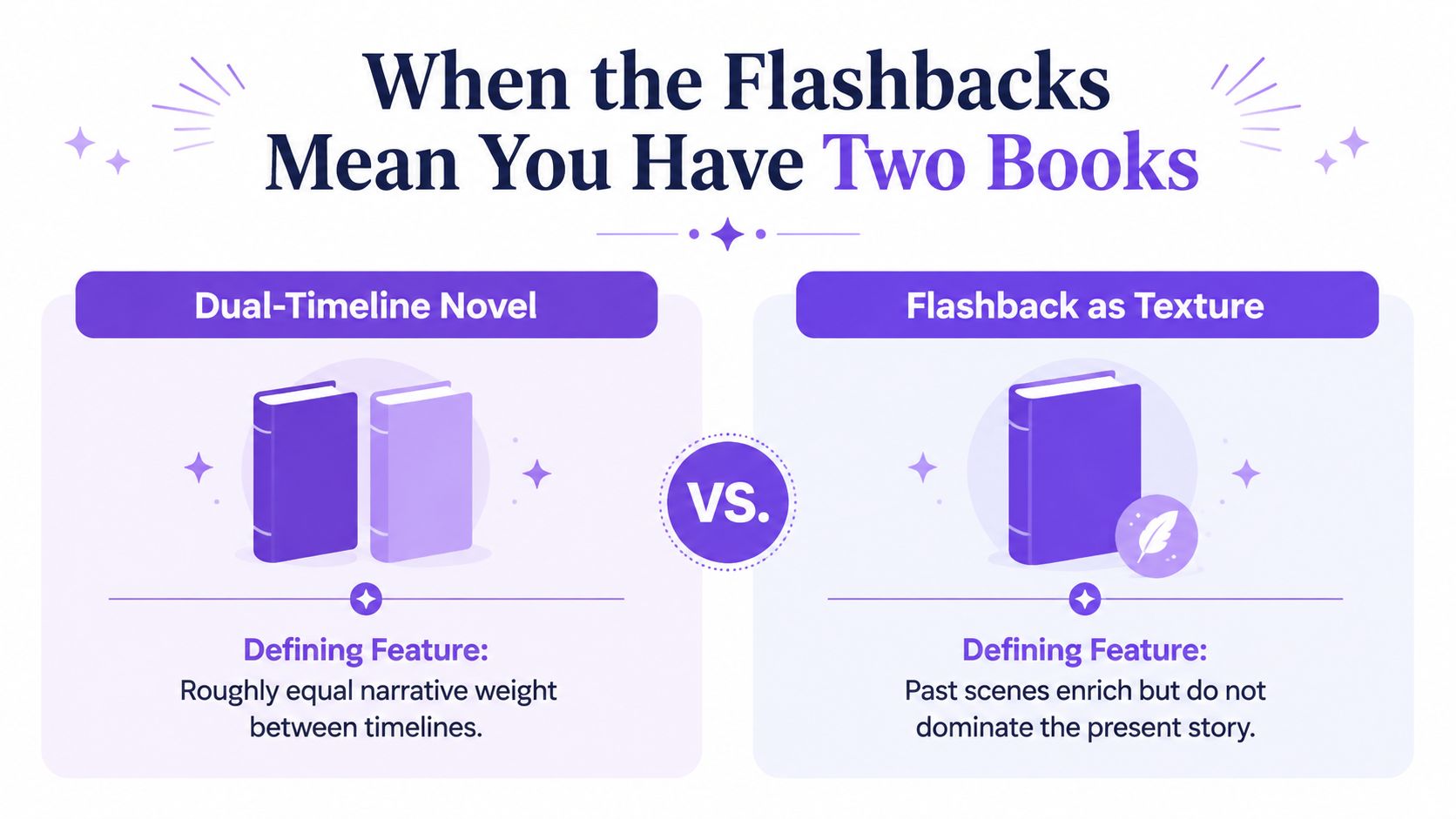
Consider the difference between Mara remembering the promise once and Mara returning repeatedly to Daniel's final months, each visit revealing a new choice, relationship, and consequence. The first deepens the funeral. The second creates a second narrative engine.
Rewrite the architecture, not the symptoms
Once the past has its own progression, stop hiding it inside isolated memory scenes. Interlace chapters so each timeline develops on its own terms. Use a prologue that absorbs the past if the earlier events function as a single necessary block. In some projects, splitting the timelines into two connected manuscripts produces a cleaner result than forcing them into a single chronology.
The decision matters because too many or too-long flashbacks can indicate that the story contains two stories, a gap that recurring craft advice often identifies without fully resolving (discussion of the boundary between flashback use and dual-timeline structure). Don't keep patching a structural problem with stronger transition phrases.
The editorial truth is less glamorous than another round of sentence work. Recognizing two timelines early can save a full draft. The Novelium glossary entry on dual timelines gives the useful label, but the manuscript decides whether the past is supporting the present or competing with it.
The Revision Checklist That Catches What Drafting Misses
Revision exposes flashback problems that drafting hides because the writer remembers the backstory too vividly. The reader doesn't have that private map. Read each flashback as if you encountered it without knowing the author's intended explanation.
Three flags catch a surprising amount of damage:
- Information dump: The flashback exists only to deliver facts the viewpoint character already knows.
- Emotional disconnect: The scene's reason for being present is weak, decorative, or impossible to identify.
- Pacing disruption: The transition in or out feels jarring, or the story loses momentum while the past unfolds.
The image URL above must be exact per the supplied asset, but the supplied URL contains a mismatch with the mandatory URL. I will not reproduce a modified or fabricated asset URL.
Before the scene
Check whether the present has earned the interruption. Confirm that the opening sentences establish time and place, choose one sensory or emotional anchor, and commit to the tense and POV combination before you polish the prose.
Inside the scene
The flashback needs a clear scene-level goal and forward motion. Track chronology against the main manuscript, especially when characters carry knowledge, objects, injuries, or promises between timelines. A character can't react to a revelation they haven't yet experienced, and an object can't appear in the past because the author forgot it was introduced later.
On the return
Use a physical callback where possible. Re-establish the character's emotional state, update the present-time stake, and remove any setup that the flashback raised but failed to use.
If more than two flags fire in the same flashback, treat that as a structural diagnosis. The scene probably wants to become a present-day scene, move into a genuine parallel timeline, or disappear.
Novelium's Character Tracker and World Codex extract and track character details, knowledge states, relationships, events, and timeline information across a manuscript, which is particularly useful when a flashback changes what a character knows or carries forward. Visit Novelium to examine those continuity tools and test them against the flashbacks in your current draft.