How to Write an Epilogue That Earns Its Place
Most advice on how to write an epilogue starts with a checklist. That's backwards. The first question isn't what the epilogue should contain. It's whether the book has earned another scene at all.
A finished novel already has a closing movement. The climax resolves the governing conflict, the final chapter registers its consequences, and the denouement lets the reader feel the new shape of the story. An epilogue should add something structurally impossible to place there, not explain the ending again in a softer voice.
The form has a long history of serving two jobs, closure and reflective framing. The Oxford English Dictionary's first citation for epilogue dates to 1564, while the related form “Epylogacion” appears in 1474 in Caxton's work. In English theatre, the Renaissance made the epilogue a formal device, and Ben Jonson's use in Cynthia's Revels around 1600 helped establish its stage function. Britannica also notes that epilogues were especially common in London during the Restoration, from 1660 to the reign of Queen Anne in 1702–1714, when few plays appeared without one. This history and the form's classic purposes are summarized here.
The Case for Skipping the Epilogue Entirely
Most epilogues are unnecessary. Writers reach the final chapter, feel the pressure to account for every character and consequence, then add a sentimental curtain call that drains the ending's voltage. The climax earned its weight through accumulation. A paragraph explaining how everyone feels afterward rarely improves it.
The symptoms are easy to spot. The epilogue re-explains the plot, reports marriages and promotions like a family newsletter, or introduces a threat from the next book while pretending to offer closure. Sometimes it just lets the author avoid making a clean cut. The manuscript says “the end,” then keeps talking.
Editorial test: Remove the epilogue and read the final page again. If the book's central promise still lands, the epilogue has to justify itself from scratch.
The best endings often trust absence. The Great Gatsby closes on Nick's meditation rather than a tour of everyone's future. Beloved leaves its final image to carry the novel's emotional burden. By contrast, an epilogue that turns resolution into a census of survivors can make a hard-won ending feel padded. Even a technically competent scene weakens the book if it changes the reader's final emotion from recognition to administration.
The form also tempts writers into a tonal seam. A close third-person novel suddenly becomes a distant historical summary. A comic romance becomes a sentimental wedding album. A brutal thriller ends with an ominous stranger whose only purpose is to point toward book two. Readers feel that seam because the epilogue has stepped outside the story's established logic.
Don't ask how to write an epilogue until you've answered a harsher question: what can this scene deliver that the ending cannot? If the answer is “reassurance,” “explanation,” or “I wanted to show what happened to everybody,” delete it. Write the epilogue only when the time gap, viewpoint, consequence, or framing device creates genuine narrative value.
When an Epilogue Actually Earns Its Place
An epilogue earns its slot when the main narrative can't deliver essential aftermath without damaging its structure. It belongs after the resolution, usually as a separate future-time scene, not as a second climax. Practical guidance places many epilogues at roughly 500–2,000 words, or about 2–8 manuscript pages, depending on formatting. That range and the short-form principle appear in this epilogue guide.
Use four decisions before drafting.
Purpose. Name the one job. A thriller might need to show that the victim's justice arrives through a quiet court filing after the investigation ends. A romance might need an older version of the couple to meet again, allowing the relationship to be seen through time rather than another declaration. A fantasy might need to reveal that the spell which saved the kingdom has a delayed cost.
Gap. Choose the distance from the ending. The gap can be years, a generation, or the time needed for consequences to become visible. It can also be a shift to a minor character's point of view. The break matters because it creates a new vantage point, not because “years later” sounds suitably epic.
Payload. Identify the single piece of information, image, or emotional change the reader carries away. If the fantasy epilogue reveals that the hero's spell is slowly turning every river to salt, don't also explain the new government, catalogue the surviving armies, and introduce three cousins.
Final beat. End on the image that makes the payload felt. The final beat should arrive quickly and carry the scene's emotional or thematic charge.
One gut-check settles many arguments: if the information could land as one paragraph inside the final chapter, an epilogue is overkill. Write down the single thing only this scene can deliver. If you can't state it plainly, you don't have an epilogue yet. You have post-draft anxiety.
Drafting the Epilogue in Four Movements
Treat the epilogue as a compact structural instrument. A useful model divides it into Purpose, Gap, Payload, and Final Beat, while the visual roadmap below applies those movements to a fantasy series.
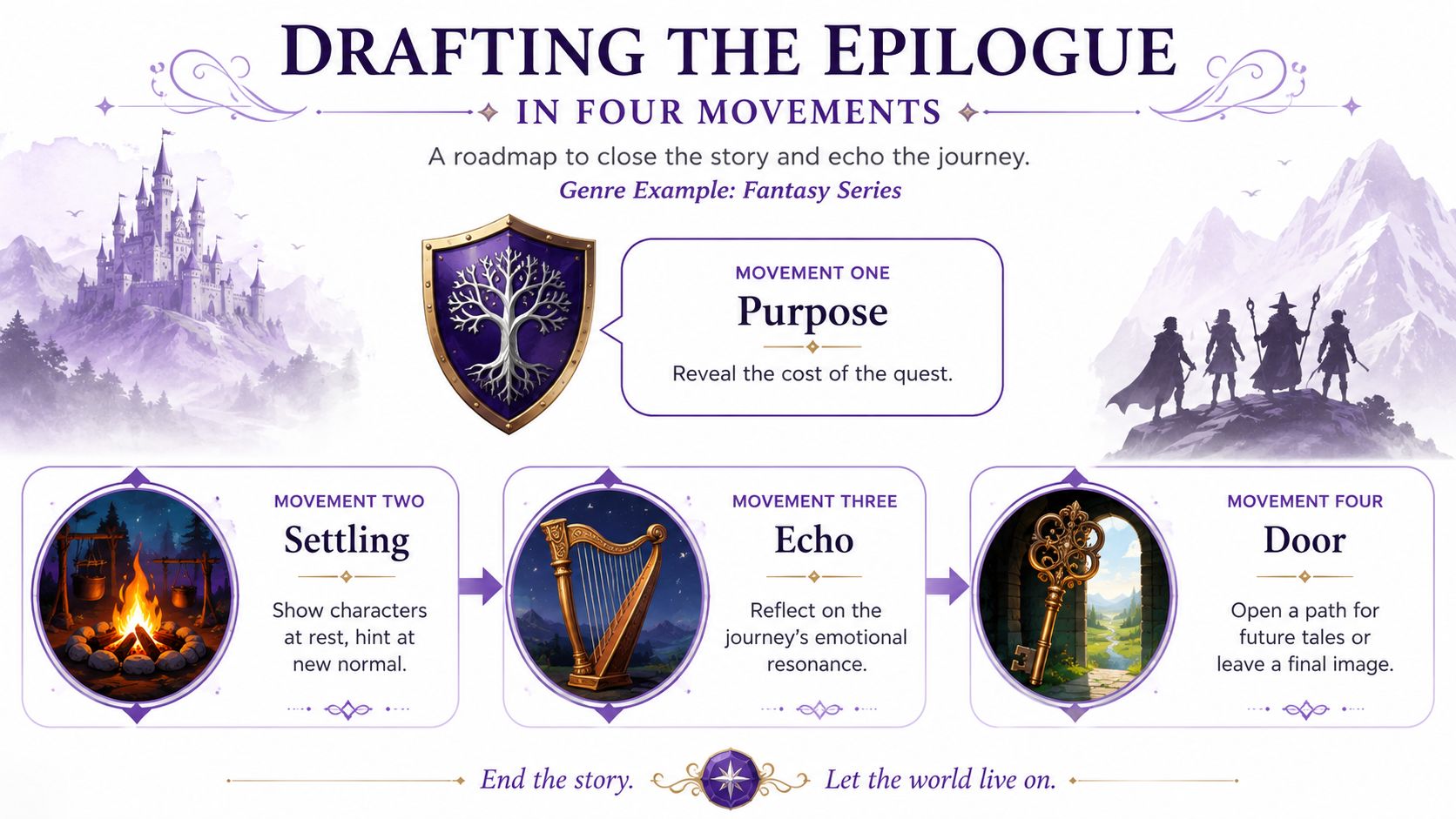
Purpose
Write one sentence: “This epilogue reveals the cost of the hero's final spell.” That sentence excludes the tempting extras. You're not wrapping up the world. You're showing the cost. If the scene starts discussing trade policy, royal succession, and the hero's childhood, cut back to the stated job.
Gap
Name the structural break and justify it. “Five years later, from the apprentice's point of view, because the cost becomes visible only after the hero disappears.” The gap can be temporal or perspectival, but it must do work. A future scene that feels identical to the last chapter is just another chapter wearing a false moustache.
Payload
Choose the concrete thing the reader learns or witnesses. In this fantasy example, the apprentice discovers that every restored forest has begun growing silver leaves, and the trees are drawing magic from the villages nearby. Draft the scene around that discovery. Don't turn it into a lore lecture.
Final Beat
Close on a sensory event rather than a thematic statement. The apprentice touches a silver leaf, hears a child coughing in the village, and lets go. The image carries consequence without announcing the moral.
A vague brief, “wrap up the world,” becomes a focused draft:
Five years after the tower fell, Mara found silver leaves on the western trees. They rang softly whenever the wind moved through them, bright as coins against the dark branches. In the village below, the wells had begun to taste of ash. Mara closed her hand around the nearest leaf, and the ringing stopped.
That micro-scene has a purpose, a gap, a payload, and a final beat. It withholds the answers that belong in another book or in the reader's imagination.
An epilogue, afterword, and author note solve different problems. Don't use a fictional scene to discuss research, or an author note to repair a character arc. The broader distinction between narrative and back matter is outlined here.
The four-movement method is a guardrail, not a formula. Let the story bend it when the voice demands it, but make every deviation intentional.
Epilogue, Afterword, or Author Note
These forms aren't interchangeable labels for “material at the back.” They make different contracts with the reader.
| Form | Purpose | Voice | Reader Expects |
|---|---|---|---|
| Epilogue | Advance story time after the resolution | Fictional, usually in character | Another contained piece of the narrative |
| Afterword | Discuss research, craft, history, or the book's creation | Authorial or invited contributor | A direct conversation outside the fiction |
| Author note | Acknowledge inspirations, dedications, translations, or real-world context | Brief and personal | Useful context without a new scene |
Choose the epilogue when a character's arc needs one final consequence. A historical romance might end with the marriage, then use an epilogue to show the couple decades later in the house they fought to keep. Choose the afterword when you need to explain the archival material behind that house, the history you changed, or the personal reason you wrote the book.
An author note is lighter. If the novel draws on a real village, a medical condition, or a translated text, a few paragraphs can acknowledge the connection without dragging the reader back into plot. That material belongs in back matter, not in a scene pretending to be fiction.
Some books need two slots. A historical novel may end with an epilogue, then follow it with an author note about the record. A memoir-inspired novel may use an afterword for context and a brief note for acknowledgments. Order matters because the epilogue should preserve the final fictional impression. Put explanatory material after it unless the project has a deliberate reason to do otherwise.
The simple rule is practical: resolve the character inside the epilogue, talk to the reader in the afterword, and acknowledge context in the author note.
Two Sample Epilogues Dissected
Here are two deliberately short models. The first closes inward. The second opens a door without pretending the first story remains unresolved.
Literary fiction
Twenty years later, Lena returned to the apartment with the landlord's key warm in her palm. The rooms were smaller, or she was larger; she couldn't decide which. In the kitchen, she placed a clean glass beside the sink, exactly where her mother had left one the morning she went away. Lena turned off the light before she left.
The time gap is long enough to alter Lena's relationship to the apartment, but the scene doesn't summarize twenty years. The point of view remains hers, and the single gesture mirrors an earlier domestic action. What's revealed is her changed ability to revisit the past. What's withheld is a complete account of her life. The closing image, the glass and the extinguished light, signals finality because Lena leaves.
Fantasy thriller
On the first morning without bells, Tomas found a black key beneath the city fountain. The metal was warm despite the snow. He carried it to the northern gate, where a woman in a red coat waited with a map of roads no living cartographer had drawn. When Tomas opened his hand, the key turned by itself.
This scene uses a compressed future gap and a new protagonist. It reveals that the defeated regime left behind a mechanism, but withholds its purpose. The final image signals continuation, not a failed resolution. The original conflict is complete. The new protagonist and object belong to the next narrative.
The examples look unrelated, yet they share the same logic: a clear payload, a contained scene, and a final image doing more work than explanation. The first epilogue closes the emotional circuit. The second creates a controlled narrative door. Neither inventories the world.
Continuity Checks Before You Call It Done
An epilogue is a manuscript of its own. Audit it against the book before submission, especially when the draft runs 80,000+ words, carries recurring characters, or belongs to a series with a large cast. Late scenes expose tracking failures because they combine the ending's consequences with information accumulated across the entire manuscript.
Timeline integrity
Check seasons, ages, travel distances, pregnancy terms, school years, holidays, and the elapsed time between the final chapter and epilogue. A character can't give birth before the pregnancy has had time to progress. A child can't begin a school year that the calendar makes impossible. A supposedly distant city can't be reached overnight unless the world's travel rules support it.
Knowledge state
Track what each character knows at the exact moment of the epilogue. A detective can't react to a confession they haven't received. A dead character can't recognize a secret unless the scene establishes a supernatural mechanism. Epilogues often drift into authorial omniscience, allowing characters to know whatever the writer needs them to know.
Object tracking
Heirlooms, weapons, vehicles, pets, wounds, letters, and keys need a last-known status. If the sword was buried, show how it returns. If the protagonist lost an eye, don't describe an effortless wink. These details look minor until they contradict a prop or injury the reader remembers.
Emotional continuity
The character's interior state must follow from the climax. Recovery can be quiet, partial, or uneven, but it can't be a sudden reset installed for a cheerful final paragraph. Emotional continuity isn't the same as keeping the character miserable. It means the aftermath belongs to the person you wrote.
Tonal contamination
Read the epilogue aloud. Cut every sentence that explains what the reader already felt, especially sentences that announce the theme or label the emotion. The writer is tired at this stage, which makes summary and sentimentality especially dangerous.
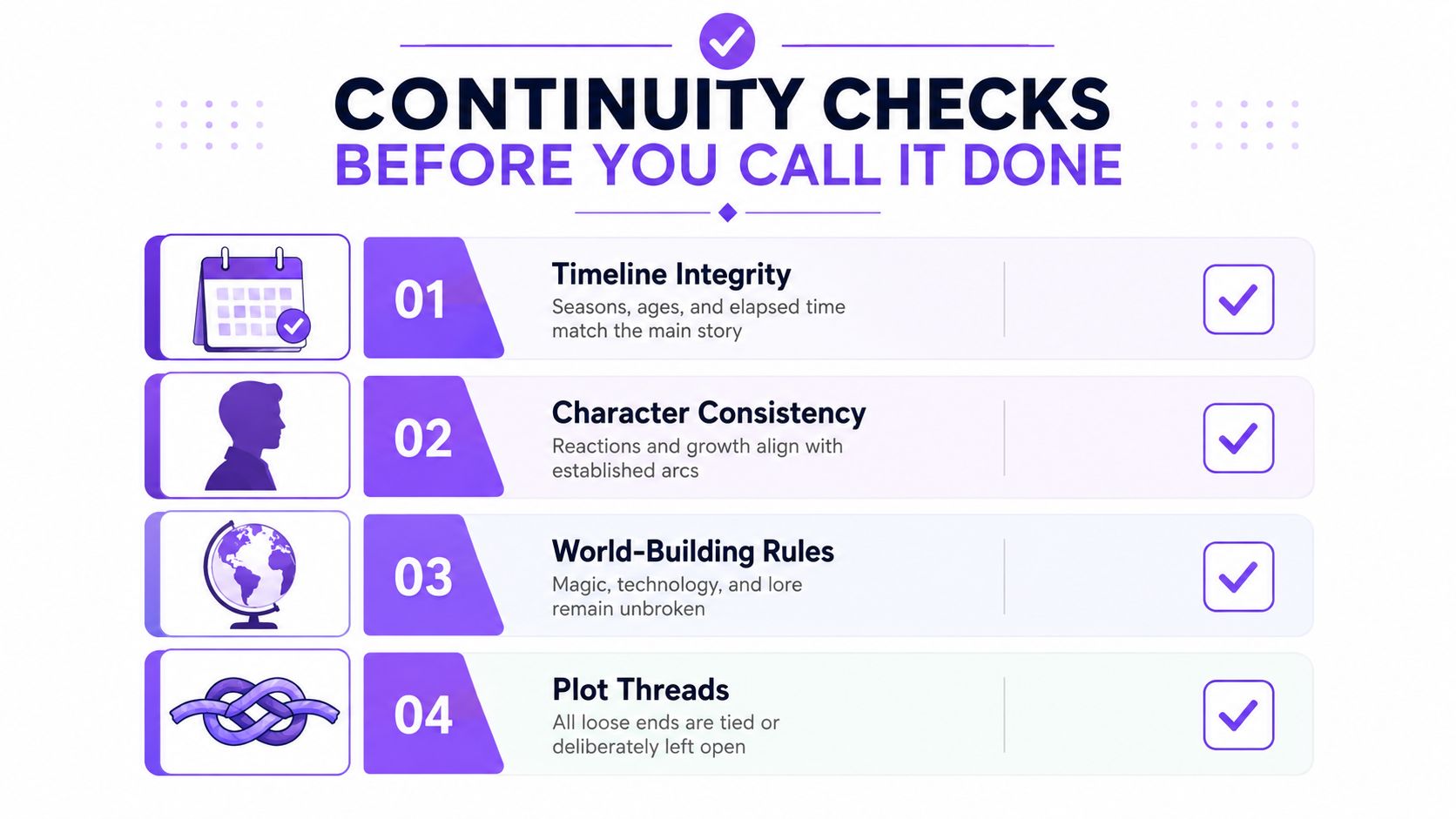
For authors preparing a release, continuity also protects the material readers discuss after finishing. A clean ending supports the same credibility you need when planning Kickstarter book launch tips, because readers notice contradictions long after they've forgotten whether a scene was beautifully phrased. One continuity error in an epilogue can undo the trust the novel spent hundreds of pages building.
The scalable answer isn't another character questionnaire. Profiles describe who a character is. Tracking records what changes, who knows it, where an object went, and when each consequence becomes possible. That distinction matters across a full novel or series, where a static document goes stale as the manuscript evolves.
Novelium's Character Tracker and World Codex extract and track character details across manuscripts, including states, relationships, events, and world information. Use that kind of systematic record to audit the epilogue against the live manuscript, not against your memory of an early draft.
Novelium's Character Tracker and World Codex help you track character knowledge, relationships, timelines, objects, and world rules across complex manuscripts, making epilogue continuity easier to audit before submission. Visit Novelium to examine your draft systematically and catch the late-stage contradictions that memory misses.