How to Write a Novel for Beginners Your Practical Guide
So, you want to write a novel. The idea of starting with a blank page and ending with a finished manuscript feels huge, almost impossible. I get it. Every author, from the seasoned pro to the nervous first-timer, starts in that exact same spot.
The secret isn’t some magical burst of inspiration. It’s a process. And it’s a process you can learn.
Your Roadmap From Idea To First Draft
Trying to hold the entire book in your head at once is a surefire way to get intimidated and quit before you even start. The real trick is to break it down into smaller, more manageable stages. Think of it less like conquering a mountain and more like a series of achievable hikes.
By focusing on one part of the journey at a time, you build momentum. You create a clear path forward that helps you sidestep the common roadblocks that trip up so many aspiring writers.
At its core, the process is pretty straightforward.
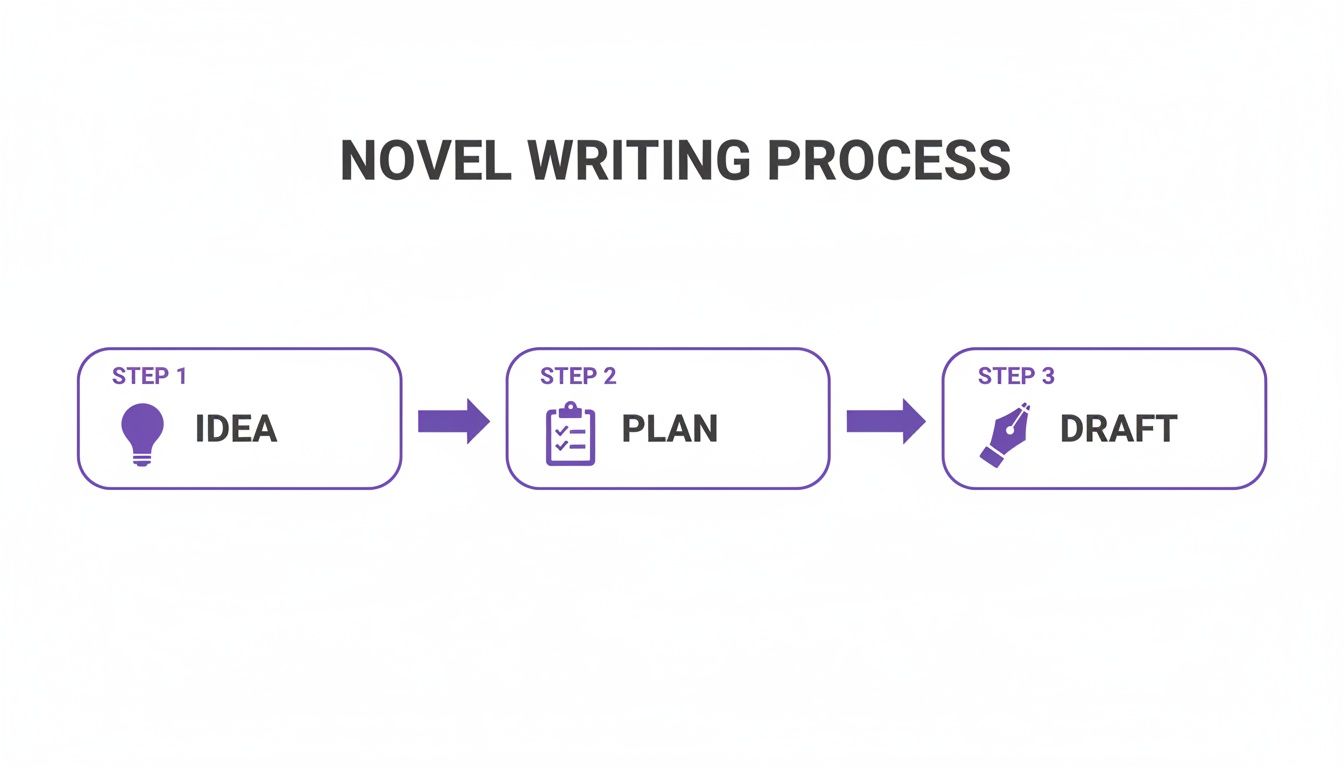
What this really shows is that a successful novel begins long before you write the first chapter. The foundation you lay in the beginning makes all the difference.
The Four Core Phases Of Writing Your First Novel
To make this even more concrete, let's break the entire journey down into four distinct phases. Each one builds on the last, giving you a reliable framework to follow from that first flicker of an idea to "The End."
Here’s a quick overview of what that looks like.
| Phase | Primary Goal | Key Activities |
|---|---|---|
| 1. Ideation | Find a story you're passionate about. | Brainstorming, asking "what if...?", exploring genres, and settling on a core concept you love. |
| 2. Planning & Outlining | Build the skeleton of your story. | Creating characters, world-building, and mapping out the major plot points (your outline). |
| 3. Drafting | Get the story down on paper. | Writing the first draft from start to finish, building a consistent habit, and ignoring your inner critic. |
| 4. Revision | Polish the rough draft into a story. | Editing for plot holes, strengthening characters, refining prose, and checking for continuity. |
By tackling them one by one, you turn an overwhelming goal into a series of smaller, more achievable projects. It’s about making the process feel less daunting and more like a craft you can master, step-by-step.
Finding Your Story and Choosing a Genre
Every novel starts with an idea you just can’t shake. It’s that little seed of a concept, the thing that’s going to keep you company through the hundreds of hours it takes to get a manuscript across the finish line. So where do these ideas come from? And how do you know if one is strong enough to carry a whole book?
The first real step in writing a novel is finding that spark. Here’s the secret: pick an idea that genuinely thrills you, not one you think you should write. Passion is the fuel that will get you through the inevitable slog of the messy middle.
Brainstorming Your Novel Idea
Story ideas are everywhere, but you can’t always wait for a lightning bolt of inspiration to strike. Sometimes, you have to go hunting for it.
Here are a few classic ways to actively track down a concept:
- Ask "What If?": There’s a reason this is the go-to method. What if a quiet librarian discovered a magical book that rewrites reality? What if a detective in a futuristic city had to solve a murder committed with an ancient weapon? Simple questions crack open entire worlds of conflict and character.
- Smash Two Things Together: Take two unrelated concepts you find interesting and see what happens when they collide. Think "cowboys in space" or "a reality cooking show on a haunted cruise ship." The tension between those two ideas is often where the magic is.
- Flip a Familiar Trope: Start with a story archetype everyone knows and turn it completely on its head. What if the "chosen one" just said no? What if the villain was actually trying to save the world, but their methods were monstrous?
Your goal isn't to find a perfect, fully-formed story right out of the gate. You're just generating a list of premises that get your imagination firing. Pick the one that makes you ask the most questions. That curiosity is what will sustain you.
Once an idea grabs you, try to boil it down to a single, powerful sentence. We call this a logline, and it’s basically the North Star for your entire project. A good one nails down your protagonist, their goal, and the main thing standing in their way.
Take this one, for example: A timid hobbit must travel to a fiery mountain to destroy a powerful, evil ring before a dark lord enslaves the world.
Why Your Genre Choice Matters
With a solid idea in hand, the next big decision is your genre. This isn't just about what shelf your book will sit on in a store; it’s a promise you make to your reader. Every genre comes with its own set of expectations, or conventions, that guide the story's structure, tone, and feel.
For a new writer, this is a massive advantage. These conventions aren’t restrictive rules. They are a proven framework for building a story that works.
- Romance: Readers are signing up for a central love story, a major conflict keeping the couple apart, and an emotionally satisfying ending (often called a "Happily Ever After" or HEA).
- Mystery: The story needs a central crime or puzzle, a trail of clues and red herrings, and a clear resolution where the detective puts all the pieces together.
- Fantasy: This genre usually leans on things like magic systems, detailed worldbuilding, and a high-stakes struggle between good and evil or order and chaos.
Picking your genre early helps steer your creative choices, making sure you’re writing a story that will land with the right audience. It can also have a real impact on your commercial prospects. Fiction is a huge slice of the publishing pie, with romance and fantasy consistently duking it out for the top spots. Romance, in particular, often represents the largest single category of adult fiction sales.
Given that only a tiny fraction of books ever sell over 100,000 copies, aligning your story with a popular genre can be a serious advantage for a debut author. You can find more great insights into the fiction market over at Lapsstudio.
Structuring Your Novel Without Losing Creativity
You’ve got a killer idea and a genre in mind. Awesome. So, what’s next? This is the part where you figure out how to wrestle that concept into a full, coherent story. It’s also where a lot of new writers get stuck, torn between wanting a solid plan and being terrified of killing their creative spark before they even start.
The good news is there’s no single “right” way to build a novel. The writing world basically splits into two camps, and understanding how they work will help you find a process that feels natural and, most importantly, keeps you writing.
The Great Debate: Plotters Versus Pantsers
The two big approaches are plotting and "pantsing." One isn’t better than the other; they just scratch different creative itches.
- Plotters are the architects. They draft detailed blueprints before laying the first brick. This can be anything from a simple list of scenes to a sprawling spreadsheet that tracks every character arc and plot twist.
- Pantsers are the explorers. They start with a character, a voice, or a single compelling situation and discover the story as they go. They are writing by the "seat of their pants."
Of course, plenty of writers land somewhere in the middle. They might sketch a rough map but leave themselves plenty of room to wander off the path and see what happens. If you want to dig deeper into which style fits you best, check out our detailed guide on plotters and pantsers.
For Those Who Love A Plan: Outlining Methods
If a blank page feels more like a threat than an invitation, you’re probably a plotter at heart. An outline is your roadmap, the thing that keeps you from getting hopelessly lost around the 40,000-word mark. Having that structure gives you the confidence that your story is actually going somewhere and hitting the beats that make for a satisfying read.
Here are a few popular structures to get you started:
- The Three-Act Structure: This is the classic storytelling model for a reason. Act I sets up the world and kicks off the main conflict. Act II throws a bunch of obstacles at your hero, raising the stakes. Act III brings it all to a boil in a climax and ties up the loose ends. Simple, effective.
- The Hero's Journey: A favorite in fantasy and adventure stories. It’s a circular structure that follows a protagonist who leaves home, faces a series of trials that transform them, and eventually returns a changed person.
- Beat Sheets: Think of these as a more granular outline. Instead of just acts, you’re mapping out specific "beats" or key moments. The Save the Cat! beat sheet, for instance, famously breaks a story down into 15 essential story beats, from the Opening Image all the way to the Final Image.
An outline isn’t a cage; it’s a scaffold. It’s there to provide support and direction, but you’re the one building the story on it. The goal is a framework that empowers you, not one that restricts you.
Using a structure like this helps ensure your story has real momentum and a clear narrative arc. For a beginner, it’s an invaluable way to learn how to craft a novel that truly works.
For Those Who Prefer Spontaneity: Writing Into The Dark
On the other hand, if detailed outlines make you feel like you’re being suffocated, you might be a pantser. For a lot of writers, the joy of writing is the discovery. They want to be just as surprised by a plot twist as their future readers will be. This method can lead to some incredibly organic, character-driven stories.
But writing without a map has its own dangers. It's surprisingly easy to write yourself into a corner or end up with a meandering plot that fizzles out.
To make it as a pantser, you need a few tools in your back pocket:
- Know Your Destination: Even if you don’t know the route, have a general idea of where the story ends. It gives you a north star to aim for, even on the foggiest days.
- Focus on Character Motivation: When in doubt, lean on your character. If you know what they want more than anything in the world, their desires will naturally drive the plot forward. Just keep asking, "What would this person do next?"
- Write in Scenes: Don't try to swallow the whole novel at once. Think of your story as a string of connected scenes. Just focus on writing one compelling scene at a time, each with its own little goal and conflict.
The trick for a pantser is to trust the process while always making sure you’re pushing the story forward, even if you’re not sure where it’s going.
Finding A Middle Ground: The Plantser Approach
The truth is, most writers don't fit perfectly into either box. Enter the "plantser," a hybrid approach that blends both methods to get the best of both worlds.
This usually looks like creating a loose, flexible outline, maybe just a few bullet points for the beginning, middle, and end. You know the major landmarks you need to hit, but you're free to explore all the interesting side roads you stumble upon along the way. This balance often turns out to be the most practical and sustainable way for new writers to finish a novel.
Crafting Characters and Worlds Readers Love
If a great plot is the skeleton of your story, then your characters are its heart. A clever mystery might keep a reader turning pages, but it’s the flawed, fascinating detective chasing the clues that makes them fall in love with the book. It doesn't matter if you're writing your first novel or your fiftieth; creating characters who feel like real people is everything.
It all boils down to what drives them. Every compelling protagonist wants something desperately, and that single desire is the engine that moves the entire story forward. On the flip side, every memorable antagonist stands in their way for reasons that, at least to them, make perfect sense, no matter how twisted they might seem to us.
Developing Your Main Characters
Let's be honest: perfect characters are boring. Readers don't connect with perfection; they connect with humanity. That means they connect with flaws, fears, and the messy internal conflicts that make us who we are. To make your protagonist feel real, you have to dig deeper than just their hair color and favorite food.
Start by asking yourself a few core questions:
- What’s their external goal? This is the tangible, plot-driven thing they're trying to do. Maybe it's stopping a villain, winning a competition, or finding a lost artifact.
- What’s their internal need? This is the emotional journey they need to go on. Maybe they have to learn to trust again or finally overcome a deep-seated fear. Very often, they can't get what they want (the external goal) until they deal with what they need.
- What’s their fatal flaw? This is the weakness that gets in their way, trips them up, and makes their whole journey that much harder. It could be anything from arrogance to crippling insecurity.
The same thinking applies to your antagonist. A villain who is just "pure evil" feels like a cartoon cutout. A truly great antagonist often thinks they’re the hero of their own story. Give them a logical, maybe even a sympathetic, reason for what they do, and the conflict becomes ten times more powerful. Their unwavering belief that they're right is what makes them a truly terrifying opponent.
The real secret to memorable characters isn't making them likable; it's making them fascinating. Readers will follow a deeply flawed person through hundreds of pages if their struggles feel authentic and their choices have real weight.
Remember the golden rule: "show, don't tell." Your character's personality should come alive through what they do and say, not through a long paragraph describing them. Don't tell me your character is brave; show him running into a burning building. Don't tell me she's witty; write some dialogue that makes me laugh.
Building an Immersive World
Beyond your cast, the world they live in is what pulls a reader headfirst into your story. It doesn't matter if you're writing about modern-day New York or a sprawling fantasy kingdom. The setting is never just a backdrop. It's an active participant in the story.
A well-crafted setting does a few jobs at once. It sets the mood, creates unique problems for your characters to solve, and can even reflect what they're feeling inside. A foggy, desolate moor can perfectly mirror a character's confusion and loneliness. A vibrant, chaotic city street can amplify their sense of being overwhelmed and out of place.
To make your world feel authentic, focus on the details that really matter:
- Engage the Senses: What does this place smell like? What does it sound like? What does the air feel like on your character's skin? The scent of rain on hot asphalt or the distant cry of an alien bird can make a setting feel instantly real.
- Establish the Norms: What are the unspoken social rules here? How do people greet each other? What do they value most? These little cultural details add incredible depth and texture.
- Weave in Some History: Your world didn't just pop into existence yesterday. What happened before your story started? Dropping small hints of history, like mentioning ancient ruins or a long-forgotten war, makes a place feel layered and lived-in.
For those of us building entirely new worlds, especially in fantasy or sci-fi, keeping all of these details straight can feel like a herculean task. This is where dedicated tools can be a lifesaver. You can learn more about how to manage all that complexity with the best worldbuilding software for novelists in our detailed guide. Staying organized is the key to making sure your world stays consistent and believable from page one to the final chapter.
Writing Your First Draft from Start to Finish
Alright, this is it. The moment your story finally starts breathing on its own. All that planning, all the character sketches and plot maps, it has all led you right here, to the blank page where the real storytelling begins. Your goal for this phase is simple, but it’s a big one: get the story down, from start to finish.

This first pass isn't the time to chase perfection. In fact, perfectionism is your single greatest enemy right now. Your only job is to get the raw material onto the page, that big, messy lump of clay you'll sculpt into something beautiful later on.
Embrace the Fast Draft Mentality
For a first-timer, one of the most powerful strategies you can adopt is fast drafting. The idea is exactly what it sounds like: you write as fast as you can, pushing ahead without looking back to revise, second-guess, or polish your sentences. It’s all about building momentum and, crucially, learning to ignore your inner editor.
That little voice in your head will whisper that a sentence is clunky or a scene feels flat. Fast drafting is your way of telling it to take a hike. You have to keep moving forward. Remember, you can't edit a blank page. A messy, completed draft is infinitely more valuable than a few perfect but unfinished chapters.
Try setting a small, achievable daily word count. For a lot of new writers, 500 words a day is a really sustainable target. It's just enough to feel like you're making real progress without getting overwhelmed, breaking down the mammoth task of writing a novel into something you can tackle every single day.
Building a Sustainable Writing Routine
Consistency beats sporadic bursts of inspiration every single time. A solid writing routine is the engine that will power you through the long, sometimes grueling, process of drafting a novel.
Be honest with yourself about what actually works for you.
- When's your best time? Are you a morning person who gets words down before the world wakes up, or do you find your focus late at night?
- Where's your space? Find a spot that's yours, where distractions are at a minimum. This little ritual signals to your brain that it’s time to get to work.
- How will you stay accountable? Tell a friend your goal, or just keep a simple spreadsheet to track your daily progress. There's something incredibly motivating about watching those numbers climb.
Your routine doesn’t need to be rigid, but it does need to be consistent. The simple habit of showing up to the page is what separates the writers who finish from those who only ever dream about it.
This whole process is a marathon, not a sprint. Just finishing a first novel is a huge accomplishment. Millions of people start, but studies suggest that maybe only 5–10% of serious beginners actually complete a full first draft within two years. The journey from idea to a finished manuscript typically takes anywhere from 18 to 30 months, which really underscores why finding an efficient process matters. You can dig into more author timelines in this indie author survey.
Maintaining Continuity as You Write
As your page count grows, keeping all the little details straight becomes a real headache. Who knows what? When did that key event actually happen? Wait, did your main character have blue eyes in chapter one and brown eyes in chapter fifteen? These tiny slips can create massive problems when you get to the revision stage.
A few simple tracking habits can save you countless hours of cleanup work later on.
Effective Tracking Methods
- Start a Story Bible: This is just a separate document where you log all the important stuff. It can be a simple text file, a spreadsheet, or a dedicated notebook, whatever works for you.
- Keep Character Sheets: For every major character, jot down their physical traits, key relationships, and what they know at different points in the story.
- Log Your Timeline: Keep a running list of major events in chronological order. This is a lifesaver for avoiding goofs, like having a character travel between two cities faster than humanly possible.
Catching these continuity errors as you go is a game-changer. Using tools that help you manage these details can slash weeks or even months off your revision time. The main goal here is just to get to "The End" with a complete story that hangs together, ready for the next phase of its journey.
Answering the Nagging Questions Every First-Time Novelist Asks
Diving into your first novel is thrilling, but it also opens the door to a thousand little worries. As you transition from the clean, organized world of outlines into the messy reality of drafting, you’re bound to hit a few walls and wonder if you're doing it "right."
Let's clear the air. Here are the most common questions that pop up for new writers, along with some straightforward, no-nonsense advice to keep you typing.
Think of this as a sanity check. Every author has been where you are, and the answers are usually simpler than you think.
So, How Long Does This Thing Need to Be?
This is probably the most practical question on any new writer’s mind, and the answer almost always comes down to your genre. While there’s no official rulebook, there are absolutely market expectations, and it's smart to know them, especially when you're just starting out.
Generally, a commercial novel will land somewhere between 70,000 and 100,000 words. But that number can swing wildly depending on what readers in your corner of the bookstore are used to.
Here’s a rough guide to give you a target:
- Mystery & Thriller: These are usually tight, pacy reads. Think 70,000 to 90,000 words.
- Romance: Much like mysteries, romance novels tend to be lean and focused, also hovering around the 70,000 to 90,000-word mark.
- Science Fiction & Fantasy: These genres often demand serious worldbuilding, which naturally pushes the word count up. A safe bet is 90,000 to 120,000 words, though some epic fantasies climb much higher.
- Young Adult (YA): YA stories are typically shorter to match their audience's reading habits, often ranging from 55,000 to 80,000 words.
The best advice? Go find five or ten successful books in your specific subgenre and look up their word counts. This gives you a real-world target that shows agents you understand where your book fits on the shelf.
What Do I Do When the Words Just Stop?
Writer's block feels like some mythical curse, but it's almost always a symptom of a concrete problem in your story. It’s not a failure of talent; it’s a blinking check-engine light.
When the words dry up, it usually means one of a few things: you genuinely don't know what's supposed to happen next, you've lost track of your character's motivation for the scene, or you're just plain burned out.
The worst way to handle writer's block is to "power through it." That's like trying to drive with a flat tire. Instead, pull over and figure out what’s actually wrong. The block is a clue, not a dead end.
Try one of these approaches:
- Go Back to Your Map: Revisit your outline. What is this scene supposed to accomplish? If you don't know, your subconscious is right to put on the brakes.
- Talk it Through: Explain the scene you're stuck on to a friend, your dog, or even the rubber duck on your desk. The act of verbalizing the problem often makes the solution obvious.
- Jump Ahead: Give yourself permission to skip this part and write a scene you're actually excited about. Momentum is everything. You can always come back and connect the dots later.
How Do I Know When My First Draft Is Actually "Done"?
This one's easy. Your first draft is done when you type "The End."
Seriously, that's it. The entire point of a first draft is just to get the whole story out, from the opening line to the final full stop.
Don't fall into the classic trap of polishing Chapter One until it gleams while the rest of your story doesn't exist. That isn't writing; it's a very convincing form of procrastination. A messy, finished draft is a thousand times more useful than a perfect, unfinished one. It gives you the raw clay you need to start sculpting.
Should I Let People Read My Draft While I'm Still Writing It?
This comes down to personal preference, but for most beginners, my advice is to wait until the first draft is finished. Sharing your work too early can do more harm than good.
Your story is still fragile and finding its shape. Early feedback, even from well-meaning friends, can throw you off course before you've even figured out your own destination.
Besides, finishing that entire draft on your own is a massive confidence builder. It proves you can see a huge project through from start to finish. Once you have a complete story, you can hand it over to beta readers or a critique group.
At that point, their feedback will be infinitely more valuable. They can react to the complete arc, the pacing, and the payoff, the big-picture stuff that really matters. Their insights will be your guide as you head into revisions. As you start weaving in new ideas, you might wonder how modern tools can help; for more on that, you can dig into the ethics of writing with assistive tools.
As you can see, writing a novel is a series of questions. It's about building habits and trusting yourself to find the answers. A tool like Novelium is designed to tackle one of the biggest questions of all: "Is this story even making sense?" By automatically tracking your timeline, characters, and plot threads, it flags continuity errors before they become massive headaches, letting you focus on what really matters: telling a great story. Find out how it can help your first novel at https://novelium.so.
Article created using Outrank