How to Worldbuild That Survives a Long Manuscript
Most advice on how to worldbuild starts in the wrong place. It tells you to brainstorm continents, religions, magic systems, dynasties, and elaborate naming conventions before you draft. That approach produces attractive notes and fragile novels. At 80,000+ words, invention is the easy part. The difficult work is keeping geography, institutions, character knowledge, objects, chronology, and rules compatible across hundreds of scenes and multiple revisions.
Worldbuilding isn't a scrapbook of appealing details. It's continuity engineering. Your setting has to behave like a working system under pressure, and your manuscript has to preserve that behavior as the story expands. The writers who avoid late-stage disasters don't necessarily invent more. They track better.
Why Most Worldbuilding Advice Fails at Novel Length
The popular model treats worldbuilding as a pre-drafting exercise. You fill out a questionnaire, assemble a setting bible, draw a map, and assume the world is ready. That method works reasonably well when the setting is a hobby in itself. It fails when recurring characters carry changing knowledge through a long manuscript.
A static profile records what exists. A novel requires you to record what changed, who knows it, when they learned it, and what it makes possible. A character may begin the book unable to read the imperial language, acquire a translator halfway through, lose that translator during a siege, and later understand an official document. A conventional profile may contain all four facts. It won't reliably tell you whether the intervening scenes support them.
This is why lore documents grow while continuity worsens. Writers keep adding answers, but rarely test whether an answer creates contradictions elsewhere. A mountain pass gets added for atmosphere, then a courier crosses it in a day. A rare medicine becomes essential to the plot, then appears casually in an isolated village. A dead ruler remains in a family tree, a timeline, and a flashback because nobody updated every dependent reference.
The practical distinction: a world bible describes the world. A tracking system records the world as the manuscript changes.
Infodumping often masks this failure. The writer explains the history of a kingdom, but never shows how that history affects a tax, a border inspection, or a character's vocabulary. The result is information without operational force. A useful diagnosis appears in this glossary entry on infodumping and worldbuilding, but the editorial fix is simple: stop asking whether a detail is interesting and ask whether the draft can contradict it.
Character development documents aren't character tracking systems, either. Development notes describe motives, wounds, arcs, and relationships. Tracking records state, location, possessions, knowledge, language access, loyalties, and physical condition at specific points in the manuscript. You need both. One supports dramatic design. The other prevents the character from becoming a different person by accident.
The Three-Pass Workflow That Actually Works
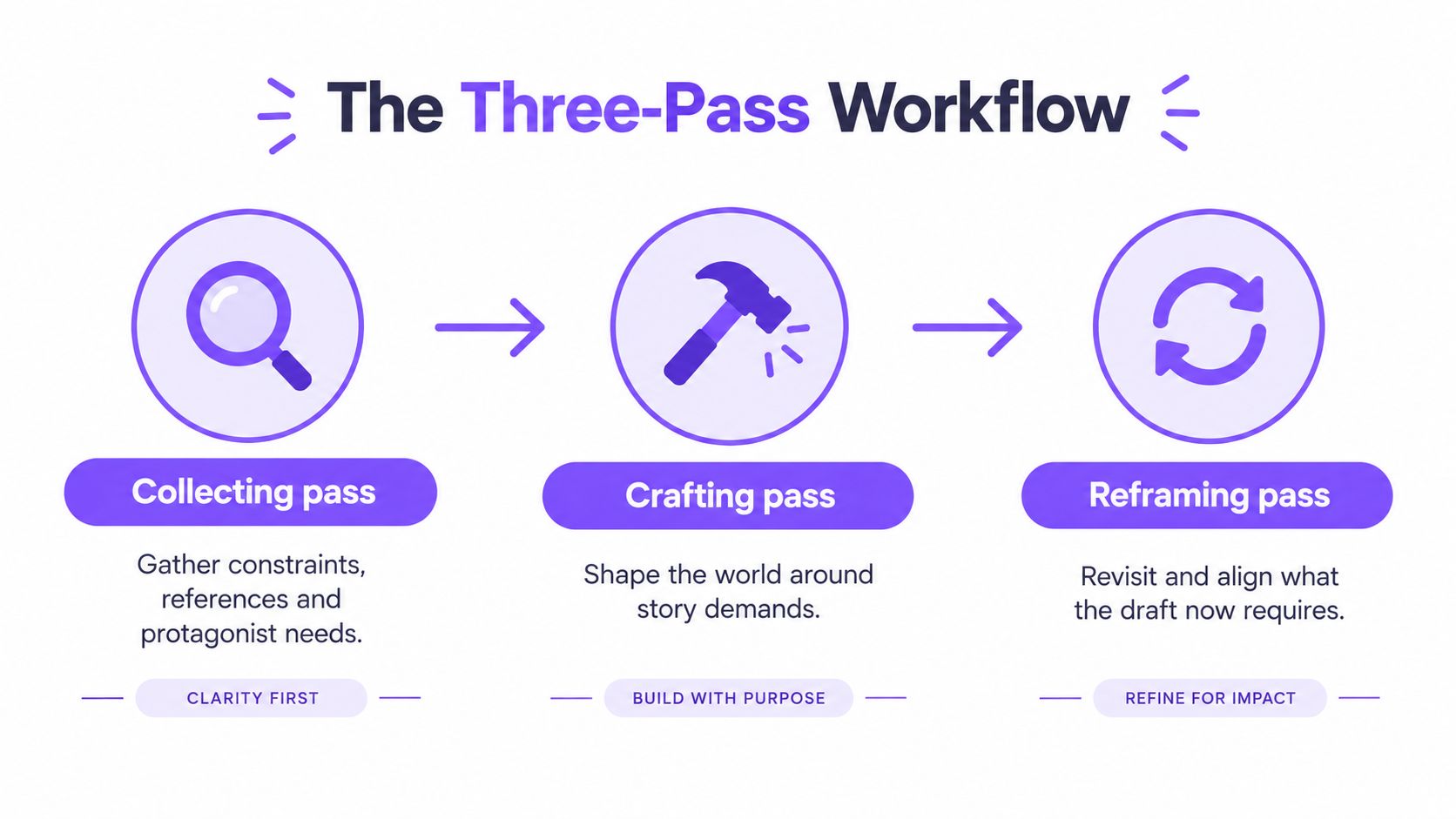
Use three passes, and keep their jobs separate. The collecting pass gathers constraints and story demands. The crafting pass turns those constraints into an interlocking world. The reframing pass tests whether the result feels different to the people living inside it.
Collecting
Don't design yet. Gather the protagonist's needs, the plot's necessary constraints, historical or cultural references, visual inspirations, and the questions the manuscript must answer. Note what the story requires, such as restricted travel, an unstable succession, a dangerous technology, or a city dependent on one trade route.
The output is a short world brief, not an encyclopedia. Record the pressures the story needs and the facts that cannot change without damaging the premise. If you're exploring visual references for a setting, resources such as the Writingmateai project page can sit alongside your own research, sketches, and reference material. Keep inspiration subordinate to narrative function.
Crafting
Now build the systems. Define geography, institutions, economy, language, customs, technologies or magic, ecology, belief, and conflict as connected decisions. For every important rule, write an if-then statement. If travel requires an imperial permit, then merchants, fugitives, lovers, soldiers, and news all encounter that permit system differently.
The output is a rule sheet and a dependency record. Identify which characters, places, factions, objects, and plot events each rule affects. Exceptions need a cost. If magic requires blood, access depends on health, medicine, coercion, and class. If teleportation exists, borders, prisons, couriers, tariffs, and assassination attempts must respond to it.
Reframing
Finally, revisit the setting through individual viewpoints. A magistrate experiences a border differently from a smuggler. A local hears an accent that an outsider misses. A wealthy merchant treats scarcity as a negotiation problem, while a laborer treats it as hunger.
Run every major plot event through a consequence check. Who gains power? Who loses it? What information changes? Which resource becomes scarce? This pass stops the world from reading like authorial reference material and makes it visible through lived experience.
Geography, Economy, and Language as One System
A mountain range isn't scenery. Currency isn't a label. Language isn't a naming exercise. At manuscript scale, geography, economy, and language are different surfaces of the same constraint system.
Start with the environment. A coastal trading city and a landlocked mountain settlement should differ in food, occupations, transport, political influence, and assumptions about outsiders. If a mountain range blocks movement, it should influence borders, prices, military campaigns, dialects, and contact between communities. If it changes nothing in daily life or institutions, it's map furniture.
That causal chain also exposes economic nonsense. Ask who produces goods, what remains scarce, what functions as currency, which routes move commodities, and who controls those routes. An isolated settlement can't casually acquire imported luxuries without a viable route, intermediaries, security arrangements, and a reason those goods survive the journey. A ruler can't tax a commodity that no institution can measure or collect.
The economic worldbuilding glossary is useful as a prompt, but don't reduce the problem to naming coins. Track what moves, who profits, and what breaks when movement stops. A trade route should affect plot timing and social power, not merely decorate a map.
Language creates gatekeepers
A multilingual empire needs visible mechanics. Who speaks the administrative language? Who translates? Which register signals education or rank? Where do documents exclude people? Can a character conceal identity through accent, vocabulary, or formal speech?
These choices affect law, trade, schooling, religion, and political access. An interpreter isn't background color. An interpreter can delay a negotiation, distort a testimony, conceal an insult, or control who receives official information. A character who can't understand a negotiation shouldn't respond as though every sentence is transparent, unless the text gives us a reason.
Language also creates continuity obligations. Track fluency by speaker, setting, and social context. If someone becomes fluent, record the cause. If a supposedly universal language spans an empire, establish the institution that spread it, whether schooling, conquest, trade dominance, or religious authority.
Visual tools can help you explore maps, factions, or cultural references before you canonize them. Writers who need to find DND image tools may use them for visual ideation, but an image can't solve an institutional contradiction. The map still has to support the economy, and the economy still has to support the language politics.
The Continuity Failures We Keep Seeing in Manuscripts
Long manuscripts fail in predictable ways. The same problems recur because writers invent the world early, then stop checking it against the scenes they write later.
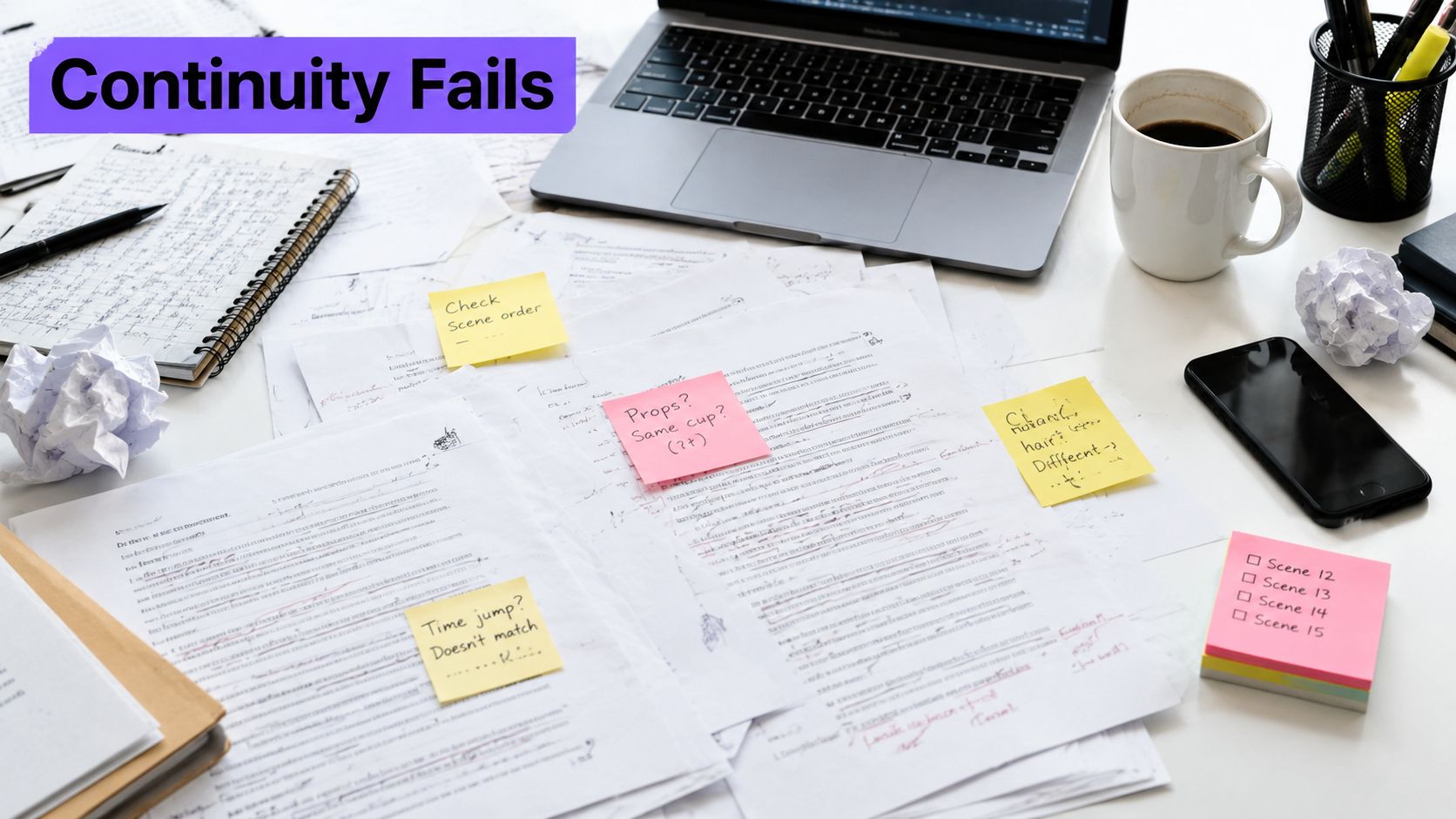
Consider the currency slip. A character pays for a room with a silver coin in one chapter, uses a different coin in the next, and later claims to have no money. The problem isn't the denomination. It's that the draft never tracks possession, exchange, or expenditure. A clean ledger of objects and transactions would catch the impossible sequence before copyediting.
The dead-character problem is worse because it often survives several drafts. A character dies in the present timeline, then appears in a later scene because the writer copied an earlier scene forward. The profile still says “deceased,” but the manuscript contains a contradictory action. Tracking the event's position on the timeline matters more than preserving the profile's summary.
The rules disappear when the plot needs them
A language barrier may hold for three chapters, then vanish when the protagonist needs to negotiate. A healing spell repairs a minor wound early in the book, but can't address a fatal injury much later, with no stated difference in cost or severity. A supposedly isolated community trades in imported luxuries despite having no route, currency, or intermediary capable of bringing them in.
These aren't unusual edge cases. They're what happens when the writer remembers the dramatic purpose of a rule but forgets its operational consequences. The draft needs a record of state transitions, not just a description of the initial condition.
The same problem appears in politics. A faction wants a resource because the plot requires conflict, but no institution can explain how that faction controls it. A ruler imposes a tax that nobody measures. A border exists on the map, yet characters cross it without permission, delay, paperwork, or consequence.
Here is the kind of sequence a tracking pass should expose:
| Failure | Missing record | Preventive check |
|---|---|---|
| A character negotiates fluently after being unable to speak locally | Language state by scene | What changed their access? |
| A supposedly isolated town imports luxury goods | Route, cost, and intermediary | Who moved the goods? |
| A deceased character appears later | Event status and timeline position | Is the scene before or after death? |
| A character spends money they no longer possess | Object and currency state | Where did the funds come from? |
A manuscript analysis pass should ask not only whether a fact exists, but whether every later scene respects it. That's the difference between a profile and a continuity system.
Treat Every Rule as Causal or Cut It
The worst worldbuilding isn't sparse. It's inert. Writers spend pages deciding what a culture calls its months, then fail to make the calendar affect a journey, a harvest, a festival, or a deadline. They design elaborate magical lineages that never constrain a choice. They add ancient ruins that produce atmosphere but no pressure.
Use a blunt release test. Every major detail must create pressure, reveal character, alter a decision, or explain a consequence. If it does none of these, keep it in private notes. The iceberg principle is useful only when the submerged structure guides what appears above water. A private archive full of unrelated lore isn't depth. It's storage.
Write each core rule in if-then form and attach affected entities. If magic requires blood, then health, medicine, class, coercion, and military recruitment change. If a city closes its gates at night, then romance, smuggling, policing, news, and plot timing change. If a technology makes distance irrelevant, then borders and prisons need a new logic.
Audit the dependency, not just the rule. When one condition changes, inspect every character, location, institution, object, and plot event that relies on it.
Record exceptions with explicit costs. An exception without a cost is usually a concealed plot coupon. If one person can bypass a restriction, the manuscript must explain whether they possess money, status, training, access, or a rare resource. The explanation doesn't need a paragraph of exposition. It does need to exist in the system.
Selective canon beats comprehensive documentation at novel scale. A rule that the draft can test is more valuable than a page of lore nobody can verify. Build the smallest world that produces the necessary consequences, then expand only when the story applies pressure.
A Pre-Drafting Audit You Can Run Today
Run these questions against your notes and your latest draft. Don't answer them as creative prompts. Answer them with chapter references, scene positions, or explicit “not yet established” labels.
| Domain | Audit Question | What It Catches |
|---|---|---|
| Magic or technology | What does each capability cost, and when does that cost apply? | Convenient solutions and forgotten limitations |
| Geography | Do travel times match stated distances and terrain? | Impossible arrivals and missing delays |
| Economy | Do currency, trade routes, scarcity, and access agree with the map? | Unsupported luxuries and arbitrary prices |
| Language | Does every language barrier persist until the manuscript explains its removal? | Sudden fluency and inconsistent dialogue |
| Factions | What resource or power does each faction control, and why does it want more? | Motiveless political conflict |
| Timeline | Does every event remain compatible with earlier dates and character states? | Dead characters, age slips, and impossible sequences |
Then test the objects. Who has the key, letter, weapon, seal, map, or coin at the end of each relevant scene? Writers track characters more often than objects, yet objects frequently carry the plot. A missing document can be as damaging as a missing person.
Finally, read earlier chapters with the strictest possible interpretation. If a later reveal depends on readers misunderstanding an earlier fact, confirm that the earlier wording permits the reveal. Continuity isn't only about what you intended. It's about what the text establishes.
Stop Tracking the World in Your Head
Your memory is not a database, and a shared document isn't automatically a tracking system. As the manuscript changes, character knowledge, object locations, relationships, rules, and timeline states change with it. Contradictions accumulate when those changes remain implicit.
The cleanest manuscripts treat world state as something they can query. A world bible can organize canon, but the useful question is always temporal and relational: who knew what in this scene, which rule applied, and where was the object then?
Novelium's Character Tracker and World Codex extract and track character details, locations, timelines, rules, factions, cultures, technology, and lore across a manuscript. It can surface contradictions involving knowledge states, character details, world rules, objects, and chronology, giving you a practical alternative to trying to remember the entire system. See the world bible glossary for the distinction between reference material and working continuity.
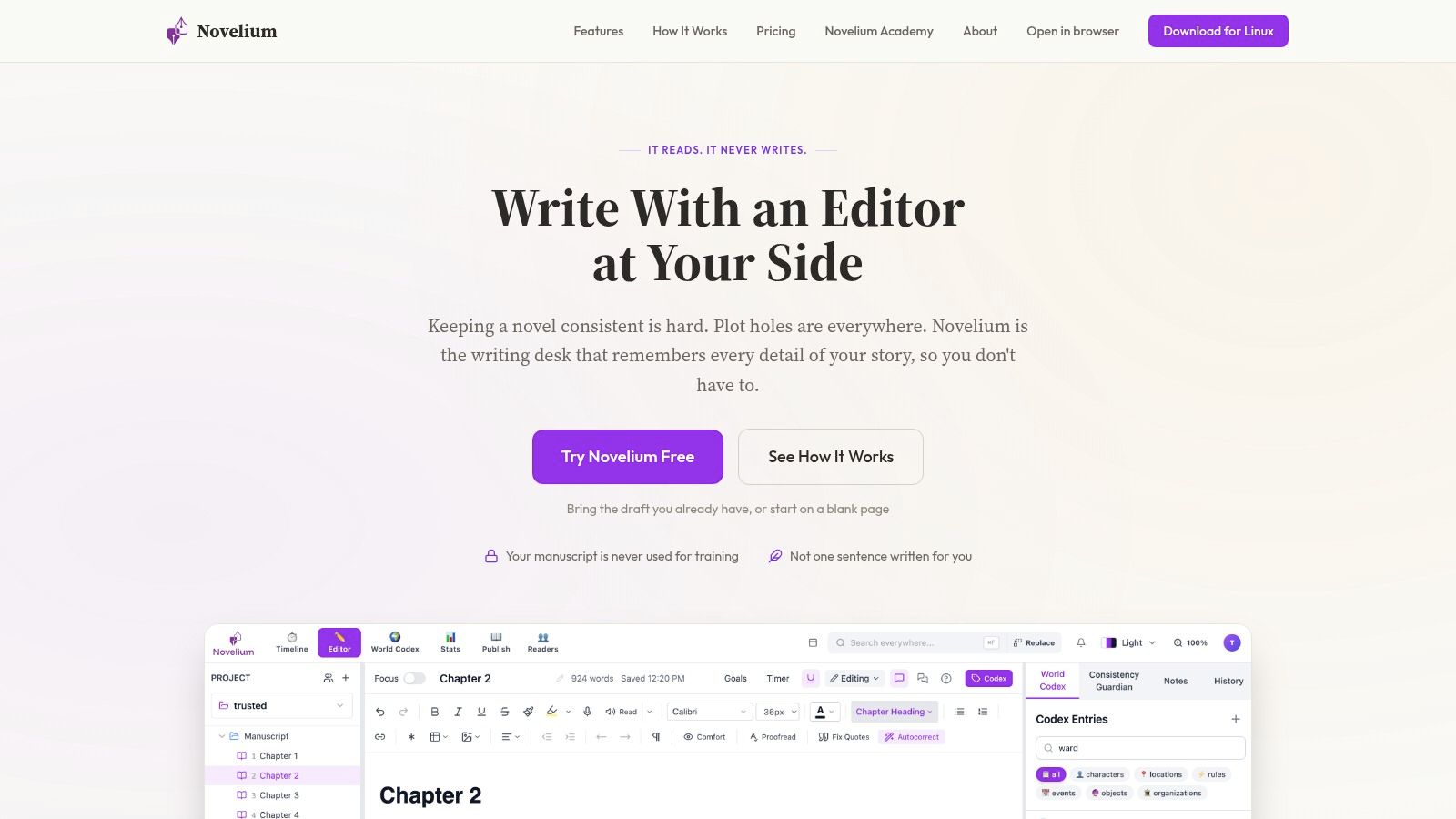
If your manuscript has recurring characters, tracked objects, or rules that change under pressure, visit Novelium and run its Character Tracker and World Codex against the draft. Use the results to find impossible sequences, missing state changes, and world rules the story violates before readers do.