How to Revise a Novel Without Losing Your Mind
The most popular advice about revision is also the least useful once you're working on a serious novel: take a break, read the manuscript, fix what feels wrong, then polish the sentences. That method can survive a short draft. It collapses inside an 80,000-word novel with recurring characters, interlocking subplots, and a timeline that keeps changing as you rewrite.
Revision isn't proofreading with better lighting. It's a systems problem. You're checking whether every scene still functions after cuts, whether each character knows only what they could know, whether objects appear where they should, and whether cause still precedes effect after you've moved half the book around. The prose matters, but prose is often the last layer to inspect.
A novel usually reaches publication through substantial rewriting rather than one cleanup pass. One writing-instruction source notes that many published authors complete about 10 drafts and spend at least a year editing, while another practitioner source places the working norm at roughly five to ten meaningful drafts (revision stages of a novel). The useful question isn't how many drafts you should produce. It's whether each pass has a defined job.
Why Most Novel Revision Advice Fails Working Writers
Line editing feels productive because the results are visible. You replace a weak verb, improve a paragraph, and get the satisfying impression that the book is moving forward. Meanwhile, the chapter that should have been cut remains in place, the antagonist learns information three scenes too early, and a character's injury disappears whenever the plot needs them to run.
That's why a general read-through isn't enough. A read-through asks you to notice everything at once: structure, pacing, character logic, continuity, dialogue, syntax, repetition, and emotional impact. Human attention doesn't audit all those layers reliably across a long manuscript. Writers remember the story they intended, not always the story the pages now contain.
Revision rule: Give every pass one dominant question. If you're asking whether a scene belongs while also fussing over commas, you're doing two jobs badly.
Professional revision works better as a sequence of dedicated passes. A practical workflow starts with cooling-off time, moves to whole-manuscript structure, then scene work, line polishing, reader feedback, and final copyediting and proofreading. Guidance on revision schedules also describes a range from three to six revisions, while noting that some published authors complete about 10 drafts (a reasonable revision schedule).
The real failure is state management
Static character profiles don't solve continuity. They tell you that Mara has a scar, distrusts her brother, or owns a revolver. They don't tell you that the scar was concealed until chapter eight, that Mara learned the truth about her brother in chapter twelve, or that the revolver was left in a locked office before the train scene.
That distinction matters in series fiction and large-cast novels. Character development documents describe who someone is. Character tracking systems record what changes, when it changes, and what the character can reasonably remember afterward. The second document has to evolve with the manuscript, because every structural edit can alter knowledge, location, allegiance, and possession.
Revise the manuscript as a set of connected story states, not as a stack of attractive sentences. That shift is what keeps a late rewrite from creating fresh contradictions faster than you can remove old ones.
The Structural Pass That Saves Your Story
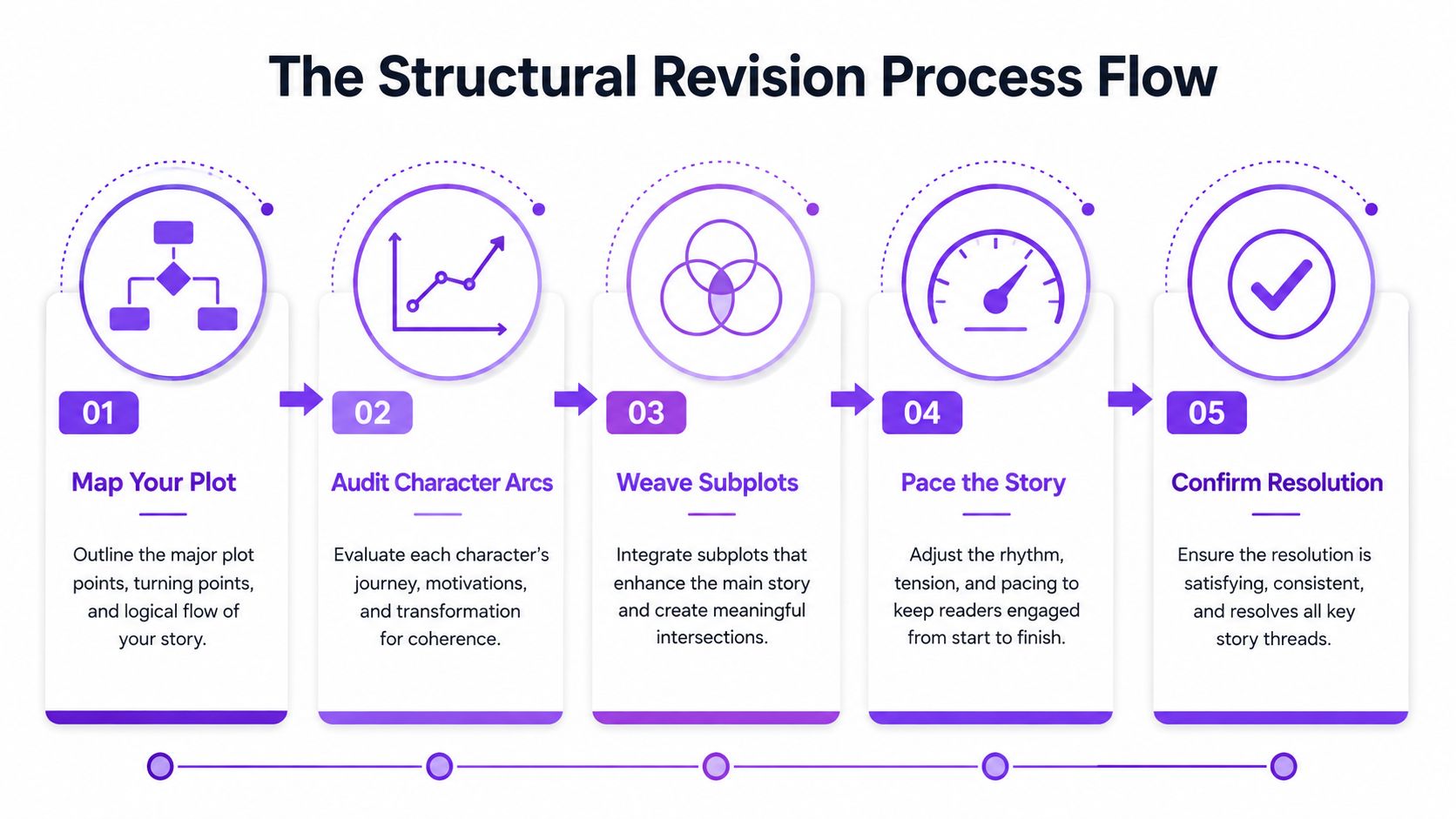
Start with the manuscript at a distance. Don't edit sentences yet. Create a chapter or scene map that records what each unit does, what changes inside it, and what later material depends on it.
The structural pass asks whether the book's architecture still supports its promise. Check the main plot's causal chain, the progression of each major character, the integration of subplots, and the rhythm of escalation and release. A subplot that merely repeats the central conflict may need merging. A chapter that delivers information without changing anyone's options may need cutting. A revelation that arrives after its consequences may need moving earlier, or the consequences need to go later.
Judge scenes by function, not affection
For every scene, write a blunt summary in your own working notes. Identify the immediate conflict, the information transferred, the decision made, and the change in status by the end. If you can't name a meaningful change, the scene is probably atmospheric support, setup that arrived too late, or material you're keeping because you like it.
Use the map to test four pressure points:
- Plot logic: Does each major turn result from choices and consequences, or does the story arrive at it?
- Character arc: Does the character's behavior reflect what happened earlier, including knowledge they gained and losses they suffered?
- Subplot integration: Does the secondary thread complicate the main story, reveal character, or alter the ending?
- Pacing: Do scenes spend too long preparing for a turn that the reader already understands?
Structural revision often demands ugly decisions. Merge two conversations when they perform the same dramatic work. Reorder chapters when the suspense depends on withholding information. Replace a scene rather than repairing it when its premise no longer fits the revised plot.
A documented revision comparison found that less than 10% of the first draft remained unchanged in the final version (revision statistics). That isn't a target, and it doesn't make every radical rewrite virtuous. It does show why attachment to original wording is a poor decision-making tool. The story's job is to work now, not to preserve evidence of how you first found it.
For a deeper distinction between structural diagnosis and sentence-focused editing, use Novelium's structural edit glossary. The central principle is simple: solve the book's design before investing in its surface.
Building a Continuity Ledger That Actually Works
Continuity errors rarely appear because a writer doesn't understand continuity. They appear because a long manuscript creates too many dependencies to hold in memory. A character hears a name in chapter six, forgets the name in chapter nine, and recognizes the person in chapter fourteen. An heirloom vanishes during a burglary, then turns up in a drawer because an earlier scene was rewritten. A journey that should take a day happens between breakfast and lunch.
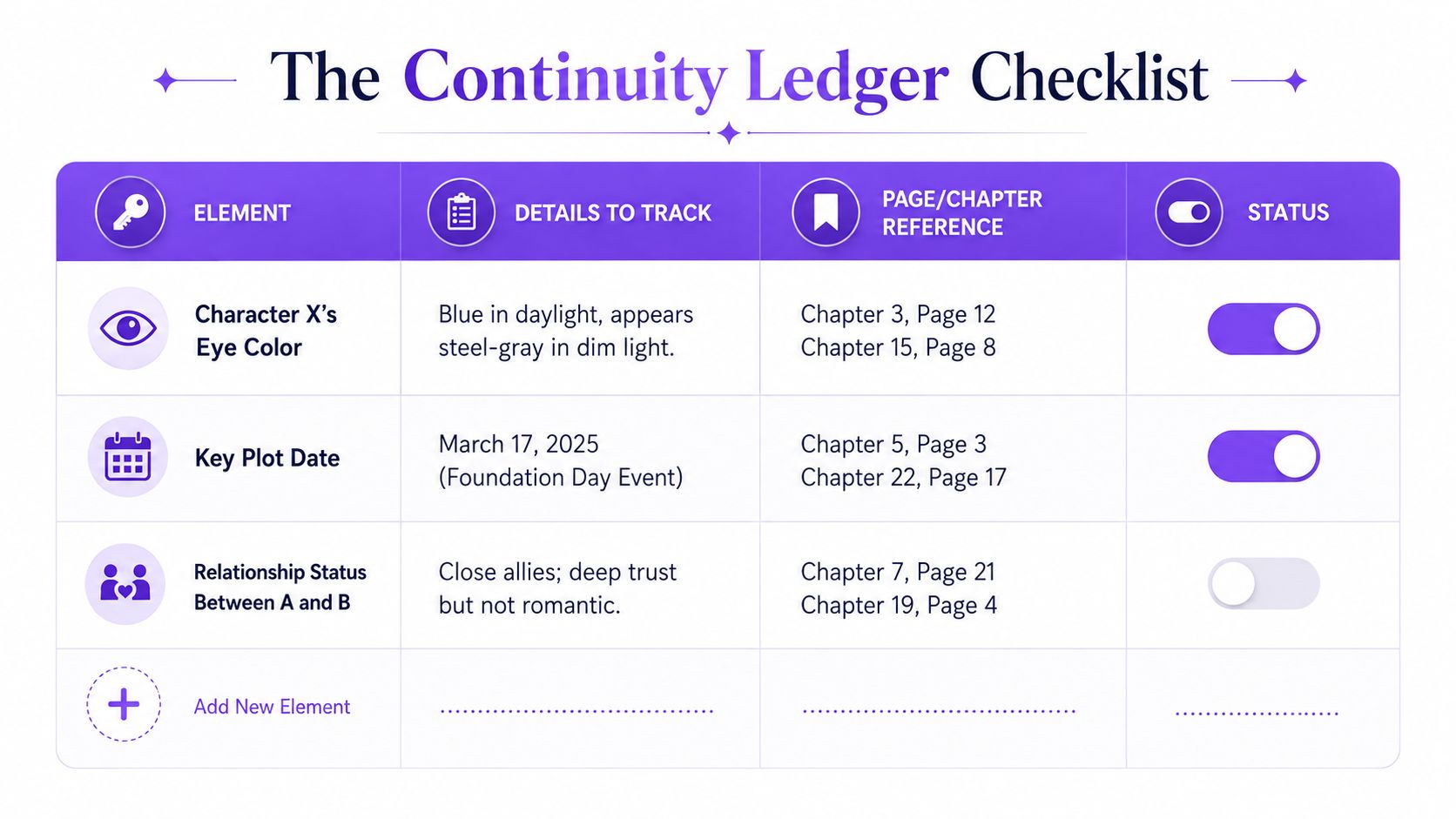
A continuity ledger turns those problems into auditable records. Track the detail, its first confirmed appearance, the chapter reference, the state at that point, and any later event that changes it. Independent continuity guidance recommends tracking character names and traits, timeline, setting geography, object facts, and plot facts, then mapping the timeline instead of relying on a general skim (continuity checking guidance).
Track changes, not trivia
Fun worldbuilding is easy to collect and hard to use. A character's favorite childhood meal may enrich your private notes, but it rarely prevents a revision failure. The details that matter are the ones that constrain later scenes.
Record character knowledge, injuries, physical descriptions, loyalties, relationship status, and location. Record objects that affect action, including who possesses them, where they were left, whether they were damaged, and whether another character could access them. Record dates, ages, travel time, recovery time, and the causal order of discoveries.
A useful ledger can use four categories:
| Category | What to verify |
|---|---|
| Characters | Traits, names, knowledge, injuries, location, relationships |
| Timeline | Dates, ages, elapsed time, travel, recovery, cause and effect |
| Objects | Ownership, location, condition, transfer, disappearance |
| Flags | Chapter reference, conflicting text, required fix |
The audit should move in both directions. Start with a character and follow their knowledge through the book. Then start with a major event and verify who could know about it afterward. A continuity checklist also recommends checking elapsed time, travel, recovery, and whether the cause appears before the effect (revision layering).
Don't write “check timeline” in the margin and call the job done. Write the contradiction precisely: “Chapter eleven says the letter arrived before the storm, chapter fourteen places the storm two days earlier.” Precision gives you a repair. Vagueness gives you another skim.
A chapter-by-chapter audit can separate characters, timeline, objects, and flags into distinct working tabs, logging the chapter and the conflicting text (chapter-by-chapter novel editing). That structure matters because a changed fact in one category can create problems in the others. Move a character's arrival, and you may also need to move their conversation, object possession, and knowledge state.
Scene-Level and Line-Level Revision Passes
Once the architecture and continuity ledger are stable, work scene by scene. The question changes from “Is this a good scene?” to “What does this scene contribute that the surrounding scenes don't?” A scene can be beautifully written and still be redundant, mistimed, or disconnected from the book's current causal chain.
Read each scene for entry and exit pressure. Does it begin close to the moment that matters? Does it end after the decision, revelation, or reversal has done its work? Cut greetings, repeated explanations, and dialogue that only confirms information the reader already has. Tighten exchanges by removing the line before the key line.
When a manuscript feels slow, one revision fact sheet recommends a dedicated pass that cuts about 5% of the material (revision factsheet). Treat that as a compression benchmark, not a superstition. Cut selectively from repeated beats, decorative transitions, duplicated backstory, and scenes whose function another scene can absorb. Then reread for pressure. Compression should make the book move, not make it starve.
The fastest scene isn't the one with the fewest words. It's the one where every word faces a live problem.
Line editing comes after those decisions. Work for clarity, cadence, specificity, point-of-view control, and deliberate repetition. Watch for habitual sentence openings, filler verbs, explanatory dialogue, vague referents, and rhythm that goes flat across a page. Read difficult passages aloud, but don't confuse smoothness with effectiveness. A jagged sentence may be exactly right for a frightened viewpoint character.
Writers who want a separate perspective on tools for drafting and language work can consult this overview of an AI writing assistant in 2026, but no tool replaces a scene decision or a continuity audit. Your line edit glossary belongs after the manuscript knows what it is. Polishing a chapter that will later be cut is not revision. It's interior decorating in a condemned building.
Integrating Beta Readers and Professional Editors
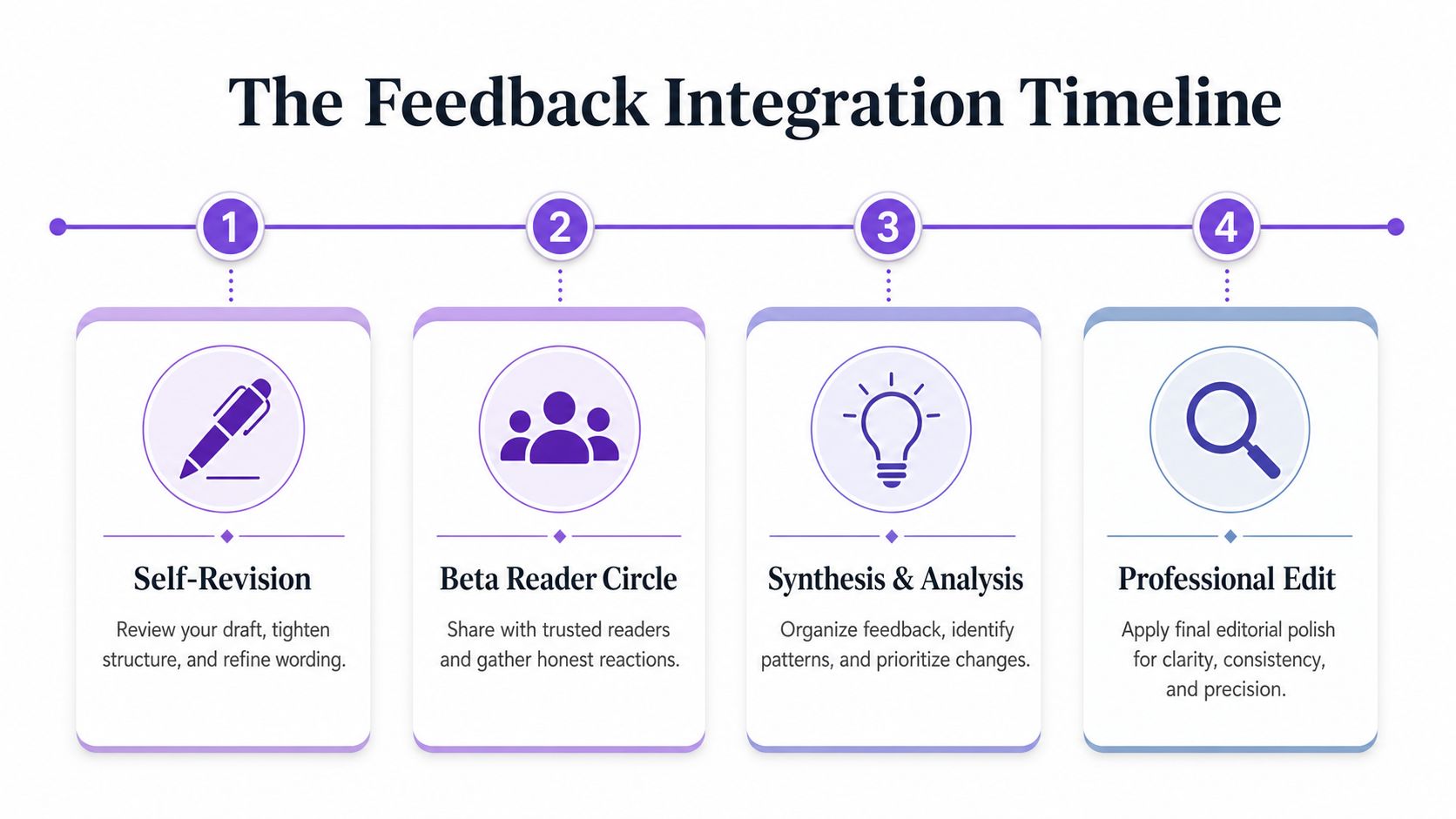
Outside feedback works best after the manuscript has a stable structure and continuity. Send it too early, and readers respond to chapter order, missing setup, or placeholder scenes instead of the book you are trying to finish. Hold the draft steady long enough for them to judge pacing, causality, and payoff.
Choose beta readers who can report their experience without trying to rewrite the novel. A beta reading guide and this beta-reader glossary can clarify the role before you send the manuscript. Ask where they became confused, where attention slackened, which relationship changes felt unearned, and whether the ending fulfilled the promise established at the start.
Separate evidence from preference
Sort feedback before acting on it. Repeated confusion, several readers missing the same turn, or consistent reports that a section drags point to manuscript problems. One reader disliking a character choice may reflect taste. Several readers failing to understand the choice may signal missing preparation, an unclear character state, or a continuity break.
Use three groups: problems to fix, questions to investigate, and preferences to decline. Take notes without defending the draft. Then return to the continuity ledger and structural map. Classify each issue as a plot problem, a character-state problem, a scene-execution problem, or a prose problem. That classification prevents a line edit from masking a broken causal chain.
Professional editors serve different passes. A developmental editor tests architecture and causality. A line editor examines voice, rhythm, and clarity. A copyeditor and proofreader address mechanics after substantive decisions settle. Sending a structurally unstable manuscript to a copyeditor first gives you a cleaner version of the wrong book.
Schedule feedback as its own revision cycle. Complete the self-revision, send the stable draft to readers, synthesize the notes, and revise with the evidence visible. Commission the appropriate professional edit only after those changes. This sequence preserves the manuscript's internal logic while leaving room for outside readers to expose problems your own tracking missed.
Why Systematic Tracking Beats Character Questionnaires
Character questionnaires fail at scale because they're static. They describe a person at the beginning of the project but don't record what that person knows after a betrayal, where they left the evidence, or how their relationship changed after the confrontation.
A tracking system treats the manuscript as evolving data. It follows knowledge states, relationships, timeline order, object locations, and plot dependencies across scenes, then gives you chapter references when two details conflict. That's the difference between a profile and an audit trail.
The right system also updates as the manuscript changes. If you cut the scene where a character learns the secret, every later scene that depends on that knowledge deserves review. Manual spreadsheets can help, but they become another document to maintain, and maintenance is where busy novelists lose the thread.
Novelium's Character Tracker and World Codex automatically extract and track character and world details across manuscripts, supporting continuity review for traits, relationships, events, objects, and information. For a long draft or series, that changes revision from a memory test into a repeatable process.
If your manuscript has outgrown character questionnaires and scattered spreadsheets, use Novelium to track character details, timelines, relationships, and object logic across the draft. Run the continuity audit before your next line edit, then revise the contradictions while the structural decisions are still visible.