How to Pace a Novel: A Scene-by-Scene Method
Shorter chapters don't automatically make a novel faster. They can create more stopping points, but if the scenes keep repeating the same discovery, delaying the same decision, or withholding consequences, the book still drags. Pacing is the relationship between what happens, what the reader learns, and how long the characters have to absorb it. Diagnose that relationship scene by scene, not by applying a shorter-sentences fix to a manuscript that's stalled for structural reasons.
For a long draft, the practical question isn't just whether the story feels slow. It's where the reader's understanding, the protagonist's situation, or the pressure on the next choice stops changing. The page count can help you set boundaries. The scene's consequences tell you whether the book is moving.
Set Your Pacing Budget Before You Touch a Scene
A word-count target can expose a pacing problem, but it cannot diagnose one. Use genre ranges as a pressure test: if your draft runs long, each movement needs to change the situation, the reader's understanding, or the emotional cost. Pacing is a measurable ratio of event, information, and emotional time. Read it scene by scene, especially in a manuscript of 80,000 words or more.
| Genre | Typical length | Average opening chapter |
|---|---|---|
| Adult thriller and suspense | 70,000–95,000 words | , |
| Mystery and crime | 70,000–90,000 words | , |
| Adult commercial and literary fiction | 70,000–100,000 words | , |
| Epic or high fantasy | 100,000–130,000 words | , |
| Historical fiction | , | 3,685 words |
| Dark fiction | , | 3,115 words |
| BookTok bestsellers | , | 2,804 words |
| All sampled bestsellers | , | 3,365 words |
The opening-chapter averages come from a comparative analysis of bestselling novels, which found first chapters ranging from 326 to 8,766 words. That spread argues against treating any single opening length as a formula. A short opening can establish pressure quickly; a long one can earn its space through new information and changing stakes. Published genre word-count guidance gives the thriller and fantasy ranges above.
A 100,000-word mystery or thriller sits about 10,000 words above the cited upper limit of 90,000. Those words need to support new complications, investigation turns, or relationship reversals, rather than repeat existing beats at greater length. For adult commercial and literary fiction, novel-length guidance places the typical range at 70,000 to 100,000 words.
Set a word budget for each major movement, then name what changes in each one. Act breakdowns for choice-based stories offer one way to divide a narrative around decisions. Use the same principle for a novel: each movement should earn its share of the manuscript by changing what the protagonist can do, what the reader knows, or what a choice will cost.
How to Build a Scene-Level Pacing Map
Make one pass through the draft before polishing sentences. Give every scene a row, and keep each entry short enough that you can spot repetition without rereading the whole chapter.
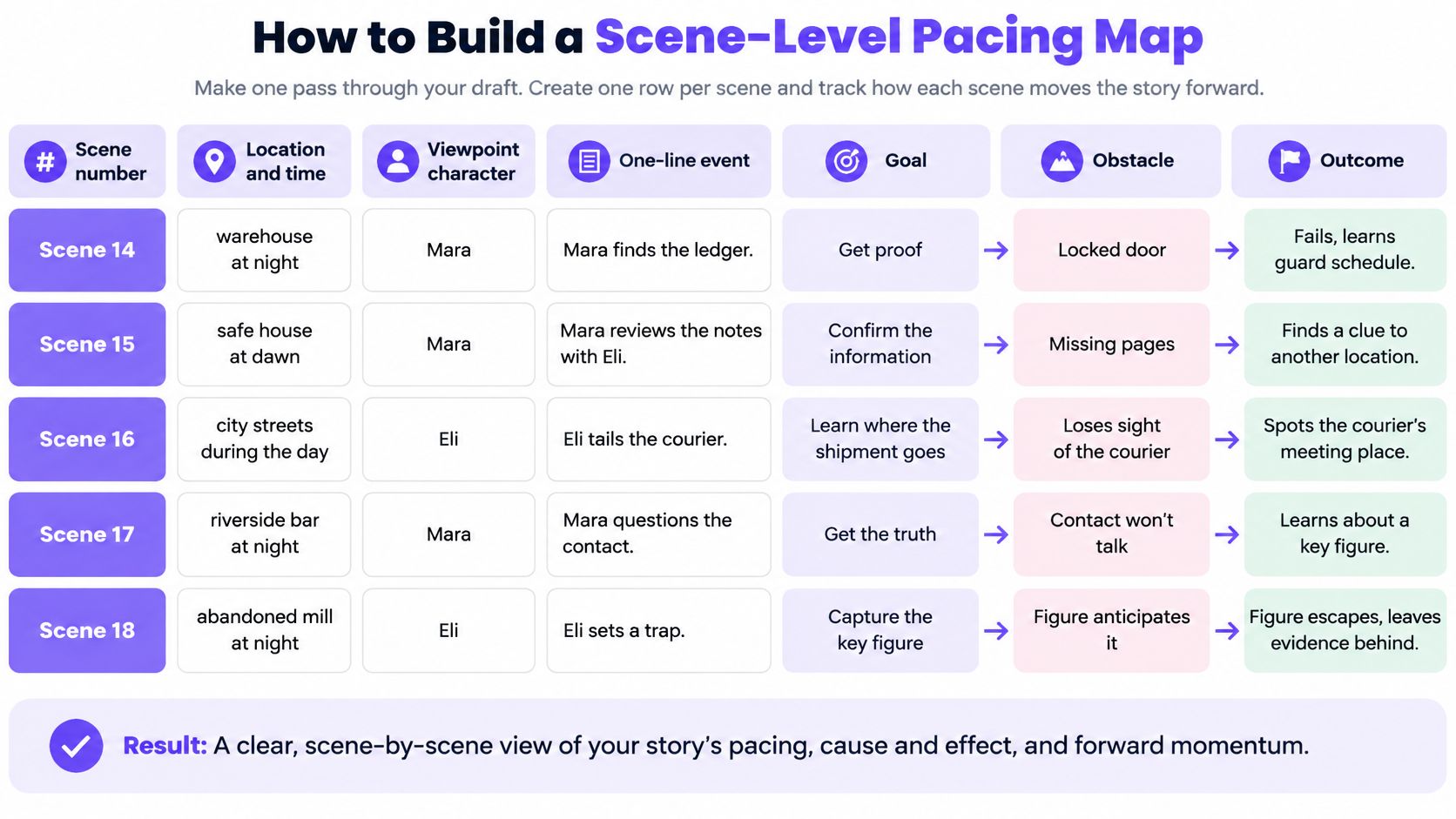
Log the scene. Record its number, location and time, viewpoint character, and a one-line account of what happens. For example: Scene 14, warehouse at 2 a.m., Mara's viewpoint, she finds the ledger missing. A common slip is to summarize the atmosphere while leaving the actual event vague.
Name the cause and result. Add the protagonist's goal, the obstacle, and the outcome, each in a short sentence. If the outcome doesn't follow from the obstacle, you've found a causal gap, not a word-count problem.
Score the reader's experience. Rate intensity from 1 to 10 based on what the scene does to the reader, not how difficult or exciting it felt to write. A high-effort scene can still have low narrative pressure if its result is obvious.
Plot the curve. Chart each score against manuscript percentage. The scene-level pacing map guidance places a first major plot point near 25%, the midpoint near 50%, and the climax around 80–90%. Treat those as diagnostic targets, not mandatory coordinates.
Read sequences, not chapters. Several low scores in a row often signal delayed conflict, redundant setup, or a weak midpoint. For scenes rated 8–10, check for late entrances, short exchanges, and immediate consequences. For scenes rated 4–7, look for useful shifts among action, reflection, and discovery. The common trap is a long run of high-intensity scenes that never gives the reader room to register what changed.
A finished map is a curve with deliberate peaks and recovery beats, plus a short list of scenes to investigate. A scene list can help you keep that inventory readable as the draft grows.
Diagnosing Drag With a Scene and Sequel Audit
A fast scene can still drag. A chase that ends with the detective exactly where she started has plenty of movement but no consequential result. Conversely, a quiet exchange can propel the plot if it changes what a character knows and forces a new decision.
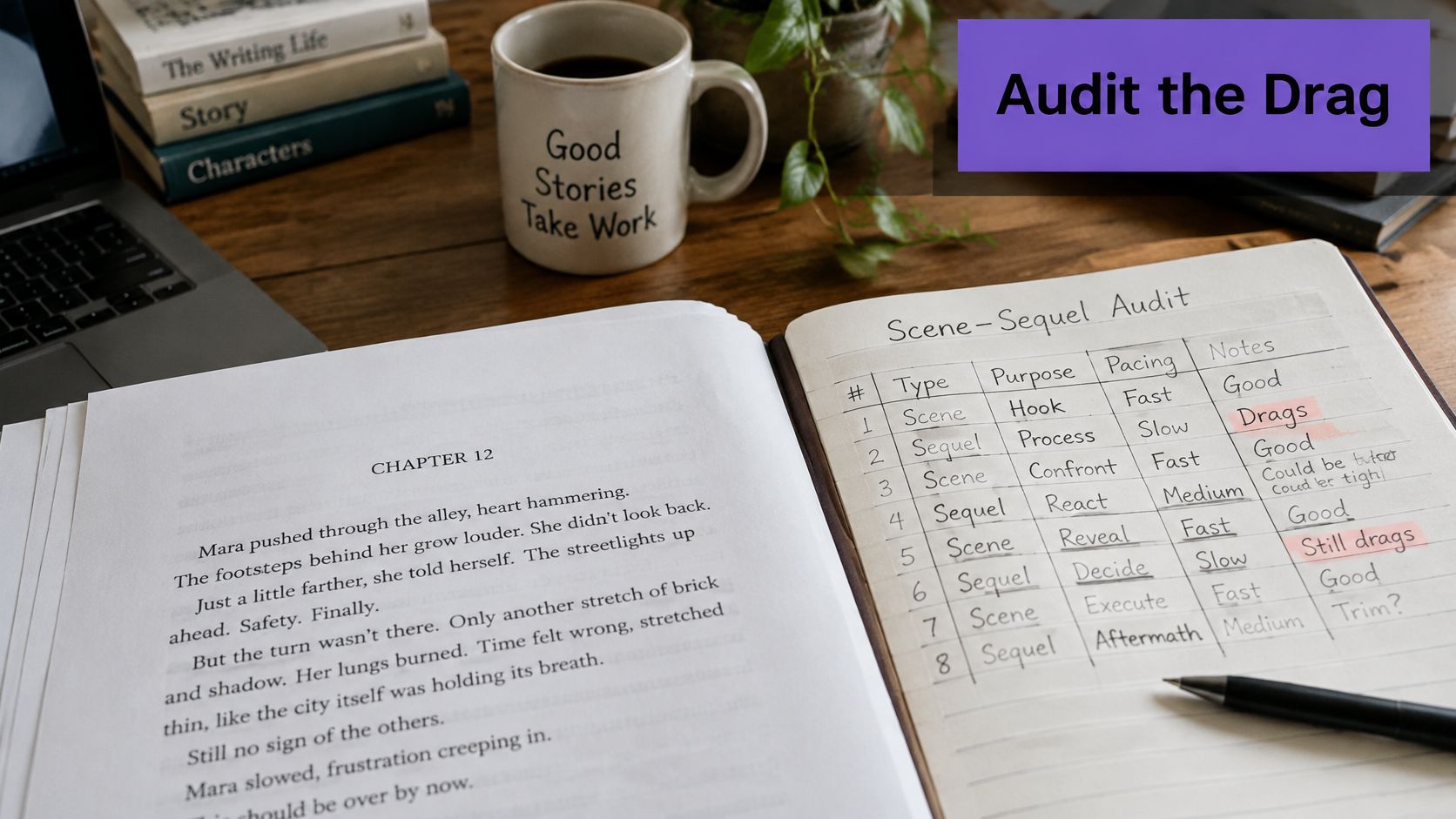
Audit the scene–sequel chain. In the scene, the viewpoint character pursues a concrete goal, meets an obstacle, and exits with a setback, revelation, or altered situation. In the sequel, the character reacts, weighs options, confronts a dilemma, and decides what to do next. That decision should generate the next scene's goal; otherwise, the plot starts to feel like a string of episodes rather than a chain of causes.
Mark each scene as primarily action or reaction, then look for long runs of either. Too much action leaves no room for emotional consequences to register. Too much reaction can become a holding pattern when nobody's decision changes what happens next. The scene-and-sequel explanation gives the terms a concise reference point.
Separate three kinds of momentum before you reach for the delete key. Event velocity is how quickly external actions happen. Information velocity is how rapidly the reader learns consequential facts. Emotional processing time is how long characters and readers have to absorb consequences. A scene can be brisk in action but slow in revelation, or still in action but active in what the protagonist understands.
For every flagged scene, write one sentence about what changes in the protagonist's knowledge, resources, relationships, location, or objective. If nothing changes, it's a cut or merge candidate. Then diagnose the drag: is the scene repeating information, missing a causal link, delaying a needed reaction, or operating without enough at stake? Fix the cause, not just the symptom.
Cutting Entrances, Exits and Chapter Breaks
A scene can lose pace before its central conflict begins. Routine arrivals, greetings, waking-up sequences, and travel often take up space without changing the reader's understanding. Start at the first moment when a conflict, disclosure, or decision becomes unavoidable. Keep the approach only if it establishes a relationship, builds pressure, or provides information the scene needs.
At the other end, stop once the situation has changed. An aftermath belongs when it introduces a new problem or lets a consequence register; otherwise, it can dilute the scene's effect. For each opening and ending, ask what the reader learns or what changes. If the answer is nothing, cut or compress the beat.
This does not mean every scene needs to begin with confrontation. A quiet entrance can create tension or show a relationship shifting. In a mystery or thriller, repeated travel and greetings can slow the investigation, but removing them indiscriminately can also erase the clues and interactions that make the next turn convincing.
Chapter length is a control, not a target. The cited guidance associates chapters of about 1,000 to 1,500 words with a faster reading experience, and chapters of 4,000 words or more with greater immersion. It also gives 1,500 to 2,500 words as a common range for thriller and young-adult chapters. Treat these as benchmarks, not formulas: a short chapter can drag through repeated information, while a long one can move quickly through escalating reversals. Chapter-length guidance by genre makes the distinction between length and pace.
Place a chapter break after a reversal, discovery, or decision when the pause sharpens the reader's question. Keep cause and effect together when a split would weaken their connection. Then read the scene's final line beside the next scene's opening. The handoff should give the reader a reason to continue, not merely signal a change of place.
Testing Pacing With Beta Readers and Genre Expectations
A single pace score is useless for revision. Readers can experience a slow chapter before a rushed climax, so one overall judgment can hide two different problems. Send the draft to readers only after you've mapped it and made the cuts; feedback about drag is more useful when the manuscript is coherent enough to finish.
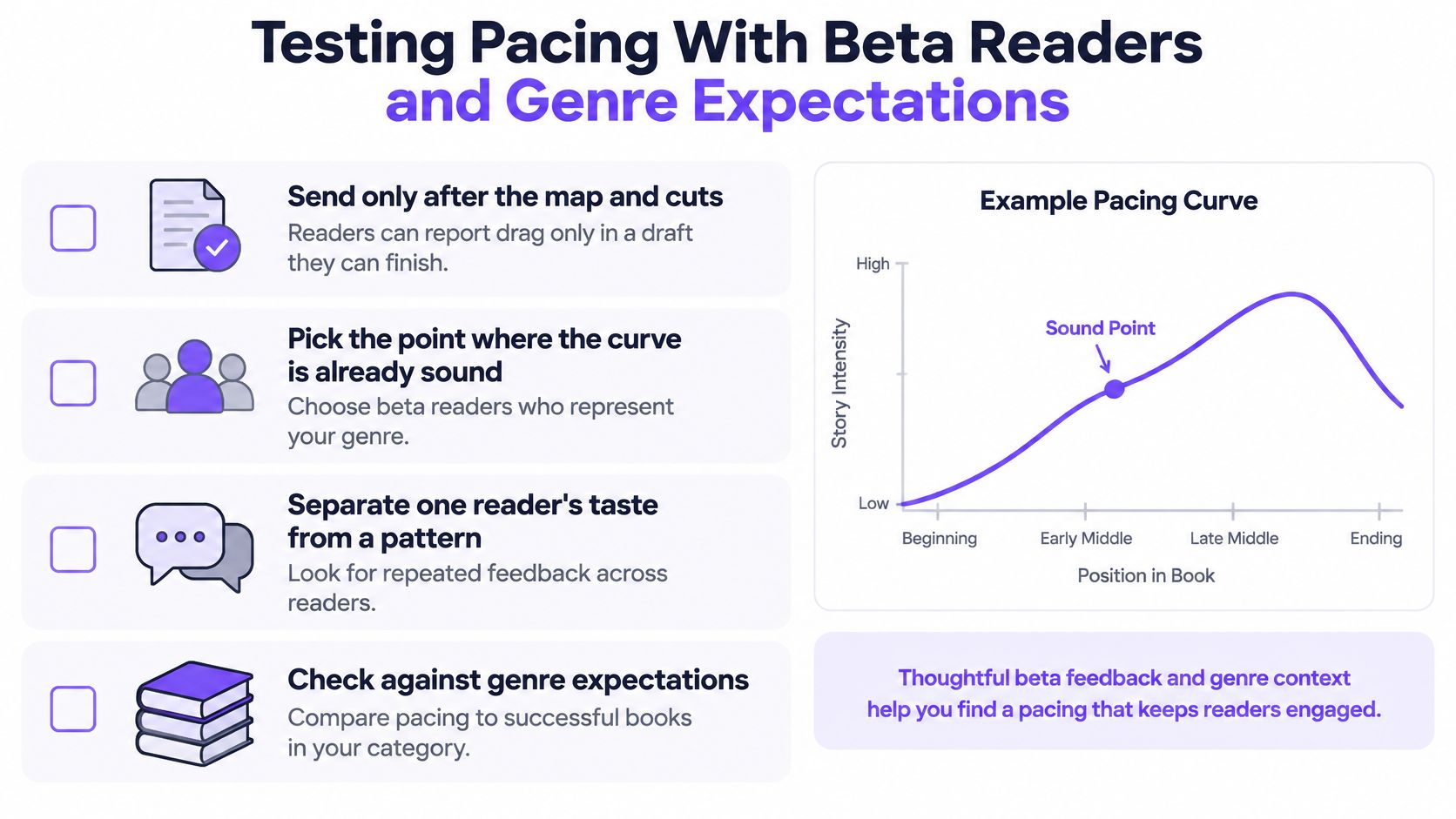
Ask for chapter-level signals. Where did readers skim, pause, or stop? Which sections felt rushed or sluggish? Look for clusters across readers rather than treating one person's preference as a verdict. A beta reader can tell you where the experience broke down; your map helps you work out why.
One reader's complaint about a quiet chapter is a hypothesis. Check whether that scene changes what the protagonist knows, what options are available, or what decision comes next. If it does, the issue may be presentation or placement rather than the scene's existence. If it changes nothing, the complaint may have found a genuine stall.
Then check genre expectations. An epic fantasy reader may welcome travel, systems, and world history as part of the book's promise; a thriller reader is more likely to expect those passages to increase pressure or change the investigation. Ask whether the recovery after a major reversal feels earned for your category, not whether it would suit a different kind of novel.
For each flagged chapter, name the cause: repetition, missing causality, delayed reaction, or insufficient stakes. Then make the corresponding fix and leave the rest alone. Reader feedback works best as a map pin, not a mandate to flatten every pause into action.
Commit to a Pacing Revision Pass This Week
Choose one movement to revise: the stretch with the most low-intensity scenes or the longest run of repeated beats. Set a word budget, then cut or merge scenes until each earns its space. Cutting the same amount from every chapter treats unlike scenes as if they do the same work.
Afterward, rescore the scenes. Check whether the movement still has the intended peaks and recovery beats, and whether the protagonist's state changes meaningfully from scene to scene. Faster prose can still leave a reader confused if a cut removes a detail or changes what a character knows.
A pacing map alone won't catch every continuity problem. Removing a scene that established a fact may leave a later action unsupported; compressing a journey may disrupt the timeline. Novelium automatically tracks characters, world details and timeline entries from your manuscript, helping you check later references when cuts change what readers or characters know. It begins analyzing an uploaded manuscript immediately.
Use the revised map to see where the manuscript speeds up or slows down, then check the tracked characters, timeline and plot threads for inconsistencies. Novelium never suggests plot changes. The editorial decision remains yours.
Run the pass on your chosen movement, check its rhythm and continuity, then decide when to send the manuscript to beta readers. That's more useful than trimming every chapter to satisfy a generic rule that shorter is faster.
Novelium's pacing analysis shows where your manuscript speeds up and slows down. Its automatic tracking can help you check character knowledge, timelines and plot threads after a cut. Upload a draft to Novelium and revise the movement that's costing your book momentum.