Character Profiles Are a Waste of Time
Let's be honest. That fifty-question character interview you dutifully filled out before typing "Chapter 1" is collecting digital dust on your hard drive. It felt productive, but it has almost zero impact on the actual manuscript.
Most advice on how to create character profiles is fundamentally broken. It treats characters like museum artifacts, frozen in time. A useful character profile isn’t a pre-flight checklist you complete and then ignore; it's a living system for tracking a person's journey over a hundred thousand words. Forget the craft books. Let's talk about what actually works when you're managing a sprawling, complex story.
Why Your Character Profiles Are Failing You
The classic character profile fails because it's a static document. It captures who your character is at a single moment—usually before the inciting incident ever happens. It’s a pre-draft exercise, and that’s the problem.
Novels are messy. Characters learn things, get new scars, change allegiances, and lose crucial items. A profile that can't keep up with that evolution across 300 pages is worse than useless. It’s a direct source of contradiction.
This isn't a problem for pantsers alone. Even the most meticulous outliners find their beautiful, static documents are obsolete by the end of Act One. You can find more of my thoughts on the whole plotters vs. pantsers debate, but the core issue is the same for both camps: a static document cannot keep up with a dynamic story.

The Real Source of Continuity Errors
At Novelium, we analyze manuscripts for a living. The most common errors we find aren't the big, theatrical plot holes. They're the small, subtle inconsistencies that pile up and slowly chip away at a reader's trust.
Here's what we see constantly:
- Knowledge Gaps: A character learns a shocking secret in Chapter 5 but acts completely oblivious to that same information in Chapter 20. Suddenly, their decisions make no sense because their "knowledge state" is broken.
- Physical Inconsistencies: A scar on their left arm in the opening scene magically jumps to the right arm by the climax. A hero who badly sprained their ankle is sprinting two scenes later with no mention of their miraculous recovery.
- Emotional Dissonance: A character ends one chapter feeling betrayed and furious. They start the next in a perfectly neutral mood, as if the writer forgot about the heavy emotional baggage they were just carrying.
These aren't failures of imagination. They’re failures of tracking. The traditional profile has you documenting your character's favorite color. That stuff is trivia, but it rarely stops the kinds of errors that actually break a story. The goal isn't just to know your character. It's to maintain a coherent, believable state for them from one scene to the next, across the entire arc of a complex story.
Shifting from Development to State Management
The solution is to reframe the problem. Stop thinking about "character development" as a one-time setup process. Instead, start thinking in terms of "character state management."
I know, it sounds like something a software engineer would say, but it's a perfect fit for a novelist managing a large cast or a multi-book series.
Your character has a "state" in every single scene. That state is made up of what they know, what they feel, their physical condition, and what's in their pockets. Every event in the plot is an input that changes that state. Your job isn't just to write beautiful prose; it's to make sure the output—your character's next action—is a logical result of their current state.
Her childhood fear of water is backstory. Her panicked reaction right now as the boat sinks is a function of her current state, triggered by that old history. The real work is in tracking the now. This is the shift from static questionnaires to a dynamic system built for the real demands of writing a novel.
Development Docs vs. Tracking Systems: Stop Confusing Them

Let's draw a hard line in the sand. Writers constantly blur the line between two very different tools: the Development Document and the Tracking System. They do different jobs, and confusing the two is a recipe for the kind of continuity disaster that plagues long-form fiction.
Your development document is the pre-draft playground. It’s where you brainstorm backstory, map out your character’s psychology, and get a feel for who this person is. Think of it as a creative sandbox, not a project management tool.
The Problem with Static Development Docs
Here’s the thing: a development document is, by its very nature, static. It’s a snapshot of your character before the curtain rises. Its main job is to help you understand the internal logic of the person you’re about to drag through hell. But the second you start writing Chapter 1, its usefulness starts to tank.
It can tell you about your hero’s childhood, but it can’t tell you what they know after the brutal interrogation in Chapter 15. It might list their greatest fear, but it won’t track the fresh trauma they picked up last Tuesday. A development doc is your character’s birth certificate. A tracking system is their live medical chart, psychological evaluation, and police blotter, updated in real time.
This distinction is everything. That sprawling spreadsheet of backstory is a wonderful creative artifact, but relying on it to maintain consistency across a 120,000-word novel is like trying to navigate a cross-country road trip using only a photo of your driveway. So many writers try to force tools like Notion into this dual role, and it almost always creates more headaches than it solves. We get into the weeds on this in our breakdown of Novelium vs. Notion for novelists.
Why You Need a Dynamic Tracking System
A tracking system, on the other hand, is a living document. It’s a pragmatic, ruthless log of what is true about your character at any given moment in the story. It doesn’t care about their third-grade teacher’s name, unless that teacher bursts into Chapter 12 with a vendetta.
Its whole purpose is to answer the critical, state-based questions that prevent glaring contradictions.
- What does this character know right now? Did they see the murder, or just hear about it from a panicked neighbor? The answer completely changes how they behave in the next scene.
- What injuries are they nursing? The limp they picked up in the last chapter can't magically disappear just because you forgot to write it in.
- Who do they trust after the big betrayal? A betrayal isn't a one-and-done event; it’s a state change that poisons every interaction that comes after.
- What are they carrying? They can’t unlock a door with a key they lost during that chase scene two days ago.
A development document is where you build a character’s potential. A tracking system is where you manage their reality within the manuscript itself. The first step to bulletproof characters is simple: separate these two vital functions.
Tracking What Actually Matters for Consistency
You’ve got a character bible filled with their favorite color and their astrological sign. That’s great. But in the hundreds of thousands of manuscript pages we’ve analyzed, those aren't the details that trip writers up.
Consistency errors almost never happen because you forgot your hero is a Sagittarius. They happen when you lose track of a handful of critical, dynamic data points. If you want a truly functional tracking system for a complex novel, forget the fifty-question interviews. It all boils down to four pillars. These aren't sexy worldbuilding details. They're the load-bearing walls of your character's reality.
The Knowledge State
What does your character know, and when did they learn it? This is the number one source of plot holes. Bar none. It's the silent killer of narrative logic. If a character overhears a villain’s plan in Chapter 3, they can't act shocked when that same plan unfolds in Chapter 28. A detective who finds a critical clue on page 50 can't forget it by page 200, unless you give the reader a very good, intentional reason for that memory lapse. Track the information that dictates future decisions. A simple note like, "Ch. 7: Learns from Maria that the safe house is compromised," stops them from naively leading allies there in Chapter 10.
The Physical State
This covers everything from permanent scars to temporary injuries, what they’re wearing, and even their current level of exhaustion. It sounds obvious, but it’s shockingly easy to forget. A character who takes a deep cut to their right arm in a fight scene can't be using that same arm to effortlessly scale a wall two scenes later. In the heat of drafting, these are the little details that slip through the cracks and shatter a reader's immersion. It’s not just for injuries. If your character is trekking through a blizzard, their physical state should reflect that: shivering, slowed movements, impaired judgment. When you ignore this, the stakes feel artificial.
Possessions and Equipment
What does your character have on them? This is the domain of Chekhov’s gun and its many misfires. A character can’t unlock a door with a key in Chapter 15 if they lost their entire bag during a chase scene in Chapter 14. We’ve seen manuscripts where a hero, fresh from a prison escape with nothing but the clothes on their back, conveniently pulls out a specific tool they need. Good tracking of possessions forces you to solve problems within the real constraints of the scene. It's just simple inventory management. If an object is critical to the plot, you need to know where it is at all times.
The Relational State
How has a character’s relationship with someone else changed based on what just happened? Relationships aren't set in stone; they’re in constant flux. A character won't trust their mentor with a critical secret the morning after discovering that mentor lied to them. Tracking this means logging the pivotal moments that shift the dynamic. Just note the event and the result: "Ch. 12: Kaelen lies about his past. Anya's trust level drops from 'Implicit' to 'Wary'." This ensures their interactions in Chapter 13 feel earned and consistent, preventing the emotional amnesia that plagues so many drafts.
These four pillars create a system that cares less about who your character was before the story started and more about who they are right now. That’s what keeps your narrative airtight.
Building a Dynamic Character Tracking Workflow
Let’s be real. You’re a novelist, not a database administrator. Any system that yanks you out of your creative flow for twenty minutes just to update a spreadsheet is a system you’re going to abandon by week two. I’ve seen it a hundred times. The key to effective tracking is making it part of your writing process, not a separate chore.
A system that works has to live alongside your manuscript and get updated as you write. This means ditching the static, external documents for something more fluid. It’s less about exhaustive data entry and more about capturing critical changes the moment they happen on the page. You need to track the dynamic states that shift from scene to scene.
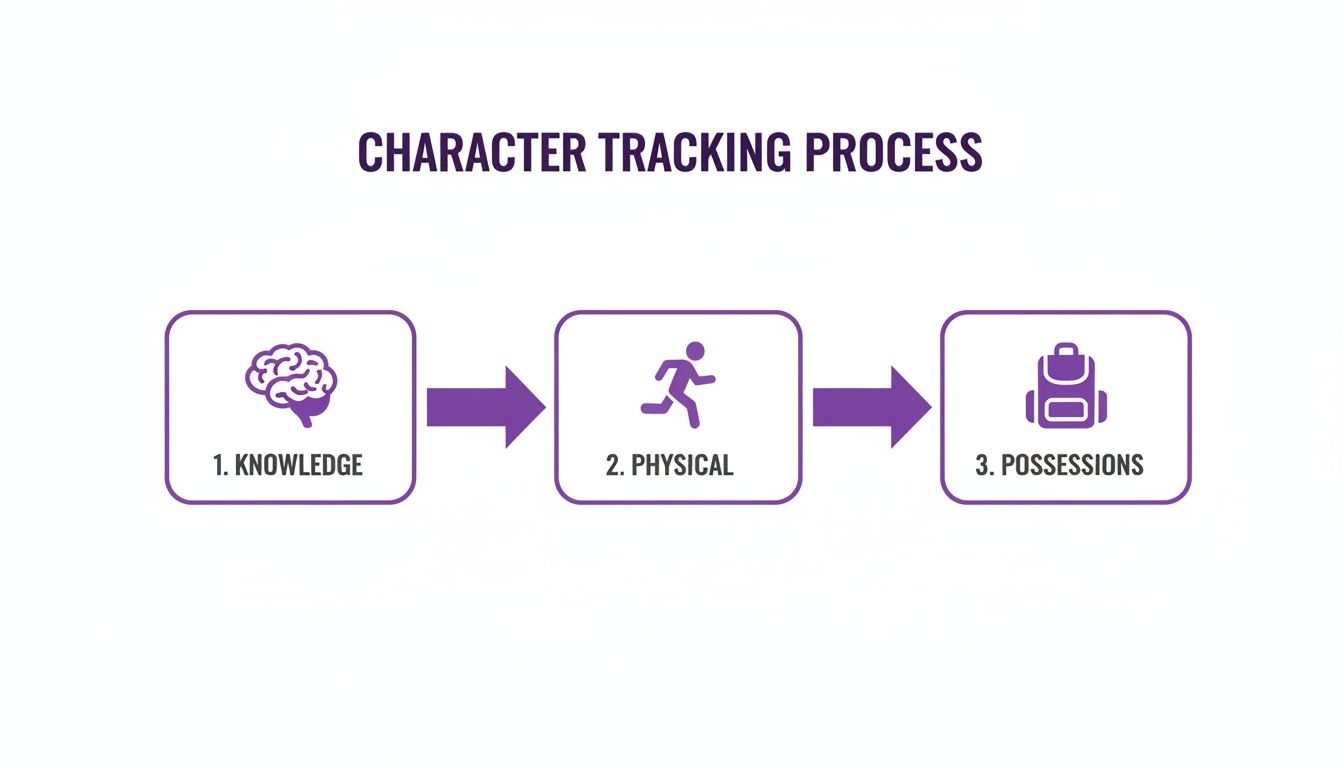
This diagram gets to the heart of it. The core pillars—Knowledge, Physical State, and Possessions—are the bedrock of manuscript consistency. Tracking these keeps your story logical and grounded.
The Scene-Level State Summary
One of the most effective, low-friction methods is the scene-level state summary. At the end of every scene you draft, take thirty seconds to jot down a few crucial notes about your point-of-view character's state. This isn’t a full-blown profile update. It’s a quick, pragmatic log.
- Knowledge: What new, plot-critical information did they just learn? (e.g., Learned Anya sabotaged the comms tower.)
- Physical: What's their current condition? (e.g., Deep gash on left forearm, exhausted.)
- Emotional: What's their immediate emotional state heading into the next scene? (e.g., Furious at Anya, terrified of being caught.)
By making this a habit, you create a real-time, chronological record of your character’s journey. Suddenly, profile maintenance isn't a dreaded task; it’s a tool that actively strengthens your draft as you build it.
Anchoring Characters in Their Occupation
Another powerful anchor for consistency is a character’s job. Too often, a profession is just set dressing, but it should be a functional baseline for their skills, mindset, and what they notice. If your character is a cybersecurity pro, she should be the one to notice the suspiciously open Wi-Fi network. If he’s a paramedic, his reaction to a gruesome injury will be fundamentally different from that of a civilian.
When a character acts outside the established baseline of their profession without a compelling reason, the reader feels the inconsistency, even if they can't name it. Tracking isn't just about what changes; it's also about reinforcing what should stay consistent.
Your tracking system should include a short, practical summary of their professional competencies. Not their entire resume, but a handful of points defining their core skills. What specific knowledge do they possess? What tools are they proficient with? How do they analyze problems? This baseline gives you a constant reference point. When your cybersecurity expert suddenly falls for an obvious phishing scam, your tracking notes will flag the contradiction. It’s a proactive way to turn your character profile into a guard against the subtle errors that undermine a manuscript.
A dynamic workflow embeds tracking directly into the act of writing. You need a system that feels less like paperwork and more like an extension of storytelling. When you see how it works in practice, you'll find that meticulous tracking doesn't stifle creativity—it liberates you to focus on the story, confident that the underlying logic is sound.
Evolving Your Character Profiles with the Manuscript
A character profile isn't a constitution, carved in stone. Think of it more like a living battlefield report. What was true for your protagonist in Chapter 5 is ancient history by Chapter 25. This is where the whole idea of a "character arc" stops being a lofty concept and becomes a practical tracking problem. A believable arc isn't a vague journey from "shy" to "brave." It’s a series of concrete changes in their state, each triggered by a specific event.
Mapping the Arc as a Series of State Changes
Your hero doesn't just wake up one morning with a new personality. They face a harrowing betrayal in Chapter 12 that fundamentally alters their trust in others. That shift has to ripple through their actions and thoughts in Chapter 13 and beyond. If it doesn’t, the arc feels hollow. Your tracking system is your proof of change, the institutional memory that ensures your character's evolution is a consistent, forward-moving thread.
The most common way a powerful character arc gets undermined is through simple reversion. We’ve seen manuscripts where a character has a transformative experience, only to behave exactly as they did before two chapters later. It’s not a failure of storytelling; it's a failure to update the character’s file. This dynamic approach is what separates a truly compelling character from a flat one. For more on this, you can explore more insights on how essential this development is for modern fiction.
Logging the Pivotal Moments
To make this practical, your workflow needs to log these pivotal moments. Think of it as creating a "before" and "after" snapshot for key events.
- Before Event X: Character trusts their mentor implicitly. Core belief: Authority figures are inherently good.
- Event X (Chapter 15): The mentor betrays them, revealing a devastating, long-held deception.
- After Event X: Character's trust is shattered. Core belief shifts to: Authority is self-serving. Their relationship with the mentor is now permanently tagged as "hostile/wary."
By logging these shifts directly into your tracking system, you create an undeniable record. When you’re deep into writing Chapter 20, a quick check of your log stops you from accidentally having your character seek that same mentor out for friendly advice. It sounds obvious, but across a 400-page manuscript, these are precisely the details that fall through the cracks. Your tracking system isn't just a place to store static details. It’s the moment-to-moment log of a character's evolution. It's what ensures that the person who finishes the story is a believable product of the journey you put them through.
Questions We Hear About Dynamic Character Tracking
Even for seasoned writers, making the leap from a static profile to a dynamic tracking system can feel weird. You've got a workflow that mostly works, and any new process has to prove it solves more problems than it creates. Let's get into some of the real friction points we hear from authors wrestling with complex manuscripts.
Isn't This Just Making Things More Complicated?
No. It’s about simplifying the single most complex part of writing a long story: keeping everything straight. A fifty-question character profile is complicated. Trying to hold a character's entire, evolving knowledge state in your head for 400 pages is really complicated. A dynamic tracking system reduces that mental load. It's not about adding work; it's about offloading the tedious, error-prone task of remembering every detail. Your creative energy should be spent on the story, not on remembering which arm that scar was on in Chapter 3. Think of it like navigating a city with a mental map versus using GPS. One requires constant effort and you're bound to make a wrong turn. The other just gives you the information you need, so you can focus on the drive.
I'm Halfway Through a Draft. How Do I Start?
Don't boil the ocean. The thought of going back and building a tracker for a 50,000-word manuscript is enough to make anyone give up. So don't do that. Just start from where you are right now.
Read through your last chapter and create a "genesis state" for your main characters based on what's true at that exact moment.
- Knowledge: What are the 3-5 most critical plot points they know right now?
- Physical State: Any lingering injuries? A new tattoo?
- Possessions: Do they still have the MacGuffin?
- Relationships: Who are they furious with? Who did they just form a shaky alliance with?
From this point on, you track forward. Later, during revisions, you can go back and fill in earlier pivotal moments as they become relevant. This turns a massive data-entry project into a manageable part of your process. The goal isn't a perfect history from page one. It's a functional tool that stops future contradictions and makes your revision process ten times easier.
What's the Best Tool for This? Spreadsheets?
Look, spreadsheets and notes apps are the default for a reason, and they're better than nothing. But they almost always break down at scale because they're completely disconnected from your manuscript. You have to constantly switch from your writing app to your spreadsheet just to log an update. That friction adds up.
The best tracking system is one that lives inside your writing environment. It needs to "see" your manuscript and help you connect the dots without you manually cross-referencing everything. This is the exact problem we built Novelium to solve. A truly useful system for how to create character profiles shouldn't feel like a separate, soul-crushing admin task. It should feel like a natural extension of your writing. When your tools can automatically pull out character details, track their states from scene to scene, and even flag inconsistencies as you write, you're not just managing data—you're protecting the integrity of your story. Novelium does that heavy lifting, so you can focus on what you do best: writing a novel your readers can't put down. See how it works at https://novelium.so.