How Many Chapters Should a Novel Really Have
Most novels don't have a correct chapter count. They have a word budget divided by a pacing decision. A widely cited publishing guide places many 70,000 to 90,000-word novels in the neighborhood of 15 to 25 chapters, with chapters often running 1,500 to 5,000 words (Urban Quill Publishing's chapter-length guide). That's useful as a baseline, not a law.
A 90,000-word manuscript can become 18 dense chapters, 30 moderate chapters, or 60 short chapters without automatically becoming structurally wrong. The number tells you very little until you know what each chapter is doing, how often you interrupt the reader, and how much continuity you're asking yourself to maintain.
The Chapter Count Question Is the Wrong Question
Writers keep asking how many chapters a novel should have because publishing advice keeps pretending the answer is a genre convention. It isn't. Chapter count is a downstream consequence of manuscript length, scene architecture, and narrative rhythm.
Industry guidance often places standard-length fiction around 12 to 28 chapters, while fantasy and science fiction can reach 30 to 90 or more because their word budgets and structural demands differ (SelfPublishing.com's chapter-count guidance). That range doesn't tell you what to do with your manuscript. It only shows that convention has plenty of room.
A 90,000-word book divided into 18 chapters averages 5,000 words per chapter. The same manuscript divided into 30 chapters averages 3,000 words, while a 60-chapter structure averages 1,500 words. All three can work. All three can also fail spectacularly if the breaks arrive without a dramatic or informational reason.
Editorial rule: Stop chasing a magic number. Decide how much narrative pressure each chapter can carry, then let the count emerge.
The useful questions are sharper. Does the chapter contain a complete dramatic movement? Does its ending create a meaningful change in pressure, knowledge, location, or consequence? Does the next chapter begin with enough force to justify the interruption?
Chapter divisions became compositional tools long before contemporary commercial fiction. Historical commentary places chapter-like divisions in prose texts by the 4th century CE, which helps explain why chapter structure has always been flexible rather than fixed (historical context in Urban Quill Publishing's guide). Treat chapter count as math first and convention second.
Word Budget Is What Actually Drives Chapter Count
The arithmetic is blunt:
Chapter count = total manuscript words ÷ average chapter length.
That formula gives you a baseline before genre, market expectations, or personal taste enters the room. It won't determine the final structure, because scenes rarely divide into identical units, but it will expose whether your desired count is plausible.
A practical word-budget table
| Total Word Count | 1,500-word chapters | 3,000-word chapters | 5,000-word chapters | 8,000-word chapters |
|---|---|---|---|---|
| 75,000 words | 50 chapters | 25 chapters | 15 chapters | About 9 chapters |
| 90,000 words | 60 chapters | 30 chapters | 18 chapters | About 11 chapters |
The 90,000-word examples follow the same logic described in publishing guidance, where a 20-chapter manuscript averages about 4,500 words per chapter and a 40-chapter manuscript averages about 2,250 (SelfPublishing.com's chapter-count guidance). The table isn't a prescription. It's a way to catch bad planning early.
Chapter length controls more than the final number. A shorter average creates more frequent stopping points, faster perceived movement, and more opportunities for cliffhangers. A longer average gives scenes room to develop relationships, complications, and continuity across several events. Writing guidance commonly places fiction chapters around 2,000 to 5,000 words, with 3,000 to 4,000 words often treated as a practical center (NY Book Editors on chapter length).
Practical test: If your chapter count only works because every chapter has the same artificial length, your structure is being driven by formatting instead of story pressure.
Take a thriller outline with a pursuit, an interrogation, and a reversal. Give each sequence room for extended action and the book may settle into fewer, longer chapters. Break the same material into compact scenes with frequent POV shifts and hard exits, and the count rises sharply. The plot hasn't changed. The reader's cadence has.
Before cutting excess prose, calculate what the word budget can support. Cutting word count without damaging structure is a structural decision, not a cosmetic one.
How Genre Reshapes Chapter Length and Count
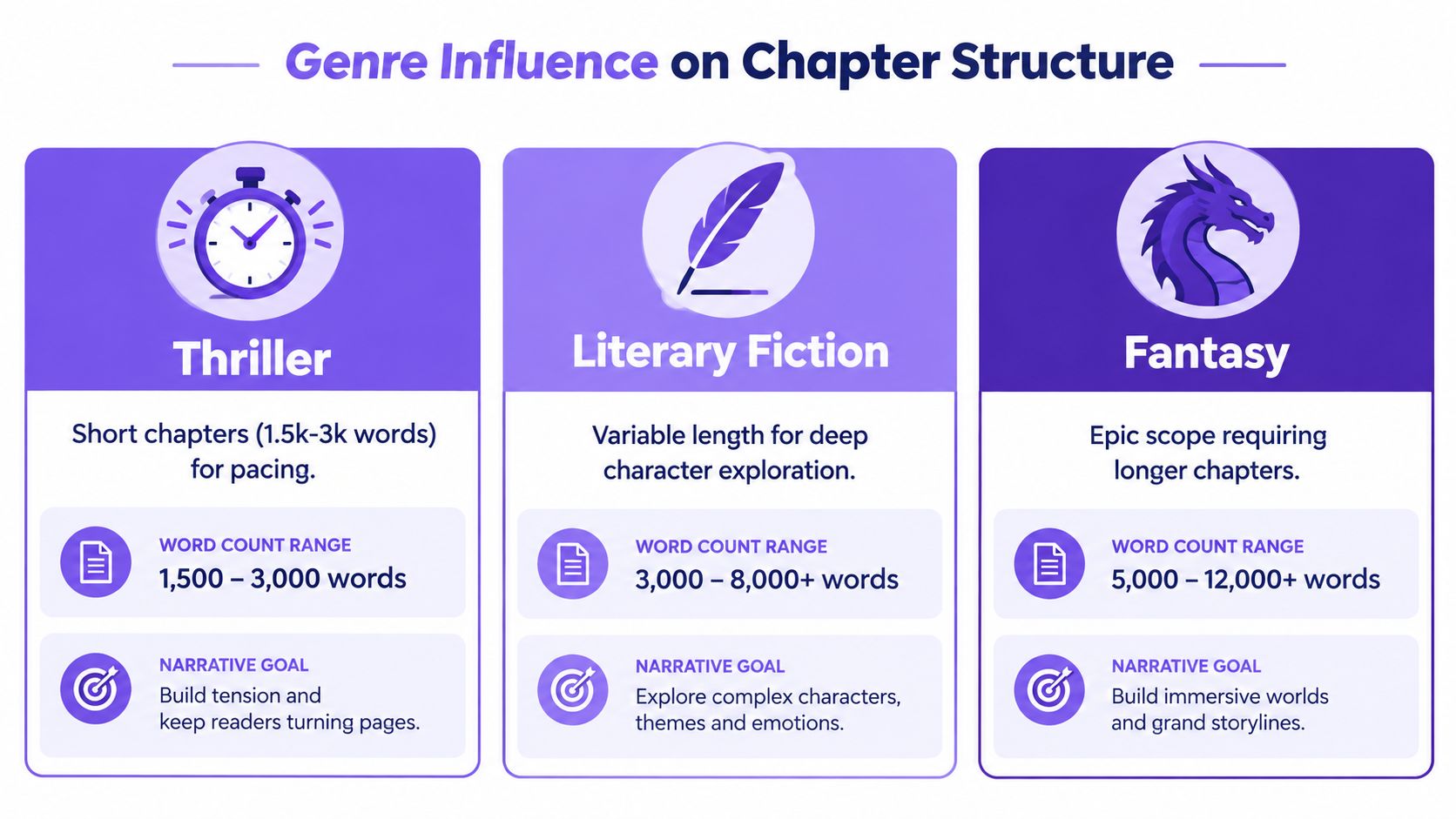
Genre influences chapter design by changing the pressure on pacing, scene scale, and continuity. It does not provide a fixed chapter template. Your word budget and desired reading speed still determine the final count.
Thriller
Thrillers commonly use 1,000 to 3,000-word chapters. Shorter units support rapid escalation, cliffhangers, and quick viewpoint changes (Chapter.pub's genre comparison). That rhythm can create a high chapter count without making the novel feel over-sectioned.
Momentum comes with a cost. If every scene becomes its own chapter, the manuscript starts to read like a string of alerts rather than a continuous narrative. End a chapter when the danger sharpens or the reader's understanding changes. A scene ending alone is not enough.
Literary fiction
Literary fiction often supports longer chapters, with many falling around 3,000 to 5,000 words. Sustained interiority, observation, and tonal development need room to accumulate. Longer units can keep an emotional movement intact instead of breaking it into disconnected fragments.
Length still needs control. Once the chapter's central movement has finished, additional pages create drag. Depth comes from meaningful development, not from leaving the chapter open.
Fantasy and science fiction
Fantasy and science fiction often use chapters of 4,000 words or more, because worldbuilding, multiple POVs, travel, and political or historical context require space. Epic structures can still reach 30 to 90 or more chapters, depending on total length and scene design (SelfPublishing.com's chapter-count guidance).
Worldbuilding-heavy genres carry a higher continuity load, and genre conventions shape reader expectations about scope and pacing. Long chapters should therefore earn their length through one sustained escalation. Split a chapter when it contains unrelated movements. Keep it intact when several scenes build toward the same turn.
Genre creates pressure on chapter length and count. Use that pressure to set the manuscript's rhythm, then track the resulting continuity risks as the book grows.
Reverse-Engineering Chapter Count From Your Manuscript
Pick the manuscript length first. Pick the chapter rhythm second. Let the number fall out of the division.
For a 90,000-word adult novel, a 2,500-word average produces roughly 36 chapters. A faster structure built around 1,500-word beats produces roughly 60 chapters. Those calculations follow the standard reverse-engineering method recommended in novel-planning guidance (Squibler's chapter-count formula).
The formula
Chapters = word count ÷ target average chapter length
A worked example:
- Target manuscript: 90,000 words
- Target chapter average: 2,000 words
- Baseline count: 45 chapters
- Working tolerance: roughly 40 to 50 chapters, depending on scene needs and pacing
That tolerance isn't an excuse to ignore the math. It recognizes that one chapter may need 1,500 words while another needs 3,000. The average matters more than uniformity.
| Total Word Count | 1,500-word chapters | 2,500-word chapters | 4,000-word chapters |
|---|---|---|---|
| 75,000 words | 50 chapters | 30 chapters | About 19 chapters |
| 90,000 words | 60 chapters | 36 chapters | About 23 chapters |
The two variables that move the answer most are your shortest scene unit and your longest scene unit. If your story regularly needs a complete sequence in 1,500 words, forcing everything into 4,000-word chapters will create dead air. If your major turns require several linked scenes, a rigid short-chapter target will chop the tension into pieces.
The chapter count shouldn't be locked before you know what your scenes can carry. Writers who choose 30 chapters because 30 sounds respectable are solving the problem backwards. Use the number as a planning consequence, then revise it when the actual manuscript exposes its rhythm.
For a draft that needs substantial movement rather than cosmetic renumbering, chapter restructuring should follow the dramatic units already present on the page.
More Chapters, More Places for Continuity to Break
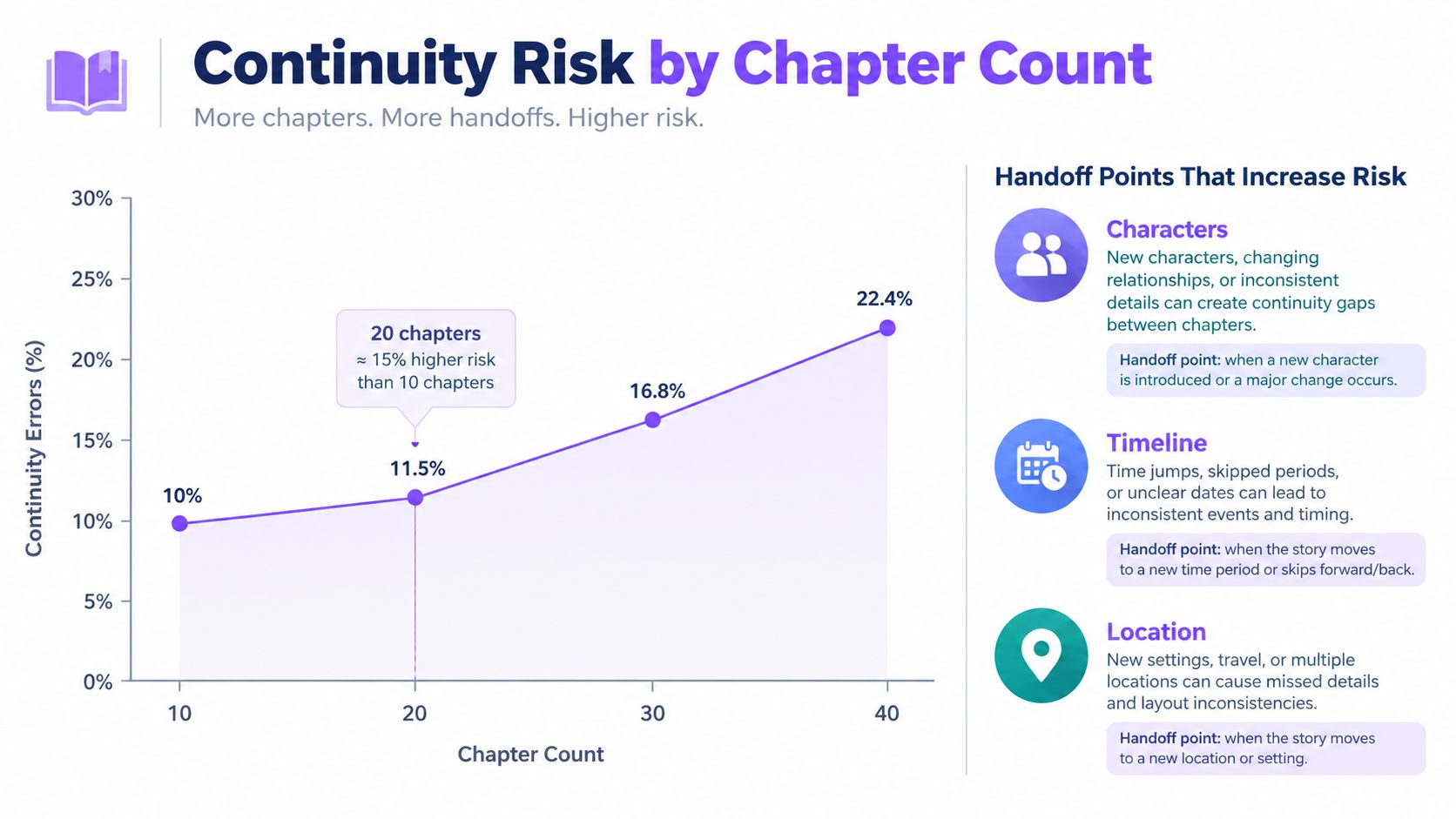
Every chapter boundary is a handoff. The reader leaves one state of the story and enters another, carrying assumptions about character knowledge, time, location, injuries, objects, and unresolved motives. The writer has to preserve those states accurately.
A 20-chapter novel has 19 handoffs between chapters. A 60-chapter novel has 59. That doesn't mean the longer book will contain a specific percentage more errors. It means the longer book gives you more transition points where a detail can be dropped, altered, or contradicted.
A character forgets the scar established earlier. A minor witness changes name. A character arrives on Tuesday despite leaving on Tuesday morning for a journey that requires more time. A weapon appears in a room where the previous scene left it elsewhere. A supposedly dead character reappears because an early draft note survived in one chapter but not the others.
The memory ceiling
At 30 chapters, many writers can still hold a rough model of the manuscript in working memory. At 50 or more chapters, that approach becomes unreliable, especially when the book includes recurring characters, multiple timelines, or a large cast. The second half of a long draft is where forgotten injuries, duplicated revelations, and impossible sequences tend to surface, not because the writer has lost control of the story, but because memory is a poor database.
Chapter count is a continuity exposure variable. More chapters mean more handoffs, and more handoffs demand a tracking system.
Character development documents don't solve this. A profile tells you who a character is supposed to be. It doesn't reliably tell you what that character knows after Chapter 27, which relationship changed in Chapter 34, or whether the character can plausibly recognize an object introduced much earlier.
That's the difference between character development documentation and character tracking. One describes a design. The other records evolving states across the manuscript. Long fiction needs the second.
A Working Chapter Structure You Can Apply Tonight
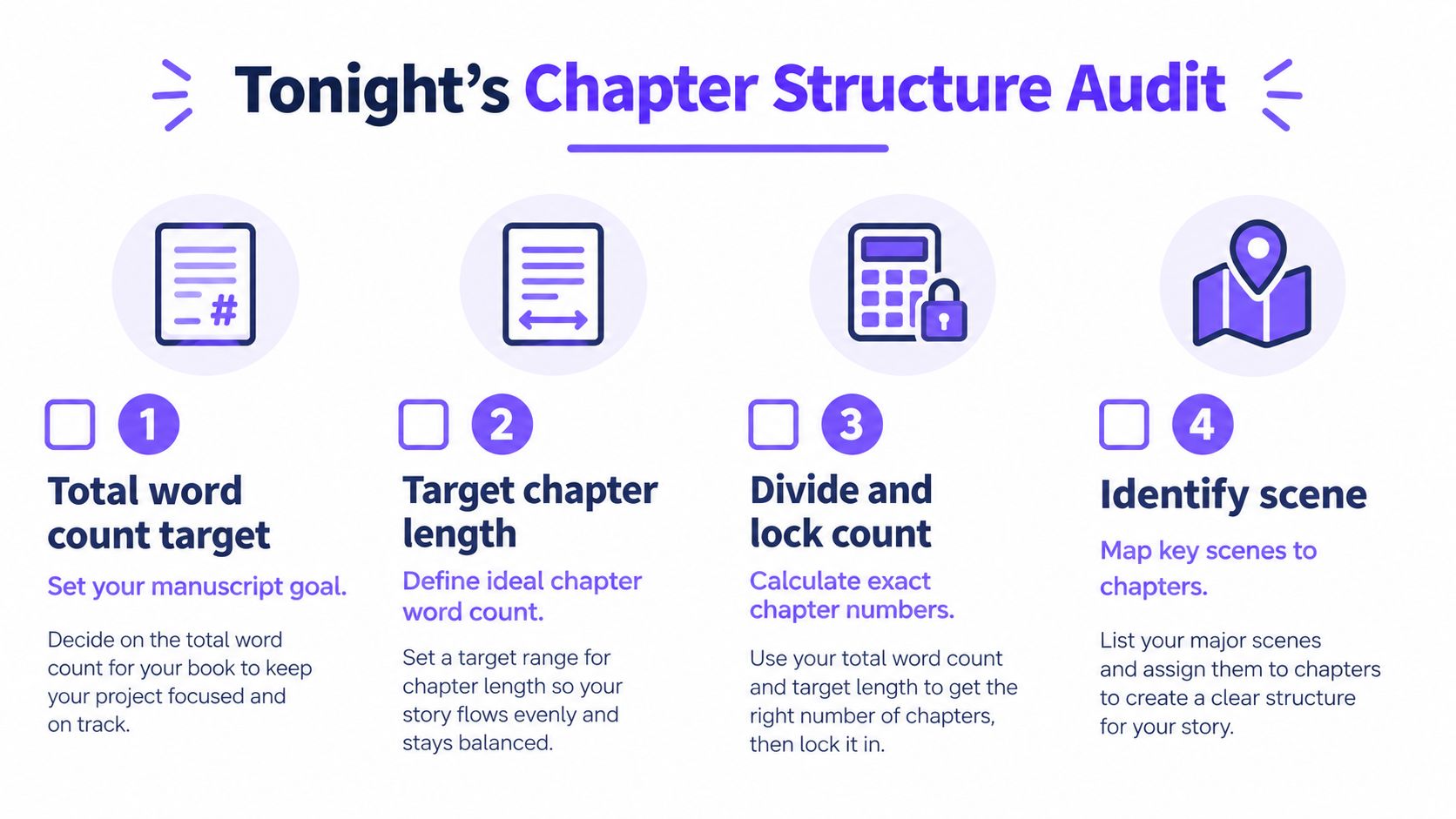
Run this audit against the draft you have, not the book you intended to write.
- Set the total word-count target. Use the manuscript length your genre and project can support, then calculate from it rather than selecting a chapter number by instinct.
- Choose the target chapter average. Base it on your shortest useful scene unit, your longest sustained sequence, and the reading rhythm you want.
- Divide and lock a provisional count. A 90,000-word manuscript divided by 2,000 words produces a baseline of 45 chapters. Treat that as a working structure, not a prison.
- Map the scene units. Mark where each chapter changes character state, timeline, location, information, or pressure.
Then audit three continuity variables in every chapter: character, timeline, and location. Flag chapters where more than one changes at once. Those chapters are your real pacing pivots, and they deserve closer scrutiny than chapters that merely meet a target word count.
At 40 or more chapters, memory and a basic spreadsheet start costing more time than they save. A spreadsheet can record a date or location, but it won't understand that a character's knowledge changed because of a revelation three chapters earlier. For a broader framework on organizing complex material, content structure for professionals offers a useful reference point beyond fiction-specific planning.
Novelium's Character Tracker and World Codex extract and track character details across a manuscript, including traits, knowledge states, relationships, events, timelines, locations, and object references. Its chapter-aware analysis is designed for the exact problem created by long, multi-chapter drafts: keeping every handoff consistent while you revise pacing and structure.
If your chapter count is drifting, upload the manuscript to Novelium and audit the structure against its actual word budget, scene rhythm, character states, timeline, and locations. Use the results to split chapters for a reason, not because a blog told you that a novel should contain a particular number.