How Long Is the Average Book for Professional Novelists
If you've ever asked, "how long is the average book?" you've probably gotten the honest, frustrating answer: it depends. For most adult fiction, the commercial sweet spot lands somewhere between 70,000 and 100,000 words. But that number is just the beginning of a much more important conversation—one that separates aspiring writers from working professionals.
Focus on Word Count, Not Page Count
Let's get one thing straight right away. When agents, editors, and publishers talk about a book's length, they care about exactly one thing: word count.
Page count is a flimsy, cosmetic number. It’s easily manipulated by font size, margins, and the physical trim size of the book. It’s a vanity metric for readers, not a professional one for writers.
Word count, on the other hand, is the industry's universal standard because it's concrete. It directly translates to real-world costs for printing, shipping, and warehousing. A 120,000-word manuscript costs a publisher more to produce than an 80,000-word one, and that difference ripples out to affect everything from a debut author’s advance to the final profit margin.
The Professional Standard
Thinking in word count forces you into a professional mindset. It’s the language of contracts, production schedules, and query letters. It’s a stable number you can use to track your progress and make crucial structural decisions—something the best writing software for novelists helps you manage with precision. This metric is your story’s true weight class.
The moment you shift your focus from "how many pages am I at?" to "what's the word count?" you start thinking like a published author. It’s not just semantics; it's a fundamental change in how you view your manuscript as a commercial product.
This shift pulls you out of the realm of guesswork and into strategic planning. Every thousand words adds tangible weight and thickness to the physical book, influencing its spine width and how it sits on a bookstore shelf. For ebooks, word count signals the time investment required, setting reader expectations before they even get to the first line.
How Word Count Translates to Pages
While the industry runs on word count, it's still helpful for writers to visualize what their manuscript might look like as a finished book. A good rule of thumb is 250 words per page for a standard trade paperback.
Here’s a quick reference to help you translate your manuscript’s length into a rough page count.
| Word Count | Book Category | Estimated Page Count |
|---|---|---|
| 40,000 | Novella / Short Novel | 160 pages |
| 55,000 | Shorter Middle Grade / Romance | 220 pages |
| 70,000 | Standard Adult Novel (low end) | 280 pages |
| 90,000 | Standard Adult Novel (high end) | 360 pages |
| 110,000 | Longer Sci-Fi / Fantasy | 440 pages |
| 130,000 | Epic Fantasy | 520 pages |
Remember, this is an estimate. Your final page count will vary based on the publisher's design choices, but this gives you a solid ballpark figure to work with.
Ultimately, your word count is the first signal you send to an agent or editor about your market awareness. A manuscript that wildly misses genre conventions suggests an author who hasn't done their homework. Before we dive into the specific numbers for each genre, internalizing this principle is the most important first step.
The Standard Word Count for Adult Fiction
If you hang around writers long enough, you’ll hear the endless debate over the perfect novel length. Let's cut through the noise and get to the reality of it.
For most adult fiction, the industry’s sweet spot—the number agents and editors want to see—hovers between 70,000 and 100,000 words. This isn't just some arbitrary number pulled out of a hat. It’s a carefully balanced equation that considers storytelling real estate, the cost of printing a physical book, and what readers have come to expect.
Think of this range as the ideal container for your story. It’s spacious enough for a complex plot and meaningful character development, but it doesn't demand an epic-level time commitment from the reader. Publishers love it because it represents a predictable financial investment. They know roughly what it will cost to produce and how to slot it into their marketing and distribution plans.
For example, when an agent sees a debut manuscript land in their inbox at 85,000 words, it sends a powerful signal. It says you’re a professional. It says you understand the market and know how to tell a complete, satisfying story without letting it get bloated—a crucial skill for any author.
Why This Range Works
So what happens when you stray from the path? A novel that clocks in under 70,000 words can feel a bit thin for the adult commercial market. It might suggest a story that’s missing the subplots or emotional depth that readers are hungry for.
On the other end of the spectrum, pushing past 100,000 words—especially for a debut author—is a huge red flag for agents. A monster manuscript can signal a lack of discipline or an unwillingness to self-edit. An agent looking at a 120,000-word contemporary novel knows it will need major surgery to get it into fighting shape, and that’s a lot of extra work for everyone involved.
You can see this standard reflected in plenty of well-known books. Orson Scott Card’s Ender's Game is a hefty 100,609 words, while J.K. Rowling's Harry Potter and the Prisoner of Azkaban comes in at a similar 106,821 words. These stories are packed with world-building and complex plots, yet they still sit right around that established benchmark. For a deeper dive into the numbers, check out Reedsy's analysis of book lengths.
The Commercial Reality
Ultimately, aiming for this word count is about managing risk and meeting expectations. A publisher is making a bet. They’re betting that a book of this length will satisfy the average reader's appetite for a good story while being priced competitively on the shelf.
Hitting the 70,000 to 100,000-word target doesn't just make your book easier to sell to a publisher; it makes it easier to sell to a reader. It’s a silent promise that the story inside is well-paced, professionally crafted, and respects their time.
Of course, there are always exceptions. You'll find sprawling fantasy epics and slim literary novels that defy the odds and find success. But they are just that: exceptions. For the vast majority of us trying to get published, aiming for this target is the most strategic move you can make. It proves you’re not just an artist, but a pro who understands the business of books.
How Word Count Averages Change by Genre
Think of a book's genre not just as a label on a bookstore shelf, but as a promise you make to your reader. Part of that promise is about the journey's length. When someone picks up an epic fantasy, they're settling in for a long haul—they expect sprawling worlds and a massive cast. A lean, mean thriller, on the other hand, promises a breakneck pace that doesn't overstay its welcome.
Ignoring these unwritten rules is a surefire way to break that promise and leave readers feeling disappointed. It's like showing up to a sprint expecting a marathon.
The general 70,000 to 100,000-word range for adult fiction is a decent ballpark, but the real story is in the details. Getting granular with your specific genre is non-negotiable if you want to give agents, publishers, and readers exactly what they're looking for. These averages aren't just arbitrary numbers; they’re a direct reflection of reader tastes and the unique narrative demands of the genre itself.
This chart gives you a quick visual on the sweet spots for adult fiction.
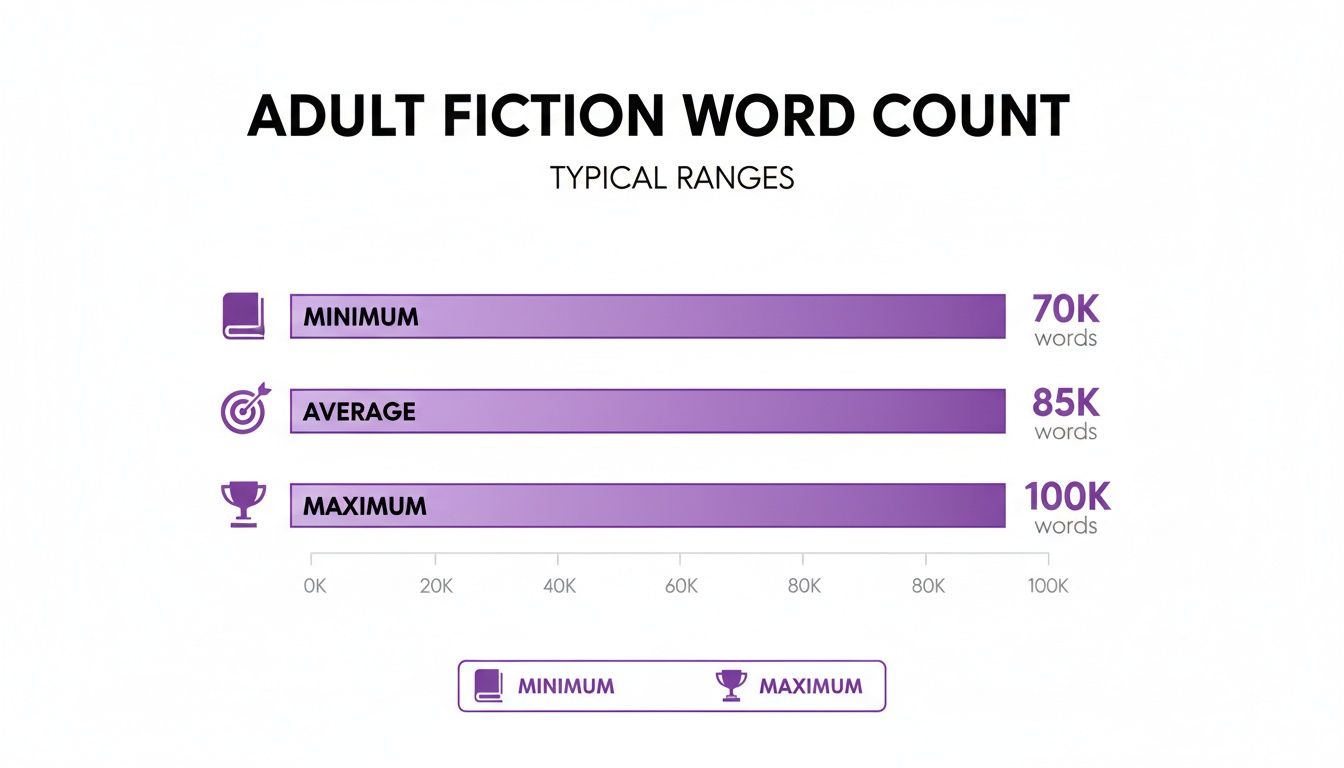
As you can see, while the average hovers right around 85,000 words, there's a pretty generous window on either side. This flexibility allows for all sorts of storytelling styles, but it's still a defined playing field.
A Deeper Dive Into Genre Expectations
To really nail your manuscript's length, it helps to see how these ranges play out across different genres. Each has its own rhythm and reader expectation, which directly influences the ideal word count.
Below is a quick breakdown of the most common goalposts for popular adult fiction categories.
Typical Word Count Ranges by Popular Fiction Genre
A comparison table detailing the standard word count windows for major adult fiction genres, helping authors target their manuscript length effectively.
| Genre | Typical Word Count Range | Key Considerations |
|---|---|---|
| Fantasy & Sci-Fi | 90,000 – 120,000+ words | These genres need room for world-building. Magic systems, new technologies, and complex histories all require extra page space. Debuts often hit 100,000 words. |
| Thrillers & Mysteries | 70,000 – 90,000 words | Pacing is king here. The goal is to maintain tension and momentum. Anything longer risks bogging down the plot and losing the reader's attention. |
| Romance | 70,000 – 90,000 words | The focus is on a tight, emotionally satisfying character arc. While some subgenres like paranormal or historical can run longer, the core story needs to be lean. |
| Literary Fiction | 80,000 – 110,000 words | Literary works often prioritize character depth and lyrical prose over plot, which can justify a longer word count. The narrative needs space to breathe and develop themes. |
| Historical Fiction | 90,000 – 120,000 words | Similar to fantasy, historical fiction requires significant world-building to immerse the reader in a specific time and place. Historical detail takes up space. |
These numbers are a fantastic starting point, but remember they aren't rigid laws. They're guidelines shaped by the market—by what sells, what readers enjoy, and what makes a story in that genre feel right.
The Epic Demands of Fantasy and Sci-Fi
It’s no secret that Fantasy and Science Fiction novels are the behemoths of the bookstore. They often push, and even pole-vault over, the upper limits of commercial fiction. It’s not uncommon to see debuts in these genres clocking in at 100,000 words or more.
And for good reason. You’re not just telling a story; you’re building an entire universe from scratch.
That requires a hefty word budget for exposition, deep history, unique magic systems, or believable futuristic tech. Readers who gravitate toward epic fantasy don't just tolerate this depth—they crave it and are more than willing to invest in a longer read. Trying to cram a world-spanning saga into 75,000 words would leave the story feeling rushed, thin, and ultimately unsatisfying.
The Tight Pacing of Thrillers and Romance
On the flip side, you have genres like thrillers, mysteries, and most types of romance that thrive on pure momentum. Here, the primary goal is to hook the reader, crank up the tension, and deliver a rapid-fire reading experience. Bloat is the absolute enemy.
A typical thriller lands somewhere between 70,000 and 90,000 words. This length is the sweet spot for maintaining suspense without letting the plot sag in the middle. In much the same way, a contemporary romance novel usually hits that same range, keeping the focus tight on an emotionally resonant character journey without getting lost in too many subplots.
Genre word count isn't a restrictive rule; it's a pacing guideline. It tells you how much runway your readers expect you to use before the story takes off, cruises, and lands.
Of course, these numbers are always shifting. Recent analysis shows that the median length for fantasy novels has actually grown to 87,100 words, while sci-fi surprisingly shrank to 71,300 words. Meanwhile, mystery and thrillers have expanded to a median of 78,500 words, hinting at subtle changes in what readers are looking for.
If you want to dig into the data yourself, you can explore more about these trends in Jericho Writers' analysis of novel word counts. Staying on top of these benchmarks is one of the smartest things you can do to position your manuscript for success.
Why Bestsellers Are Getting Shorter
The market is sending a signal, and it’s impossible to ignore: our shrinking attention spans are demanding tighter stories. This isn't just a hunch writers have; it’s a trend you can actually measure, and it directly affects how agents, publishers, and readers will see your book.
A fascinating study looked at data from 2011 to 2021 and found that the average New York Times bestseller is shrinking—and fast. The average page count dropped from 437.5 pages to just 386. That’s a loss of over 51 pages in a single decade, an 11.8% nosedive. Don't just take my word for it; you can see the full analysis of declining bestseller lengths for yourself.
This isn’t some minor statistical blip. It’s a fundamental shift in publishing, driven by the absolute avalanche of digital content competing for our eyes and ears. For a novelist trying to make a living, this trend has some stark implications.
The New Commercial Reality
Simply put, every single word has to earn its keep. A manuscript that sprawls past its genre’s sweet spot isn’t just a pacing problem anymore—it’s a commercial liability. Agents and editors are keenly aware of this. When they see a 120,000-word manuscript, they don't just see a long story. They see higher printing costs, a steeper price tag for the reader, and a bigger time commitment for someone who has a dozen other options waiting on their phone.
The odds of a thick, doorstop-sized book cracking the bestseller list have dropped significantly. A bloated manuscript isn't just harder to edit; it's fundamentally out of step with how people read today.
This changes the game for submissions. A leaner manuscript has a better shot right out of the gate. Handing an agent an 85,000-word thriller shows them you don't just understand storytelling; you understand the business of selling books in this market. It shows discipline and a respect for the reader's time, making you look like a much more appealing partner for a publisher.
Tighter Stories, Not Thinner Plots
Now, this isn't a rallying cry to gut your story or ditch complex narratives. Far from it. It's a call for ruthless efficiency. It means every subplot must feed the main plot, every scene has to push the story forward, and every character needs a damn good reason to be on the page.
The pressure is on to deliver maximum impact with maximum economy. The novels that are breaking through today are the ones that are plotted with surgical precision and meticulously paced. They’ve trimmed the fat without sacrificing an ounce of depth. The message from the market couldn't be clearer: say what you need to say, and then get out of the way.
Word Counts for YA and Middle Grade Fiction
If you think writing for younger readers is just "adult fiction-lite," think again. It's an entirely different craft, with its own set of rules and expectations. Moving from a sprawling 90,000-word adult thriller to a punchy 65,000-word Young Adult novel demands a completely different narrative blueprint. It’s not about watering down your themes; it’s about tightening the timeline and laser-focusing the story.
For writers who jump between these age categories, getting a feel for the market's conventions is non-negotiable. These word count ranges aren't just arbitrary numbers—they’re a reflection of the pacing, the emotional depth, and the reading habits of the audience you’re trying to reach.
The Young Adult Sweet Spot
Young Adult (YA) fiction really hits its stride in the 50,000 to 75,000-word range. This word count is the perfect container for what makes YA so powerful: a sharp focus on a single protagonist's high-stakes journey, a gripping emotional arc, and a story that just doesn't quit. A YA contemporary romance, for example, simply doesn't have the space for a bunch of meandering subplots. Every single scene has to earn its place by pushing the central conflict and character growth forward.
This tighter frame forces you to be ruthlessly efficient. You don't have the word budget for the long-winded backstories or sprawling casts you might find in an adult historical epic. The story has to be lean, fast, and emotionally honest—which is exactly what YA readers are showing up for.
Middle Grade Manuscript Length
Drop down to Middle Grade (MG), and the target gets even leaner, usually landing somewhere between 30,000 and 55,000 words. The biggest difference here isn't just the length, but the complexity. MG plots tend to be more straightforward, the emotional stakes are immediate and easy to grasp, and the endings are often more clear-cut. The word count is a direct reflection of this need for clarity and forward momentum.
Writing for younger readers is a masterclass in narrative efficiency. The tighter word count forces you to make every character, every scene, and every line of dialogue pull its weight. There's simply no room for fat.
Think about it: a 40,000-word MG adventure has to build its world, introduce its heroes, and wrap up its plot with incredible precision. It’s all about delivering a complete, satisfying story that respects a younger reader’s attention span without ever skimping on the heart. Stray too far from these norms, and you risk making your book a tough sell for the librarians, teachers, and parents who get books into kids' hands. For any author hoping to break in, mastering these specific story sizes is one of the most important keys to success.
Hitting Your Target Without Gutting the Story
Knowing your target word count is one thing. Actually getting there is another beast entirely. The real test comes when your sprawling 120,000-word epic needs to slim down to a much more marketable 100,000.
It’s tempting to just start slashing. Amateurs often make random cuts, killing their darlings and just hoping for the best. But that’s a great way to accidentally pull the heart out of your story. Pros know better. They make strategic cuts based on the actual structure of the narrative.
This isn’t about just running a search for adverbs or chopping every instance of the word "that." Real revision is about diagnosing your manuscript’s core rhythm to find what’s really weighing it down. You have to move beyond vague feelings like "this scene feels slow" and get a clear, data-driven map of your story's momentum.
Beyond Subjective Edits
Smart trimming means understanding your novel's architecture. Where does the pacing truly sag? Which subplots spin their wheels without ever connecting back to the main story? Where do your characters just rehash information the reader already knows? These are the places ripe for cutting—not the powerful emotional beats that make your story sing.
A visual pacing analysis, for instance, can show you a bloated second act long before a beta reader ever points it out.
Here’s a glimpse of how Novelium’s Pacing Analyzer maps out a manuscript's rhythm, charting scene length against emotional impact.
A chart like this instantly flags structural problems. See that cluster of long, low-conflict scenes? That's a narrative dead zone, and it’s killing your story’s drive.
Making informed decisions means seeing your story in a new light. You’re looking at it as a sequence of events, character interactions, and information transfers. By using a deep manuscript analysis, the kind built into dedicated novel writing software, you can find the exact places to cut without gutting the story.
The goal isn’t just to hit a word count. It’s to align your manuscript with market expectations while strengthening its internal logic and consistency, turning a long book into a tight, propulsive one.
This strategic approach ensures every scene left standing serves a critical purpose. It’s how you tighten the narrative, improve the reader's experience, and transform a flabby manuscript into a lean, powerful story that sells.
A Few More Questions About Word Count
We’ve gone over the standards and the trends, but the day-to-day reality of writing is always messier. Let’s tackle some of the common questions I hear from authors trying to figure out this whole word count thing.
How Strict Are Agents About Genre Word Counts?
Let’s be real. An agent isn't going to slam the door on your manuscript for being 5,000 words over the average. But once you start straying more than 20% from the norm, you’re making their job—and your chances—a lot harder. This is especially true if it’s your debut novel.
A 150,000-word contemporary thriller doesn't just read as a long story. To an agent, it can be a red flag, signaling that the author might not understand the market or, more importantly, might not be able to self-edit.
Unless your book’s core concept is so brilliant it absolutely demands the extra space, try to stick close to the target. It’s a simple way to show you’re a professional who gets the business side of publishing.
Does Word Count Matter for Self-Published Authors?
It absolutely does, but for completely different reasons. For indie authors, word count is directly tied to your wallet and your readers' patience.
A longer book costs more at every single stage:
- Editing: Most editors charge by the word. A 120,000-word manuscript will cost a whole lot more to get into shape than an 85,000-word one.
- Proofreading: Same deal here. More words mean more time, and time is money.
- Printing: Print-on-demand services calculate their fees by the page. A thicker book means a thinner profit margin on every single copy you sell.
Beyond the cash, think about your audience. A sprawling debut in a genre known for quick, punchy reads (like contemporary romance) might just turn off readers who were looking for a weekend escape, not a long-term commitment. Hitting those genre norms is a good way to find your people.
Is It Better to Be Shorter or Longer When Querying?
If you have to pick, shorter is almost always the safer bet, provided the story feels whole and complete. An agent’s inbox is an absolute warzone, and a lean, tight manuscript stands out. An 85,000-word novel tells them you’re confident and disciplined.
A bloated 110,000-word manuscript, on the other hand, just looks like a project. It screams, "Get ready for a fight over major developmental edits." This is one of those spots where the endless debate between plotters vs. pantsers can reveal manuscript weaknesses; a well-plotted book often naturally finds a more disciplined word count.
Bottom line: Send them something polished and professional in length. You'll already be one step ahead of the competition.
Nailing your word count isn't just about hacking away at scenes—it’s about deeply understanding your story’s rhythm and structure. Novelium dives into your manuscript to analyze its pacing, timeline, and character arcs. It gives you the kind of intelligence you need to make smart, strategic edits that both strengthen your narrative and hit those all-important market expectations. Stop guessing and start analyzing with Novelium today.