How Do Beta Readers Work in Novel Drafting
Beta readers are typically unpaid, non-professional test readers who read a complete or nearly complete manuscript and report whether the story lands, rather than editing the prose. A useful beta round usually involves three to five targeted readers, with a reading window commonly set at two to four weeks or, depending on manuscript length, four to six weeks (Codartium, Medium).
That distinction answers the basic question, but it doesn't explain why beta reading so often produces a folder full of comments and no defensible revision plan. The problem usually isn't that the readers are unintelligent, inattentive, or insufficiently enthusiastic. It's that the author has treated a manuscript-quality stage as a social favor. “Tell me what you think” isn't a brief. It's an invitation to receive several hundred pages of unfiltered preference.
For complex novels, especially manuscripts of 80,000+ words, series with recurring characters, or books with a large cast, beta reading works only when the process captures reader experience in a form you can analyze. The reader supplies observations. The author supplies calibration, structure, and judgment.
Why Beta Reading Is an Operational Problem
The popular advice is simple: recruit as many readers as possible and look for common complaints. That sounds sensible until ten readers produce ten incompatible priorities, three different definitions of “slow,” and a pile of sentence-level corrections nobody asked for. More readers don't automatically create more signal. They often create a larger administrative burden.
Beta readers are meant to act as an audience test. They evaluate broad reader experience, including plot, pacing, consistency, motivation, and emotional impact, rather than performing line or developmental editing (American Editor). The operational question is therefore not “How many opinions can I collect?” It is “Can I tell which reactions represent a recurring failure in the manuscript?”
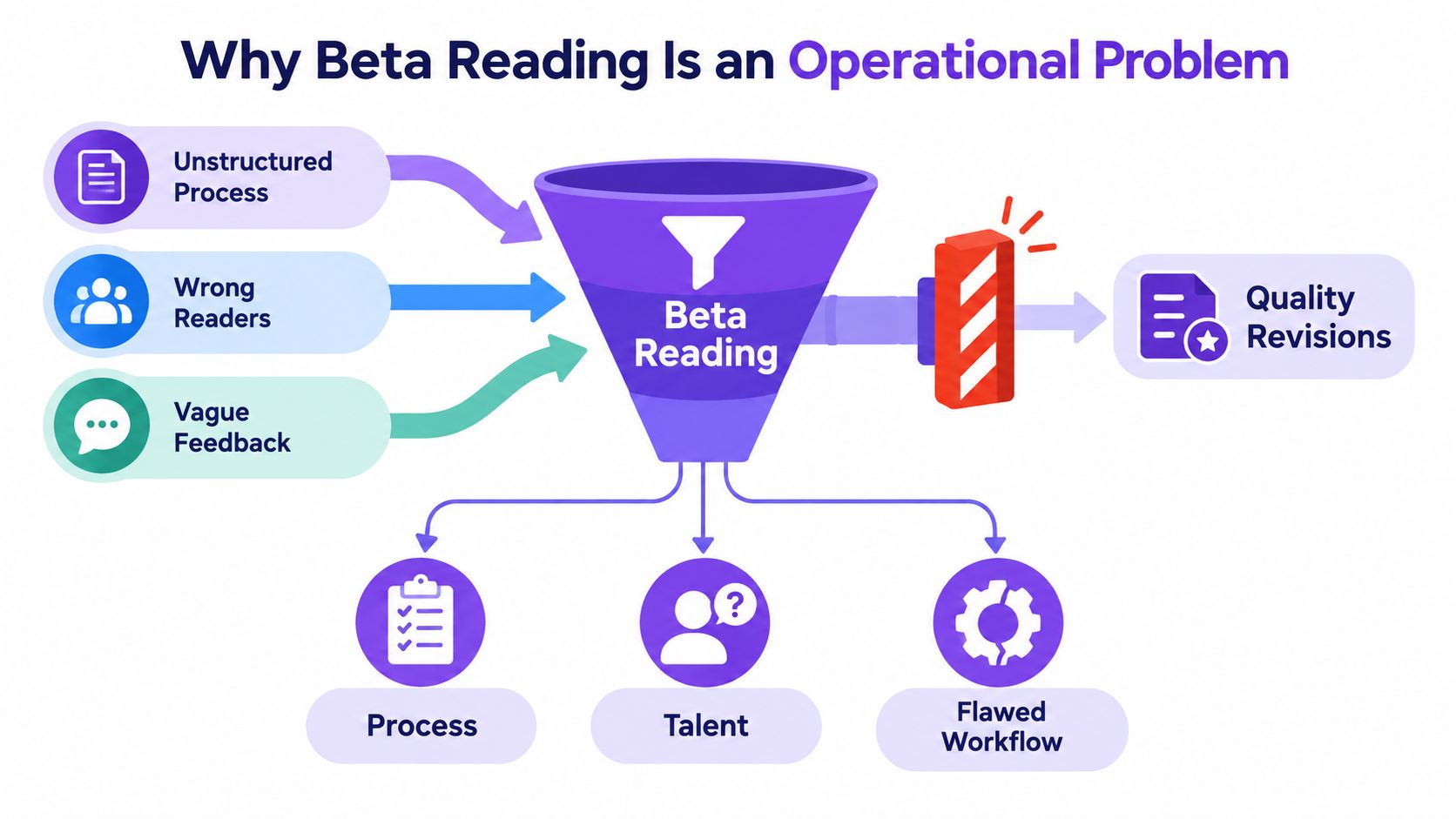
Headcount is a poor substitute for alignment
A panel of readers who regularly read your genre gives you a more useful baseline than a crowd assembled from politeness. Genre familiarity helps readers distinguish an intentional convention from a genuine mismatch, while readers outside the target audience can expose assumptions that loyal fans overlook. Neither group is automatically right. Their reactions answer different questions.
Prompt design matters just as much. A reader who reports “the middle dragged” has given you a starting point. A reader who marks the exact chapter where attention dropped, identifies what they expected to happen, and separates boredom from confusion has given you diagnostic material. The latter report can enter a revision queue. The former needs interpretation.
Practical rule: Treat every beta comment as an observation first and a recommendation never.
The workflow has four inputs: a stable draft, aligned readers, constrained questions, and a collection method that preserves chapter-level context. Its output should be a ranked set of revision hypotheses, not a referendum on your taste. Guidance on beta-reader workflows recommends a small, manageable group, focused questions, and a deadline because repeated reactions reveal stronger patterns than isolated comments (Codartium).
That is why beta reading resembles quality assurance more than a critique circle. You're testing whether the manuscript creates the intended reading experience, locating where it fails, and deciding which failures justify intervention. The readers provide the test results. You still own the release decision.
The Mechanics of a Beta Reading Round
A beta round starts when the manuscript is complete or nearly complete, not when you're still discovering the book. Readers need to experience the whole system before they can judge whether a subplot pays off, whether a revelation arrives too late, or whether a character's final decision feels earned. Sending unfinished material invites readers to diagnose problems created by later chapters that don't exist yet.
Prepare the pass before recruiting
Recruit for reading behavior, not friendship. Screen for readers who know the genre, have the time to finish, and can describe a reaction without rewriting the novel in your voice. A small panel is generally more useful than a mob. One industry guide identifies five beta readers as an ideal number, with three to five presented as a practical sweet spot, while other guidance allows a somewhat wider panel when the project needs broader reactions (The Book Designer).
Send one readable draft in a stable format. Name the file consistently, identify the version, and don't replace chapters after readers begin. Give readers the deadline before delivery. A commonly recommended reading and feedback window is four to six weeks, depending on manuscript length (Medium). If you need reports by a specific date, build in a buffer for late submissions rather than pretending every volunteer will behave like a production vendor.
Your brief should state what beta readers are evaluating and what they aren't. Ask them to flag where they became confused, disengaged, emotionally surprised, or unconvinced. Include scene-level and character-specific questions tied to your actual risks, but don't bury the first reading under an enormous survey. One editorial handout recommends keeping questions to roughly six to twelve, particularly when thoughtful answers are required (FoxPrint Editorial).
Confidentiality should be plain rather than theatrical. State that the manuscript is unpublished, ask readers not to forward or publicly quote it, and specify whether excerpts may be shared for private discussion or marketing. Keep marketing permissions separate from reading feedback. A beta reader agreeing to review a draft hasn't automatically agreed to let you publish their comments or circulate their name.
Use a single collection channel where possible. Inline comments, chapter forms, or a shared report template preserve location and context better than scattered email threads. After the deadline, collect the reports before discussing individual comments with readers. Early conversations can contaminate later reactions and make it harder to tell what the manuscript produced on its own.
What Beta Readers Are Not Editors
Beta readers report on reader experience. Professional editors diagnose the manuscript through a craft or technical lens. Confusing those roles creates bad handoffs, especially when an author expects a beta reader to identify the problem and prescribe the fix.
A developmental editor examines structure, narrative architecture, character arcs, causality, point of view, and the relationship between scenes. A line editor works at the sentence level, addressing rhythm, diction, voice, repetition, and clarity. A copyeditor checks grammar, usage, spelling, factual consistency, and house style. Beta readers aren't substitutes for any of them.
| Feedback Type | Beta Reader | Developmental Editor | Line/Copy Editor |
|---|---|---|---|
| Reader experience | Reports engagement, confusion, emotional response, and expectations | Interprets why the structure creates that response | Usually outside the primary scope |
| Plot and pacing | Flags where momentum drops or events don't make sense as a reader | Diagnoses sequence, stakes, causality, and structural pressure | Doesn't redesign the plot |
| Character response | Reports whether motivation feels clear or behavior feels inconsistent | Assesses arc construction and characterization at manuscript level | Corrects wording and consistency details |
| Sentence craft | May identify a passage that feels difficult to read | May note recurring craft patterns | Revises sentence-level language and mechanics |
| Grammar and consistency | May notice an error incidentally | May flag a pattern for later editing | Performs systematic correction |
“I got bored in chapter nine” is valid beta feedback. It tells you where the reader's attention failed, even if the reader can't explain the structural cause. “Cut this sentence because the adverb weakens the paragraph” is line editing wearing a reader's name tag. It may be a good suggestion, but it belongs in a different pass.
The beta reader glossary makes the same scope distinction useful in practice: a beta reader reads an unpublished manuscript as a representative audience member and gives general feedback, not professional editorial correction. If readers start rewriting your dialogue, don't treat their alternatives as answers. Extract the underlying reaction, then solve the problem yourself.
A beta reader can tell you that the door scene stopped working. They don't get to choose the replacement door.
The boundary also protects the manuscript's voice. Amateur editors often normalize prose toward their personal preferences, while a reader's strongest contribution is the unprocessed response generated by the existing draft. Preserve that response. Discard the unsolicited overhaul.
What Strong Reader Reports Actually Contain
A strong report doesn't merely summarize enjoyment. It records when the reading experience changed, what caused the change, and whether the reaction is emotional, mechanical, or preferential.
The opening reaction matters because it establishes the reader's initial contract with the book. Later notes should become more localized. A reader might report that the premise engaged them, that a reveal landed, and that the final act felt rushed. Those observations become useful when attached to chapters, scenes, or passages rather than left as a general impression.
| Report Element | What It Captures | Signal Type |
|---|---|---|
| Gut-level impression | Immediate engagement, resistance, or investment | Emotional |
| Chapter or scene reaction | Where attention, clarity, or interest shifts | Mechanical and emotional |
| Character question | Missing knowledge, unclear motivation, or weak identification | Diagnostic |
| Pacing checkpoint | Drag, acceleration, skim points, or stalled progression | Structural |
| Confusion flag | Contradiction, unclear reference, timeline problem, or missing context | Mechanical |
| Emotional beat | Whether a twist, loss, reunion, or decision produced the intended response | Emotional |
| Passage reference | Exact location of the reaction | Evidence quality |
Useful readers mark the place where they stopped, skimmed, reread, or felt lost. They quote a passage that worked when the language created a strong effect, but they don't attempt to rebuild the prose. The feedback glossary is a useful reference for keeping response notes distinct from editorial prescriptions.
Separate feeling from mechanism
Keep emotional and mechanical reactions in different fields. “The betrayal hurt” tells you the emotional beat landed. “I couldn't remember why she trusted him” identifies a knowledge-state problem. Both matter, but they require different revision decisions.
The panel creates the evidence. One reader disliking a subplot may reflect taste. Multiple readers identifying the same midpoint drag, confusing identity shift, or unearned reversal points toward a manuscript-level issue. That doesn't mean a recurring comment is automatically correct. It means the comment deserves investigation before dismissal.
A report should therefore preserve reader identity, chapter, scene, category, and confidence. “Reader B, chapter fourteen, pacing, skimmed the exchange because the investigation didn't change” gives you a testable claim. “Too slow” gives you a mood.
Ask questions that produce decisions
Questions should expose failure points without dictating the answer. Ask where the reader expected a turn, which character's behavior felt least legible, whether a scene changed the situation, and where they wanted to continue versus pause. Avoid asking readers to solve the scene unless you specifically need market or genre reactions.
The best report is not the longest one. It is the one that lets you compare reactions across the panel without stripping away their context.
Sorting Conflicting Feedback Without Losing Your Mind
Three readers finish the same manuscript. Reader A loves the slow subplot in chapter fourteen because it deepens the relationship between the investigator and her estranged brother. Reader B is bored and says the book stalls. Reader C doesn't mention the subplot at all, but marks the next chapter as confusing because the brother suddenly knows information he wasn't present for.
Treating those comments as a vote would be a mistake. The apparent disagreement contains three different signals: one reader reports emotional value, one reports pacing resistance, and one exposes a possible information-continuity problem.
Triage the passage, not the loudest reader
Log each note with the reader identifier, chapter, scene, category, and reaction. Then ask whether the passage serves plot, character, pacing, or setup. If the subplot supplies essential motivation but delays the investigation, the revision may not be “cut the subplot.” It may be to move a revelation, compress a repeated exchange, or make the investigative consequence visible inside the chapter.
Consensus gets priority, but intensity still matters. A single reader who identifies a concrete contradiction can reveal a real defect that other readers tolerated. Conversely, three readers can repeat a preference that conflicts with the book's deliberate point of view. Repetition raises confidence. It doesn't remove the need for judgment.
Filtering rule: Consensus tells you what to inspect. Function tells you what to change.
Separate taste from craft. Reader A may prefer relationship-heavy scenes. Reader B may expect a faster procedural rhythm. Reader C may have missed a fact because the manuscript failed to anchor it, or because that reader skimmed. The report location and surrounding evidence help distinguish those possibilities.
The chapter fourteen scenario becomes actionable when you compare the notes against the manuscript's job at that point. Does the chapter alter a relationship? Does it reveal necessary information? Does it increase pressure? If the answers are yes but the reader can't feel the movement, preserve the function and revise the delivery. If the chapter repeats information already established, the pacing complaint has a stronger structural basis.
Don't force every conflict into a compromise. A manuscript with a distinct voice will produce some polarized reactions. Your task is to fix ambiguity, contradiction, and dead weight without sanding away the choices that make the book itself.
Turning Filtered Notes into a Revision Plan
Raw beta feedback becomes useful only after you convert it into a backlog. Keep the original report attached to every backlog item, including the reader identifier and exact location. That traceability stops revision from turning into an anxiety-driven scavenger hunt through old emails.
Use three tiers, then assign passes.
Must-fix structural issues belong at the top. These include repeated pacing failures, plot holes, broken causality, inconsistent characterization, and endings that several readers experience as unearned. Fix the underlying mechanism, not each reader's proposed solution.
Clarity and logic gaps come next. A single reader may reveal a timeline slip, an unclear relationship, or a character who appears to know something too early. These problems can be serious even without consensus because they often affect continuity rather than preference.
Optional polish comes last. This includes isolated wording concerns, a reader's preferred description, and local rhythm suggestions that don't point to a broader pattern. Keep them visible, but don't let them hijack a structural pass.
A practical backlog row might read: chapter fourteen, pacing and relationship subplot, flagged by Reader B and supported by Reader C's confusion note, revise during structural pass. The original comments remain attached. That lets you test whether the revision addresses the observed failure rather than merely making the prose feel busier.
Sequence the work
Run the global pacing and structural pass before sentence-level polish. Then run a continuity pass for dates, locations, knowledge, objects, and character behavior. Only after those systems stabilize should you spend time refining line rhythm and copy details.
Give each pass a defined scope. Once the structural pass is complete, lock its decisions before opening a new round of optional changes. Otherwise every note becomes permission to reopen the whole manuscript, and the book never exits revision.
The revision and editing journey is most useful when treated as a sequence of controlled interventions rather than one undifferentiated polishing session. Beta feedback tells you where the reader experienced friction. Your backlog decides which friction belongs to structure, logic, or style.
How a Beta Reader Dashboard Changes the Loop
Email is adequate for one reader and a liability for a recurring beta program. It scatters comments across threads, hides completion status, and makes chapter-level patterns difficult to see. A dashboard changes the unit of analysis from “what did Reader A say?” to “where did the panel converge?”
A centralized system can place reader reports, chapter impressions, and progress in the same view. You can see which chapters attract confusion flags, where readers stop or slow down, and whether a sentiment shift begins before the scene you initially suspected. That doesn't turn subjective reading into laboratory data. It makes subjective evidence traceable.
Read the signals as a group
Completion status helps distinguish a late-book problem from a recruitment problem. If several readers stop around the same chapter, inspect the manuscript there. If readers stop at scattered points, examine whether the panel lacks genre alignment, whether the draft is too unstable, or whether the deadline was unrealistic.
Consensus tags also give you a cleaner triage surface. “Pacing” may conceal repetition, low consequence, delayed information, or a scene that arrives before its pressure is visible. “Motivation” may conceal an omitted fact, a contradiction with an earlier choice, or a character who acts correctly but without enough on-page preparation.
Per-chapter impressions let you compare the intended rhythm with the experienced rhythm. Time spent per chapter can add context, but don't confuse duration with quality. A long chapter may hold attention because it creates escalating pressure. A short chapter may consume disproportionate effort because the reader keeps rereading to reconstruct what happened.
The operational benefit compounds across rounds. Store the first panel's notes, weight recurring issues, revise, and test the next draft against the same categories. You won't need to reread raw emails to remember why a scene changed. You can ask whether the original confusion flag disappeared, whether the drop-off moved, and whether a fix created a new inconsistency elsewhere.
Novelium provides a beta-reader dashboard that centralizes reader progress, inline comments, drop-off points, and consensus issues, alongside manuscript analysis that tracks characters, events, and continuity across chapters. It fits the broader principle of this process: reader reactions need a durable evidence layer before they become revision decisions.
Use Novelium to centralize beta-reader progress, inline feedback, drop-off points, and consensus issues while you manage a complex manuscript. Visit Novelium when your next beta round needs more than scattered emails, and turn reader reactions into a revision backlog you can defend.