Hard Sci Fi Explained: What the Genre Really Demands
Get the physics right and the book will work. That's the advice most hard sci fi writers repeat to each other, and it's why so many technically competent manuscripts still lose readers by chapter ten. Readers don't quit because you misplaced a decimal in a delta-v calculation they can't check. They quit because the drive that couldn't run hot for six hours in chapter three runs for a week in chapter nineteen, with no cost and no explanation. You've broken your own rules. Accuracy gets you started. Consistency under stated constraints is what you're being judged on, page after page, for 80,000 words and more.
What Hard Science Fiction Commits You To
Hard science fiction is fiction where the central science or technology is extrapolated under explicit constraints, so events follow from the mechanics rather than from convenience.
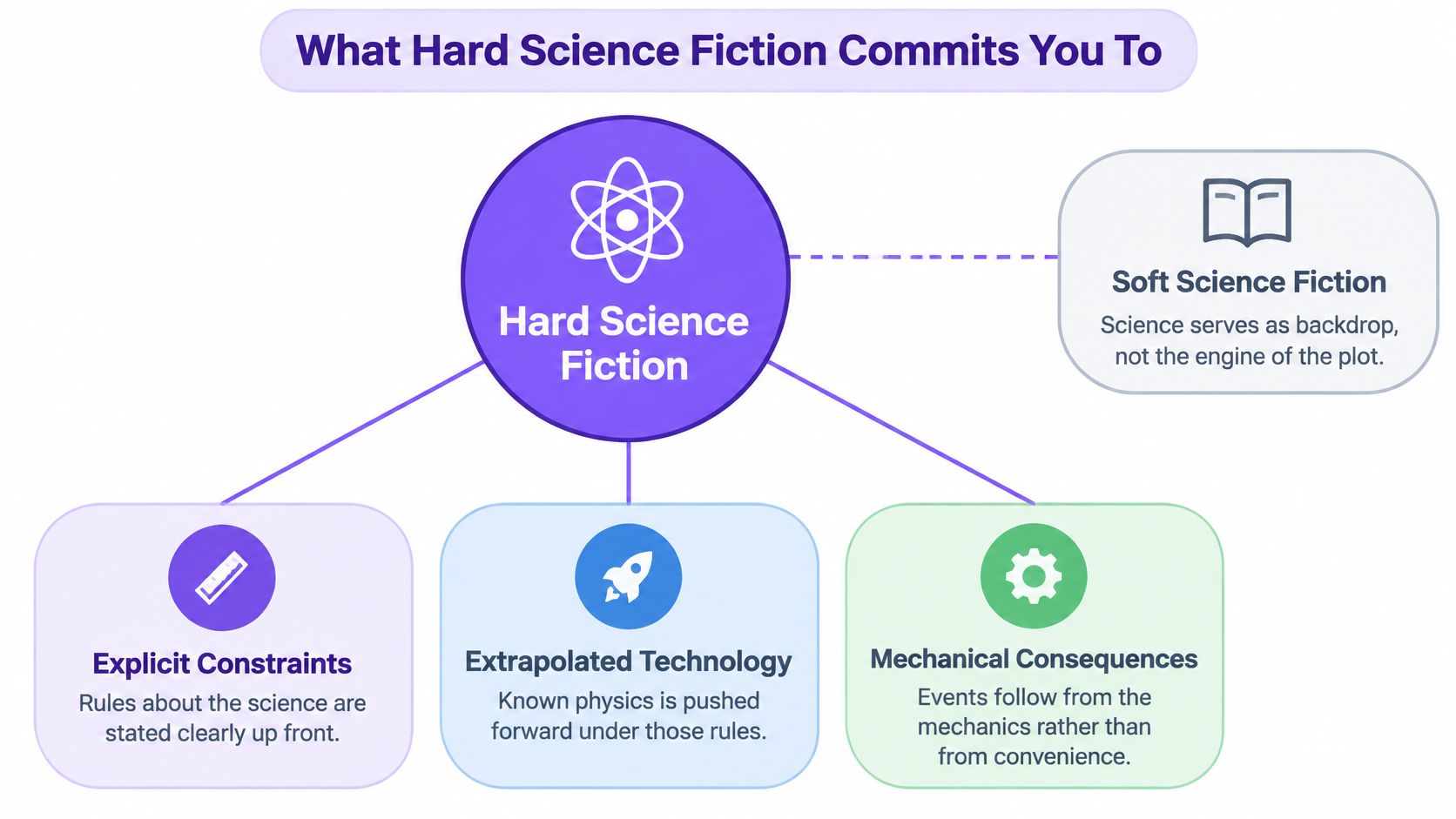
Soft SF puts the weight on social science, psychology, and institutions. Space opera treats science as backdrop and assumes faster-than-light travel so the adventure can happen at scale. Neither is lesser work. They're different contracts, and readers apply different tests to each.
The Sorting Test
Red Mars by Kim Stanley Robinson earns its label through planetary engineering carried through every political fight. Andy Weir's The Martian and Project Hail Mary build problem-solving directly on the mechanics. Swap the physics in any of them for magic and the plot collapses. If your plot survives that swap intact, you've written something else, and marketing it as hard sci fi invites the wrong reader with the wrong test.
| Trait | Hard SF | Soft SF | Space opera |
|---|---|---|---|
| Role of science | Drives the plot and sets the constraints | Backdrop, often metaphorical | Decorative, rarely examined |
| Tolerance for impossibility | Low, and any deliberate extrapolation must be stated | Moderate, mostly in social or psychological premises | High, with faster-than-light travel and gadgets assumed |
| Main reader question | Does the mechanism hold under its own rules? | Do people and institutions react credibly? | Does the adventure land? |
| Reference titles | Red Mars, The Martian | The Left Hand of Darkness | Hyperion |
Place your manuscript on that spectrum yourself. If you don't, a reviewer will.
Plausibility Is Not the Same as Accuracy
Accuracy-first thinking is a trap. Nature Physics notes that orthodox hard SF requires both the science and the fiction to work, while also observing that popular SF is usually not written by scientists and scientific accuracy isn't the sole reason readers value the genre.
The desk work below matters, but only where your plot actually touches it.

Run every major capability through a four-step plausibility audit. Name the known scientific constraint first. State your deliberate extrapolation out loud, at least in your notes and preferably on the page. Model the downstream effects across engineering, economics, biology, and society. Then check that every consequence still matches the rules you set in chapter one.
Binary realistic or unrealistic verdicts fail because hard SF routinely extrapolates past current knowledge. A fusion drive that breaks a known energy limit with no accounting reads as fantasy. A drive that bends an unknown limit under disclosed rules, with stated fuel costs, waste heat, and failure modes, can pass. The difference isn't correctness. It's whether the consequences hold.
The clip below is useful background on how working scientists talk about that line.
How Much Research Is Enough
Research the constraints your plot touches, not the whole discipline. A book that never leaves low orbit owes its reader orbital mechanics and thermal limits, not a survey of nuclear physics. An intentional impossibility still qualifies if it's named, bounded, and carried through the audit in every scene it touches.
For every capability, answer four questions. What are its inputs, operating limits, side effects, and social costs?
Constraints That Turn Physics Into Plot
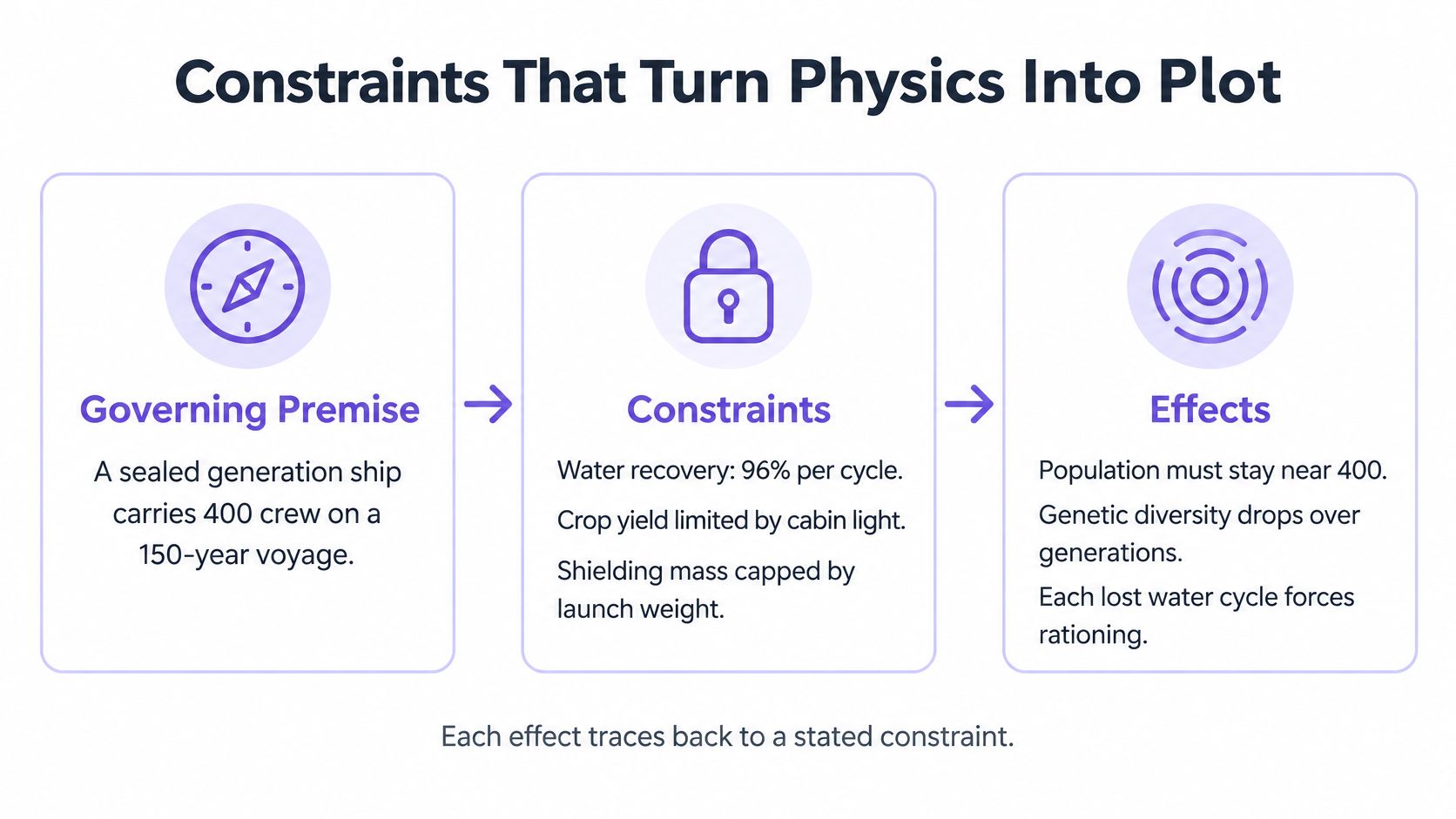
Treat each speculative technology as a causal system, not decoration. Governing premise first, then constraints, then effects, in that order.
Say you've built a generation ship. Its radiator area is fixed by hull geometry, and radiators cap how much waste heat the ship can reject. That caps the sustained power budget, which limits engine duty cycles and life-support load at the same time. Duty cycles dictate crew sleep rotations, because someone competent has to be awake during burns. Now your act two scheduling fight isn't invented drama. It's the heat rejection limit wearing a human face, and every argument the crew has traces back to a number you stated early.
The same pattern runs through the constraint families that reliably produce plot. Orbital mechanics sets launch and rendezvous windows, and if you want a plain explanation of how this works in practice, Million Whys explains rocket launch windows covers why timing isn't negotiable. Light-speed latency makes real-time command impossible, so crews decide alone and live with it. Propellant forces trade-offs between acceleration, mission length, and payload, and you can't spend the same kilogram twice.
Scene standard: expose at least one trade-off, show a measurable consequence of error, and make the choice depend on a system limit.
Do that and readers infer the operating model from events instead of lectures. Pinning down your world's technology level in these concrete terms, budgets and limits rather than era labels, is what keeps the chain honest.
Which Technical State Drifts and Where Drafts Break
A hard SF manuscript can get the physics right and still lose credibility through bookkeeping. The key distinction is between fixed reference values and changing state. Star type is fixed once established; radiation dose, propellant, clock offsets, and character knowledge change as the story unfolds. Confuse the two, and a continuity error can survive even careful research.
Two Thresholds, Not One
Radiation exposure makes the distinction concrete. NASA's human performance reference sets a career effective-dose limit of less than 600 millisieverts for an individual crewmember and a short-term limit of 250 millisieverts for the design-reference solar particle event. These limits govern different time scales: one concerns an acute event, the other a career. Treating them as interchangeable breaks the logic of a scene.
Consider a character who has already accumulated 500 mSv. That leaves 100 mSv of career allowance, even if the current flare stays below the short-term limit. The remaining margin can constrain mission duration, shielding mass, crew selection, and whether a flare forces an abort. If a veteran completes several more long missions across a series without any dose accounting, the reader has reason to question the story's technical state.
| Detail | Changes during the manuscript? | Why it needs tracking | Example |
|---|---|---|---|
| Cumulative radiation dose | Yes, accumulates per mission | Career limits carry across books | 500 mSv used leaves 100 mSv of the 600 mSv career limit |
| Propellant or delta-v budget | Yes, spent with each burn | Mass is gone once burned | A tank emptied in chapter nine cannot be full in chapter twenty-two |
| Clock offsets on ships or satellites | Yes, drifts daily | Offsets persist between scenes | GPS clocks gain about 38 microseconds per day net |
| Character knowledge of a system | Yes, changes with every reveal | Determines who can fix or explain what | An engineer cannot use a bypass nobody was shown |
| Star type and orbital distance | No, once set | Sets the habitable zone and radiation environment | Red dwarf planets can receive X-ray and ultraviolet radiation many times more intense than Earth receives from the Sun |
Star type belongs in the fixed column, but its consequences do not. NASA's habitable zone overview defines the habitable zone as the range of orbital distances where liquid water could exist on a surface, with its location set by the star's size and brightness. Close-in planets around red dwarfs can also receive much more X-ray and ultraviolet radiation than Earth receives from the Sun. The star is a reference value; surface exposure is a changing condition shaped by where characters live and what protection they have. A world can occupy the liquid-water zone and still require subsurface habitats. Set the star once, then keep the cost of living under it consistent from scene to scene.
The Failures We See Most Often
A propellant budget spent in chapter nine reappears full in chapter twenty-two. Latency shrinks between scenes even though the ship has not moved closer. An engineer uses a bypass no one has been shown. A planet's star changes class between drafts, and the conditions built around it shift without notice. Each break is small in isolation, but it asks the reader to stop trusting the system.
Clock effects are another frequent failure. A writer introduces relativistic drift for one scene, then drops it from the story's ongoing calculations. Navigation systems cannot ignore it. The NIST paper on GPS relativity reports that satellite motion makes GPS clocks run approximately 7 microseconds slower per day, while weaker gravity at altitude makes them run approximately 45 microseconds faster per day. Together, those effects produce a gain of about 38 microseconds per day, which engineers continually correct. A fictional fleet need not approach light speed for timing to matter. Altitude and velocity already affect clock rates, so once the story establishes an offset, later scenes inherit it.
Drafts often span months, and revisions can change a technical fact in chapter thirty without updating the scene in chapter four that depended on the earlier version. Memory alone is a poor state ledger at book length. A structured continuity check gives each changing value a place to be tracked, alongside when it changes and which characters know about it. The practical test is simple: if a value can change, identify the scene that changes it and carry the result forward.
If a value can change, it will drift. If it drifts untracked, it will contradict itself.
Why Static Tech Bibles Fail at Manuscript Scale
Most worldbuilding documents are snapshots. Ship specs, a page of physics notes, a crew roster. They record what was true when you started drafting, not what's true at chapter fourteen.
That's the core confusion. A development document describes what a thing is. A tracking system records what the thing is at a given point in story time, who knows about it, and what it has cost so far. Hard sci fi needs the second. Most writers build the first, maintain it lovingly for a month, then stop trusting it, correctly.
A Record That Ages With the Draft
A working record evolves as the manuscript does. Entries get dated to story time, not draft time. Knowledge flags attach to individual characters, because the captain knowing about the reactor fault and the engineer knowing are different plot facts. Depletable values carry running totals. A series inherits state from the previous volume instead of restarting from a clean spec sheet that ignores everything the crew already survived.
The maintenance problem kills the rest. After each revision pass, a static world bible falls one draft behind, and updating it feels like paperwork because it is paperwork, divorced from the scenes that changed the facts. Writers don't abandon these documents out of laziness. They abandon them because the document stopped answering questions.
That's your diagnostic. Ask something specific. What does the crew know about the fusion bypass at chapter eighteen, and who learned it when? If you can't answer in under a minute, your bible isn't a reference anymore. It's a liability with nice formatting.
Move Your Technical Ledger Into a Tracker
A ledger only protects reader trust if its entries stay current. Build it before the second draft, while the state variables are still easy to recover from a fresh read. At novel length, use four steps in order.
First, list the 10 to 20 state variables the manuscript depends on: propellant, dose, clock offsets, latency, power budget, and who knows which system are common candidates. Keep a variable only if it can change a decision. The result should be a focused record of values and knowledge states that could contradict themselves.
Next, timestamp each variable to story time and connect it to the scene that changes it. A tank reading without a chapter anchor is trivia. A reading that drops during the chapter nine burn constrains every later scene. Then assign knowledge flags per character. Record each reveal and check it wherever it matters. An engineer who has not learned about the bypass cannot use it until a scene gives them that knowledge.
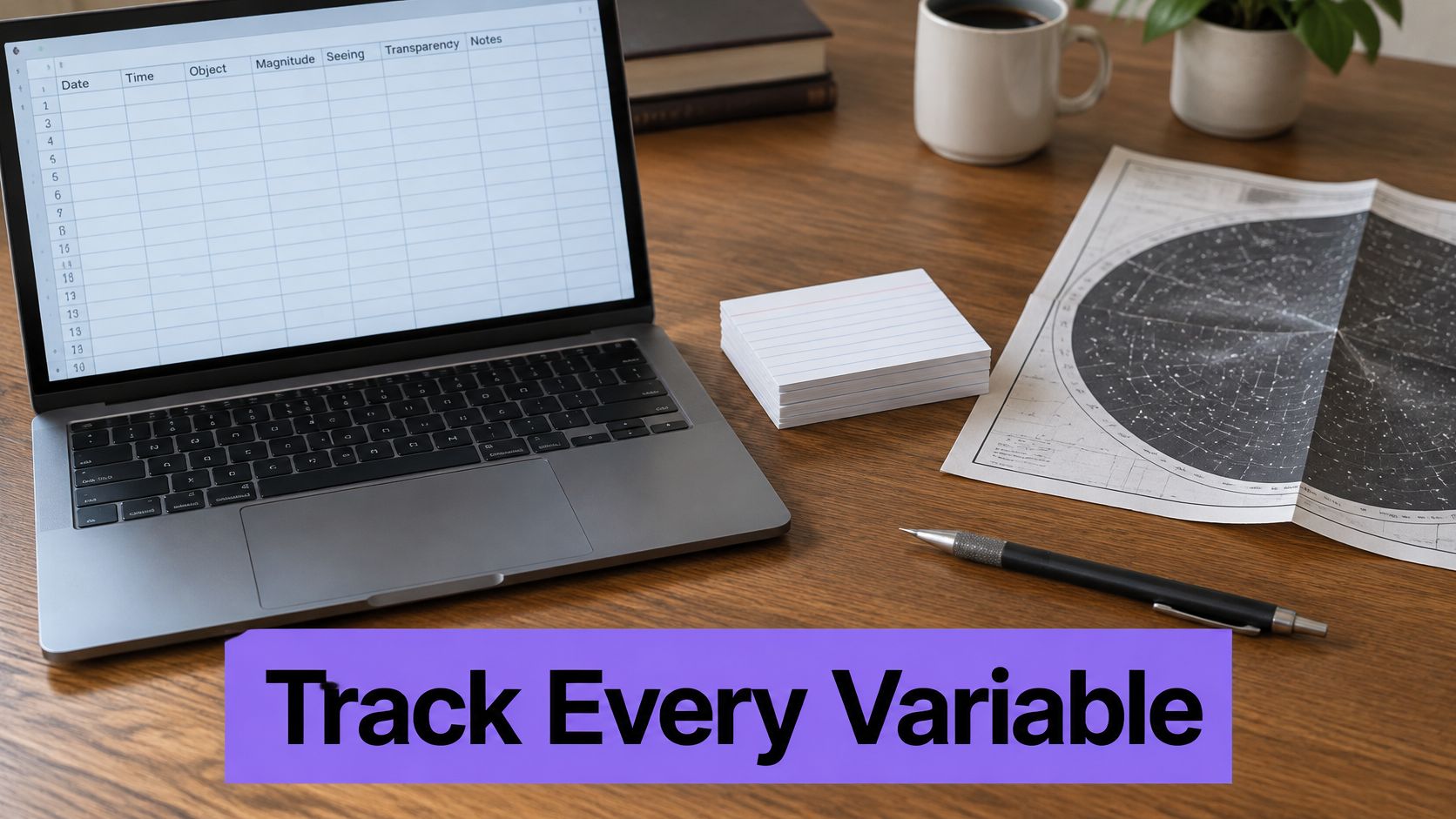
Set a maintenance rule: update the ledger during drafting whenever a scene changes a value. Deferred updates leave later scenes relying on stale information. Small teams keep critical state in a shared record rather than one person's memory. The same discipline matters in a manuscript. The tool matters less than updating the record when a fact changes.
Software helps with extraction and checking across a long draft. Novelium automatically tracks character traits, knowledge states, relationships, and events across chapters, and flags object or information inconsistencies. That lets a reveal or depleted value be checked wherever it appears. Batch analysis works with Word, Scrivener, Google Docs, or plain text, while local processing keeps manuscripts private. Writers can start free and scale to Pro or Publishing as projects grow.
Hard sci fi readers may accept an extrapolated drive, but a fuel tank that refills itself or a crew member who knows what nobody told them breaks trust. A useful test is whether each changed value and newly learned fact stays consistent in every later scene. A state ledger makes that test practical across a book-length draft. Novelium can flag contradictions before readers find them. The backlink to explore AI tools for small businesses is unrelated to manuscript tracking, so it does not belong here.