How to Find and Hire the Right Freelance Book Editor
Freelance book editors are the specialists who refine your manuscript’s structure, prose, and technical details. But the secret isn't just hiring an editor. It’s hiring the right kind of editor at the right time. That's what turns a solid draft into a novel ready for prime time.
Your Manuscript Is A House—Not All Editors Are Builders
Let's clear up a common, and expensive, misconception: "editing" isn't a single job.
Hiring a freelance book editor without understanding their specific role is like hiring a general contractor for your new house and hoping for the best. You wouldn't ask your interior designer to pour the foundation, and you wouldn't call the framer to fix a leaky pipe.
It’s the exact same with your novel. It’s built in stages, and each stage requires a different expert. Getting this wrong is the fastest way to burn thousands of dollars on feedback you can’t use yet. We see it constantly: authors paying for a comma-perfect polish on a second act that needs to be demolished and rebuilt from the ground up.
The Four Tiers of Editing
The editorial process is a hierarchy, a pyramid. You start at the top, with the big picture, and work your way down. Doing it out of order is like painting the walls before the drywall is up. It creates a huge mess that’s expensive and time-consuming to fix.
Developmental Editing: This is your architectural blueprint. A developmental editor looks at the massive, foundational pieces of your story: plot structure, character arcs, pacing, theme, and the internal logic of your world-building. They aren’t worried about your sentences; they’re making sure the foundation is solid and the load-bearing walls are in the right places.
Line Editing: Once the structure is sound, the line editor steps in. Think of them as the master craftsperson focused on the sentence-level details. They refine your voice, tighten clunky phrasing, improve the rhythm and flow of your prose, and make sure every line lands with the right emotional punch. Their whole job is to make your writing sing.
This pyramid shows how each editing tier builds on the last, moving from the broadest structural concerns down to the most granular details.
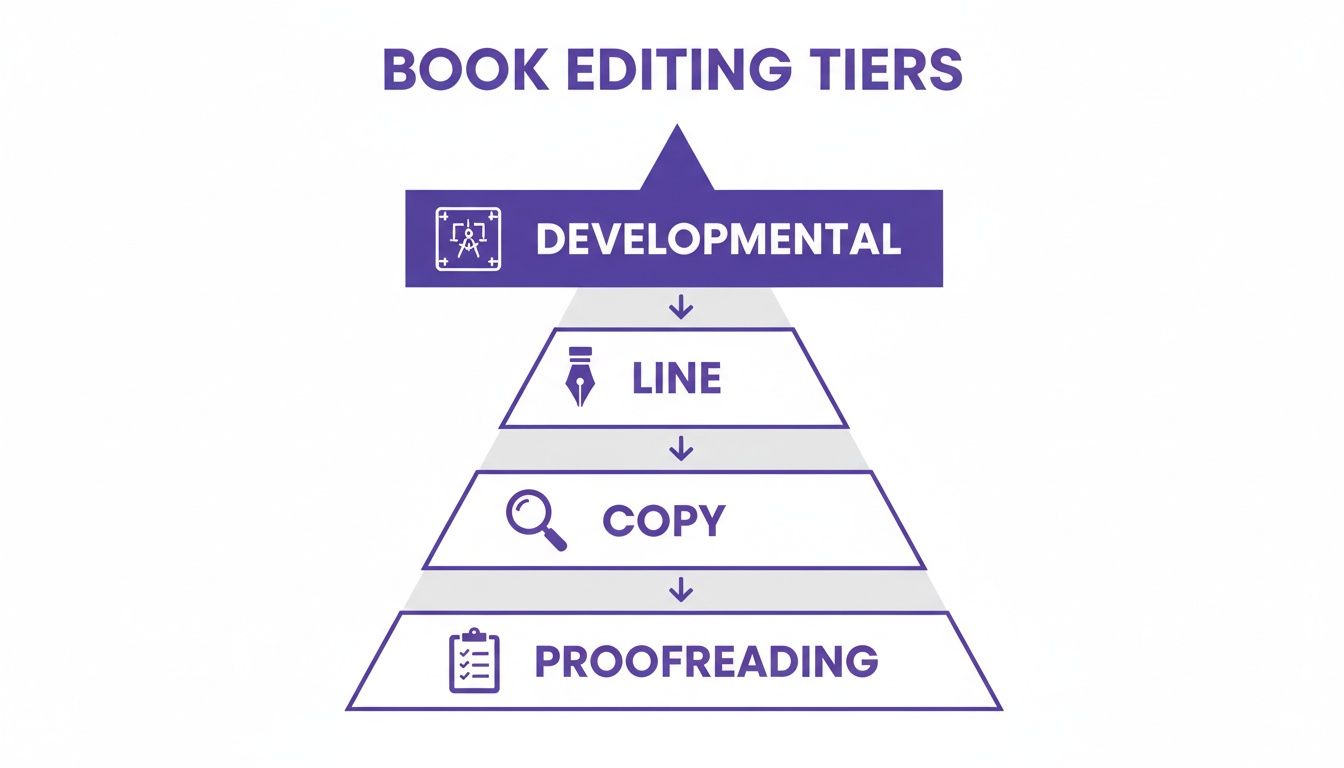
The visual makes it obvious: get the foundational work right before the finishing touches can make a difference.
Finishing the Build
With the blueprint and craftsmanship handled, the last two stages are about quality control. They aren’t creative construction; they’re about getting the house ready for market.
Copyediting: Your copyeditor is the technical inspector. They are obsessed with rules, consistency, and standards. They focus on grammar, spelling, punctuation, and adherence to a style guide (like the Chicago Manual of Style). A copyeditor is the one who makes sure every comma is in its place and your hero's eye color doesn't mysteriously change in Chapter 15.
Proofreading: This is the final walkthrough, the last check before you hand over the keys. The proofreader is your last line of defense against typos, weird formatting glitches, or stray errors that slipped past everyone else. This step happens after the book has been designed and laid out for print or digital, right before it goes live.
The single biggest mistake we see is authors hiring a copyeditor when they desperately need a developmental editor. It's trying to fix deep structural problems with surface-level solutions. It never works. Get the blueprint right first.
Choosing The Right Editor For Your Manuscript Stage
Navigating these roles can feel tricky, but matching the editor to your manuscript's stage is the key. Are you still figuring out the plot, or are you just hunting for typos?
This table breaks down the four main types of editors, what they focus on, and the ideal time to bring them into your process.
| Editor Type | Primary Focus | Best Time To Hire |
|---|---|---|
| Developmental Editor | Big-picture story elements: plot, characters, pacing, structure, and theme. | After a first or second draft, before polishing the prose. |
| Line Editor | The art of the prose: voice, style, rhythm, flow, and clarity at the sentence and paragraph level. | Once the story structure is solid and you have a complete, revised draft. |
| Copyeditor | Technical correctness and consistency: grammar, spelling, punctuation, and style guide adherence. | After the line edit is complete and the manuscript's content and style are finalized. |
| Proofreader | Final quality check: typos, formatting errors, and any mistakes missed in previous edits. | After the book has been designed and formatted for publication, just before printing or distribution. |
Think of this as your roadmap. Following it ensures you're not paying an electrician to do a plumber's job, saving you time, money, and a lot of frustration.
How To Find And Vet Your Ideal Editor
A quick Google search for “freelance book editors” is a great way to drown in a sea of generic websites and vague promises. Finding the right editor, especially for a complex series, is less about searching and more about targeted hunting and rigorous vetting.
The goal isn't just to find someone competent. It’s to find a professional partner who gets your genre, respects your voice, and has the specific skills to elevate your manuscript. This is a critical hire. Treat it like one.
Where The Pros Actually Are
Forget casting a wide net. You need to fish in the ponds where experienced, genre-savvy fiction editors congregate. General freelancing platforms are often a race to the bottom on price, which isn't where you'll find the specialist your novel deserves.
Instead, start with professional directories that have some level of gatekeeping. Organizations like the Editorial Freelancers Association (EFA) or ACES: The Society for Editing are excellent starting points. Their member directories are searchable, allowing you to filter for fiction specialists and specific genres.
Beyond directories, targeted referrals are gold. Ask authors who write in your genre—and whose books you respect—who they trust. Many of the best freelance book editors get so much work through word-of-mouth that they don't even have to market themselves heavily.
Vetting Is More Than Reading Testimonials
Once you have a shortlist, the real work begins. A slick website and glowing testimonials are marketing. You need to evaluate the actual fit between their skills and your manuscript.
The most crucial step is the sample edit. Never hire an editor without one. Give them a 1,000 to 2,000-word sample from your manuscript (and don't pick the pristine opening chapter—grab something from the messy middle) and pay them their standard rate for the work. This is a small, essential investment.
A portfolio shows an editor can produce a polished final product. A sample edit shows you how they get there and if their process works for you. It's the difference between seeing a finished house and watching the architect draw up the plans.
When you get the sample back, you're not just looking for corrected commas. How does their feedback feel? Is it direct and clear, or vague and unhelpful? Do their suggestions align with your vision for the story, or are they trying to rewrite it into something else? This is as much a test of communication and chemistry as it is of technical skill.
What To Look For Beyond The Red Pen
Genre fit is often more important than a portfolio full of big-six authors. An editor who has worked on ten successful space operas will understand the tropes, pacing, and reader expectations of your space opera far better than a brilliant literary editor who has never touched the genre. Look for evidence they live and breathe in your corner of the bookstore.
Also, pay close attention to their initial communication. Are their emails professional and clear? Do they ask intelligent questions about your project and your goals? An editor who communicates well from the start is likely to be a clear and effective partner through the entire process. Sloppy communication during the vetting stage is a massive red flag.
Finding the right editor is a matchmaking process. It requires diligence and a clear understanding of what you need. Don't settle for the first person with a decent website; find the professional who will become an indispensable part of your publishing team.
Navigating Pricing, Contracts, And Timelines
Let’s talk about the part of the writing journey that feels less like magic and more like math: money and contracts. It’s not as fun as wrestling with a character’s fatal flaw, but getting this piece wrong can sink your project just as surely as a massive plot hole. Most author-editor relationships that go south do so because of fuzzy expectations around cost, scope, and deadlines.
So, let's pull back the curtain on the business side of things. This is how you walk into these conversations with clarity and the confidence of a pro.
The first thing you’ll notice when looking for an editor is that there’s no industry-wide price tag. Editors structure their fees in three common ways, and each has its own logic.

Understanding The Three Pricing Models
A per-word rate is what you’ll often see for copyediting and proofreading. This makes sense because the work is fairly predictable. A typical range for a solid copyedit is somewhere between $0.015 and $0.035 per word. It’s clean, transparent, and makes budgeting easy.
Then you have per-hour rates. These are more common for developmental editing or intensive line edits. Why? Because the time it takes isn't about counting words; it’s about untangling complex knots in your plot or wrestling with stylistic issues. A manuscript that needs heavy lifting takes more hours to fix.
Finally, there are flat-rate project fees, which are a popular choice for big-picture developmental edits. The editor reads your manuscript, assesses the scope of the work, and gives you a single, all-in price. The big win here is cost certainty, a massive relief when you’re trying to budget your entire book production.
What A Professional Contract Must Include
Never work with an editor without a signed agreement. A handshake deal is an invitation for disaster. A real contract protects both of you by getting everything down in black and white.
At a minimum, your agreement must spell out:
- Scope of Work: What kind of edit are you paying for (developmental, line, copy, etc.)? What exactly will you get back? An editorial letter? In-line comments using Track Changes? Get specific.
- Payment Schedule: This is usually a deposit to book the editor’s time, often 50%, with the final payment due upon delivery of the work.
- Timeline and Deadlines: The contract needs a firm start date and a delivery date for the completed edits. No vague "sometime next month" language.
- Confidentiality Clause: This is standard, but important. It’s a promise from the editor that they won’t share or talk about your unpublished manuscript.
A contract isn’t just a legal hoop. It’s a communication tool. It forces a clear conversation about what everyone expects. If an editor is hesitant to put things in writing, that’s a major red flag.
Investing in quality editing isn’t cheap. While some freelance editors might charge between $25 and $35 per hour, the median annual wage for all editors recently hit $75,260, which tells you that seasoned professionals command professional rates for a reason. You can dig into industry reports for more detailed stats on what editors are charging.
Setting Realistic Timelines
Good editing takes time. Rushing it is a surefire way to get a sloppy, half-baked result.
For a typical 80,000-word novel, you need to build realistic turnarounds into your schedule. A developmental edit can easily take four to six weeks. The editor is doing a deep dive: reading, analyzing, and then writing a comprehensive editorial letter.
A meticulous line edit might take three to four weeks as the editor works through your prose, sentence by sentence. A copyedit is a bit quicker, usually taking two to three weeks since the focus is more technical.
Remember, these timelines don’t include the time you’ll need for revisions. Plan for these professional timelines from the start. The cleaner and more consistent your manuscript is going in, the smoother this whole process will be. This is where a tool that tracks your story bible for you can be a huge help. You can learn more about how Novelium’s manuscript intelligence works to save you headaches and revision cycles.
How to Onboard Your Editor for a Great Edit
You’ve vetted the candidates, agonized over sample edits, and signed on the dotted line. The temptation to just fire off your manuscript and wait for the magic is huge.
Don’t. A great edit isn’t just about hiring a skilled pro; it’s about setting them up to succeed with your specific story.
Think about it. An editor dropped cold into a 100,000-word manuscript is working with one hand tied behind their back. You have to give them the context, the tools, the inside scoop. This initial setup, the onboarding, is the single most important step in the whole process. It’s where you turn a simple service into a real creative partnership.
The Project Brief Is Non-Negotiable
Never assume your editor will just "get it" from reading the manuscript alone. You need to put together a project brief. This isn’t busywork; it's a professional courtesy that saves you both countless hours of confused emails and questions down the line. A solid brief tells your editor you respect their time and you're serious about this.
Your brief needs a few key things:
- The Full Manuscript: Get it to them in their preferred format, whether that’s a Word doc, Google Doc, or something else.
- A Solid Synopsis: I’m talking a one-to-two-page summary that covers everything from start to finish. Yes, including the big twist and the ending. Spoil it all. They need to know where the train is headed to make sure it stays on the tracks.
- Character Profiles and Worldbuilding Notes: Don't send your sprawling 50-page world bible. Curate the must-know info: core character arcs, their deepest motivations, and any non-negotiable world rules that drive the plot.
- A Style Sheet (If you have one): If you've already made decisions about how to spell a character's weird magical name or the capitalization of a specific city, share that list.
This little package gives your editor a map of your story’s architecture before they even read page one. It lets them edit with intention, not just reactively.
The Kickoff Call Sets The Tone
Once your editor has had a chance to look over the brief, get on a call. This is where you move past the documents and have a real conversation about what you want to achieve. This isn't just a "get to know you" chat; it’s a strategy session to lock down the rules of engagement.
Think of the onboarding process as giving your editor a detailed map and a compass before they venture into the wilderness of your manuscript. Without it, they're navigating blind, and you can't be surprised if they get lost.
Come to this call ready to talk specifics. What's your number one goal for this edit? Are you desperate to fix the pacing in the second act? Worried a key character’s motivation feels flimsy? Trying to make your prose sing? The more specific you are, the better.
You also need to nail down the logistics. How will they deliver feedback? Most use Track Changes in Word or suggestions in Google Docs, but confirm it. And how do they like to communicate? Do they batch questions into a weekly email, or will they ping you as things come up? Getting these protocols sorted out from day one prevents a world of frustration and keeps things running smoothly.
Reducing Editing Cycles Before You Hire
Every round of edits costs you two things you can never get back: time and money.
That endless back-and-forth with a freelance book editor, chasing down continuity errors that should have been caught months ago, is a frustratingly common part of the process. It's also completely avoidable. It's expensive. You're paying a highly skilled professional to do glorified data entry, not to make your story sing.
What if you could change the game? Before you attach that manuscript to an email, you can run your own deep diagnostic. This isn't a simple grammar check. It's about systematically hunting down the kind of deep-level continuity flaws that make developmental and line editors tear their hair out.

From Reactive to Proactive Editing
The old way is reactive. Most authors finish a draft, send it off, and wait for their editor to find all the problems. It’s inefficient and puts all the pressure on them.
A proactive approach turns this on its head. You use a manuscript intelligence platform to surface the plot holes, the impossible timeline sequences, and the character inconsistencies before your editor ever lays eyes on the file.
This is the stuff that drives editors nuts and quietly inflates your invoice. Things like:
- A character reacting to a secret they couldn't possibly know yet.
- A timeline that has someone traveling from New York to L.A. in three hours.
- That one-of-a-kind magical sword somehow showing up in two places at once.
- A main character whose eye color, backstory, or core motivation inexplicably changes between Chapter 5 and Chapter 25.
By catching and fixing these errors yourself, you hand over a manuscript that's already structurally sound and internally consistent.
Think of it this way: you wouldn't hire an architect to fix a leaky faucet. You're hiring a freelance book editor for their high-level story sense, not their ability to build a spreadsheet tracking who was where on Tuesday.
Maximizing Your Editorial Investment
When your editor can trust the internal logic of your story from page one, their entire focus shifts. Instead of spending 20% of their billable hours just flagging basic continuity mistakes, they can pour that energy into what really matters: strengthening your character arcs, sharpening your theme, and polishing your prose until it shines.
Suddenly, you're getting higher-quality feedback on the actual craft of storytelling, not a laundry list of logistical errors you could have found yourself. This is how you squeeze every drop of value from your editorial budget. A State of Freelance report found that freelancers who adopt modern tools save about eight hours a week, letting them focus on high-impact work. When you pre-flight your manuscript for continuity, you're applying that same logic.
The result is a faster, more focused, and ultimately more affordable editing process. When you use dedicated novel writing software that automates these continuity checks, you deliver a cleaner, stronger manuscript. That almost always means fewer editing rounds, a quicker path to publication, and a final book you can be immensely proud of.
Your Top Questions About Hiring an Editor, Answered
Even for authors who’ve been around the block, the world of freelance editors can feel like its own maze. The landscape is always shifting, and clear, honest answers are the best way to make smart decisions for your book.
Here are a few of the most common questions that cross our desk.
How Much Should I Actually Budget for a Professional Fiction Editor?
This is the big one. And the honest answer is: it varies wildly. An editor's rates are a cocktail of their experience, genre specialty, and the kind of edit you’re after.
But you need a ballpark figure to start. For a standard 80,000-word novel, expect a developmental edit to fall somewhere between $2,000 and $5,000. A line edit might run you $1,500 to $4,000, and a copyedit typically lands in the $1,000 to $2,500 range.
My advice? Always get a few quotes. Remember that an editor who lives and breathes your specific genre will command a higher rate, and frankly, they should. Their niche expertise is what you're paying for. Price isn't everything, but it's a good signal of the value and experience someone is bringing to your manuscript.
What's the Real-World Difference Between a Line Edit and a Copyedit?
This distinction trips up authors all the time. The easiest way to think about it is art versus science.
A line editor is the artist. They're obsessed with the craft of your writing at the sentence level. They tinker with rhythm, polish your voice, and ensure the emotional current flows through your prose. Their entire job is to make your writing sing.
A copyeditor, on the other hand, is the scientist. They are all about technical correctness—grammar, spelling, punctuation, and making sure everything is consistent according to a style guide like the Chicago Manual of Style. They’re the ones who make sure your story is mechanically sound.
A line editor asks, "Does this sentence feel right?" A copyeditor asks, "Is this sentence grammatically correct?" You need both, but at different points in the process.
Is a Sample Edit Really Necessary if an Editor Has a Great Portfolio?
Yes. One hundred percent. A sample edit is non-negotiable.
A portfolio proves an editor can deliver a polished book, but it tells you nothing about their process, their communication style, or how they'll interact with your specific voice. The sample edit is the single best diagnostic tool you have. It's a small, low-risk way to see if an editor's feedback style clicks with you, and it reveals more about your potential working relationship than any testimonial ever could.
It's a booming industry out there. The manuscript editing services market was valued at $271 million last year, and it’s only getting bigger, thanks to the millions of titles self-published annually. That boom means more professionals, but it also means finding the right fit is more critical than ever. You can read the full research about the book editing services market to see just how much it's growing. And as you get your manuscript ready, it's worth taking a look at our guide on the ethics of writing with modern tools to stay current.
A cleaner manuscript means a more effective edit. Before you hire anyone, let Novelium run a full diagnostic on your draft to catch continuity errors, plot holes, and timeline snags. You’ll save time, reduce costs, and empower your editor to focus on what truly matters. Get started for free at https://novelium.so.