Forgotten Realms Timeline: A Writer's Reference Guide
“Find a master chronology and follow it” is lousy advice for writing a Forgotten Realms novel. A date list can tell you where an event belongs. It can't tell you which version of that event your manuscript has adopted, whether your viewpoint character witnessed it, or whether an adventure's suggested placement constrains your plot.
The useful Forgotten Realms timeline isn't an encyclopedia copied into a spreadsheet. It's a record of decisions: which historical baseline you're using, which outcomes you've accepted, and what each character can know when a scene begins.
Why a Single Timeline Won't Work for Your Novel
Treat the setting as overlapping continuities, not a queue of events waiting politely for their turn. Publication order, fictional history, and campaign placement answer different questions. Mixing them produces errors that look plausible until a reader checks who was alive, informed, or in office.
Publication chronology tells you when readers encountered material. Dalereckoning chronology places events inside the world. Adventure-recommended placement gives you a working position for a particular story, but shouldn't automatically become an immutable dependency for every other story.
Separate sequence from causality
A timeline in fiction needs more than ordered entries. It needs relationships between entries: this revelation follows that discovery, this journey requires that departure, this political allegiance changes after that appointment. Those dependencies matter more than the order in which you read the books.
Suppose you adopt both Waterdeep: Dragon Heist and Baldur's Gate 3 as background. Don't make a Waterdhavian character discuss the game's outcome merely because you've decided the game comes earlier in your reading order. Your manuscript must establish that the event has happened and that the information has reached the speaker.
Practical rule: Publication order isn't evidence that a character knows something.
Contesimal's structure in writing frameworks offers a useful companion when you're distinguishing structural sequence from the order in which readers receive information. For continuity work, make that distinction concrete: keep a historical event record separate from the manuscript's reveal order.
The trade-off is administrative friction. You'll maintain more than a date column, but you won't have to rebuild an entire subplot after discovering that its premise depended on an assumed adventure sequence.
How Dalereckoning and the 1357 DR Baseline Function
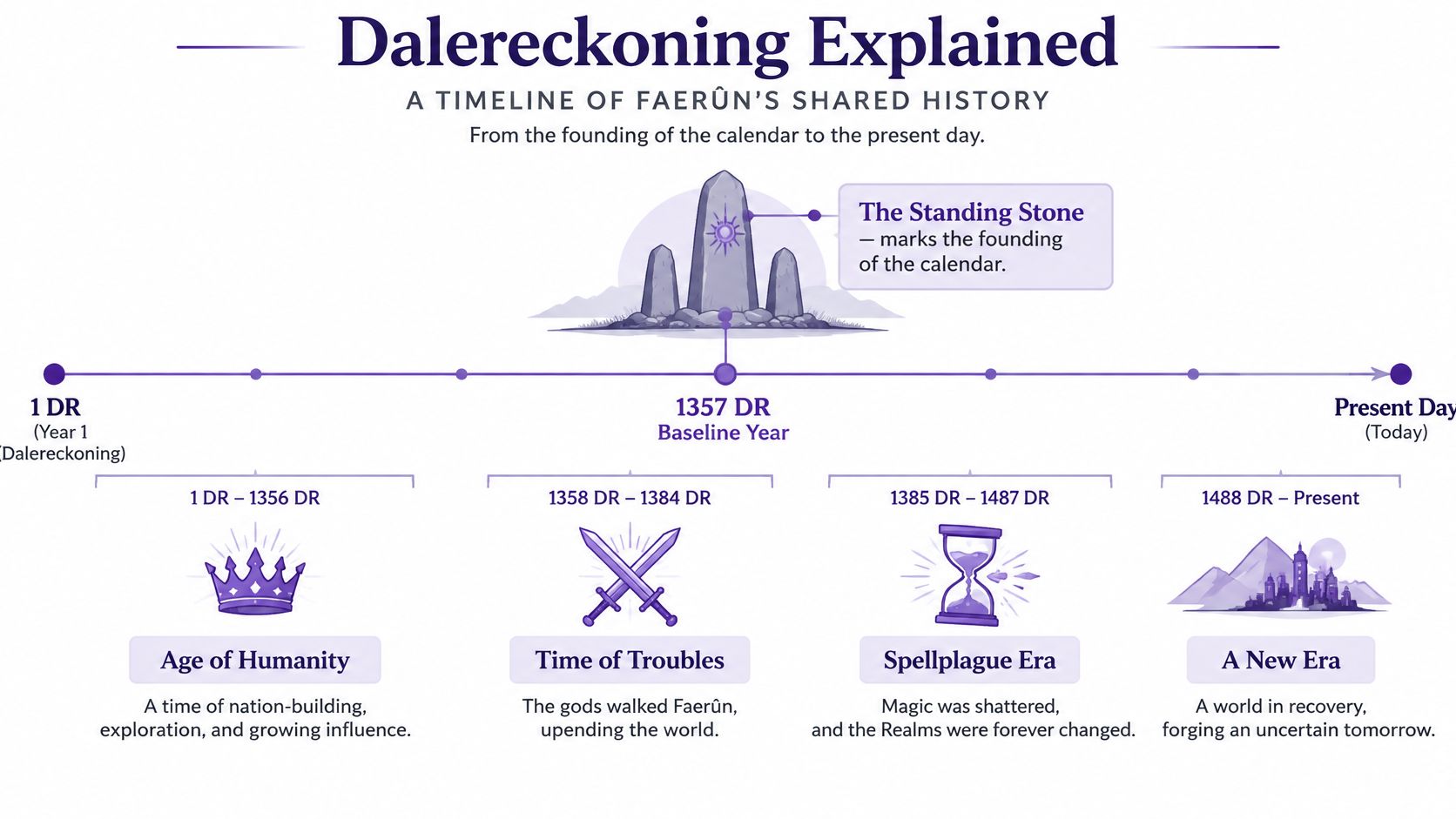
Dalereckoning, abbreviated DR, supplies the setting's principal year reference. Its traditional starting point is 1 DR, the Year of Sunrise, associated with elves of Cormanthyr and humans of the Dalelands raising the Standing Stone, as described in the Forgotten Realms chronology overview.
The publication baseline is separate: the setting officially launched in 1987 with the Grey Box, whose game material generally starts in 1357 DR, the Year of the Prince, and progresses into 1358 DR, the Year of Shadows, according to the setting's publication history. That makes the original material a dated snapshot, not a timeless description of Faerûn.
Date the claim, not just the object
When an old sourcebook describes a ruler, fortress, or organization, record when that description applies. A fortress's existence doesn't prove its later ownership. A character's introduction doesn't establish their whereabouts throughout every subsequent era.
For age calculations, subtract the birth year from the scene year, then check whether the birthday has occurred. Apply the same discipline to an artifact's creation, a dynasty's founding, or a character's years of service. Don't substitute the year you first encountered something for its in-world origin.
A sourcebook entry describes a state at a particular historical position. It isn't a warranty that nothing changes.
Keep an “established by” field alongside exact dates. Sometimes you can prove that an object existed before a scene without knowing when it was made. Preserving that uncertainty is more accurate, and more useful, than inventing a precise origin.
The Four Major Eras Every Writer Should Know
For manuscript planning, organize your historical research around the Time of Troubles, the Spellplague era, the Second Sundering recovery, and the later fifth-edition present. Treat these as editorial research brackets, not interchangeable backdrops. Each bracket tells you which historical assumptions require checking before you reuse an older character or location.
The Time of Troubles bracket demands scrutiny of divine identities, religious claims, and eyewitness testimony. If a plot depends on what a god did or what a mortal saw, retrieve the relevant account rather than trusting a compressed historical summary.
Research consequences, not catastrophe names
For a Spellplague-era story, build the research around the actual dependencies in your scenes: magical practice, geography, institutional survival, and personal experience. The event's name won't tell you whether your particular route, spell, or returning character works. Those require source-specific decisions.
| Historical bracket | Manuscript question |
|---|---|
| Time of Troubles | Which divine events does this scene require, and who witnessed them? |
| Spellplague era | Which magical, geographic, or personal conditions must be verified? |
| Second Sundering recovery | Which apparent restorations does this manuscript actually adopt? |
| Later fifth-edition present | Which inherited conditions remain relevant to the current cast? |
For a recovery-era novel, don't assume that restoration means every earlier arrangement resumes unchanged. Verify the particular location, office, or relationship you need. A map can answer a geographic question without resolving a survivor's loyalties.
The later present creates a different editorial problem: historical knowledge can sound suspiciously uniform. A scholar, veteran, and provincial merchant shouldn't automatically possess identical accounts of earlier upheavals. Choose the era early, then investigate the consequences your scenes use, rather than collecting catastrophe summaries you'll never dramatize.
Edition Transitions and the Spellplague Discontinuity
Edition changes are where a neat spreadsheet becomes dangerously reassuring. You can sort every entry correctly and still combine incompatible descriptions of the world.
Keep the discontinuities visible while researching.
The major date progression runs from 1358 DR to 1372 DR, through the Spellplague in 1385 DR, to the fourth-edition setting in 1479 DR, with fifth-edition adventure placements commonly around 1489–1492 DR, as summarized in the edition-transition chronology). These aren't adjacent snapshots of an unchanged world.
Choose a governing source baseline
For fiction, the most useful source set is the one whose assumptions match your chosen period. Don't rank every later publication above every earlier publication regardless of the scene date. A later description can be unsuitable evidence for an earlier political arrangement.
Treat edition transitions as continuity boundaries, not permission to ignore inconvenient facts. If you import an older institution into a later setting, document whether it survived, returned, or has been deliberately retained in your adaptation. The distinction prevents collaborators from “correcting” a choice you've already made.
This accompanying video can sit beside that source comparison, rather than replace it.
A useful exception record contains the adopted version, the conflicting version, and the affected scenes. That's enough to make an intentional departure auditable. Calling everything a soft reset isn't: it leaves you without a defensible answer when a returning character's history depends on what you've discarded.
Sequencing the Dense 1489-1492 DR Period
A shared year doesn't establish a shared sequence. Reference material places Waterdeep: Dragon Heist and Baldur's Gate 3 in 1492 DR, while dating clues for Dragon Heist include Lord Neverember's removal in 1489 DR, as discussed in the adventure chronology and placement reference.
That's enough to establish a useful year band. It isn't enough to assign every adventure a month or decree that an outcome in Baldur's Gate precedes an unrelated Waterdeep scene.
1489-1492 DR Adventure Dependencies
The dates below use the reference cited above; the dependency tests are editorial checks, not additional claims of canonical ordering.
| Adventure | Year (DR) | Hard Dependencies | Can Run Simultaneous With |
|---|---|---|---|
| Waterdeep: Dragon Heist | Placement discussed above | Verify political offices and any adopted outcome before reusing them | Regional plots without conflicting shared-character states |
| Baldur's Gate 3 | Same year placement discussed above | Later references require the selected outcome to have occurred | Waterdeep scenes that don't depend on its unresolved events |
| Other nearby fifth-edition adventures | Check individually | Establish prerequisites from the specific adventure | Stories with compatible locations, travel, and character availability |
Start with shared-state dependencies. If an NPC holds an office in your opening and has lost it by a later scene, establish the transition. If a plot assumes a particular political outcome in Baldur's Gate, record that adopted outcome before another character reacts to it.
Then test geography and information flow. Separate regional plots can coexist without trouble, but a shared courier, witness, or recurring antagonist creates constraints. The character must have time to travel, and the message must exist before anyone receives it.
Don't solve an overlap by arbitrarily moving everything into sequence. That can create longer absences, impossible journeys, and unexplained delays. Preserve simultaneity unless a specific dependency requires otherwise.
Character Knowledge States Across Eras
A static profile can tell you that someone is a Harper agent. It can't tell you whether they recognize a particular divine manifestation in your current scene.
Consider a hypothetical agent active during the Time of Troubles. Their affiliation doesn't establish eyewitness knowledge. If your manuscript says they personally encountered a figure, record what they perceived, which identity they understood at the time, and whether they later revised that understanding.
Biography isn't scene state
A hypothetical Red Wizard who lived through the Spellplague needs a personal history, not an automatic package of memories. Survival doesn't prove direct exposure to every consequence. Decide what this individual experienced, then stop later dialogue from granting them somebody else's testimony.
For a Waterdhavian noble, distinguish allegiance from current information. A profile might say they support a particular officeholder; a scene record must establish whether they've heard about the relevant political change. An outdated opinion can be intentional characterization. An inexplicably current opinion is a continuity mistake.
Track what the character believes, what actually happened, and what the reader knows as separate records.
Character development documents explain motives, contradictions, and intended arcs. Character tracking systems record changing conditions: injuries, possessions, relationships, location, secrets, and confidence in particular beliefs. The former helps you design the person; the latter helps you stop that person from becoming accidentally omniscient.
Update those records when revisions change scenes. Move a confession later and every intervening reaction needs checking. Delete a witness encounter and recognition may no longer be justified. Add a false report and subsequent decisions must reflect the character's mistaken belief until the correction reaches them.
That is why elaborate profiles fail at scale. Favorite foods and ancestral heraldry can be enjoyable worldbuilding, but neither tells you whether the agent has opened the letter.
Sourcebooks and Reference Materials by Writer Job
Buy or consult references to answer a manuscript question, not to complete a shelf. The following is a working division of research tasks, not a declaration that any reference settles every continuity dispute.
Reference Materials by Writer Job
| Reference | Best For | Limitations |
|---|---|---|
| Forgotten Realms Campaign Setting | Establishing a chosen political and geographic baseline | Requires attention to the edition and historical position |
| Sword Coast Adventurer's Guide | Targeted regional research for a Sword Coast manuscript | Doesn't replace scene-specific chronology checks |
| Ed Greenwood-authored novels | Studying tonal choices and character portrayal | A character's perspective isn't an impartial reference entry |
| Grand History of the Realms | Investigating long historical sequences | Broad chronology doesn't establish personal knowledge |
| Setting wikis | Locating dates and leads for further verification | Summaries can conceal qualifications and disagreements |
For a disputed claim, find the passage behind the summary. A wiki is efficient for locating a date; an original passage is more useful when you need its qualifications, narrative perspective, or context. Neither should become binding merely because it was the last tab you opened.
Keep research separate from adopted continuity
Your world bible should record what the manuscript uses, alongside the evidence supporting that choice. Keep rejected alternatives in research notes rather than presenting them as equally active facts.
For reading beyond setting reference work, browse the Expert Author Community reading list with a specific research question in hand. Separate reading for technique from reading for continuity evidence. Both have value, but a useful storytelling model can't settle who occupied an office on your scene date.
The practical hierarchy is simple: locate the claim, inspect its context, adopt a version, and record the decision. More reading isn't automatically better verification.
Dating Scenes with the Calendar of Harptos
Year-level accuracy won't save a journey with broken elapsed time. Once scenes depend on festivals, appointments, or pursuit, use the setting's calendar rather than silently substituting an Earth calendar.
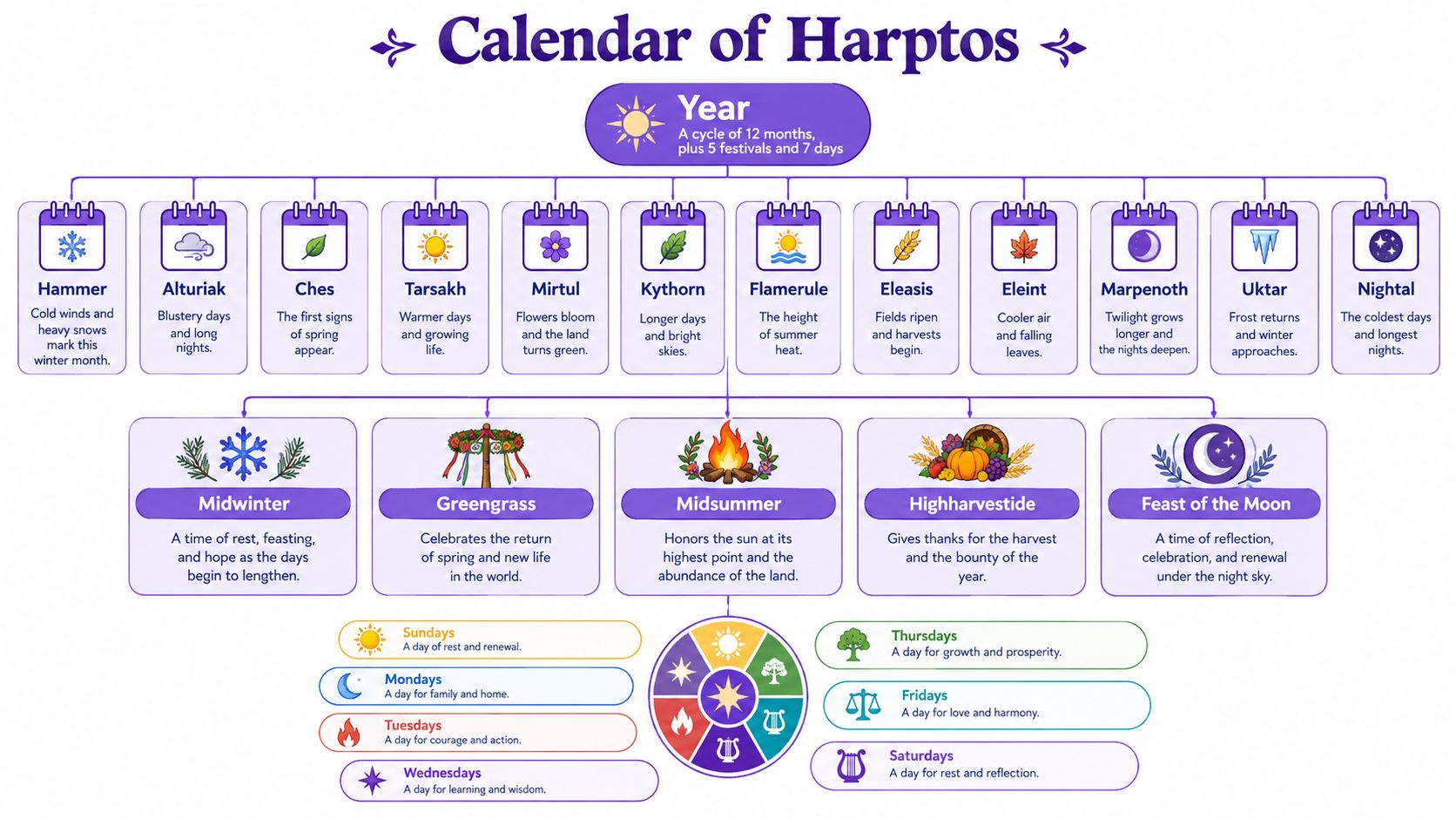
The Calendar of Harptos has twelve thirty-day months, divided into three tendays each, plus five intercalary festival days, making a standard 365-day year; those festivals are Midwinter, Greengrass, Midsummer, Highharvesttide, and the Feast of the Moon, as detailed in the Calendar of Harptos reference.
Track elapsed time separately
Use the tenday structure described above, not a Gregorian weekday cycle. The illustration's reference to seven days shouldn't govern your calculations. Festival days also need explicit treatment because they're placed between months rather than absorbed into an ordinary month.
For each dated scene, retain the DR year, named month or festival, day where applicable, and elapsed time since the previous relevant event. Separate elapsed time from the displayed date so a calendar-label revision doesn't change the duration of a siege.
Calendar check: A festival is a date in its own right, not decorative scenery between numbered days.
Test travel against departures and arrivals, not chapter adjacency. Alternating viewpoints can conceal a long interval in one region while only a brief interval passes in another. Maintain each storyline's local sequence, then reconcile their meeting points.
For multi-year plots, flag anniversaries and festival crossings for a separate calendar check. “The same date next year” and “the same elapsed interval” aren't interchangeable instructions.
A Writer's Continuity Checklist
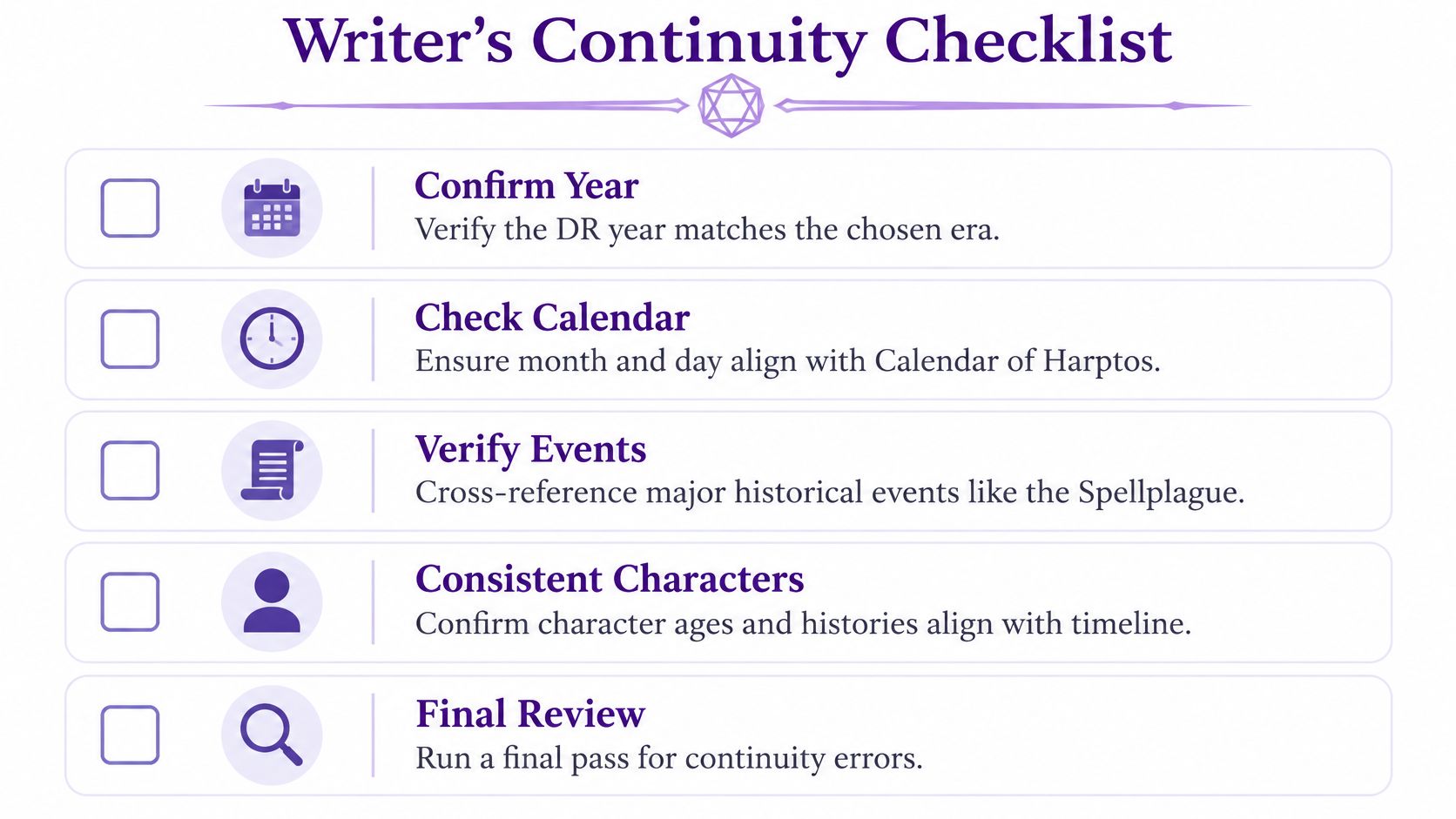
Before submission, audit decisions and dependencies, not just dates. Confirm the governing era and source baseline, then check every exception you've adopted. An unexplained exception is unfinished editorial work, even when the departure itself is defensible.
For each recurring character, compare current knowledge with witnessed events, received reports, and established misconceptions. Check referenced NPCs against the states your continuity has adopted, then test cross-regional encounters against travel and message delivery.
Audit the transitions
Calendar verification must include Shieldmeet, an extra festival day after Midsummer every four years, adding a day to the ordinary year, as described in the Shieldmeet calendar reference. Check whether your elapsed-time calculations cross it rather than assuming every year has an identical duration.
Treat a timeline error as a broken relationship between events. A date can be valid in isolation while the scene remains impossible because its witness hasn't arrived, its revelation hasn't occurred, or its political premise belongs to another version of the setting.
The sustainable workflow is a dated scene record, an adopted-continuity register, and evolving character states. Spreadsheets can handle that if you maintain them; manuscript-analysis tools offer another way to reduce manual extraction. Neither replaces your judgment about which continuity you're writing.
Your final test isn't whether you've memorized Faerûn. It's whether every important change has a cause, a position in time, and a traceable effect on the people who experience it.
Novelium's Character Tracker and World Codex automatically extract and track character details across manuscripts, providing an alternative to maintaining every record by hand. Visit Novelium to check your draft's character knowledge, event sequence, and recurring details against the Forgotten Realms continuity you've chosen.