8 Flaws for Characters That Wreck Your Plot
Most character profiles fail because they freeze a character into a static document. Marcus may be described as a recovering gambler with a sister in Dublin, but that profile won't tell you what he knows after chapter 14, which promises he's still bound by, or which version of events he believes. A profile describes who a character is. A tracking system records what remains true in each scene.
That distinction matters because readers build expectations from a character's established traits, then notice when behavior contradicts them. In one narrative-comprehension experiment, readers took 705 milliseconds longer to process an outcome sentence that contradicted a character trait established earlier in the story (the study on trait-based character expectations). A flaw can generate conflict, but an untracked flaw can also make a carefully built novel feel careless.
The strongest flaws for characters aren't generic labels like pride or dishonesty. They're recurring behavior patterns that shape decisions, create consequences, and require the manuscript to track changing knowledge, beliefs, plans, and relationships. The eight patterns below show where continuity tends to break, what a useful tracking record needs to capture, and why a profile alone won't catch the problem. The same principle applies whether you're sketching a relationship map or exploring journal posts on visual thinking: the representation has to help you see how details change, not just collect them.
1. The Compulsive Secret-Keeper
A secret isn't a personality note. It's a knowledge state, and every conversation can change it. When a character speaks, overhears, lies, or chooses silence, the manuscript has to preserve who knows what, when they learned it, and whether they know that someone else knows.
That's why the secret-keeper exposes the weakness of static profiles so quickly. A profile might say that Marcus is hiding his gambling relapse from his partner. It won't tell you that he saw the ledger two scenes ago, that his sister already knows he's lying, or whether he's had a chance to explain the unexplained withdrawal since then.
Practical rule: Track the secret as a changing set of permissions. Who can say what aloud, to whom, and at this point in the story?
A familiar failure: a detective discusses the warehouse fire in front of a witness after previously swearing she'd never been near the building. If she's deliberately changing her story, the text needs to establish that choice. If she isn't, readers may read the contradiction as an authorial oversight, not a clever deception.
Track the secret, not just the secret-keeper
Give each important secret a record of its origin, current holders, and disclosures. Add what each character believes about the others' knowledge. That last piece matters: a character who knows the detective was near the warehouse may still believe she doesn't know about the witness's testimony.
This kind of behavior can make a character's flaw consequential rather than decorative. The character flaw glossary is a useful label for the pattern, but the manuscript needs to track the decisions that label produces. In a large cast, the key question isn't "Who knows the secret?" It's "Who is allowed to say this out loud right now?"
2. The Stubborn Believer
Pride often hides a continuity mistake in plain sight. A character who refuses to accept a warning can plausibly keep acting on a false belief, so the writer may miss that the character has also received information that should change the scene.
Suppose a character learns that the bridge is out, rejects the warning as unreliable, then plans to drive across it later. That can work. What won't work is letting the character behave as if they never heard the warning, then later treating their decision as a deliberate act of denial. Those are different mental states, and the text needs to establish which one is active.
Aristotle's account of hamartia in the Poetics, commonly dated to approximately 335 BCE, describes an error or frailty that contributes to a tragic reversal, not necessarily an inherent moral defect (Britannica's account of hamartia). That distinction is useful here: stubbornness becomes dramatically productive when it shapes action, not when it merely sits in a profile as a trait.
Separate what the character knows from what they believe
Knowledge is what the character has encountered. Belief is what they accept, reject, or reinterpret. A stubborn character can know that a bridge is reported closed and still believe the report is a lie. That gap is a source of conflict, but it has to persist consistently across scenes.
A false belief can survive new evidence. The character's exposure to that evidence can't disappear unless the story gives them a reason to forget, dismiss, or misunderstand it.
Track the warning, the character's response, and any later evidence that changes their position. This also helps distinguish deliberate resistance from an accidental reversal. The fatal flaw glossary names the familiar concept, but in revision, the more useful question is whether the character's current belief matches what they've chosen to accept.
3. The Impulsive Actor
Impulsive characters act before all the information arrives. That makes them effective at creating trouble and unusually good at exposing a manuscript's timing mistakes.
A character might react to a letter in one chapter even though the story's internal chronology has the letter arriving later. Or a character leaves for the coast on Tuesday after a conversation that the manuscript places on Monday, then attends a meeting that still assumes they're in town. The emotional logic can feel immediate and convincing while the event sequence stops making sense.
Put information events and action events on the same timeline. If the character acts because they received a warning, the warning needs to reach them first. If the action changes the schedule, every dependent appointment has to move too.
Use timing as part of the character record
The Monday-to-Tuesday slip is a classic revision trap: a meeting shifts by a day, and the downstream events keep their old dates. Impulsive characters make that drift harder to notice because their speed can disguise the impossible sequence. A visual timeline helps expose whether the character could know, travel, recover, or arrive when the scene says they did.
The narrative's perspective can also affect how readers judge an unreliable or complex character. In a controlled study, third-person narration produced higher trust than first-person narration in the tested material, while the shift in perspective didn't significantly alter empathy for the character (the study on perspective, empathy, and trust). For an impulsive narrator, that distinction matters: readers may still care about the character while questioning whether the account is credible.
The character development glossary can help name the arc, but the timeline is what keeps the action legible. Treat the infographic below as a reminder that a character's established belief and the moment they act on it need to line up.
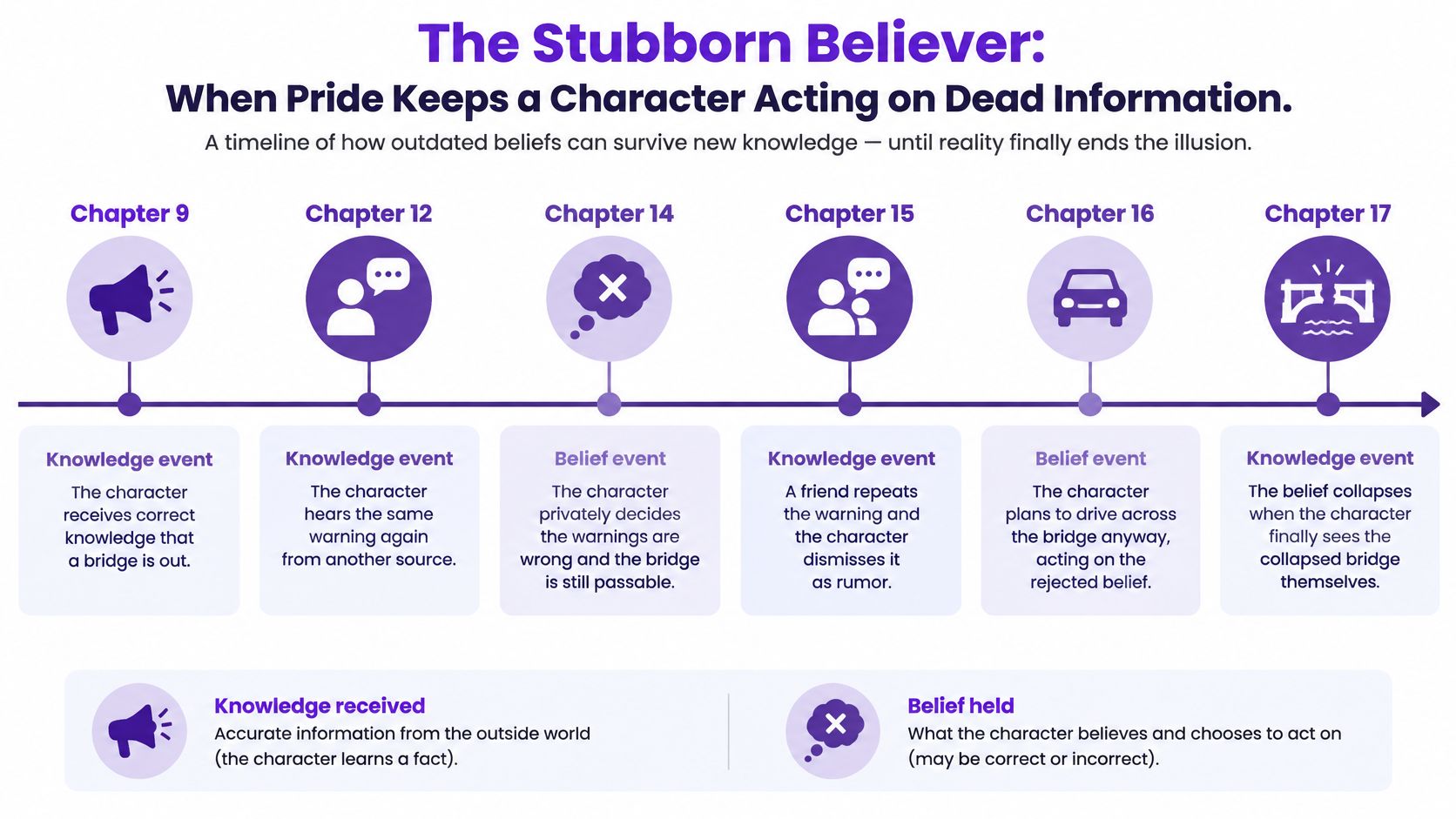
A discussion of viewpoint and character trust can add another angle to the timing problem:
4. The Habitual Liar
A lie is a claim that creates obligations for every later scene where someone remembers it. A habitual liar multiplies those obligations by tailoring different stories to different listeners.
The trouble starts when a character's cover story says they were in Lisbon during the week of a murder, but a later postcard is postmarked from Porto. That detail can be an intentional crack in the lie. It becomes a continuity error if the writer no longer remembers which city the character named, who heard the claim, or what that listener still believes.
Give every lie its own record
Keep a claims ledger separate from the character's true timeline. For each lie, record the statement, the listener, the time it was told, and the facts the statement implies. Then mark later scenes where that listener's belief affects their choices.
A lie often functions like a promise: if it stays in circulation, the story must track its consequences. The ledger makes those consequences visible. A character who claims to have been in Lisbon may need to answer questions about the hotel, the travel dates, and the person who supposedly saw them there. If the lie changes, the reason for that change should also be available to the writer.
This becomes more demanding in a series. A false account introduced in one book may still shape another character's behavior in a later installment. Don't store the lie only under the liar's personality. Store it under every person who heard it and the version they currently believe.

5. The Grudge Keeper
A grudge keeper may remember an old argument differently from the way it happened. That distortion can reveal character. The danger is letting a biased memory rewrite facts the manuscript has already established.
Imagine a character who recalls a fight with her brother as the moment he betrayed her, although the scene showed him apologizing and her accepting it. Her interpretation may have changed. But if she also recalls his age at a funeral incorrectly or describes a childhood kitchen with a window the story established was bricked up, readers have to decide whether those errors are deliberate or accidental.
Keep canon and memory in separate layers
Maintain the story's canonical record of events, then record each character's version as biased, incomplete, or mistaken where appropriate. This lets the character distort selected details without making every memory unreliable by default.
That separation is particularly useful when the same event returns through multiple viewpoints. One sibling may remember the apology as sincere; the other may remember it as a tactic to end the argument. Both accounts can be psychologically plausible, but the underlying event still needs a stable reference point for the writer.
Let the character misremember on purpose. Don't make the manuscript forget by accident.
A 2024 dissertation based on three experiments and a focus-group study found that readers could empathize with immoral or morally ambiguous protagonists when the story felt realistic or personally relatable (the dissertation on fiction reading and moral judgment). For a grudge keeper, the practical implication isn't that every distortion earns sympathy. It's that the reader needs enough causal evidence to understand why this person holds to this version of events.
6. The Over-Planner
The over-planner's plans can hold a plot together until revision changes the machinery. A safehouse has three exits and a laundry chute; the escape depends on the chute. After a structural edit, the location has a stairwell instead, but two later scenes still refer to the old route.
That isn't a problem with the character's personality. It's a dependency problem. The plan refers to a place, a sequence, and a set of contingencies, so each of those details needs to stay connected to the scenes that use it.
Version the plan as carefully as the setting
Track the plan's current version, its dependencies, and the contingency the character uses. If the laundry chute disappears, record what replaces it and which later actions need to change. A plan is not just a note about what the character intends to do. It's a structured object with assumptions that can become obsolete.
Plans also contain schedules. If an operation has timed stages, shifting one stage affects every dependent stage. A character who revises the plan in-scene needs to respond to the version that exists at that point in the story, not a version the author has already edited away.
The over-planner also offers a clean example of the difference between profile-writing and continuity work. “Precise, cautious, always has a backup” tells you how the character tends to behave. It doesn't tell you which exit they blocked, which alarm they disabled, or whether the backup plan is still possible after a location change. Even creative habits like perfectionism can have costs; the discussion of how perfectionism fuels procrastination is a useful parallel, but a novel needs its own record of what the plan depends on.
7. The Conflict Avoider
Avoidance is especially troublesome in a series because relationships can remain unresolved for a long time. A character postpones a confrontation, another character interprets the silence, and the relationship changes without either person saying exactly what changed.
A couple might stop speaking after a fight in one book, reconcile offstage in the next, then behave as if the original fight just happened in a later installment. No single line has to be plainly false for the emotional history to feel incoherent. The reader has lost track of what was repaired and what's still open.
Track relationship states, not just relationship labels
A note like “estranged siblings” won't preserve the sequence that led there. Record the last known status, what changed it, and what remains unresolved. For the avoidant character, add the moments when they could have addressed the conflict and chose silence instead.
That history helps distinguish tension from omission. If the character repeatedly gets a chance to ask about the missing money and doesn't, the silence can become a meaningful pattern. If the story forgets the missing money, the same silence feels like a dropped thread.
Relationship states also interact with secrets. A character who avoids conflict may keep withholding information after a reconciliation, even if the other person believes the issue is settled. The writer needs to track both the relationship's visible status and the private issue that continues to shape it. In a complex cast, “they're on speaking terms” is not enough. The relationship's open questions are part of its current state.
8. The Dependent
Addiction, injury, and other dependencies don't stay safely inside the character profile. They alter what a character can do in each scene, and those effects change over time.
A broken wrist in chapter six should affect the actions available in chapter nine. A character who's recovering from addiction needs a timeline that makes their progress, relapse, and exposure to triggers coherent. A fractured rib and a fire escape may both belong in the same novel, but the manuscript has to show how the character gets from injury to exertion.
Track state, duration, and consequences
For each dependency or injury, record when it begins, how its state changes, and what it prevents or enables. Then check those facts against the character's actions, their information processing, and the scene's date.
These states can also affect other flaw patterns. A character in pain may react impulsively. Someone hiding a dependency may become a secret-keeper or habitual liar. Those interactions are exactly why it's inadequate to keep isolated notes about traits while leaving scene-by-scene state unrecorded.
A character-development document describes who someone is. A character-tracking system records what remains true about them as the manuscript changes. That's the difference between knowing a character has an injury and catching the later scene where they climb a fire escape as if the injury has vanished.
Comparison of 8 Character Flaws
| Character Pattern | 🔄 Implementation Complexity | 💡 Key Tracking Need | 📊 Expected Continuity Impact | ⭐ Ideal Use / Key Advantage |
|---|---|---|---|---|
| The Compulsive Secret-Keeper | High: knowledge and disclosure change scene by scene | Record what each character knows, when they learned it, and who knows they know | Reduces accidental secret leaks and dialogue contradictions | Mystery and suspense; preserves tension around hidden information |
| The Stubborn Believer | Medium–high: separate known facts from accepted beliefs | Track received information, beliefs, and moments of rejection | Keeps actions consistent with a character's chosen beliefs | Character-driven drama; makes denial and pride a deliberate source of conflict |
| The Impulsive Actor | High: actions, information, and story time must align | Timestamp triggering information, actions, travel, and appointments | Catches premature reactions and timeline drift | Fast-paced stories; makes urgency and rapid decisions feel plausible |
| The Habitual Liar | High: each lie creates listener-specific claims and consequences | Maintain a claims ledger with each lie, audience, date, and implied facts | Prevents cover stories from conflicting across scenes or installments | Intrigue and deception; maps which characters believe false information |
| The Grudge Keeper | Medium–high: distinguish objective history from biased recollection | Track canonical events alongside each character's version | Prevents unintended factual errors while preserving selective memory | Family and relationship drama; supports intentional emotional distortion |
| The Over-Planner | High: plans, dependencies, schedules, and revisions interact | Track plan versions, contingencies, locations, and execution stages | Keeps plans and scene logistics consistent as events or settings change | Heists and operations; turns planning and failed contingencies into plot structure |
| The Conflict Avoider | Medium–high: unresolved relationship states can persist across scenes or books | Record relationship status, open issues, missed resolution opportunities, and changes | Preserves emotional continuity and deferred tension | Relationship arcs and series; sustains tension through consistent avoidance |
| The Dependent | High: conditions and limitations evolve over time | Track state, start date, duration, effects, and recovery or relapse markers | Prevents physical, behavioral, or recovery-state contradictions | Long character arcs; grounds abilities and setbacks in ongoing conditions |
Build a Flaw That Survives Revision
A workable arc isn't a personality checklist. It's a traceable sequence: the behavior appears, creates a concrete cost, triggers a response from other characters, meets resistance, and changes the character's strategy without necessarily erasing the underlying pattern. One character learns to manage the flaw. Another relapses. A third becomes more effective at using it. The point isn't that every arc ends in moral improvement. The point is that the behavior remains legible as it changes.
That takes more than a development document. Track the facts that determine what a character can plausibly do in the next scene: knowledge gained, beliefs held, claims made, memories distorted, plans invoked, relationship states, and dependencies changing. When those records are missing, an established trait can't rescue a contradiction. The detective who discusses the warehouse fire after swearing she'd never been there needs a deliberate reason to break her story. The injured character climbing the fire escape needs a legible change in their condition, or a choice to risk the consequences.
Readers also separate responses that character questionnaires tend to lump together. In a controlled study involving Dutch high-school students, changing narrative perspective affected trust in the protagonist but not participants' empathy for the character (the study on difficult empathy and narrative perspective). A character can remain emotionally compelling while becoming less credible. That's useful dramatic tension, but it works only when the text gives readers evidence for both reactions.
Hand-maintained profiles and spreadsheets decay when revisions, multiple timelines, and large casts start changing the same facts. A change to an injury, secret, or travel date can affect scenes far beyond the one you're editing. Character tracking needs to evolve with the manuscript, not trail behind it.
Novelium's Character Tracker and World Codex are designed to extract and track character traits, knowledge states, relationships, and events across chapters. Test that approach on a current manuscript before structural edits spread an inconsistency through multiple scenes and turn one fix into a continuity hunt.
Novelium's Character Tracker and World Codex track character details, knowledge states, relationships, and events across your manuscript, helping you catch when a flaw's consequences stop lining up from scene to scene. Start free and test the system on your current draft before the next structural edit makes the same continuity error harder to untangle. Visit Novelium to see how it fits your writing workflow.