Find Book by Plot: A Method for Recalling Lost Novels
You can remember the reveal, the unpleasant little seaside town, and exactly how the ending made you feel. The title? Gone. You're trying to recover a comp, check whether someone already used that narrative mechanism, or find the novel whose handling of withheld information has been bothering you all week.
To find a book by plot, treat your recollection as evidence, not a synopsis. The useful question isn't how much you remember. It's which details another reader, a catalog record, or the text itself can confirm.
Sorting Half-Remembered Clues Into a Search Brief
Typing an entire remembered scene into a search box feels precise. It usually isn't. You've supplied your own prose, complete with inferred motives and possibly invented furniture, rather than language a catalog is likely to contain.
Use a search brief instead. Keep the memory intact somewhere, but build your queries from separable claims.
Separate certainty from interpretation. Make columns for sure details, guesses, and feelings. A dead narrator belongs under certainty only if you remember that revelation explicitly. The publication decade, cover illustration, and author's gender belong under guesses unless you can substantiate them.
Rank by distinctiveness. A detective investigating their own earlier testimony is more useful than a detective with a drinking problem. Preserve relationships and causal order, not just striking nouns. Vividness isn't rarity.
Record the delivery. Readers' advisory scholarship identifies five appeal dimensions: pacing, characterization, storyline, frame, and tone. Record the slow accumulation of dread or deadpan narration alongside the murder. Those qualities help distinguish books with almost interchangeable premises.
Add practical boundaries. Note when you read it, its language, intended audience, and format. Your reading date establishes a latest possible publication date, not necessarily its original publication period. An old paperback isn't evidence of a recent release.
Rephrase without embellishing. Try a noun-heavy query, a relationship-based query, and an object-or-event query. For an invented example, those could be ghost dog fiction, dog sees dead owner, and animal recognizes murdered owner.
The useful transition is from an unsearchable recollection to checkable clues.
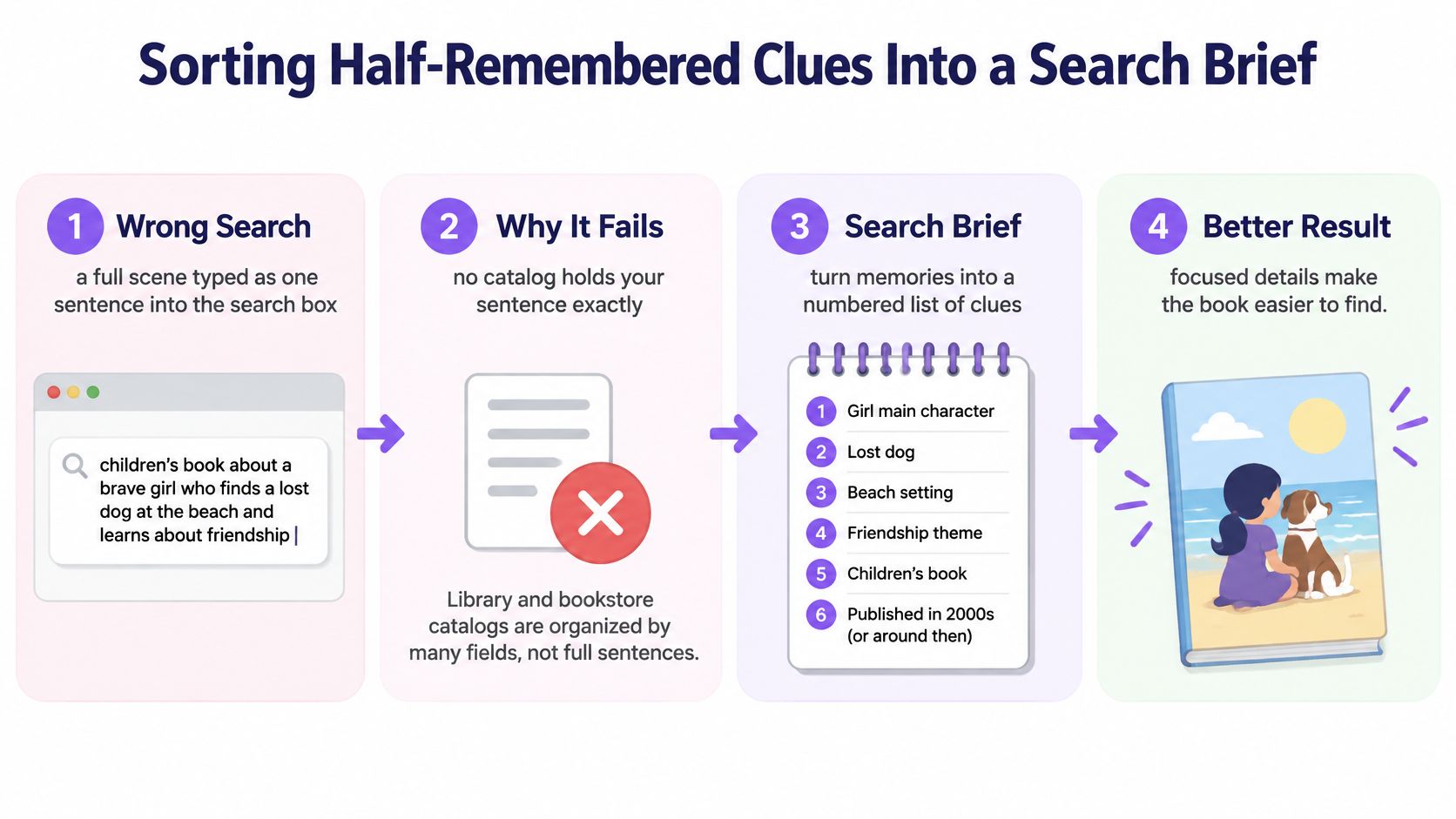
Keep the finished brief short enough to paste into a reference request. This is backlist discovery through remembered content rather than author recognition.
Practical rule: An empty certainty column is better than a confident invention.
If only a single distinctive detail survives, search that detail in full text and take it to a reader community. Don't manufacture supporting evidence just to make the brief look respectable.
Translating Remembered Scenes Into Catalog Terms
The Library of Congress fiction cataloging rules permit four heading categories for an individual novel: form or genre, character, setting, and topic. Catalogers can use any, all, or none of them, and assign them after a superficial review of the work. A catalog record isn't a miniature scene index.
That explains an infuriating search failure: the scene can be central to your memory and absent from the searchable headings. The location or character type may be your only useful catalog-level hook.
Remembered details mapped to catalog categories
| Remembered detail | Catalog category | Search term to try |
|---|---|---|
| A town that shuts down every winter | Setting | Small town winter fiction |
| A narrator who lies to the reader | Topic | Unreliable narrators fiction |
| A retired spy running a bakery | Character | Retired spies fiction |
| A court case over a stolen recipe | Topic | Trade secrets fiction |
| A cozy tone with a body in the freezer | Genre | Cozy mystery fiction |
These are keyword starting points, not promises that a catalog uses those exact authorized headings. Search the broadest viable concept, inspect a plausible record, then reuse the actual subject terms attached to it. That's more productive than repeatedly polishing your original sentence.
Search the concept the catalog can represent
A retired spy running a bakery gives you character, occupation, and setting material. Start with retired spies fiction, then add bakery if the results need narrowing. Requiring every remembered feature immediately can exclude a record whose summary mentions espionage but not the shop.
Themes need particular care. Cataloging rules distinguish fiction centered on a theme from fiction that merely contains it. A lawsuit involving a stolen recipe doesn't guarantee that trade secrets will appear as a subject heading, especially if the novel primarily concerns a family rupture.
The catalog's job is to produce candidates, not certify your memory.
Keep scene-level claims available for verification, but don't demand that subject metadata carry detail it wasn't designed to preserve.
Where to Search and What to Type in Each Place
Search sources and the query patterns that work
| Source | What it indexes | Query pattern that works |
|---|---|---|
| Library catalog keyword search | Subject headings, summaries and notes | Catalog terms from the mapping step, setting first then genre |
| WorldCat | Union catalog across participating libraries | Keyword plus publication decade filter |
| Google Books full-text search | Searchable text of many books | Short distinctive phrase in quotes |
| Goodreads search and shelves | Descriptions, reviews and reader tags | Two or three tropes plus setting |
| Reddit r/tipofmytongue | Human recognition of plot descriptions | Spoiler-tolerant summary with approximate year |
| Library reference desk | Subject expertise and catalog access | Written brief with decade, language and format |
Begin with your library catalog because it accepts the concepts you've already extracted. The Library of Congress guide to finding forgotten novels recommends distinctive plot elements, character names, and remembered wording, and explains how keywords in summaries and annotations support discovery.
Widen to WorldCat when local holdings constrain the search. Apply a publication-period filter only when you've got a defensible boundary. If the decade is a guess, rerun without it before abandoning a promising query.
Match the query to the search surface
Use Google Books for wording that could appear inside the novel, not just on its cover. Quotation marks help only when the wording survived your memory. Quote the fragment you trust most and leave uncertain details unquoted; if nothing appears, remove the quotation marks before rewriting everything.
Move to Goodreads when reader vocabulary seems more useful than catalog vocabulary. Search descriptions, inspect relevant shelves, and use reviews to locate clues that marketing copy avoids spoiling. Don't assume every site's search box searches every review or shelf label equally well.
For a community post, supply the reading period, language, likely audience, and permission to discuss the ending. A red door isn't much to work with. A red door the narrator refuses to open after recognizing their missing brother's handwriting gives responders a relationship and an event.
Take the same compact brief to a library reference desk if the publication period is uncertain or your searches keep circling the same unsuitable titles.
Keep a search ledger: Record the query, source, candidate, and reason for rejection.
That ledger prevents repeated dead ends. It also tells you which search surface helped, so you've got a sensible starting point next time.
Ranking Candidates and Ruling Out Look-Alikes
A synopsis that feels right isn't confirmation. Familiar premises invite premature recognition, especially when you've already spent an evening searching and would quite like to be finished.
Rank candidates by rare conjunctions: an unusual causal sequence tied to a specific relationship deserves more weight than a matching genre. Keep alternatives visible rather than allowing the first plausible title to swallow the investigation.
Why a plot match fails and how to fix it
| Failure mode | How it shows up | Fix |
|---|---|---|
| Paraphrase mismatch | Results miss because your wording differs from the book's | Search likely synonyms and the character's own terms |
| Translated title | The book you remember has a different English title | Search the original-language title and the translator's name |
| Edition difference | The plot matches but the year or cover does not | Check the earliest edition and its publication date |
| Adaptation mismatch | The scene you remember comes from a film or series | Search the source novel's title and its original author |
| Conflated books | You blend two novels with similar premises | List one sure detail per candidate and test each separately |
| Trope over-weighting | Every book with the trope matches | Require two rare conjunctions before accepting a match |
Verify a scene, not a resemblance
Check finalists against a publisher description, library record, or scanned excerpt. Use bibliographic records to establish identity and publication history; use text to determine whether the remembered event occurs. A correct author and plausible cover won't prove a particular reveal.
Reviews provide useful secondary evidence about plot, character, and tone, as Library Journal's readers' advisory guidance explains. Reading-history records in StoryGraph can also help recover candidates you previously logged, but an atmosphere match still isn't scene evidence.
When ordinary searches stall, recruit recognition. The New York Public Library's plot-search guidance points readers toward people who may recognize a storyline that catalog searching hasn't resolved.
Be especially suspicious of adaptation memories. Establish the source novel and author before treating a screen scene as evidence about the book.
Finally, compare delivery. A relentless twist thriller is a poor match for a memory of reflective, sustained dread. Treat that contradiction as a reason to investigate, not an inconvenience to explain away.
Two Worked Searches From Vague Memories
These hypothetical searches show the method without pretending that an unverified premise identifies a real title. The useful outcome is a defensible shortlist, not a theatrical reveal.
Keep the search brief beside the results rather than rewriting it to fit each promising book.

The victim was already dead
Say you remember a mystery in which the protagonist discovers that the victim died earlier than everyone assumed. The usable clue isn't merely that someone was dead before an investigation. It's that correcting the death timeline changes the explanation of earlier events.
Start with mystery fiction time of death in the catalog. Suppose the candidate set includes forensic procedurals and psychological mysteries. Reject nothing solely on genre yet; inspect descriptions for the chronology mechanism.
Next, try Google Books with victim died earlier and investigation. Use a quoted fragment only if you remember its wording. In this scenario, an excerpt establishes that a promising procedural concerns a misidentified corpse, not a revised timeline, so it leaves the shortlist.
A reflective mystery survives if its slow reveal and character relationships also fit. It remains provisional until you locate the relevant passage.
For a companion discussion of plot-based searching, use the video below.
The city moves every night
Now suppose you remember a fantasy city that physically relocates after dark. Search moving city fantasy in the catalog, then mobile city and wandering city in reader descriptions and shelves.
In a hypothetical result set, reject a city whose streets rearrange but whose location never changes. Keep a traveling settlement provisionally, then ask a reader community whether anyone recognizes nightly movement rather than continuous travel.
The title responders name first is a lead, not a winner. Compare the mechanism, the inhabitants' understanding of it, and the narrative frame against an excerpt. Those checks distinguish the remembered book from a collection of novels with ambulatory architecture.
Start a Plot Log for Your Own Manuscript
A character can know a password in one chapter and have no reason to know it in the next. In a long manuscript or recurring-cast series, familiarity with the story does not guarantee you can reconstruct what each person knew at every moment.
Character development documents capture identity, history, and intended change. A plot log records events and their consequences: who learns the secret, who holds the key, how much time passes, and which unresolved promise still constrains the next scene.
A favorite childhood meal may add texture. Whether the witness has already seen the suspect can change the logic of a scene.
Update the log as you revise. If a confession moves earlier, adjust every knowledge state that depends on it, not only the confession's chapter entry. Otherwise, a character may hide information they have not received or act surprised by something they already know.
For suspense-specific context, MEB Books on writing psychological thrillers offers a companion resource. Keep continuity facts distinct from your intentions for the reader's experience.
Novelium automatically extracts story elements from a manuscript, including characters, timeline entries, and plot threads. Its Character Dashboard tracks character descriptions, personality, backstory, and arcs, while the system tracks what each character knows and can catch timeline inconsistencies as you write. It does not suggest plot changes or write any part of your story.
For each finished chapter, note knowledge gained, time elapsed, relationship changes, object transfers, and open threads. These checkable details make a plot log useful during revision, when moving one scene can affect several others.
Novelium can help track continuity in a draft without taking story decisions away from you. Visit Novelium to see how its manuscript analysis can help you keep track of your own story.