Your Character Bible Is Causing Plot Holes, and Your Fiction Writing App Should Fix It
Let's be honest. We’ve all built them—the sprawling character bibles filled with eye color, favorite foods, and detailed childhood traumas. We were told to. But if you’re a series author juggling dozens of characters across multiple 100,000-word manuscripts, you know these static documents are worse than useless. They're a liability.
The meticulous character profiles you built are lying to you.

The problem with a traditional character profile is that it’s a photograph of a person who is about to run a marathon. It captures them at a single point in time, usually before the story even kicks off. Then you spend the next 100,000 words changing them, teaching them things, breaking them, and building them back up again. Your profile never keeps pace.
This isn't just a minor headache; it's the root cause of catastrophic continuity errors. Having analyzed thousands of manuscript pages, we've observed that the most stubborn plot holes aren’t born from forgetting a character’s hair color. They happen when a writer loses track of what a character knows.
A character can’t react to information they don't have. They can't forget a crucial secret they just learned two chapters ago. Yet, when you're 80,000 words deep and wrestling with three subplots, relying on memory and a static document is a recipe for disaster. That meticulously crafted profile you made three months ago is now a historical record, not a functional tool for the book you're writing today. This is exactly why so many authors are searching for a better fiction writing app.
The real job of a character document isn't to tell you who the character was before the book started. It's to tell you, right now, in Chapter 27, what they know, who they trust, and what they believe to be true. Anything else is just trivia.
The old character profile method fails because it treats character details as a collection of fixed facts. But inside a novel, character information is a live database. Every single scene can update a character's knowledge, twist a relationship, or change their physical state. A spreadsheet can't tell you if your protagonist is acting on information they won't learn for another five chapters. A binder full of questionnaires won't flag the scene where your antagonist monologues about a secret they were never told. It doesn't matter if you're a die-hard plotter or a committed pantser; maintaining this continuity is non-negotiable. The goal isn't just to store information. It's to have a system that actively tracks how that information evolves across the entire manuscript.
Character Development vs. Character Tracking
It’s a tale as old as time. You spend weeks, maybe months, mapping out the perfect character. Their backstory is a tragic masterpiece, their motivations are crystal clear. You've done the creative work. You know them. Then, halfway through your draft, a nagging question pops up: "Wait, does Sarah know that Mark lied about the inheritance yet?" And just like that, your beautiful character bible is useless.
This is the crucial difference between character development and character tracking. Development is the art—the soul-searching and creative brainstorming that gives your character life. Tracking is the cold, hard logistics of what that character knows and when they know it. It’s the science of continuity, and it’s where even the most seasoned writers get tripped up. Development is your character’s resume and personality profile. Tracking is the live project plan detailing every piece of information they’ve picked up, every conversation they've had, and every secret they've learned, scene by scene.
A static document, no matter how lovingly crafted, just can't keep up with the dynamic reality of a story in motion. It can tell you who your character is, but it can’t answer the questions that really matter mid-draft, like, "In Chapter 27, is my protagonist still angry about the argument from Chapter 12, or has he forgotten?"
Trying to manage this with memory alone is a recipe for disaster in any book-length project. Spreadsheets aren't much better; they quickly become sprawling, unmanageable beasts. We see the fallout all the time in the manuscripts we analyze. A character suddenly has knowledge they couldn't possibly possess. Another forgets a life-altering event from three chapters ago. These aren't just little nitpicks for your copyeditor to fix. They're fundamental breaks in the story's logic that often require painful, time-consuming structural surgery.
A character's internal state is not a constant. It's a variable that is updated with every scene they participate in. Tracking this variable is the single most important administrative task in writing complex fiction.
We pour all our energy into the "art" of preparation, building these elaborate wikis full of fascinating details that never actually make it onto the page. Meanwhile, we leave the most volatile and critical element—the character's ever-changing state of knowledge—completely untracked. Development asks: Who is this person, deep down? Tracking asks: What does this person know right now, at this exact moment in the story? A true fiction writing app has to be built for the logistics. Character development is what gives your story its heart. But character tracking is what keeps it from collapsing under its own weight.
What Actually Matters for Consistency
After looking at countless manuscripts, you start to see the patterns. You see exactly where a complex story goes off the rails. And it's almost never about a character's favorite childhood memory. The kinds of plot holes that force massive rewrites almost always spring from a tiny handful of dynamic, scene-level details. Get these right, and your continuity holds. Get them wrong, and the logical foundation of your story crumbles. A purpose-built fiction writing app has to be obsessed with tracking this stuff above all else.
The single most critical piece of information is what a character knows and when they know it. It’s the linchpin. A character referencing a secret they weren’t there to hear is an instant credibility killer. I once saw a manuscript where the protagonist spent three chapters agonizing over a decision, completely forgetting that her ally had given her the key piece of information back in Chapter Four. The author just lost track. This is a state-tracking problem. A character's knowledge isn't a static list; it’s a variable that’s constantly updating.
This is the essential split between the creative work of developing a character and the logistical task of tracking them through the plot.
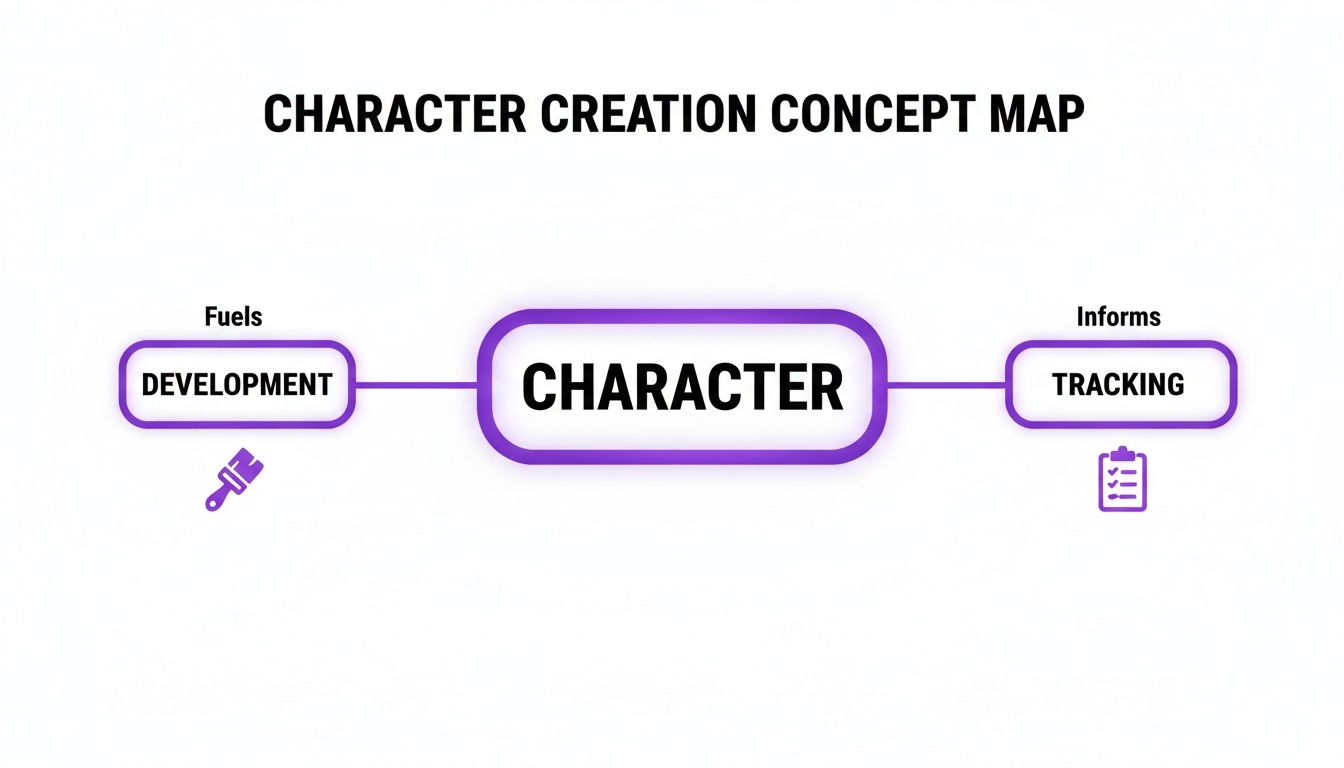
Development tells you who a character is. Tracking ensures their actions stay consistent with the story you’re actually telling. Beyond a character's knowledge, a few other dynamic states are responsible for the vast majority of plot holes. Your system must monitor these things as the story moves forward.
First, relationship states. How does Character A feel about Character B in this scene? Trust isn’t a fixed attribute. A character who feels deeply betrayed in Chapter 10 can't act with unguarded trust in Chapter 11 without a good reason. We’ve seen allies suddenly act like enemies because the author forgot about the pivotal reconciliation scene they wrote a month earlier.
Next is object possession. Who has the magical locket? Where is the incriminating file? A classic error is having an object appear in two places at once or having a character pull something from their pocket that they lost two hundred pages ago. This isn't just a minor goof; it can completely invalidate entire plotlines.
Finally, there’s physical location and state. Where is the character, and what condition are they in? A character can't be in the throne room and the stables in the same scene. If they sustained a serious injury in the last chapter, they can't be sprinting up a flight of stairs in this one unless you explicitly show their recovery. For more complex stories, having robust worldbuilding software that integrates with your character tracking is a necessity.
These four categories—knowledge, relationships, possessions, and location—are the bedrock of your story’s integrity. Any fiction writing app that prioritizes a character's favorite band over a timeline of what they know is fundamentally missing the point. Static trivia is fun for worldbuilding, but it doesn't prevent plot holes. Only dynamic state tracking does.
How the Manuscript Changes Your Characters
There’s a myth that you can perfectly define a character before you even start writing. But we all know the truth, don't we? Characters don't really show up until you throw them into the messy middle of a scene you never saw coming. The person your protagonist is in Chapter 30 is a world away from who they were in Chapter 1. That change is the story.
When you cling to a rigid, pre-written character profile, you’re actively working against that organic evolution. It anchors you to your initial ideas, acting as a dead weight on the story you’re actually writing. Your character tracking system has to evolve with the manuscript. It needs to be a living document that mirrors the character's current state, not a memorial to the person you thought they were going to be six months ago.
The manuscript itself must be the single source of truth. A character is who the text says they are, right now. Your tools should serve that reality, not fight it.
This is where a truly effective fiction writing app changes the game. It doesn’t just store your initial notes. It reads your manuscript and pulls its data directly from the text, automatically updating a character's knowledge, relationships, and even their physical condition as the story unfolds. It’s the only way to make sure your notes serve the book you're writing today, not the one you originally planned.
Characters aren't just static data points; they're complex systems that change in response to the plot. Any tracking system that demands constant manual updates is just another chore—and it's always the first thing to get neglected when you hit a creative flow. This is precisely why so many professional novelists find that spreadsheets and personal wikis eventually fail them.
Think about it: the moment you move a key conversation from Chapter 20 back to Chapter 10, your entire web of notes is instantly obsolete. A character now knows something critical, much earlier. Every single scene that follows has to reflect that shift, but a static profile won't flag the now-broken logic in Chapter 15 for you. The market for specialized novel writing tools is forecast to grow significantly, a clear signal that authors are tired of the old way and are demanding smarter solutions to manage narrative coherence. You can explore more about this growing market for advanced writing tools and what it means for writers.
The real shift we need is from simple documentation to active intelligence. Your system shouldn’t just be a filing cabinet where you record facts. It should be a partner that analyzes your text and flags inconsistencies based on who your character has become within the manuscript itself. This transforms character tracking from a passive, administrative chore into a dynamic, preventative process.
Choosing a Fiction Writing App That Thinks Like an Author
The market is flooded with apps that call themselves fiction writing software. But frankly, most of them are just prettier versions of Word or glorified note-taking systems. They give you a digital corkboard and a place to dump your character trivia, but they don’t solve the one problem that trips up every complex narrative: dynamic, scene-by-scene tracking. The real question is, "Can this thing actually read my manuscript and tell me what my characters know, and when they knew it?"
Any tool worth its salt has to fit into your existing workflow without a fight. You've got a process that works, whether it’s in Scrivener, Google Docs, or good old Microsoft Word. A real fiction writing app should act as an intelligent layer on top of that process, not demand you migrate your entire life’s work into some proprietary format.
This brings us to maybe the most important point of all: privacy. Your manuscript is your intellectual property. Sending your unpublished work to some third-party server where it can be used for model training or get exposed in a data breach is an absolutely unacceptable risk. A serious fiction writing app must process your manuscript locally on your own device. There is no middle ground here. Your story, your characters, and your plot twists should never be uploaded to a cloud server for analysis.
The moment your manuscript leaves your machine for analysis, you’ve lost control of it. True professional tools respect your ownership and privacy by design, keeping everything local.
The final, and most crucial, distinction is between a tool that simply stores your notes and one that actively analyzes your manuscript. The first is just a database. The second is an intelligence platform. The manuscript itself is the single source of truth. A character isn't who your notes say they are; they are who the text says they are back in Chapter 27 when they swore they’d never return to Boston. The significant growth in the writing software industry shows that writers are finally moving beyond simple text editors and demanding tools that provide genuine insight. You can discover more insights about the AI writing assistant software market and the forces driving its growth.
A truly useful fiction writing app should be able to automatically build a timeline, track knowledge states, and identify inconsistencies with objects, locations, and character relationships. This is the new standard. Don't settle for a glorified notebook. Find a tool that thinks like an author, respects your privacy, and treats your manuscript as the living document it is. At Novelium, we built our platform around this very principle. You can see how our manuscript intelligence system works to analyze your text and give you the clarity you need to nail those complex revisions with confidence.
Making Your Revisions Count

A story isn't born in the first draft; it's forged in the revisions. This is also where a simple spreadsheet or a folder full of notes completely falls apart, and where a true manuscript intelligence platform shows its strength.
Think about a common structural edit. You get a flash of inspiration: that huge plot reveal in Chapter 20 would hit so much harder if you moved it to Chapter 10. With a manual system, you’ve just signed yourself up for a nightmare. Now you have to reread ten chapters, painstakingly hunting for every conversation, internal thought, and subtle glance that’s suddenly out of sync. It’s tedious work guaranteed to introduce new mistakes.
This is exactly where a smarter fiction writing app changes the game. The system re-analyzes your manuscript based on the new order of events. It understands cause and effect. It can automatically flag the specific scenes where inconsistencies now live, from knowledge contradictions to missing reactions. It’s the difference between blindly digging for needles in a haystack and having a magnet that yanks them all out for you.
The goal of a great revision isn't just to fix typos. It's to strengthen the novel's core logic. You can't do that effectively if you're spending 80% of your time on manual continuity checks.
By turning your manuscript into a queryable database of events, relationships, and knowledge, you can pull off these complex structural edits with total confidence. You go from hours of slow reading to a focused, surgical strike on the exact moments that need fixing. This is how you reclaim your creative energy for what actually matters—strengthening the story, deepening character arcs, and making your novel sing.
At Novelium, we built our manuscript intelligence platform to give you this exact power. Stop hunting for plot holes and let our automated analysis show you precisely where your story's logic needs attention. You focus on the art; we'll handle the continuity. Try Novelium for free and see how it transforms your revision process.