Enemies to Lovers: Build a Romance That Actually Works
Why do so many enemies-to-lovers manuscripts produce excellent banter and a romance nobody believes? The missing ingredient usually isn't chemistry. It's engineering. At novel length, attraction has to survive chapter sequencing, changing knowledge, reversals, power shifts, and the accumulation of consequences. A clever exchange can start the engine, but it can't carry an 80,000-word manuscript by itself.
The trope has lasted because readers understand its central promise immediately. Two opponents meet, reassess each other, and develop intimacy through pressure. Jane Austen's Pride and Prejudice, published in 1813, remains a defining example, and commentary continues to trace related adversarial romantic tension to Shakespeare as well. The pattern has moved from canonical fiction into searchable digital culture, with over 53,000 Archive of Our Own works tagged with the trope in 2021 according to Syfy's discussion of the trope's fanfiction history.
That recognition creates an editorial problem. Readers arrive with expectations, and a manuscript that confuses hostility with intimacy will fail them fast. The work isn't making two people rude to each other. The work is showing why their opposition changes, what that change costs, and why love becomes possible only after their assumptions collapse.
The Mechanics of the Enemies to Lovers Trope
Can snark carry a romance across an entire novel? Only if each exchange changes what the characters know, want, or risk. Banter is surface activity. Tension comes from pressure on incompatible goals, while attraction develops through accurate observation and revised judgment.
Enemies to lovers requires meaningful opposition. Give the characters incompatible interpretations of the world, competing loyalties, or a history that makes their hostility specific. Each person needs a defensible position, even when the moral balance is uneven. A rival who resents the other's methods can sustain conflict. A character who humiliates, threatens, or controls a partner, then receives a kiss as narrative compensation, needs a serious reckoning. Most drafts do not provide one.

Track two separate forces: volatility and recognition. Volatility creates movement through arguments, reversals, and tactical losses. Recognition creates romance when each character notices the other's discipline, courage, intelligence, restraint, or concealed fear. The attraction becomes credible when those observations alter decisions, not merely internal monologue.
Editorial rule: Every hostile exchange should expose a belief, alter a tactical position, or create a new emotional risk. If it does none of these things, cut it.
Strong tension in fiction does not depend on louder insults or harsher treatment. It comes from incompatible needs operating in the same scene. One character may need an opponent's expertise while trying to defeat them. They may distrust a confession yet depend on its information. They may recognize desire and refuse to act because doing so would validate the worldview they started by rejecting.
The trope works as a tracking problem as much as a chemistry problem. Record each character's current belief about the other, the evidence that challenges it, and the consequence of every shift. Without that record, attraction jumps ahead of the manuscript's logic. With it, character development becomes an adversarial process: the lovers force each other to abandon a comfortable lie.
The Four-Stage Structure Every Writer Must Respect
A sequence of random meetings doesn't build a romance. It produces coincidence, and coincidence gets expensive across a long novel. A durable arc needs a reason these specific people keep colliding, especially after the novelty of their first argument wears off.
A 2025 academic analysis identifies four recurring stages, initial conflict, forced proximity, building connection, and the start of the romantic relationship, as described in the analysis of enemies-to-lovers narratives. The order matters because each stage supplies the conditions for the next. Remove the first and the hostility has no foundation. Remove the second and the characters can avoid meaningful revision. Remove the third and the romance becomes a switch. Rush the fourth and the reader sees the machinery.
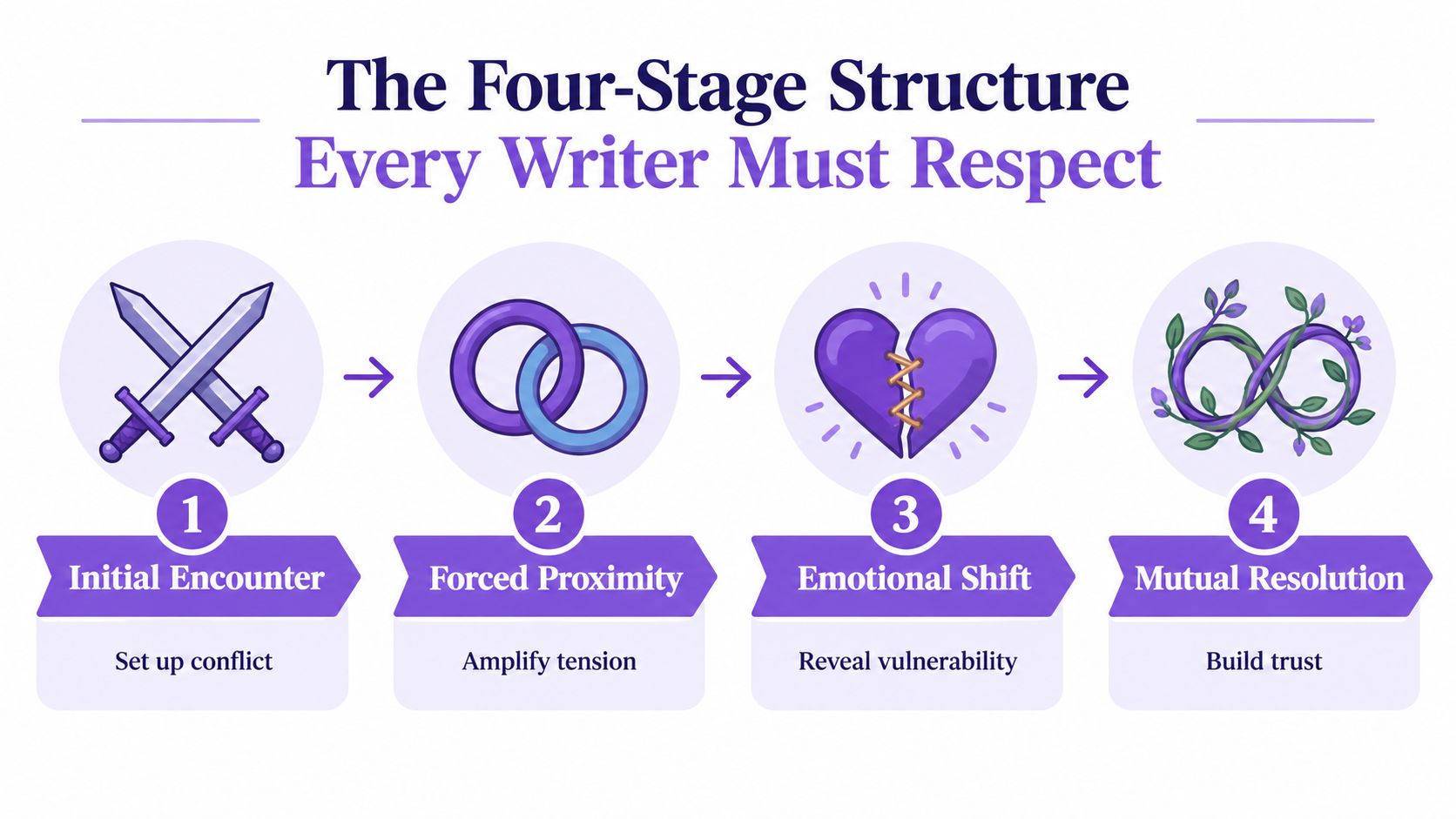
Initial conflict establishes opposing positions, not manufactured irritation. Give each character a defensible reason to resist the other. A political negotiator may see compromise as survival while a commander sees it as surrender. A workplace rival may believe process protects the team while the other trusts improvisation. The conflict should generate decisions, not merely insults.
Forced proximity must be causal. A shared assignment, captivity, treaty, investigation, inheritance, or professional obligation can work because it removes the easy option of walking away. The device fails when the characters could leave at any moment but stay only because the plot needs another argument. Track the practical constraints. Who controls the room, resources, information, transport, or timetable? Those details determine whether proximity creates tension or feels contrived.
Building connection requires scenes that update the reader's understanding. Shared adversity helps, but it isn't enough on its own. The characters need new evidence about each other's values, competence, and limits. A small act of restraint can matter more than a grand rescue if it directly contradicts the initial belief.
The relationship begins after the manuscript has earned a changed interpretation, not merely physical access. Before the first kiss, identify the belief each character can no longer sustain. The three-act structure glossary can help place reversals, but the emotional sequence still needs its own tracking. A plot turn can force them together. It can't make them trust each other.
The structural model also works as a chapter audit. Mark the first clear conflict, the point of no easy separation, the first unguarded connection, and the scene where mutual choice replaces tactical dependence. If several chapters pass without one of those functions advancing, the romance is idling.
Here is a visual treatment of that architecture in motion:
Converting Conflict into Intimacy Scene by Scene
The scene-level test is simple and brutal. Each encounter must do two jobs: change the external situation and alter the internal relationship. If the characters argue for three pages and finish with the same information, the same assumptions, and the same advantage, the scene is decorative.
Start by assigning the interaction a surface objective and a relational consequence. The surface objective might be securing passage, hiding evidence, winning a negotiation, or escaping a threat. The relational consequence might be that one character discovers the other protects civilians, refuses an easy betrayal, or understands a private fear. Don't announce the second function in the prose. Let the action force it into view.
Dialogue works best as a contest over interpretation. One character makes a claim about the other, and the other person either confirms, complicates, or disproves it. Banter becomes useful when it carries risk. An insult that lands on a real insecurity changes the relationship. A retort that reveals unexpected knowledge changes it again. Repeated quips with no new exposure are just the manuscript clearing its throat.
Practical rule: Make the characters earn every softer exchange by paying for it with information.
The turning point shouldn't be a generic romantic gesture. Flowers, gifts, and dramatic rescues can work, but only when they cost the giver something specific. A proud strategist admitting a tactical mistake in front of allies carries weight because it damages status. An enemy handing over evidence that could secure victory carries weight because it creates vulnerability. The action must contradict the character's established survival strategy.
Use a progression such as this, but make each beat concrete:
- Pressure exposes the default defense. One character attacks, withdraws, controls, jokes, or lies.
- The other character responds with unexpected precision. They don't magically heal the defense. They read it accurately.
- A practical choice creates trust. Someone protects the other's agency, keeps a confidence, or accepts a disadvantage.
- The next conflict tests the new knowledge. The character must act differently when reverting would be easier.
That last step separates a turning point from a mood. In the scene and sequel framework, the scene changes circumstances, while the sequel lets the characters process what the change means. Enemies-to-lovers drafts often skip the processing because the author wants to reach the next charged encounter. Don't. The pause is where attraction becomes interpretation, and interpretation is what makes the eventual choice credible.
Navigating Subgenre Variants and Reader Expectations
“Enemies” covers more than one reader contract. Fanlore draws a useful boundary between enemies to lovers, where characters may stand on opposite sides of a war, battle, or feud, and rivals to lovers, where the conflict is competition without that larger violent division, as explained in Fanlore's trope distinction. Treating those labels as interchangeable can miscalibrate the entire manuscript.
A workplace rivalry usually depends on competence, status, ethics, and professional consequences. The characters need reasons to keep collaborating after the attraction appears, and the power dynamic must remain legible. A fantasy romance involving opposing courts can support betrayal, political danger, and divided loyalties, but the manuscript must clarify what intimacy risks for each faction. Romantic fantasy readers may accept broader external stakes, while contemporary romance readers often expect closer attention to workplace boundaries and practical consequences.
Romantic fantasy currently gives the trope substantial room to mutate. One 2026 reader-demand analysis ranked enemies to lovers fourth among 56 romantic-fantasy tropes, with 341 mentions over 28 weeks, as reported by Just Love Publishing's romance-trend analysis. That finding supports a useful editorial conclusion, not a shortcut: a recognizable trope still needs precise positioning.
Dark romance changes the calibration again. A dangerous dynamic can be intentional, but the narrative should know whether it is presenting danger, condemning it, or romanticizing it. Spice doesn't repair a weak transition from harm to trust. Neither does darkness. Decide which behaviors your readership is meant to experience as thrilling, alarming, unforgivable, or transformed, then make the manuscript's consequences agree with that decision.
Avoiding the Toxic Trap and Common Pitfalls
The line between high-conflict romance and abuse isn't mysterious, but manuscripts often blur it because the author wants the antagonism to feel intense without accepting its consequences. Start with the source of the conflict. A political disagreement, professional rivalry, or inherited feud gives the characters room to revise their positions. Persistent humiliation, coercion, stalking, or violence requires accountability that cannot be replaced by attraction.
Rivals and bullies aren't the same. Rivalry preserves the other's status as a person and opponent. Bullying seeks submission. If one character repeatedly targets a vulnerability, controls access to safety, or punishes refusal, the story needs to treat that behavior as a central moral problem rather than flirtation with sharper dialogue.
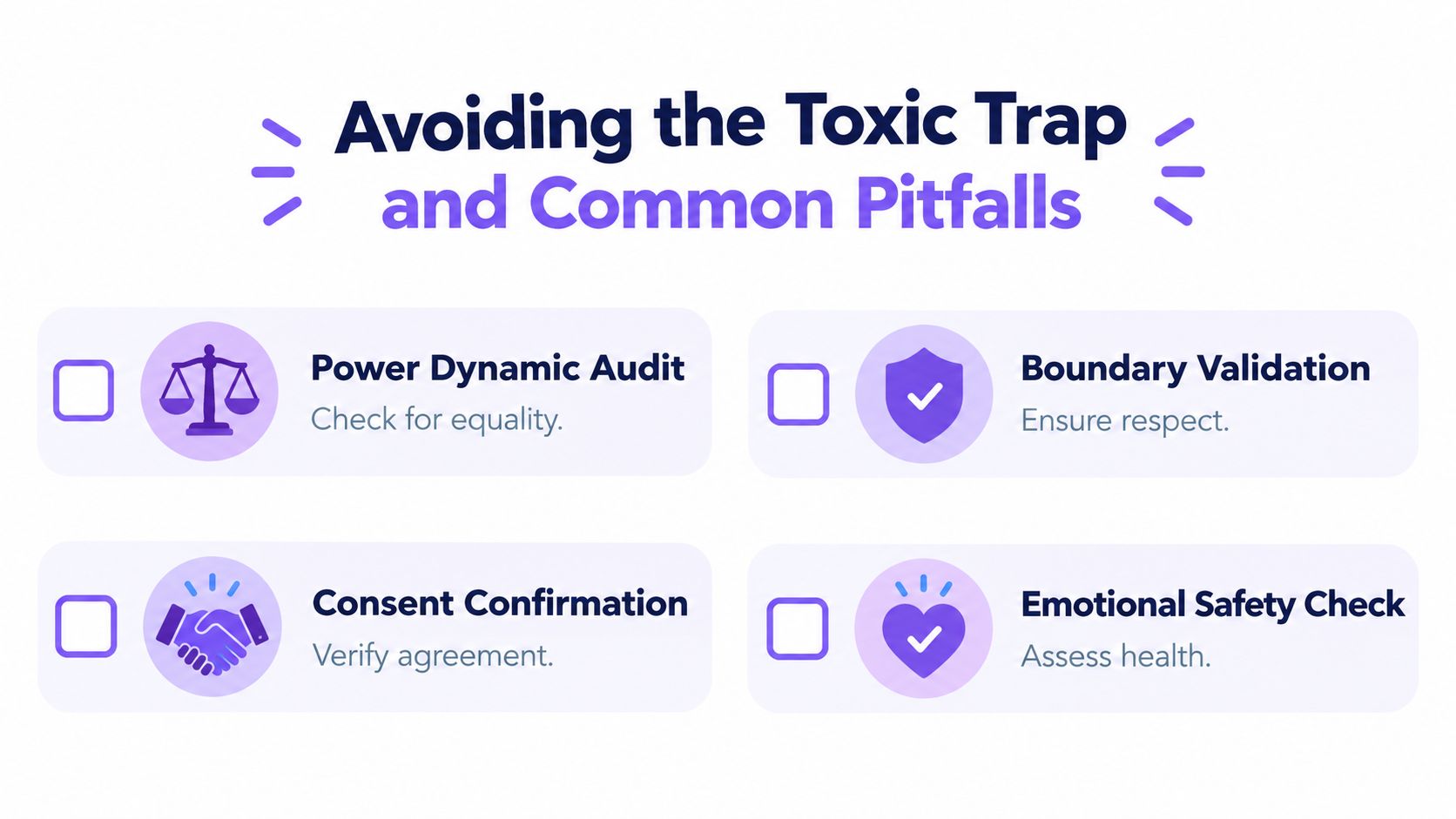
Audit the draft at the level of behavior, not intention. A character can believe they're protecting someone and still remove that person's agency. A character can be traumatized and still be responsible for what they do. Backstory explains pressure. It doesn't erase impact.
| Audit question | Healthy dramatic pressure | Predatory shortcut |
|---|---|---|
| Power | Authority shifts or is openly negotiated | One person controls the other's options |
| Boundaries | Refusal changes the interaction | Refusal becomes a challenge to overcome |
| Consent | Desire is confirmed through action and choice | Silence or fear is treated as agreement |
| Repair | Harm receives specific acknowledgment and changed behavior | A kiss ends the conflict without repair |
The romantic payoff must be proportional to the damage that came before it.
The most common failure is unresolved transition. The characters stop fighting because the plot requires a kiss, not because either person has developed empathy. Another is the false apology, where a character says “I'm sorry” while defending the conduct that caused the injury. Rewrite the scene until the apology identifies the act, the consequence, and the change in behavior.
Track setbacks in good faith. A betrayal after intimacy can deepen the arc if it forces both characters to reassess trust. It becomes cheap melodrama when the secret exists only to delay the relationship. Every reversal should reveal a limit in the new bond and create a decision that demonstrates whether the characters have changed.
Tracking Character Dynamics Without Losing Your Mind
Most character profiles fail because they're static documents. They record appearance, history, preferences, and perhaps a few notes about motivation, but they don't record who knows what after Chapter 17, which promise was broken in Chapter 29, or why a character who distrusted leadership suddenly follows an order in Chapter 42.
That difference separates a character-development document from a character-tracking system. Development documents help you design a person. Tracking systems preserve continuity as the manuscript changes. For enemies to lovers, you need the latter because the relationship is a sequence of state changes, not a fixed trait.
Track each major interaction as an update. Record the characters' public position, private belief, known information, current power, and emotional residue after the scene. If Character A hates Character B in Chapter 3 but admires their leadership in Chapter 7, the manuscript must show how that admiration entered the record. If Character B doesn't know about the betrayal until Chapter 24, earlier reactions can't rely on that knowledge.
At scale, spreadsheets become brittle. You duplicate names, forget to update relationship labels, and miss contradictions buried in scenes you revised months earlier. A tool that extracts character details and knowledge states from the manuscript can reduce that manual burden, particularly when the book includes recurring characters, multiple timelines, or a large cast.
Novelium's Character Tracker and World Codex automatically extract and track character details across manuscripts, including traits, knowledge states, relationships, events, and continuity issues. That gives you a practical way to inspect whether the conflict-to-intimacy pipeline is visible on the page instead of relying on memory.
Novelium can help you audit enemies-to-lovers dynamics by tracking character knowledge, relationship changes, and contradictory details across a long manuscript. Visit Novelium to examine your draft systematically before a continuity error turns earned tension into accidental nonsense.