Email List Development for Novelists: What Actually Works
“Grow your list” is lousy advice when nobody asks who's joining. A novelist doesn't need a database full of people who wanted a giveaway and can't remember the author's name. You need readers who recognize the series, expect your messages, and want the next book.
Email list development is audience selection, not address collection. For authors juggling several series or pen names, consent and segmentation aren't footer housekeeping. They determine whether your launch feels like welcome news or an interruption.
Signup Conversion Benchmarks to Plan Around
A higher signup rate is a weak target if those people never open a launch email. Plan from a modest baseline, then keep the readers who actually want the series.
Signup form conversion benchmarks
| Form type | Overall average (Claspo roundup) | Best fit for a novelist |
|---|---|---|
| Single email field | About 3.5% | Series homepage with one clear promise |
| Multi-step form | About 3.5% | Asking genre or reading stage before the email field |
| Teaser-based form | About 3.5% | Showing an opening excerpt before the email field |
Claspo's signup-form benchmark roundup reports average signup conversion around 3.5%. Use that one figure as a planning proxy across these layouts. It is not a conversion rate earned by a particular form.
A single-field form fits when the series page already does the persuading. A multi-step form lets readers name genre or reading stage before the address, which is segmentation you can store with consent instead of tracking them around the web. A teaser puts an opening excerpt before the field. Choose it when the prose is what should earn the address, and when you want people who picked the voice rather than a random giveaway.
Run the current form unchanged for two weeks. Split visitor-to-subscriber conversion by traffic source, device, and landing page. Readers from a finished novel's back matter are not the same traffic as giveaway visitors.
Testing rule: Change the promise, asset, layout, or form mechanics individually. Otherwise, you won't know what caused the result.
Judge the winner by qualified subscriber rate: subscribers who later click a book page or buy, not raw opt-ins. A smaller self-selected list beats a bigger scraped one. Consent and clear segments protect deliverability and reader trust, while a bloated list of people who never asked for the series trains ignores and bounces. Your author platform should connect interested readers to the books.
For an acquisition checklist beyond form design, Mailbeam's responsible email list growth tactics is a useful companion. Keep permission quality inside the test.
Double opt-in cuts mistyped and fabricated addresses and adds a step. Compare confirmation completion by acquisition source before you blame that step for every lost subscriber. I would rather drop the casual signup than mail a list that bounces and teaches readers to skip the next book.
Choosing a Lead Magnet Readers Will Trade For
A free asset selects an audience. Choose it for the reader you want buying your books years from now, not the easiest signup this month.
Use the desk exercise below to separate story assets from writer-facing resources before building anything.
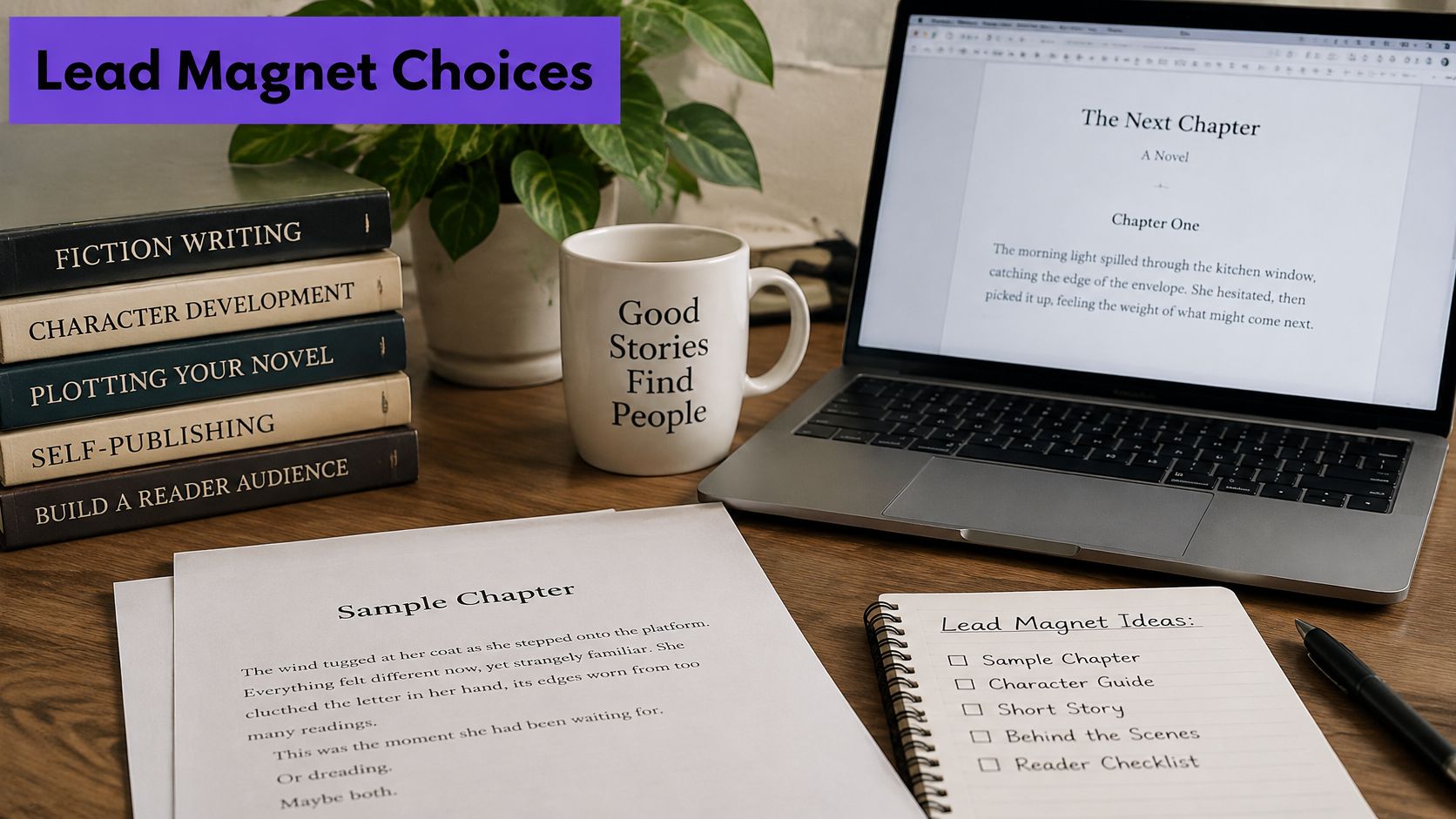
Lead magnet types and the readers they attract
| Lead magnet | Reader it attracts | What it converts into |
|---|---|---|
| Sample chapter from the book in progress | Readers who want that specific book | Strongest route to book-page clicks and preorders, if the chapter is clean |
| Prequel short story in the same world | Readers of the series who want to start at book one | Strong for series backlist and first-book sales |
| Annotated chapter with revision notes | Other writers | Subscribers who rarely buy fiction |
| Writing template | Writers looking for templates | Wrong audience for a novel |
Treat those outcomes as selection logic, not guaranteed conversion results. Writers buy fiction too, but downloading your revision worksheet doesn't establish interest in your space opera.
A sample chapter makes a direct promise about a particular book. A prequel offers a doorway into the series. An annotated chapter promises professional discussion, which is a different relationship entirely.
For broader acquisition mechanics, the Rebus guide to building email lists provides a useful planning reference. Your novelist-specific filter remains simple: does this asset attract someone who wants the story you're selling?
Your giveaway needs a canon check
Run competing assets through the same form and acquisition channel, changing only the asset. Compare downstream book-page clicks and purchases.
Then check continuity before release. Subscriber fiction becomes published canon in the reader's mind. Say your prequel leaves a signet ring with the protagonist's sister, but a later novel claims he's carried it since childhood. That's not a mailing problem. It's a contradiction you've distributed directly to your keenest readers.
Static character profiles won't catch that reliably. They describe a person, not who held an object or knew a secret at a particular scene. A useful tracking system records knowledge, possession, location, relationships, and dates, then changes as the manuscript changes. Favorite foods can wait.
The Welcome Sequence That Delivers the Promise
The welcome sequence isn't an excuse to introduce your entire publishing business. Its job is to fulfill the signup agreement and establish a recognizable relationship.
Use this schedule as a starting template, then adapt the spacing to the cadence you've promised.
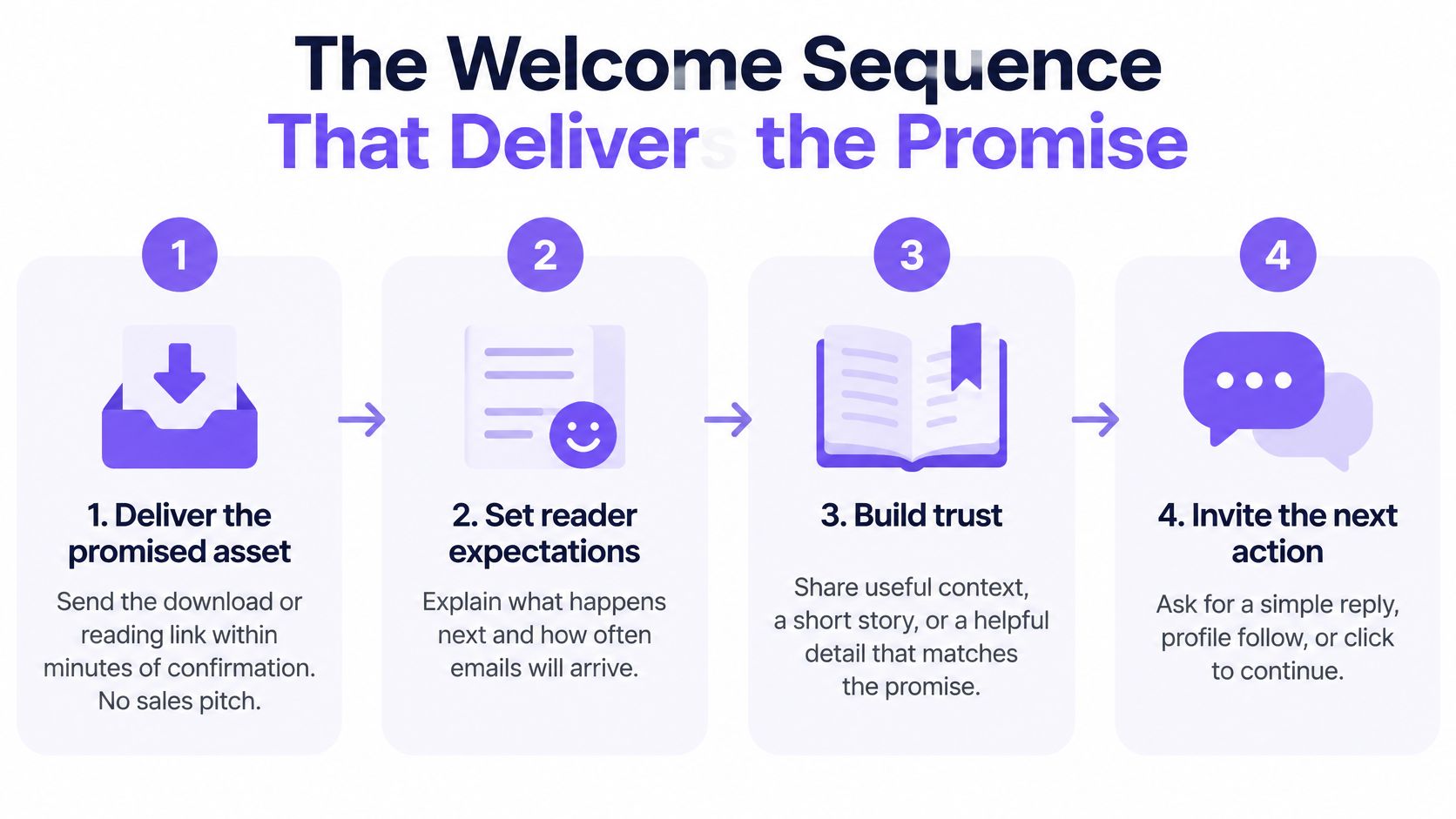
Deliver the asset within minutes of confirmation. Put the download or reading link at the top, with a brief reminder of what the reader requested. Skip the sales pitch, because making someone hunt through promotional copy for their chapter starts the relationship badly.
On day two, set expectations. State the content and frequency plainly, such as a monthly update plus launch notices for the selected series. This message belongs early because readers need to understand what they joined before regular campaigns begin.
On day five, make it about the book. Send a short excerpt or behind-the-scenes detail connected to the promised story. Give the reader something enjoyable without turning the message into your production diary.
On day nine, ask a preference question. Ask which series or format they want, then tag the answer. Keep the choice easy enough to answer without composing an essay.
Test the reader's experience
The common failure isn't complex. The automation sends a generic newsletter instead of the asset, or asks several questions before giving the reader any reason to answer.
Test confirmation, delivery, mobile reading, and tagging using an address that hasn't already passed through your system. Existing subscriber records can conceal broken entry conditions or skipped messages.
For a companion walkthrough, use this video alongside your own end-to-end test.
A useful welcome sequence makes the next message unsurprising.
During the opening fortnight, look for an asset click, a genuine reply, or a preference answer without a sudden unsubscribe spike. Don't demand every action from every reader. Someone who downloads the story has still received what you promised.
Segmenting Subscribers Without Invasive Tracking
Stop building segments around who supposedly opened an email. An open doesn't establish that someone read your chapter, much less wants another pen name's release.
Litmus's email marketing trends guidance recommends zero-party data, information subscribers deliberately provide, as privacy protections make inferred engagement less dependable. That's a better fit for authors handling unpublished material and beta-reader information than increasingly elaborate surveillance.
Start with an optional genre choice at signup. Ask about reading stage during the welcome sequence, such as new to the series or caught up. Ask about ebook, print, or audio preference later, when the answer will change what you send.
Privacy rule: If a field won't change the reader's experience, don't collect it.
Separate interests from permissions
Keep newsletter consent and launch-announcement consent distinct. A request for free chapters isn't blanket agreement to every preorder campaign you can devise. Record the signup wording and source alongside the preference, so you can establish what the reader accepted.
Pen names need their own boundaries. Say someone joins for your cozy mysteries and later receives a grimdark promotion under an unfamiliar name. Sharing a database doesn't make those audiences interchangeable. Segment by the identity and series the reader recognized.
Give subscribers a preference center where they can change genre and frequency without contacting support. Let them leave altogether without forcing a preference negotiation.
Set a fixed retention window that fits your publishing cadence, then delete or re-permission contacts who show no meaningful activity within it. Don't classify someone as inactive merely because they haven't opened a tracking pixel.
I'd take the smaller, self-selected list over the larger scraped one. Readers who deliberately chose the relationship give you usable preferences and fewer reasons to send irrelevant mail. Replies, clicks, complaints, and sending behavior are operational signals, not just dashboard decoration. Collect less information, but make the information you keep actionable.
Metrics and Deliverability Limits That Govern Scale
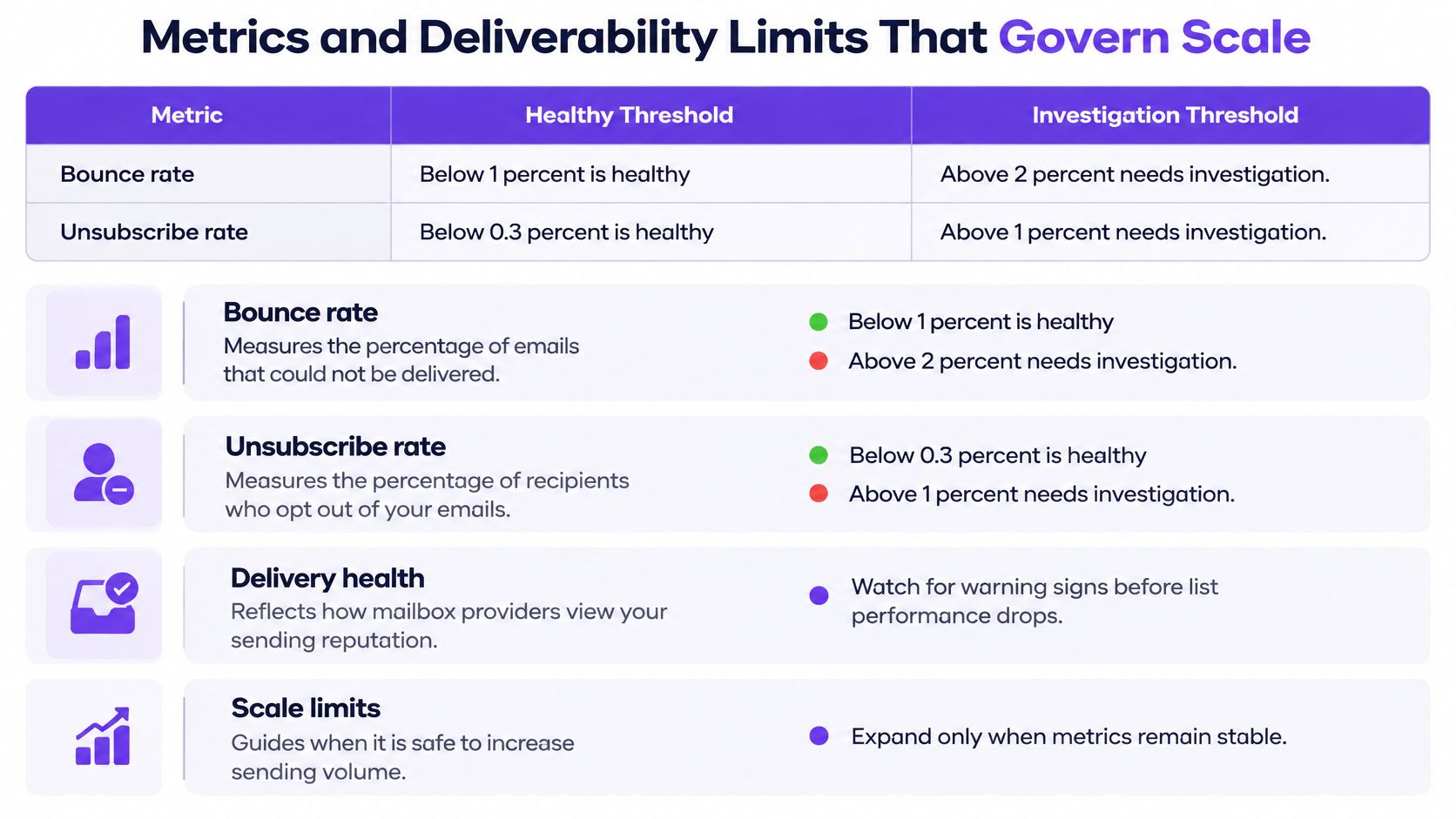
List health thresholds and what to do
| Metric | Healthy range | Act when |
|---|---|---|
| Bounce rate | Below 1% | Above 2% |
| Unsubscribe rate | Below 0.3% | Above 1% |
| Spam complaint rate | Aim below 0.1% | Approaching 0.3% |
| Open rate | Directional only, never proof of engagement | Open rate rises while clicks fall |
Klaviyo's deliverability guidance supplies the below 1% bounce and below 0.3% unsubscribe health benchmarks, with investigation above 2% and 1%, respectively. Gmail's complaint guidance, summarized by TechRadar, requires staying below 0.3%, with a best-practice aim below 0.1%; at 10,000 delivered messages, those percentages represent 30 and 10 complaints.
Use the visual as a campaign-review prompt, not permission to ignore deterioration below a threshold.
The Global Statistics reports average monthly email-list growth of 2.5% in 2025, with top-performing organizations reaching 8–12%. Those aren't novelist-specific targets.
Calculate net growth consistently:
List-growth rate = (new confirmed subscribers − unsubscribes − suppressed addresses) ÷ starting list size.
Scale the infrastructure too
Gmail's bulk-sender guidance applies at 5,000 or more daily messages to Gmail accounts, not that many total subscribers, and calls for SPF, DKIM, DMARC, and sending-domain alignment through SPF or DKIM. Authentication isn't a substitute for permission.
Google's unsubscribe requirements require bulk subscribed marketing messages to support header-based one-click unsubscribe, show a visible body link, and process opt-outs within two days. Suppression must reach scheduled launch messages too.
Suppress hard bounces immediately. Don't buy addresses, and don't treat a valid mailbox as evidence of consent.
Acoustic's email metrics analysis warns that privacy-related automated activity inflates opens. Act on unique clicks, sample-chapter clicks, preorder clicks, conversions, and complaints instead. Review every campaign by acquisition source, because an apparently acceptable overall result can hide a damaging signup channel.
Launch Sequences and Drip Campaigns That Sell Books
Treat a book launch as an agreed sequence, not a sudden demand for attention. The following is a proposed schedule, not a universal conversion formula.
- Two weeks before release, send an opening excerpt with the preorder link to readers who selected that series and launch notices.
- Five days before release, send a reminder with a fresh reason to care, not the same message with a louder subject.
- On launch day, put the buy link prominently and offer retailer choices on the destination page.
- At the end of the launch window, send a closing note without inventing scarcity for a book that remains available.
A subscriber who joined for chapters and then heard nothing won't necessarily welcome a sales run. After a long quiet period, send a re-permission message before enrolling dormant contacts in launch promotion.
Keep the backlist moving
- Monthly series message: Send relevant reading context or a bridge from the book just finished to the next.
- Six-week entry-point message: Offer new subscribers a prequel or sample chapter, excluding anyone who already received it.
- Preference-based routing: Keep every send inside the reader's chosen series and format interests.
Don't pile these schedules together blindly. Exclude subscribers from routine drips while they're receiving the launch sequence.
Pasteable launch structure: Subject option A: [character + immediate problem]. Subject option B: [series + release news]. Hook: [one sentence]. Excerpt: [short passage]. Action: [single book-page link]. Footer: [plain unsubscribe line].
Test the subject alternatives without changing the body simultaneously. Compare preorders per 1,000 subscribers and unsubscribes per send against your previous launch, using equivalent segments and measurement windows.
Confirm Your Signup Path This Month
A larger list is the wrong goal if those readers never chose the mail you are about to send. Confirm the signup path before the next release. More traffic will not repair a broken promise, a muddy permission, or a chapter that contradicts the series.
I would hold paid traffic and the next promotion until these checks pass.
Send yourself the complete welcome sequence. The asset has to match current canon, not an abandoned draft. Novelium tracks character traits, knowledge states, relationships, and events across manuscripts, including the timeline, so the giveaway chapter and the next release can agree. Notes record intention. Tracking has to follow scene-level changes, such as when a witness learns the murderer's identity. Start free on Novelium, bring in your manuscripts and notes, and check that chapter against the books readers already know.
Open the live form. Keep newsletter and launch consent separate, both unticked. Labels inside the email service are not the form a reader submits. An unticked box keeps the list smaller and the complaints lower, which is the trade that protects inbox placement.
Confirm SPF, DKIM, and DMARC before a large send. Resolve failures before you upload the launch audience.
Test header-based one-click removal and the visible body link. Promotional automations have to respect the suppression. Readers who cannot leave will use the spam button.
Finish the fortnight's conversion measurement. Inspect bounce, unsubscribe, and complaint rates on the latest three campaigns. Test every entry point, including back matter. The homepage form does not stand in for the rest.
Fix the weakest step before you buy traffic. Scale when the promise, the permissions, delivery, and the story still hold. For a series author, the smaller self-selected list beats a bigger scraped one.