Editing Software for Books: The Novelist's Guide
For an 80,000-word novel, no single tool replaces a human editor for prose quality. Specialized tracking software catches continuity errors that ordinary proofreading misses, especially when a manuscript contains a large cast, several timelines, or recurring locations and objects.
That distinction matters because the most expensive errors in fiction rarely announce themselves with a red underline. A spell-checker can catch a typo. It won't notice that your detective recognizes a clue before anyone has shown it to him, or that a character arrives in Paris before the train journey has happened. In a long manuscript, the problem isn't clean sentences alone. It's preserving the book's internal logic while the story changes underneath you.
A conventional novel generally falls around 70,000 to 100,000 words, with 80,000 to 90,000 words a comfortable range for literary fiction and many commercial categories, according to this continuity guide for novelists. At that scale, editing software for books needs to remember more than the last paragraph. It needs to connect details across chapters, distinguish established facts from later revelations, and show you where the manuscript contradicts itself.
Why Standard Editing Tools Fail Novelists
Spell-checking is useful. It just isn't the same thing as editing a novel.
Standard word processors work exceptionally well at the sentence level. They identify misspellings, flag some grammatical constructions, and make it easy to search for repeated words. They don't understand that Mara's left arm was broken in chapter four, that she spent three weeks in a cast, and that she shouldn't be climbing a ladder unaided in chapter six unless the manuscript explains the recovery.

The silent failures are structural and contextual. A character knows about a private conversation they didn't attend. A dead character walks back into the story. An object moves from the kitchen to the study without anyone carrying it. A journey takes one afternoon even though earlier passages establish a multi-day route. None of these errors necessarily produces a grammatical mistake.
The profile problem
Most character profiles fail because they're written as static documents. They record eye colour, height, occupation, family history, and perhaps a polished paragraph about personality. That information can be useful, but it doesn't answer the questions that become dangerous in a complex draft.
What did this character know at the end of chapter nine? Who told them? Did they believe the information, reject it, or misunderstand it? Which injury, relationship, possession, or location changed during the story? A profile that never changes can't answer those questions.
Practical rule: If a reference sheet doesn't point you to the scene where a fact was established or changed, it's an archive, not a tracking system.
That gap explains why experienced writers still find continuity problems late. They know the story intimately, which helps them create it and makes them dangerously familiar with its intended version. The manuscript contains the actual version. Those two versions drift apart during rewrites.
The Fragmented History of Book Software
Book software didn't begin as book software. It inherited its basic machinery from general word processing, which developed from specialized computer tools in the early 1960s into personal-computer applications during the 1980s and early 1990s. Products such as Electric Pencil and Easy Writer appeared in the mid-1970s, IBM released its Personal Computer in 1981, and programs including WordStar and WordPerfect made long documents increasingly manageable. By the mid-1980s, more than 300 word-processing software versions existed, a sign of a fragmented market before consolidation, as documented in the history of word processing.
Microsoft Word entered the Mac OS market in 1986 and Windows three years later, helping establish a dominant standard by roughly 1990. Google Docs, launched in 2006, added a browser-based model centred on collaborative editing. The result wasn't one perfect writing environment. It was a division of labour between compatible document tools and applications built around long-form structure.
Author preferences reflect that split. In a 2024 survey of 1,007 independent authors, Scrivener was the primary drafting tool for 38%, Microsoft Word for 31%, and Google Docs for 14%, according to the reported comparison in this author software survey. Scrivener's share had fallen from 47% in 2021, while the three leading tools together represented 83% of primary-tool responses.
The lesson isn't that one platform won. It's that novelists use different tools for different pressures. Drafting, restructuring, collaborative review, formatting, and continuity analysis are separate jobs because the software evolved along separate paths.
Comparing the Big Three for Long-Form Fiction
Under the stress of a full-length manuscript, Scrivener, Word, and Google Docs occupy different positions. Treating them as interchangeable creates needless friction.
| Tool | Best For | Limitation |
|---|---|---|
| Scrivener | Structural drafting, chapters, scenes, research, and reordering | Basic proofreading and weak real-time collaboration |
| Microsoft Word | Editorial review, Track Changes, comments, and delivery standards | One large linear document becomes cumbersome to restructure |
| Google Docs | Browser access and real-time collaboration | Less specialised support for complex long-form organisation |
Scrivener's document-oriented architecture is excellent for novels. Chapters, scenes, research files, and notes remain separate items inside one project, and the binder, corkboard, and outliner let you move material without turning every structural change into a cut-and-paste operation. Project targets can track manuscript and section word counts, while Compile exports to Word, PDF, ePub, and plain text. Capterra's Scrivener review captures the trade-off clearly: the application is strong for structure and reordering, but its spelling support is basic rather than a full grammar, style, or readability edit.
Word becomes indispensable when other people need to work through the manuscript. Track Changes records insertions, deletions, and formatting changes. Comments preserve the conversation between editor and author. Changes can be accepted, rejected, or inspected instead of replacing the original text without notice. Word also supports real-time co-authoring through OneDrive, while Scrivener generally requires controlled file-syncing rather than built-in concurrent editing, as outlined in this Scrivener workflow review.
Google Docs is the practical choice when access and simultaneous review matter more than manuscript architecture. It removes the file-version shuffle and lets collaborators work in the browser. It doesn't replace Scrivener's chapter-level organisation or Word's established editorial exchange, but it can be useful for shared notes, beta-reader feedback, and targeted review.
A sensible pipeline is therefore not “pick the best app.” Draft and restructure in Scrivener, move to Word when an editor needs granular revision control, and add a continuity layer that examines the manuscript as a connected system. The relevant question is not whether Novelium or Scrivener fits your process. It's which job each tool can perform without making the next job harder.
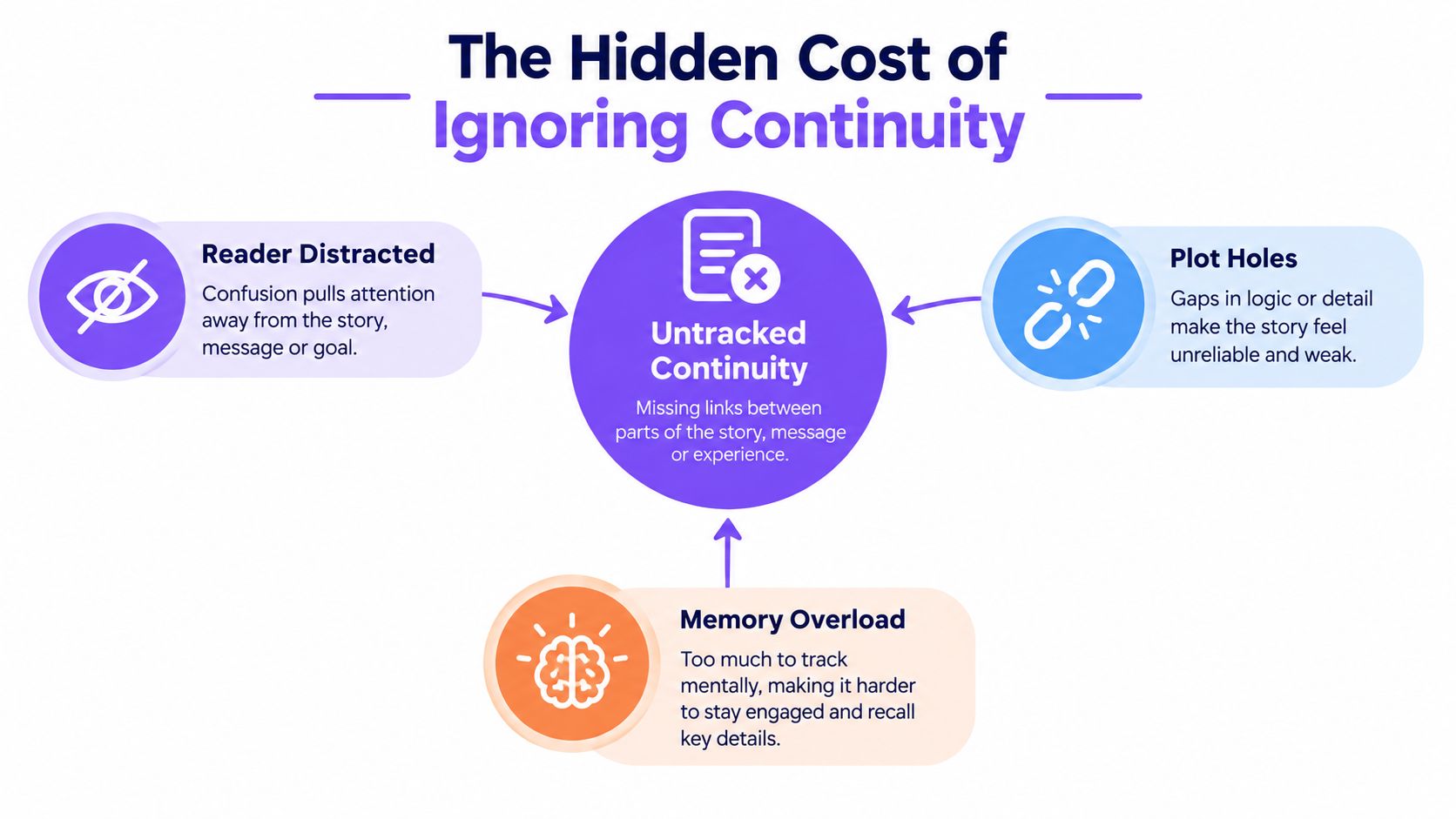
The Hidden Cost of Ignoring Continuity
A continuity error is a break in the story's established facts, sequence, or causal logic. It can be small enough to survive a sentence edit and large enough to pull a careful reader out of the book. The continuity error glossary describes the category broadly, but manuscript reviews reveal how ordinary the failures are.
A character leaves a hotel carrying a revolver, enters the next scene empty-handed, and later fires the same weapon. The draft never explains the transfer. A woman is pregnant for so long that the seasonal setting changes twice, yet nobody notices the timeline. A child is described as eight in one chapter and seven in another, not because the author intended a time shift, but because an old description survived a revision.
Static files cannot track moving stories
A spreadsheet can store a character's eye colour. It can't automatically find every later mention, decide whether a change is deliberate, or distinguish a revealed false identity from an accidental contradiction. Reference sheets work when they're checked against the manuscript's actual claims, not when they're treated as the author's unquestioned canon. This guide to tracking continuity makes the important distinction between recording a value and locating every passage that asserts one.
The same problem affects timelines. A chapter list tells you order, not elapsed time. If the manuscript says a character reached a village after three days, then describes the next scene as Monday when the journey began on Monday, the software needs to represent duration rather than merely sort chapters.
A useful audit records the scene or chapter, in-world date, relative day count, injuries, pregnancies, school terms, seasons, ages, and journey duration. Assigning Day 1, Day 4, and Day 12 before choosing calendar dates can expose arithmetic failures without forcing the author to settle the entire calendar prematurely.
What Character Tracking Requires
A character profile describes identity and development. Character tracking records the changes that affect the manuscript: what a person believes, when that belief shifts, and which scenes support it. Treating those as one document creates a reference file that looks complete but cannot audit a finished novel.
A static character bible might describe a detective as observant, distrustful, and estranged from his brother. Tracking must follow the evidence and the interpretation attached to it. In scene three, he sees a bloodstained coat. In scene seven, he learns the victim's name. In scene nine, he has “formed the wrong theory,” perhaps because the clues support a deliberate misdirection. By scene fourteen, he learns about his brother's connection.
That record lets an editor ask a sharper question than whether the plot has revealed the truth. Did the detective's theory remain reasonable from his perspective? Did a later scene revise his belief, or did the manuscript make him behave as though he knew the answer already? A tracking system should distinguish intentional misunderstanding from an accidental contradiction. The discussion of character continuity treats knowledge as a changing state rather than a permanent profile field, a useful model for complex fiction.
Track what can break
Track details that can alter a scene, a decision, or the reader's interpretation. Physical descriptions matter when they recur. Relationships matter when they change conduct. Objects matter when possession drives a plot. Worldbuilding that never affects the manuscript can remain outside the continuity audit.
A practical system follows:
- Knowledge states: What each character knows, suspects, believes, misunderstands, or has forgotten.
- Relationships: Who has met, betrayed, trusted, avoided, or misidentified whom.
- Physical changes: Injuries, disguises, pregnancy, ageing, haircuts, and other visible transformations.
- Causal events: What happened, who witnessed it, and which later choices depend on it.
A character bible for complex fiction earns its place when it evolves with the manuscript and links claims to scenes. Otherwise, it describes the intended novel rather than testing the one on the page.
Building a Professional Hybrid Workflow
Keep the tools that already work. Add structure where they stop working.
Draft in Scrivener if its binder and corkboard suit the way you build a novel. Keep chapters and scenes separate, maintain research outside the narrative, and use relative day numbers while the chronology is still moving. Scrivener is especially useful before the manuscript settles because restructuring doesn't require dragging paragraphs through one enormous file.
Run a basic language pass before sending the manuscript to anyone else. Correct obvious spelling, standardise names and place names, and decide which version of English the book uses. For production-heavy projects, a dedicated resource such as the best PDF toolkit for writers can help prepare working files and reviewable exports without turning the writing application into a typesetting battleground.
Move the stable manuscript into Word when an editor, co-author, or beta reader needs tracked revisions. Don't accept every change automatically. Preserve the revision history, resolve comments deliberately, and keep a clean master copy separate from the marked-up file. That separation protects the manuscript when several editorial passes overlap.
Then run a continuity audit against the manuscript itself. Check each major character's knowledge state, each important relationship, every physical change, object ownership, setting geography, and the elapsed time between events. A dedicated manuscript intelligence platform can import Word, Scrivener, Google Docs, and plain-text files, then surface timeline conflicts, character contradictions, plot-continuity issues, and inconsistent objects or information. Novelium also offers local manuscript processing, encrypted storage, and no training on submitted work, according to its product information.
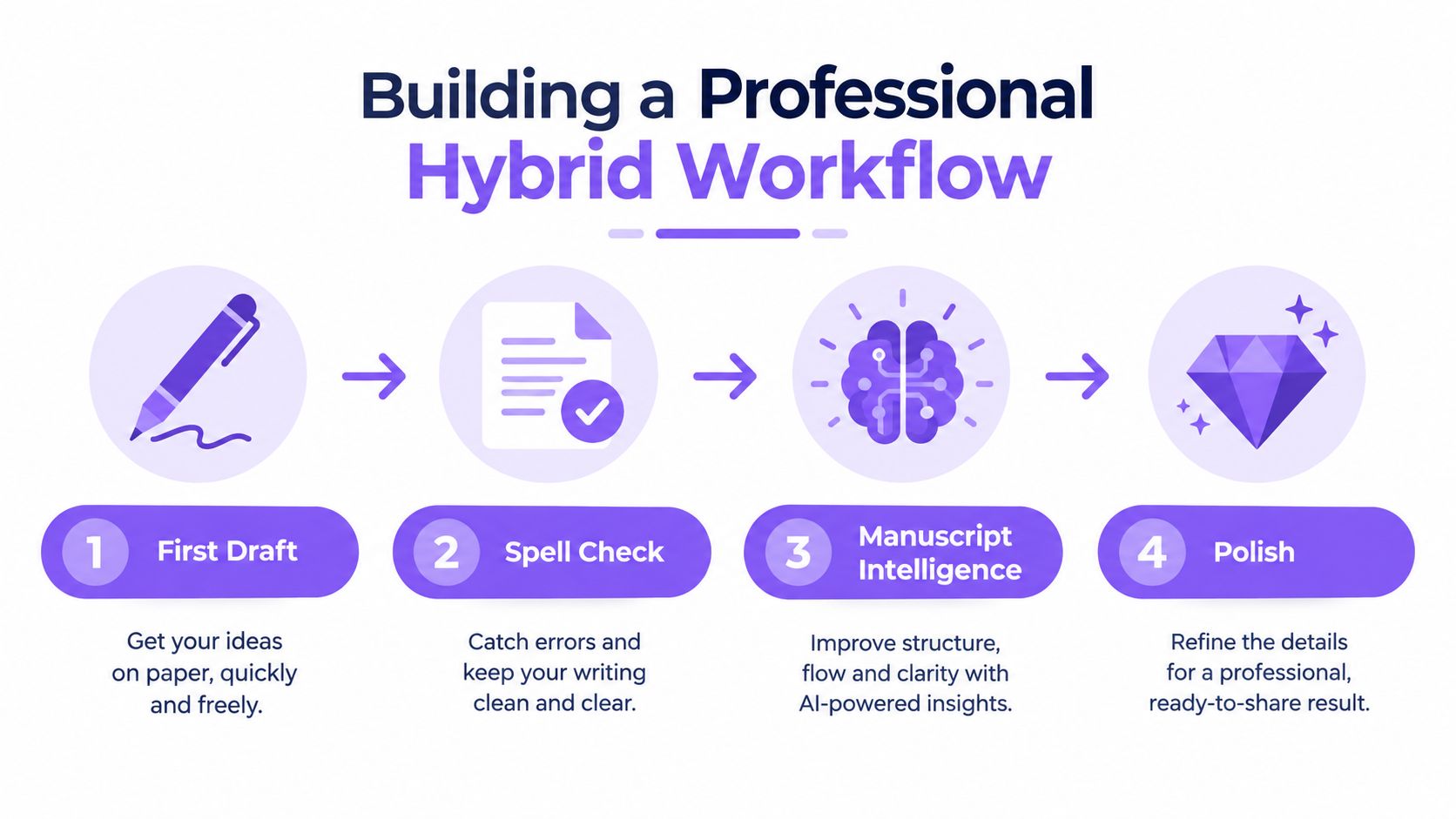
The final pass belongs to you. Verify every flag against the prose, because a deliberate transformation can resemble an error and a false belief can be essential to the plot. The software should show you where to look. It shouldn't rewrite the novel while you stop paying attention.
Novelium's Character Tracker and World Codex extract and track character details, relationships, events, timelines, and recurring world elements across a manuscript. Visit Novelium to run a continuity audit on your next long-form draft before beta readers find the impossible journey, missing injury, or suspiciously well-informed character.