Your Character Profile Is a Useless Museum Exhibit
Every writing guide tells you the same thing: your character needs a flaw. Arrogant, naive, stubborn—pick one from the list, check the box, and move on. That’s beginner advice, and it’s the first mistake that sets you up for an inconsistent, unbelievable protagonist by the time you hit page 300.
If you just define character flaws as simple labels, you're building a museum exhibit of your character, not a person.
Flaws Are Operating Systems, Not Labels
Let's kill the idea that a flaw is a static trait. It's not a sticker you slap onto a character profile and call it a day. Across an 80,000-word manuscript, a character's pride isn't a label; it's a dynamic system. It dictates their reactions, filters how they interpret the world, and evolves from chapter one to chapter thirty.

We've analyzed thousands of manuscripts, and the most glaring consistency failures don't come from a lack of flaws. They happen when a character's core flaw stops operating consistently under pressure. The author knows the flaw is there, but they haven't built the behavioral logic that powers it through the entire story.
The issue isn't contradiction. Characters should evolve. The problem is the absence of mechanics. Why did their deep-seated distrust suddenly vanish in one moment? Was it sheer desperation? A critical miscalculation? Without that underlying logic, the character’s action feels like an authorial shortcut, not an authentic moment of weakness or change. A character flaw isn't what your character is. It's the biased, unreliable, and often self-destructive code they run to interpret the world and make decisions.
Instead of just writing "arrogant" on a character sheet, define it as an operating system that runs a specific script: If challenged, dismiss the source. If praised, internalize it as fact. If faced with evidence of error, find someone else to blame. This system is predictable, but it also allows for nuance. What happens when the script fails? That’s where your plot and character arc are truly born. You can explore more about the psychological roots of character traits to see these connections. When you build a flaw as a system, you automatically create a framework for consistency. You're no longer asking, "What would an arrogant person do?" You're running the specific, unique code for your character's arrogance and seeing what output it generates. This is the difference between a flat character and one who can sustain the weight of a 100,000-word journey.
From Character Development Docs to Character Tracking Systems
That fifty-question character profile you spent a week filling out? It’s a snapshot. A carefully posed photograph of your character on page one, right before the chaos begins. The second your story’s inciting incident hits, that document is functionally useless. This is the central failure in how most writers are taught to think about characters.

The traditional profile encourages you to build a museum exhibit of your character. The profile becomes a static artifact, a relic of who they were before the story’s pressure started changing them. We see the damage this causes constantly in the manuscripts we analyze. An author’s notes will define a character as fundamentally “suspicious,” but then in Act Two, that character trusts a stranger because the plot requires them to get a piece of information. The author forgot the operating rules they set for their own creation. The flaw wasn't an integrated part of the character; it was a forgotten note in a separate file.
To manage a character across 300 pages, you must shift from character documentation to character state tracking. Documentation is a static record of the past. State tracking is a dynamic, real-time log of the present: what the character knows, who they trust, what they fear, and why—right now, in this scene. Your character profile is an origin story. Your manuscript is the real-time log of every choice that proves it wrong. The gap between the two is where your story lives.
This distinction is a game-changer for any writer wrestling with a complex plot. We’ve all seen the endless debates about plotters vs. pantsers, but both camps fall into the static profile trap. A plotter can outline a perfect arc that their character's later behavior contradicts. A pantser can lose the thread of their character's internal logic halfway through a draft.
Think of your character's flaw not as a trait but as a variable. If character.trustLevel = 2 on a scale of 10, what specific event would it take to raise it to a 3? What would drop it to a 1? A static profile just says “distrustful.” A dynamic tracking system logs the events that change that state. Consider a common failure: a pragmatic, ruthless leader who makes a suddenly sentimental choice that jeopardizes everything. The profile says she’s “ruthless,” but the scene needed a moment of heart. The author forces the action, creating a plot hole that feels like a character betrayal. A state-tracking mindset would have forced the author to answer the tough questions first. What event was powerful enough to temporarily override her core programming? Did she just suffer a loss that cracked her emotional armor? Was she manipulated by someone exploiting a hidden vulnerability? Answering these questions creates a chain of cause and effect that makes her sentimental choice feel earned and impactful, not like a mistake.
The Difference Between a Flaw and a Plot Hole
A true flaw has its own internal logic, even if that logic is completely irrational. A plot hole is a bug in the code. It’s when a character's actions flatly contradict who you've told us they are, just to make the plot work. You've defined the rules of their flaw, but you aren't playing by them.
We see this in manuscripts constantly. A fiercely independent heroine spends two hundred pages refusing all help, then suddenly waits around to be rescued. It's not because her spirit is broken or trauma shattered her worldview. It's because the author wrote themselves into a corner and needed an easy out. Readers feel that cheat instantly. To prevent this, interrogate every major choice. Make sure their flaws create earned complications, not flimsy plot devices. Before you commit to an action that feels off, run a quick diagnostic:
- What is the flaw's core logic? If the flaw is paranoia, the logic is, “Always assume hidden motives and prepare for the worst.”
- Does this action violate that logic? If your paranoid character accepts a mysterious package from a stranger without a second thought, then yes, it does.
- What is strong enough to override that logic? A violation isn't a deal-breaker if you can justify it. Maybe his child's life is on the line, and taking the risky package is his only shot. That external pressure is now powerful enough to short-circuit his default programming.
If you can't point to a force strong enough to cause that override, the action is a plot hole masquerading as character development. It’s you, the author, pulling the strings. When a character acts against their core flaw without a powerful, story-driven reason, it's the loudest possible signal to a reader that you're cheating.
Flawed characters are often illogical. Their paranoia makes them misread people. Their pride makes them turn down help they desperately need. But their illogical behavior has to come from a logical internal system. We, the author, must understand the cause-and-effect, even if the character is clueless. A classic example we’ve seen is the "sudden coward." A battle-hardened warrior, whose identity is built on courage, suddenly flees a fight. The author meant it as a deep, humanizing moment. But nothing set it up. No crisis of faith, no traumatic trigger, no hint of PTSD to explain this 180. The result? The moment felt cheap. It wasn't a flaw revealing itself; it was a character acting like a puppet because the plot needed more tension. An authentic flaw would have been baked in from the beginning. Maybe his courage was always a mask for a deep-seated fear of failure, and this particular battle presented a scenario where failure was humiliatingly public. Now, the cowardice makes perfect sense. It’s the flaw’s internal logic running its course, creating an earned complication instead of a lazy contrivance.
Crafting Flaws That Resonate Instead of Alienate
Not all flaws are created equal. Some drag the heavy chains of societal stereotype, and this is where many otherwise solid manuscripts wobble. Slapping the ‘indecisive’ label on your female protagonist or making a character from a marginalized group ‘untrustworthy’ isn't just lazy—it's tapping into centuries of literary baggage.
This isn’t about being "politically correct." It's about writing compelling, active characters who don't accidentally kick your reader out of the story with a tired cliché. When we analyze manuscripts, we often spot flaws that feel less like a unique part of a person and more like a trope assigned along gender or cultural lines. Readers feel this instantly. It shatters the illusion because the flaw feels borrowed, not earned.
The key is to spot the difference between a character who is flawed and also happens to be passive, versus a character whose primary flaw is passivity. One is a person grappling with circumstances; the other is a plot device waiting for the hero to do something. This problem has deep roots. A computational analysis of over 87,000 works of fiction published between 1850 and 2010 uncovered a stubborn "gender agency gap." Male characters drove 53.6% of actions in cross-gender interactions, while female characters drove only 46.4%. The data shows a long-standing pattern of portraying female characters as more passive, reflecting biases that fiction both mirrors and reinforces. You can read the full analysis on this gender agency gap. When you hand a character generic passivity, you might be unintentionally continuing this pattern.
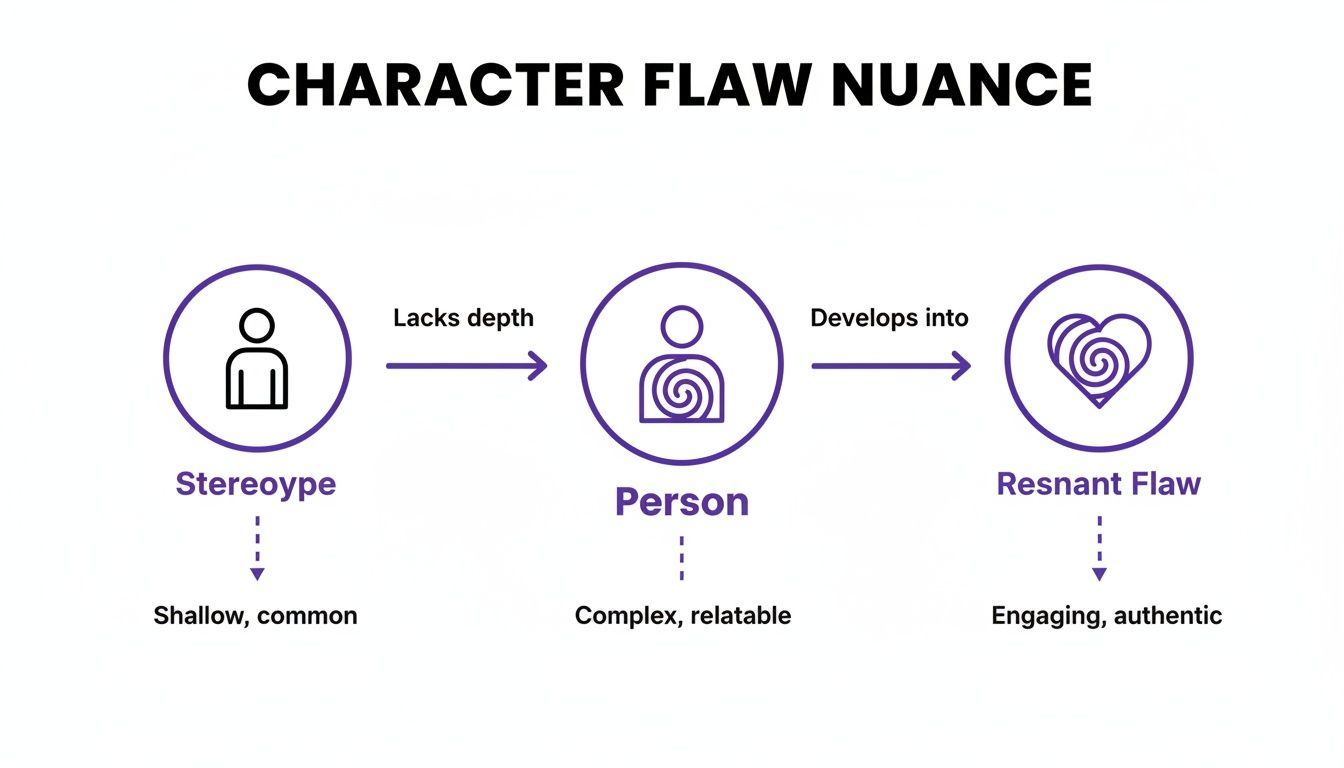
So, how do you fix it? Anchor the flaw to their specific history and worldview. Why are they indecisive? Maybe a single impulsive choice in their past led to catastrophe, and now they're paralyzed by the fear of making the same mistake. This gives the flaw texture and logic. Their indecisiveness isn't a label; it's a scar. They might be perfectly decisive ordering coffee but freeze up when a choice echoes their original trauma. A resonant flaw is a character's history made manifest. A stereotype is a cultural assumption masquerading as characterization. One creates empathy, the other creates distance. If a character’s flaw could be swapped with another character from a different story without anyone noticing, it’s not specific enough.
The Tracking System That Prevents Inconsistencies
Let's be honest: you can’t keep it all in your head. Not when you're juggling ten point-of-view characters and a three-book arc. Spreadsheets are a decent first step, but they’re just as static as a Word document. They are dead artifacts.
A spreadsheet won't tap you on the shoulder when a character who despises magic suddenly uses an enchanted dagger in Chapter 28 without a moment of internal struggle. It won't flash a warning when your stoic warrior, defined by unwavering loyalty, fails to react to a friend's betrayal for three chapters because you lost track of the timeline. These are the slips that derail complex stories. To manage a character's flaws at scale, you need a system that tracks three things: the flaw’s core logic, what the character knows, and when events happen. Anything less is a disorganized notebook.
This is the difference between a static character bible and a dynamic intelligence platform. A bible is a reference document you have to remember to check. An intelligence platform actively hunts for contradictions because it understands the relationships between character, knowledge, and time. Imagine a system that asks: "John found out Maria betrayed him in Chapter 5. Why is he confiding in her again in Chapter 12?" This isn't about replacing your intuition. It's about giving it a safety net that catches the human errors that creep into a 400-page manuscript.
A working system must be built on three core pillars constantly updated as your manuscript grows. Without all three, consistency will eventually shatter.
- The Flaw's Definition: The "if-then" logic. If confronted with failure, the character's pride then forces them to blame someone else. This is the core rule.
- The Knowledge State: A running log of what a character knows and when they learned it. It’s the firewall preventing them from acting on information they couldn’t have yet.
- The Event Timeline: This connects internal logic to the external plot. It tracks scenes that trigger, challenge, or reinforce their flaw, creating a clear chain of cause and effect.
Together, these pillars transform your character from a list of attributes into a coherent person. For authors managing huge casts and multi-book series, this kind of systematic approach isn’t a luxury; it’s a necessity. It’s the hidden engineering that ensures your character’s journey feels earned, logical, and powerfully consistent. This is the exact framework we've built into our tools. You can learn more about how it works and see how these connections are built for you automatically.
Building Your Character's Operating System
Let’s move from defining character flaws to engineering the machinery that makes them work. This isn’t about filling out another tedious questionnaire. For every major character, you need a living document that tracks how every plot point either bends, breaks, or reinforces their flaw. A character's flaw is their operating system, and the plot is a series of stress tests you’re running against that code. Your job is to log the results.
Let's use a concrete example: a spy whose core flaw is paranoia. Writing "she's paranoid" is useless. Building her operating system means defining the rules. Her core logic might be: "Trust is a liability. Every alliance is temporary. Assume betrayal is inevitable and plan accordingly." Now, we track her state changes across the manuscript. This isn't a static profile; it's a dynamic log.
- Initial State (Chapter 1): She trusts only her handler, Anton, and a contact named "Sparrow." This trust is purely functional.
- Inciting Incident (Chapter 4): A mission goes sideways, and Sparrow is killed. Her paranoia script flags Anton as a possible leak. Her trust in him plummets from 90% to 40%.
- Midpoint (Chapter 15): She finds evidence Sparrow was a double agent. Her paranoia is validated. This reinforces her core logic. Her trust in Anton craters to 10%, and she starts running counter-surveillance on him.
This creates a powerful feedback loop. The plot tests the flaw, and the flaw’s reaction dictates the next plot point. This is the engine of a character-driven story. This idea of a rules-based system of flaws also scales up. You see it with national stereotypes, which are really just collective flaws applied to entire cultures. Research on stereotypes across 26 cultures found that while many are inaccurate, they are not entirely baseless, showing how a perceived "flaw" can become a powerful narrative. You can explore the research on cultural stereotypes and personality traits to see how these big assumptions take root.
Let's get back to our spy. How does her paranoia look different after she’s been proven right versus when she’s been proven wrong? Tracking this is critical.
- When Her Paranoia Is Vindicated: After finding out Sparrow was a traitor, her methods become more extreme. She treats every new person as a threat. Her flaw is reinforced, making her a more effective spy but a more isolated person.
- When Her Paranoia Is Disproven: Imagine she later learns Anton was loyal and sacrificed himself to save her. This event creates a system crash. Her core logic—“Assume betrayal is inevitable”—is shattered. This is the moment where true character change can happen. She might overcorrect and become recklessly trustful, or she might retreat entirely.
If you don't track these state changes, you risk massive inconsistencies. She might suddenly trust a new ally in Act Three for no reason because you forgot how Act One should have hardened her worldview. This is the kind of subtle but damaging plot hole that good tracking prevents. This level of detailed tracking is precisely what standard novel writing software often misses, leaving authors to juggle these complex variables. The system you build needs to be as dynamic as the characters it’s meant to track.
Juggling all these moving parts—character states, evolving flaws, and branching timelines—is where complex manuscripts break down. Novelium is designed to be your character's operating system. It automatically extracts and tracks every detail, flagging inconsistencies before they become plot holes and giving you a clear view of your character's logic from page one to the end.
Stop trying to keep it all in your head. Build a smarter manuscript with Novelium.