Cult of the Dragon Lore Writers Can Use
The usual advice for writing the Cult of the Dragon is to lean into dragon worship: robes, treasure, terrified villagers, something enormous under the mountain. That's how you get a serviceable encounter and a faction that stops making sense halfway through a novel. The consequential choice isn't which dragon the cult serves. It's which doctrine the cult is enforcing, and who knows it.
What the Cult of the Dragon Actually Is
The Cult of the Dragon is not just a sect that bows to living dragons. For a series bible, use this definition: In the Forgotten Realms, the Cult of the Dragon is a transregional network founded around making dracoliches so that undead dragons will rule Faerûn.
That definition gives the institution something concrete to do. Its members need access to dragons, ritual knowledge, and people capable of moving both without attracting the wrong attention. A congregation can worship indefinitely; this organization has a transformation project to complete.
The fork that wrecks continuity is Sammaster's older dracolich doctrine versus the later campaign to free Tiamat. Those aren't interchangeable expressions of enthusiasm for dragons. They require different operations, different information controls, and different explanations for why someone's hauling treasure through your setting.
Choose the Institution Before the High Priest
Cells do the work, not a single throne room issuing perfectly understood instructions. The organization's counted population is predominantly human, too. Write the clerks, intermediaries, and local operators as the institution's working machinery rather than disposable scenery around its monsters.
Outside Faerûn, the name alone doesn't establish that machinery. A book set elsewhere needs its own written doctrine before drafting; importing a Forgotten Realms organization unchanged imports assumptions about its history and cosmology as well.
Decide which cult you're writing before inventing its high priest, hoard, or theology.
Use the chronology to establish what can exist, and the membership count to establish who performs the work. Neither a dramatic costume nor an impressive dragon compensates for choosing the wrong institution.
From Sammaster to the First Cells
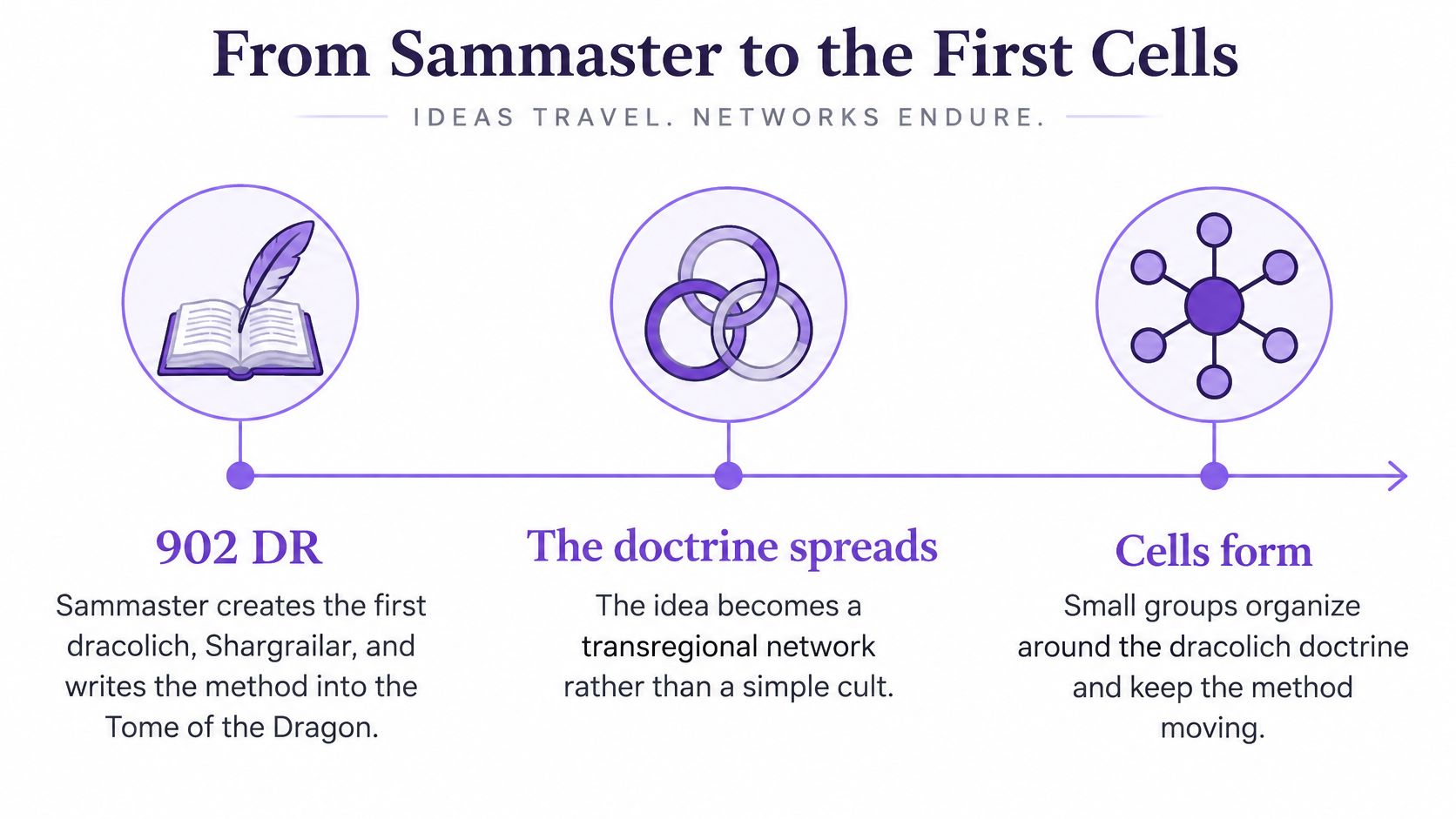
The foundational event comes before the recognizable network: according to the Forgotten Realms Wiki's history of the Cult of the Dragon, in 902 DR, the mage Sammaster created the first dracolich, Shargrailar, and recorded the method in the Tome of the Dragon. The doctrine specified dragons ruling Faerûn as undead beings, not merely living monsters.
That distinction makes the Tome more than a religious prop. It contains a method someone can preserve, transmit, withhold, or misunderstand. In a flashback, possession of that knowledge needs a provenance.
Cult of the Dragon founding timeline
| Year | Event | Continuity lock |
|---|---|---|
| 902 DR | Sammaster creates the first dracolich, Shargrailar, and records the method in the Tome of the Dragon | No dracolich or Tome before this date |
| 905 DR | Cult begins spreading, with early cells in Chondathan, Chancelgaunt and Yhaunn | No cells before this date |
| 906 DR | The name Cult of the Dragon is widely used | Use the name only from this date |
| 913 DR | Expansion into the new nation of Sembia | No Sembia cell before this date |
| 1018 DR | Mourktar cell turns the blue wyrm Alasklerbanbastos into a dracolich | Proof the rite is repeatable |
Treat those as conservative drafting locks, not permission to fill every undocumented interval with certainty. The spread began around the date recorded above; widespread naming doesn't prove nobody uttered the phrase earlier. If your plot requires an exception, establish it deliberately rather than smuggling it into incidental dialogue.
Give Every Flashback a Knowledge Boundary
The sequence distinguishes invention, dissemination, public recognition, territorial expansion, and successful repetition. Those are different institutional states. A scene set during early dissemination shouldn't assume the cult already possesses its later geographical reach or that every local operator has mastered the rite.
Say a flashback follows a scholar carrying a copied passage toward a prospective cell. Record whether the passage contains the complete procedure, an interpretation, or merely the promise of transformation. Otherwise, a later revision can accidentally turn the scholar into a fully equipped ritual specialist.
Alasklerbanbastos matters because the Mourktar transformation demonstrates continuity beyond the founder's experiment. The narrative implication is technical competence surviving through a network, not an endlessly repeated origin miracle.
That's useful history-building: record the event and the capability it makes available. Pin each flashback to a milestone, then track the route by which its characters acquired their knowledge. A later transformation needs an established transmission path, not just an author who remembers that dracoliches exist.
Dracolich Doctrine Versus the Tiamat War
Two Cult of the Dragon operating models
| Model | Aim | Method | Allies | Signature |
|---|---|---|---|---|
| Sammaster doctrine, from 902 DR | Undead dragons rule Faerûn | Tome of the Dragon rite, cell by cell | Decentralized cells | Dracolich |
| Tiamat campaign in Hoard of the Dragon Queen | Free Tiamat from the Nine Hells | Raids, captives, and treasure convoys | Dragons and the Red Wizards of Thay | Five-headed queen |
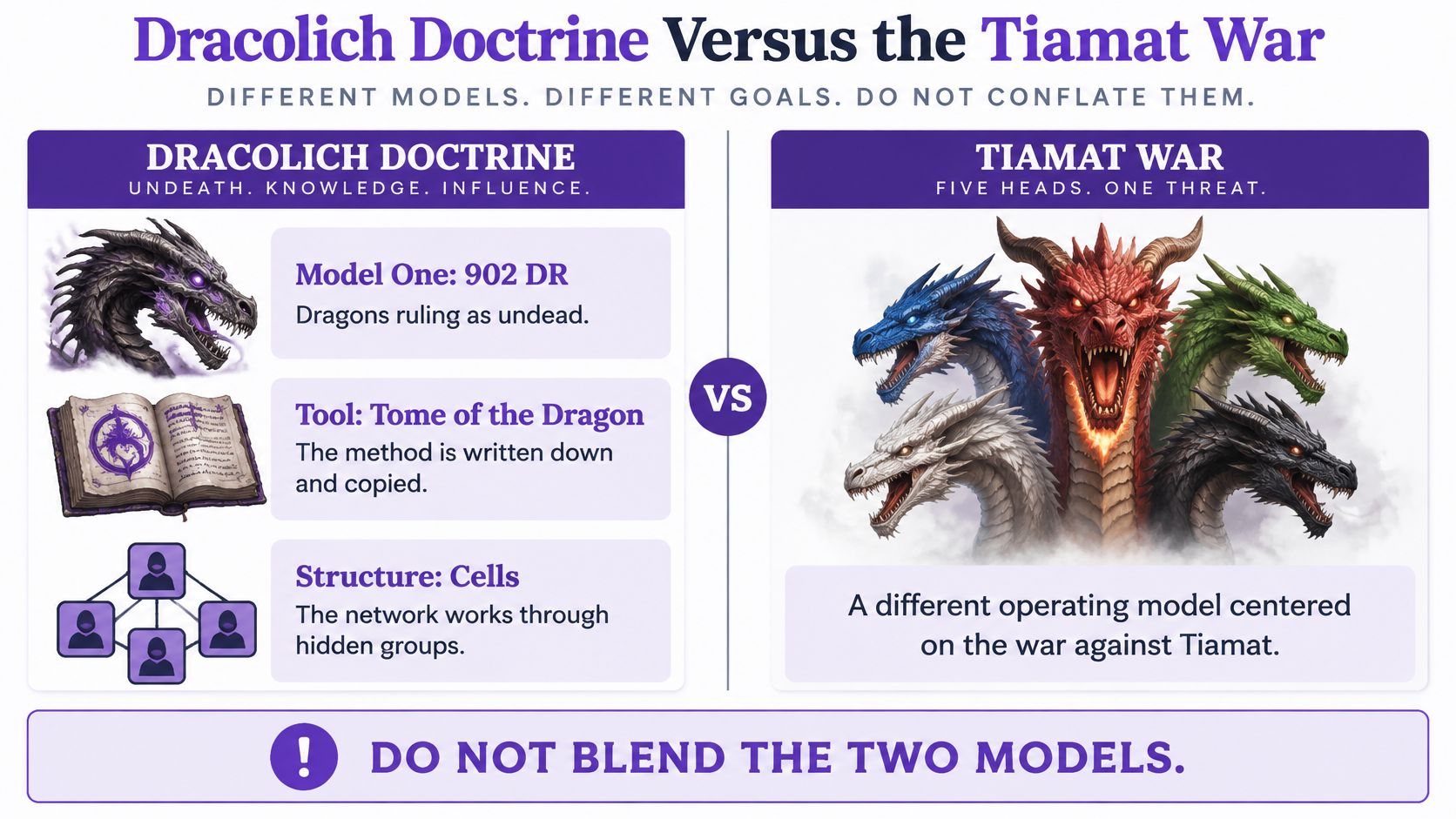
The Forgotten Realms Wiki's account of Hoard of the Dragon Queen describes the later operation as a campaign to free Tiamat from the Nine Hells and bring her to Faerûn, supported by dragons and the Red Wizards of Thay; player characters begin at 1st level, gain a level per chapter, and finish at 8th level.
The operational change matters more to prose than the change of emblem. Cult forces move between towns, crush resistance, capture civilians, and gather a hoard for their queen. Your manuscript therefore needs routes, custody, transport, and coordination, not merely a priest delivering a more ambitious sermon.
Different Doctrine, Different Cargo
For a dracolich-centered plot, give a cell remains, ritual notes, and disputes over whether its knowledge is sufficient. For a Tiamat-centered plot, give it gold, roads, prisoners, and a timetable. These are writing choices that express the documented aims, not universal inventories every canonical cell must possess.
The distinction sharpens religion in worldbuilding. Belief becomes legible through what an institution spends resources on, which failures it punishes, and what its officers conceal. A theological paragraph won't rescue scenes whose logistics serve a different religion.
A Wearer of Purple who preaches undead dominion and then treats Tiamat's arrival as the identical objective needs an explanation. Make the contradiction intentional: conversion, political expediency, concealed heresy, or a schism with an established place in your chronology. Don't let the character switch gospels because you changed reference tabs.
A doctrinal change needs a messenger, an audience, and consequences for refusing it.
Choose the Plot's Working Model
The Tiamat campaign supplies the convoy, the town-by-town assault, the captive ledger, and the strained alliance with outside spellcasters. Its useful suspense lies in movement and coordination: who knows the destination, who controls the cargo, and who can delay departure.
The Sammaster model supplies the rite, the cell hunt, and the attempt to turn a demonstrated transformation into local power. Its useful suspense lies in access and competence: who holds the method, who understands it, and who can persuade a dragon to participate.
Pick the row whose operations your plot requires. Keep the other as history, opposition, or an explicitly tracked institutional dispute. A book can contain both doctrines without pretending they're the same doctrine.
How Big the Cult Got by 1374 DR
Cult of the Dragon counted membership in 1374 DR, as recorded in the Forgotten Realms Wiki's Cult of the Dragon entry:
| Group | Count |
|---|---|
| Humans | 4,527 |
| Dragonkin | 516 |
| Draconic creatures | 286 |
| Half-dragons | 178 |
| Other creatures | 115 |
| Dragons | 57 |
| Dracoliches | 51 |
The reported total was 5,730, including unwitting servants and broader affiliates; humans represented approximately 79.0%, while dragons and dracoliches together numbered 108, about 1.9%. The earlier estimate for 1372 DR described almost 1,000 active, willing, cognitively aware members, making the broader tally nearly 5.7 times that estimate without establishing equivalent growth in committed membership.
That last distinction is where a careless faction bible becomes misleading. These aren't matching measurements taken at different moments. Don't write a recruitment boom when the figures also reflect a wider definition of participation.
Count Allegiance Separately From Participation
A carrier moving cult-owned cargo isn't necessarily a believer. An intimidated servant isn't necessarily an initiate. A person who knows their employer's name doesn't necessarily know the employer's ultimate purpose.
For a complex faction, distinguish association, consent, and knowledge. Otherwise, every captured porter becomes an implausibly well-informed source, and every exposed business connection becomes proof of religious commitment.
The human majority also changes where you should put narrative attention. The useful horror is a human bureaucracy supporting a comparatively small draconic presence. Let the intermediary authorize a delivery, the scholar conceal a passage, and the recruiter decide whose questions have become inconvenient.
That doesn't make the dragons unimportant. It makes access to them consequential. A conversation with a dracolich should change someone's position in the institution, rather than function as the ordinary equivalent of walking into the manager's office.
Membership Has an Accounting Trail
The same entry records a joining cost of 300 gold pieces, followed by monthly dues of 100 gold pieces. Those charges give you something more useful than a vague hierarchy: a payment history that can conflict with a character's claimed standing.
A lapsed member can still know secrets. A solvent member can still lack access. If you decide that a patron pays another member's dues, record the obligation separately from formal rank; financial dependence and institutional authority aren't identical.
Use the ledger to complicate scenes rather than explain the entire organization. A receipt can expose a lie about affiliation without proving knowledge of the rite. A collector can recognize a debtor without being entitled to hear the debtor's operational orders.
Counting rule: Being inside the cult's reach doesn't mean being inside its confidence.
The headcount isn't a scene list, and it isn't a map of cells. It doesn't tell you how many participants occupy a particular town, who reports to whom, or which local group can summon draconic assistance. Establish those relationships in the manuscript instead of dividing a setting-wide total into convenient local armies.
Named Figures and the Tropes Worth Keeping
Give each major name a dramatic job. Sammaster is the founder-mage, useful through a text, disputed interpretation, or authority someone invokes to end an argument. He doesn't need to appear personally whenever the institution needs weight.
Shargrailar is the prototype, the proof that the project worked. Alasklerbanbastos is the successful repetition, allowing a later story to concern itself with transmitted expertise rather than another miraculous discovery. Don't flatten those functions into interchangeable dragon bosses.
Authority Isn't the Same as Presence
Tiamat belongs to the war model as its intended sovereign and objective, not as a compulsory mascot for every chapel. A character invoking her name should tell the reader something about that character's allegiance or the institution's current direction.
The Red Wizards of Thay serve a different function: outside magical partners. Write them as allies with their own interests, not cultists wearing a second uniform. If you give them a divergent motive, make that your plot's explicit development rather than presenting it as a sourced universal fact.
The most useful confrontation may therefore occur between a local handler and an allied wizard who disagree about custody of an object. Neither needs to explain the entire cosmology. Their competing claims can expose where institutional authority ends and negotiated cooperation begins.
| Trope worth keeping | What it should do on the page |
|---|---|
| Sacred tome | Establish who can authenticate, interpret, or withhold the method |
| Purple-clad handler | Connect local orders to an identifiable chain of authority |
| Tribute-paying town | Show a community purchasing safety while denying complicity |
| Logistical hoard | Establish custody, destination, and the consequences of missing treasure |
Treat those as adaptation choices, not a checklist of canonical features every location must contain. The tribute-paying town, in particular, earns its place when you dramatize the arrangement: who collects, who pays, and what the townspeople agree not to ask.
The hoard needs the same discipline. Decide whether it's available wealth, committed cargo, a payment, or material someone has stolen from its intended destination. Those states produce different crimes and different reasons for the cult to intervene.
Make the memorable recurring figure the accountant, recruiter, or scholar whose decision changes access. Then reserve the dracolich for the moment when that access matters. Another named monster won't compensate for an institution whose human operators have no distinct authority.
Running the Cult Across a Long Book
Track each cell through doctrine in force, rank and payment status, secrets received, and draconic life state. Keep those fields attached to scene changes, not stranded in a profile written before the draft existed.
A static profile says a recruiter is loyal, scholarly, and afraid of dragons. A tracking record says the recruiter received a revised order after the failed delivery, still hasn't seen the ritual text, and falsely believes the cell's patron survived. The latter tells you what dialogue the recruiter can plausibly deliver.
Track Changes, Not Just Descriptions
Character-development documents help you discover an individual. Character-tracking systems preserve what remains true at a particular point in the manuscript. Confusing the jobs produces beautiful dossiers that don't prevent contradictions.
Use a scene reference for every consequential update. When a messenger delivers a secret, record its recipients; when an officer lies, distinguish what the officer knows from what the listeners now believe. During revision, move the update with the scene or invalidate it when the scene disappears.
| Failure case | What a usable record preserves |
|---|---|
| The resurrected speaker | A killed wyrm can't speak later without an established survival or return |
| The premature Sembia cell | Local institutional presence must fit the founding chronology |
| The omniscient recruiter | The village operator hasn't automatically heard the plan disclosed to the Thay alliance |
| The contradictory entrance fee | A changed payment demand needs an established exception, fraud, or rule change |
| The duplicated dragon | Proper name, color, identity, and living or undead state remain attached to the same entity |
These failures aren't all solved by searching a proper name. The recruiter's error is an information-access problem. The payment contradiction concerns an institutional rule. The dragon duplication combines identity with transformation, which means a replacement name alone can conceal rather than repair the mistake.
For a campaign, the same distinctions prevent every Wearer of Purple from becoming an identical intelligence terminal. Capturing a senior figure should reveal that figure's actual knowledge, including outdated orders and mistaken beliefs, not everything the game master knows.
Revise the Record With the Scene
When you cut a courier encounter, check who loses the information it carried. When you move a death earlier, check later speech, orders, debts, and assumptions about protection. When you change a cell's allegiance, check who accepted the change and who still operates under the previous doctrine.
Don't add another goals-and-flaws worksheet to solve this. Establish a reference layer for institutional facts and a changing record for scene-dependent states.
If a fact cannot change across chapters, it's worldbuilding. If it can, it's tracking.
Lock One Doctrine Before the Next Chapter
Choose Sammaster or Tiamat as your book's governing model. Name the year your narrative treats as the present, then write the focal cell's knowledge limit in a sentence. Everything else is reference until a scene gives someone access to it.
A useful boundary is concrete: the cell knows its delivery destination but not the cargo's ultimate purpose. A useless boundary says its members know cult secrets. The former constrains dialogue and action; the latter excuses whatever revelation the next chapter happens to need.
Put the Rule Where You'll Use It
The practical failure isn't lack of lore. It's keeping lore, magical constraints, and social authority in separate documents that nobody consults during revision. A deleted scene then leaves behind knowledge, or a rewritten alliance changes who can command whom.
Our World Codex stores lore, settings, and rules; it can define magic systems, technology, and social structures. Use that reference layer for the rite's constraints, the convoy's operating requirements, and the relationship between dues and rank. It also tracks locations, cultures, and world rules, and sends alerts when rules are broken.
That's a different job from writing an evocative villain biography. The biography explains why the handler craves recognition. The reference and tracking records preserve whether the handler can authorize a transformation, has received the current orders, or is lying about either.
Revision test: Can you identify the scene that made this character entitled to know, command, or attempt this?
Don't Let Revision Invent a Third Cult
Keep the manuscript local if secrecy matters. More, maintain an authoritative place for doctrine instead of allowing every new scene to redefine the institution by implication.
When you deliberately break a rule, record the exception and who understands it. A rogue cell can pursue an unauthorized rite. An officer can redirect a convoy. A scholar can misquote the founder, but the manuscript must distinguish the scholar's claim from the world's established facts.
That distinction preserves room for unreliable testimony without sacrificing continuity. Readers can enjoy uncertainty about whom to trust while still trusting you to know what happened.
Before drafting the next cult scene, establish its governing doctrine, its institutional present, and its knowledge boundary. Then check the speaker's current state against them. You don't need another page describing the robes; you need to know whether the person wearing them has received the order they're about to enforce.
Novelium's Character Tracker and World Codex automatically extract and track character details across manuscripts, helping you keep the cult's people, knowledge states, and institutional rules consistent. Visit Novelium to check your draft, establish the doctrine your cells follow, and catch the chapter where someone starts serving a different cult.