Creative Writing Programs University: BA, MA or MFA?
Most advice about choosing a creative writing program is wrong in the same direction. Go where the faculty are famous, the logic runs, and the writing will follow. Faculty prestige is the easiest thing to measure and the least useful thing to measure, because the famous novelist who teaches two seminars a term will read forty pages of your manuscript and then leave. The degree that changes your career is the one with funding attached, a thesis requirement that forces a finished book, and a net cost you can survive.
So flip the criteria. Judge every program on three numbers. What it costs after waivers and stipends. Whether it demands a book-length manuscript rather than a folder of excerpts. Whether anyone on the faculty publishes the kind of fiction you write, at the scale you want to publish it. Everything else, the reading series and the handsome brochure and the alumnus who won a prize in 2009, is noise.
Novelists face greater demands than anyone else in the building. Short story writers can workshop a single piece and walk out with something. You need two or three years of structured time, and you need the book to hold together after you leave.
Degree Types and the Rules That Decide Fit
Sort the three degrees before you compare anything else. The BA is a broad undergraduate major: workshops bolted onto literature and language study, usually closing with a capstone portfolio. The MA runs shorter and often bridges to teaching or doctoral work. The MFA is the terminal degree most novelists mean, and its rules diverge so sharply from school to school that the label alone tells you almost nothing.
UCF makes a useful stress test. The MFA there requires at least 36 credit hours, at least nine graduate credits in writing workshops, and a book-length creative thesis, per the University of Central Florida MFA program page. It also treats literary study as a gate rather than a garnish: applicants must show proficiency in both American and British literature, and anyone whose transcript lacks those surveys completes them as co-requisites before defending the thesis. The workshop menu separates multi-genre writing, the novel, and nonfiction, which matters if you write long fiction and don't want to be folded into a generic fiction section.
| Program | Size or credits | Thesis or capstone | Distinctive requirement |
|---|---|---|---|
| Cornell University MFA | Six students per year, two concentrations | Book-length manuscript developed with a special committee | Two years of guaranteed funding and six one-semester courses |
| University of Central Florida MFA | 36 credits, at least nine in workshops | Book-length creative thesis | Survey courses in American and British literature |
| North Carolina State University MFA | 36 credits: 18 specialization, 6 literature, 12 electives | 6 thesis credits, about 200 pages for fiction | Comprehensive written exam on a jointly selected book list |
| Harvard Extension School graduate creative writing | 12 courses, 48 credits | Eight-credit ALM thesis | Seven-day on-campus residency followed by two weeks online |
Three tests do the filtering from here. Thesis length tells you whether the program is built to produce a book or a portfolio, and a program that accepts 60 pages as a thesis will not push you through 300. The literature gate tells you whether your transcript is admissible without extra coursework, which can add a semester and real money. The residency tells you whether you can keep your job, your mortgage and your childcare arrangements while you study.
Run each shortlisted program against the three tests before you read another word of the brochure. The one that fails the test that breaks your schedule gets cut, however good the faculty.
How the Workshop Sequence Builds a Novelist
The workshop sequence is a production line. A room full of smart readers is the brochure version, and the order of courses decides whether you leave with a book or a stack of pages.
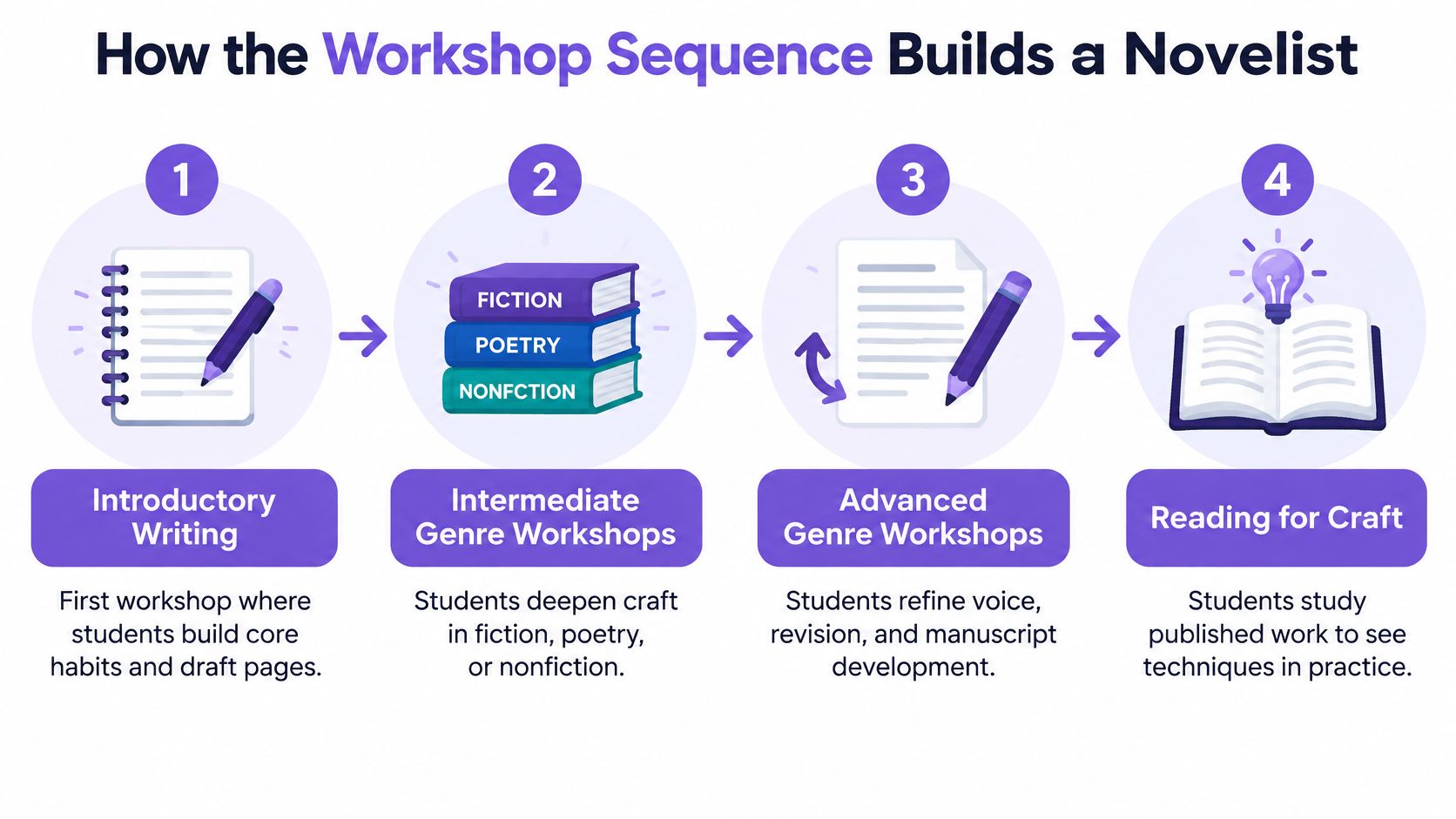
The standard pipeline runs from introductory writing into intermediate and advanced genre workshops, then through reading for craft. At UNC Wilmington, the course list pairs fiction, poetry and creative nonfiction workshops with research for creative writers, reading fiction, poetry and nonfiction for craft, an introduction to book publishing, and bookbuilding, as the UNC Wilmington creative writing BFA page lays out. The workshop itself runs on constructive responses from classmates and professors, backed by courses in grammar, mechanics and the psychology of creativity.
That order is deliberate. You produce drafts first. Then you learn to diagnose how published books achieve their effects. Then you apply research and technical control, and only then do you push the work toward a book-shaped object. Reading-for-craft courses are the part writers undervalue on the way in and rely on hardest once the degree is over.
The feedback loop is worth understanding rather than just surviving. Why workshops help students write better is a plain account of the group dynamics that make critique land or collapse into politeness. Before you sit in one, the workshop glossary entry covers the mechanics: what the format is, why the term matters, and a short exercise for reading a draft the way a workshop does.
What one semester actually produces
A typical semester, not one observed classroom, runs like this. You submit a chunk of the manuscript. Peers read it cold, mark the pages, and write a letter. The instructor says something about structure you will argue with for days. You revise, and a later workshop, often a different group, repeats the process on the same pages. After several passes, a chapter either holds or gets cut.
Practical rule: if a curriculum ends in a finished, internally consistent book rather than a folder of excerpts, the sequence is doing its job. If it ends in excerpts, you're paying tuition for a writing group you could assemble for free.
A novelist who already has books runs a version of this loop alone. What the program should add is deadline pressure, an audience that is not your agent, and time spent on one project until characters, events and facts still agree from the first chapter to the last. Judge the sequence by that manuscript, not by how lively the room felt.
What the Degree Costs and What Funding Changes
Build the total yourself. Program pages almost never publish a figure you can set beside another school's figure.
| Program | Published cost | Funding | Notes |
|---|---|---|---|
| Old Dominion University MFA, Virginia resident | $510 per credit | None listed on the program page | In-state per-credit rate |
| Old Dominion University MFA, nonresident | $1,361 per credit | None listed on the program page | Same program, higher rate for out-of-state students |
| American University of Paris MFA, international | €55,296 tuition and fees | None published | Single published total for the degree |
| US low-residency MFA | A single-school estimate, not a shared national total | None published | Use only that program's own published estimate |
| US low-residency MA | Priced below the MFA at the same kind of program | None published | Shorter credential. Still price the whole degree, not the format |
| University of Miami MFA | Tuition covered | Annual stipend with teaching and professional development | A funded package, not a sticker price |
| Cornell University MFA | Tuition covered | Multi-year stipend, full tuition fellowship, and health insurance for every candidate | A guarantee beats a funding pool you might win |
Old Dominion's fiction MFA page lists $510 per credit for Virginia residents and $1,361 per credit for nonresidents. A 36-credit degree therefore runs about $18,360 in state and $48,996 out of state. That $30,600 gap is where you live, not how the faculty teaches.
The American University of Paris MFA page publishes tuition and fees of €55,296. Low-residency US schools publish their own estimates, and the MA at that format comes in below the MFA. Do not lift one campus's total and stick it on another degree. Net cost is the published price minus the funding that disappears from the bill.
Miami advertises a full tuition waiver and an annual stipend tied to teaching and professional development. Cornell guarantees every MFA candidate multi-year support: stipend, full tuition fellowship, and health insurance. Hunt the guarantee. A waiver you might receive is a different financial object from a waiver written into admission.
Pay when funding or a teaching stipend clears tuition. Skip the degree when you would be paying retail for prose you can revise without it.
Add lost earnings before you accept. Two years out of a paid job, at whatever you earn now, is usually the largest line, and no program page prints it. If the offer does not cover tuition and that missing income, you are financing the diploma. Take the funded seat, or don't go.
Career Outcomes and How to Read the Numbers
The outcome figures floating around are mostly institution-wide, and reading them as career forecasts for novelists is a category error.
| Program | Cohort | Measure | Figure | Scope |
|---|---|---|---|---|
| University of Glasgow | Graduates 15 months after graduation | In work or further study | 93.3% | Institution-wide, single and joint honours |
| University of Glasgow | Employed graduates | In graduate-level jobs | 75.4% | Institution-wide, single and joint honours |
| University of Glasgow | Employed graduates | Average professional salary | £29,161 | Institution-wide, single and joint honours |
| University of Mary Washington | 171 English: Creative Writing graduates, 2018 to 2022 | Knowledge rate | 79% | Specific major |
| University of Mary Washington | 171 English: Creative Writing graduates, 2018 to 2022 | Career-outcome rate | 79% | Specific major |
The University of Glasgow creative writing degree page reports that 93.3% of graduates are in work or further study 15 months after graduating, that 75.4% of those employed hold graduate-level jobs, and that average professional salary is £29,161. The university also states plainly that these are institution-level figures covering single and joint honours programs, not creative writing alone. Mary Washington's numbers are narrower: among 171 English: Creative Writing graduates from 2018 to 2022, the knowledge rate and career-outcome rate were each 79%.
Four questions expose any dashboard. How large is the cohort? Does the rate count employment, further study, or both? When did the survey run? Does the data describe the major or the whole university?
For someone with books out, the useful outcome isn't a first job. It's whether the degree produced a teaching post, a publishing contact, or a manuscript that sold. None of these sources tracks novelists' earnings by career path, so ask each program directly, and treat a vague answer as the answer. If you're weighing the broader trajectory, this writing career overview is a sane starting point.
Evaluating Fit, Faculty, Funding and Alumni
Prestige is not a criterion. These four are.
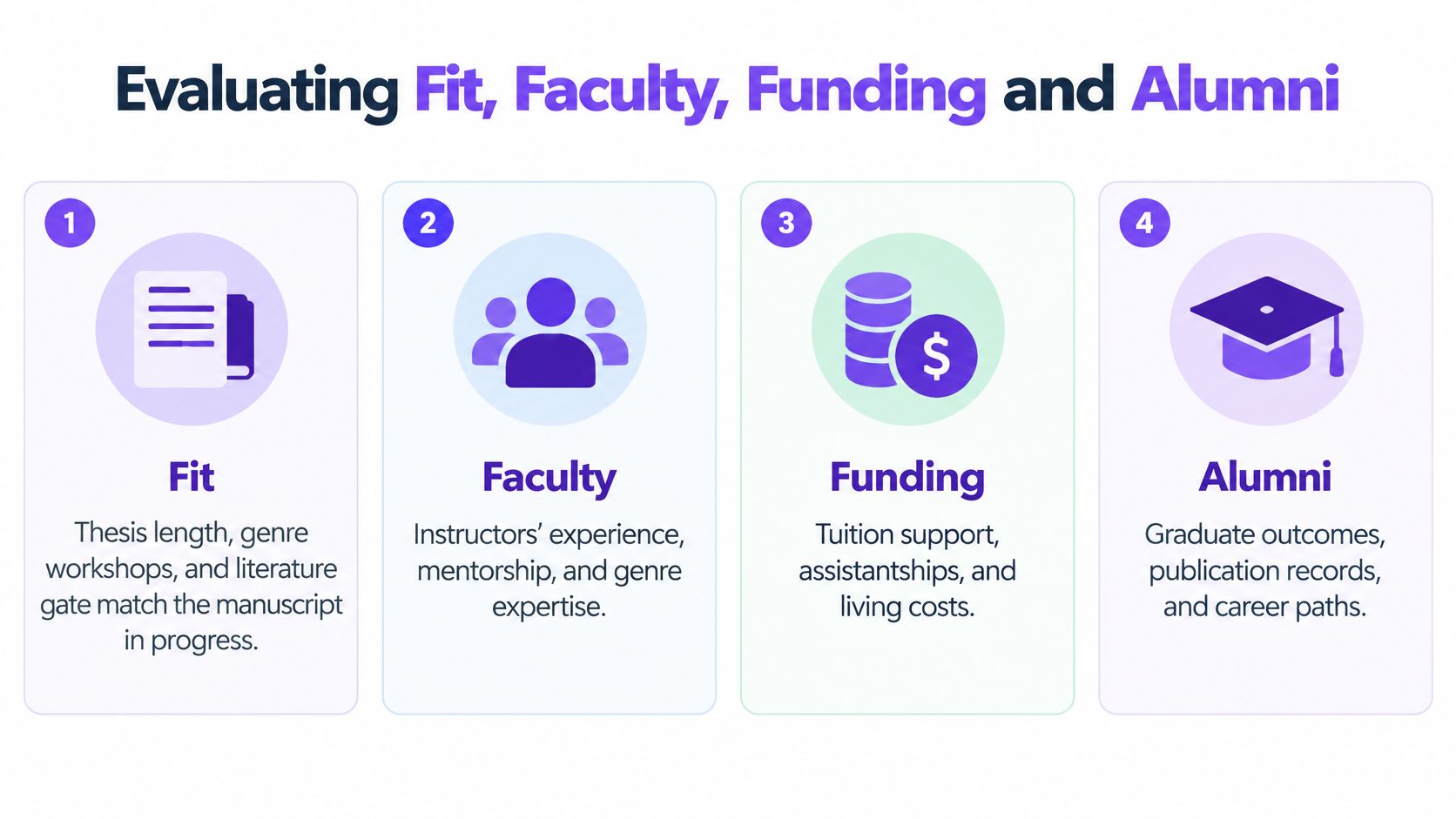
Fit is mechanical, not emotional. Does the thesis length match the book you're writing? Are there genre workshops, or is fiction one undifferentiated bucket? Does the literature gate require coursework you don't have?
Faculty means reading the actual books. Check whether the instructors publish the kind of fiction you want to write at the level you want to reach, and ask how many students land in each workshop group. A seminar of eight is a different product from a seminar of twenty.
Funding is net cost, never sticker price. Compare waivers, stipends, teaching assignments and health insurance against tuition and the city's rent.
Alumni is the test most applicants skip. Find three former students with published novels and email them. Ask what the program did for the book after graduation, not during.
Then apply the format test. The University of Miami MFA page highlights intensive study and professional development but doesn't specify manuscript-continuity or beta-reader processes, and that omission is typical. Published complaints about online and low-residency delivery cluster around high tuition, weak financial-aid communication, inconsistent instructor responsiveness, limited credit transfer, burnout and uneven career services. Delivery format changes the product as much as the curriculum title does.
The application calendar
- Twelve months out: shortlist programs and log every deadline in one calendar, including funding deadlines, which are often earlier than admissions.
- Eight to nine months out: email two or three faculty whose books match your project. Ask one specific question about your manuscript.
- Around month six: revise the writing sample to the exact length each program specifies. Ten pages means ten.
- Month five: draft a statement of purpose that connects your sample to the thesis you intend to finish.
- Month four: request transcripts and recommendations, and give each recommender your sample and a one-page summary.
- Before the earliest deadline: submit everything, then compare funding offers side by side before accepting any.
The judgment call: a funded offer at a mid-tier program beats an unfunded offer at a famous one almost every time. Debt follows you; the reading series doesn't.
Pick a Program and Keep Your Manuscript Straight
A brochure will sell the workshop and the faculty. It will not tell you what happens to a long manuscript after the degree ends: several drafts, several workshop groups, and no one left to check whether chapter 30 contradicts chapter 12.
Character profiles are the wrong tool for that job. A profile is a static document. It records that the protagonist is guarded, drinks too much, and lost a sister. It goes stale the moment she learns a secret in chapter 12 and then acts as if she never heard it in chapter 30, because a profile has no field for what she knows and when she learned it.

Why profiles fail on long manuscripts
Development documents answer who a character is. Tracking systems answer what a character knows, where they are, and what changed in the last scene. Those are different records. Writers who treat them as the same thing build an elaborate bible in Scrivener and never open it again.
The failures good tracking catches are boring and fatal. A Monday scene drifts into Tuesday without an intervening night. A character who died in act two answers a phone in act three. A relationship flips from hostile to intimate with no scene to explain it. A letter left in a desk drawer appears in a coat pocket two chapters later. Readers forgive a lot. They do not forgive a book that contradicts itself.
Record a narrow set of facts: knowledge states (who knows what, and from which scene), timelines (the sequence of days), relationships and their changes, and event history per character. Favorite foods, childhood towns, and the detailed magic system are decoration. Fun to write. Useless when a contradiction is hiding three hundred pages later.
Judge a program by the same standard. Demand a published cost, a funding figure, and an outcome number before you apply, then read where the model came from. The University of Iowa Writers' Workshop history documents the 1922 decision to accept creative work as a thesis and the 1936 founding that followed. A second historical account of how the model spread traces how hundreds of MFA programs and a far larger undergraduate sector grew from it. That scale is why you can be picky: take the funded program whose thesis requirement forces a finished book, then keep that book consistent after the cohort leaves.
If you are moving from the degree into a series or a large cast, the manuscript glossary gets the vocabulary straight. If you are heading into the job market alongside the writing, graduate CV examples that highlight impact show how to frame the work you have done.
Novelium reads the draft locally on your device and tracks character traits, knowledge states, relationships, and events across chapters. It surfaces plot holes, timeline mistakes, character contradictions, and object or information inconsistencies as you write. The manuscript stays private because the analysis stays on your machine. Novelium Academy adds free long-form guides covering five stages from idea to publishing, readable with no account, plus glossary pages with a definition, why the term matters, famous examples, and a quick exercise.
Choose the funded program with the thesis requirement that forces a finished book, then protect that book with a system that tracks what your characters know and when they learned it. Novelium reads your draft on your own machine and surfaces the timeline slips, dead characters who reappear, and knowledge contradictions before a reader finds them. Start free at Novelium and run your current manuscript through it this week.