Comma Splice Checker: A Tool for Technicians, Not Storytellers
A good comma splice checker feels like a secret weapon during that final, painstaking polish. It's supposed to catch those sneaky errors that trip up a reader and disrupt your story's rhythm. You know the ones—where two complete thoughts are jammed together with just a comma, a common slip when you're wrestling with a massive manuscript.
But the best approach isn’t about finding a reliable tool. It’s about knowing when to tell that tool to back off.
Why Your Grammar Checker Fails Fiction

Let's be blunt: the grammar checker baked into your word processor is a corporate drone. It was built to scrub personality from business memos and enforce rigid academic standards, not to appreciate the nuances of your narrative voice. Its world is black-and-white rules, which puts it directly at odds with the creative freedom fiction requires.
When you deliberately write a run-on sentence to show a character’s spiraling panic, the checker sees a mistake. When you use a comma splice in dialogue because that's how people talk, it slaps a red line under it. This sledgehammer approach carpet-bombs your manuscript with corrections, treating intentional stylistic choices as clumsy typos.
The Problem with One-Size-Fits-All Rules
The real issue is a total lack of context. Your standard comma splice checker can't distinguish between a genuine mistake and a deliberate artistic choice. It only knows "correct" and "incorrect," leaving zero room for the human judgment that shapes a writer's unique voice.
That’s a huge risk for any novelist. If you lean too heavily on these tools, you can end up "fixing" sentences that were doing their job perfectly—setting a mood, controlling pace, or building character. You might iron out a character's frantic inner monologue or chop up a sentence that was meant to feel long and dreamy, all to please a rule that has no business in your story.
The goal isn't grammatical perfection for its own sake. The goal is an immersive experience for the reader. A genuine error pulls them out of the story, but a well-placed, intentional rule-bend can pull them in deeper.
The demand for smarter tools is clear, especially as more writers manage their own editing. The global market for these grammar tools was valued at USD 1.09 billion in 2024 and is on track to more than double by 2033. This explosion shows a massive need for software that does more than blindly enforce rules. You can read the full research about grammar checker market trends if you're curious.
What a writer truly needs is a system that respects the craft. The challenge isn't just finding a comma splice checker; it's finding one that understands a splice can be a flaw in one sentence and a feature in another. It’s about keeping control, using technology as a scalpel, not a wrecking ball.
Hunting Splices with an Editor's Eye
Before any software touches your manuscript, you need to sharpen your own editorial eye. This isn't about the flimsy advice to "read your work aloud." We're talking about the specific, high-yield manual techniques professional editors use to hunt down these errors across a hundred thousand words. It's about building a core skill, not just ticking a box.
The most reliable manual check is the full stop test. Find a sentence you're questioning and try swapping the comma with a period. Can the clauses on either side of that new period stand on their own as complete sentences? If they can, you're looking at two independent clauses.
Take this example: The rain hammered the roof, he wished he’d never left home.
If you swap in a period, you get: The rain hammered the roof. He wished he’d never left home. Both are perfectly good sentences. That test reveals a classic comma splice that needs fixing—unless you’ve done it on purpose for a rushed, breathless effect.
A Test for True Independence
Another solid technique is the conjunction test. Take your two clauses and see if a coordinating conjunction (for, and, nor, but, or, yet, so) makes sense between them. If one fits, you've just confirmed they are independent, and a lonely comma isn't strong enough to hold them together.
The real skill isn't just spotting the splice; it's judging its intent. A comma splice in a tense action sequence might be a feature, reflecting a character's panicked, run-on thoughts. The same construction in a calm, descriptive passage is almost certainly a distracting error.
These manual tests are your best defense in the places where splices love to hide. Think rapid-fire dialogue where characters cut each other off, or stream-of-consciousness passages designed to mimic the chaos of thought. A standard checker will flag these as errors, but your editorial judgment knows they're serving the story.
Weaponizing Your Word Processor
You can also turn your word processor's basic search function into a surprisingly effective splice-hunting tool. This isn't automated grammar checking; it’s simple pattern recognition. From what we've seen analyzing manuscripts, one of the most common comma splices in fiction happens when a writer links two sentences, and the second one kicks off with a pronoun.
So, you create a targeted search for those specific patterns. Use the Find function to look for:
, he, she, it, they
This search will highlight every instance where you've followed a comma with a common subject pronoun. The vast majority of these will be fine. But buried in those results will be your accidental splices. It turns a massive proofreading task into a focused review, letting you jump from one potential problem to the next and apply your judgment with surgical precision.
It's a smart, efficient way to use a dumb tool.
Using Regex for Surgical Comma Splice Hunts
A manual search is fine for a single chapter, but it falls apart across an entire manuscript. When you're dealing with 100,000 words, your eyes glaze over. You will miss things.
This is where you bring in a more powerful tool. You don’t need to be a programmer to use regular expressions, or regex. Think of them as a super-powered find-and-replace that hunts for patterns, not just specific words.
This approach elevates you from a simple proofreader to a manuscript technician. By running these searches in powerful text editors like Scrivener, Ulysses, or even VS Code, you can perform surgical strikes on potential errors. It’s a systematic workflow that catches what the naked eye misses and saves you hours of tedious work.
Decoding the Basic Regex Pattern
The most common comma splice in fiction involves two independent clauses where the second one starts with a subject pronoun. A regex pattern can sniff these out with incredible precision.
Here's a workhorse pattern to get you started:
, (he|she|it|they|we|I|you)
Let's break that down. The , finds a literal comma followed by a space. The parentheses () create a group of options, and the pipe symbol | acts as an "or." This expression tells your editor to find every instance of a comma and a space that is immediately followed by "he" or "she" or "it," and so on.
Pasting this into your search bar instantly highlights every potential trouble spot matching this structure. The majority will be legitimate clauses, but your actual splices will be caught in the same net, ready for a quick, decisive judgment call.
A well-crafted regex string is a diagnostic tool. It doesn't give you the answer, but it highlights every location where a specific problem might exist, letting you apply your authorial judgment efficiently.
Customizing Your Hunt for Specific Characters
The real power of regex comes from its customizability. You can adapt these patterns to fit the specific needs of your manuscript. If you have a main character named Kaelen who is the subject of many sentences, add his name to your search.
Consider this expanded pattern:
, (he|she|it|they|Kaelen|Maria)
Now you're not just looking for generic pronouns. You’re actively hunting for sentences where a clause might incorrectly run on into another clause centered on your key characters.
This level of targeted analysis is something no standard grammar checker can offer. It’s a precise way to manage the linguistic quirks that emerge across a long narrative. The tools we develop at Novelium are built on this same principle of deep, pattern-based analysis, showing exactly how it works to track manuscript data systematically.
Common Regex Patterns for Finding Comma Splices
To get you started, here are a few regex patterns you can copy and paste directly into your editor's search function. Each one is designed to catch a slightly different, but common, comma splice structure.
| Pattern | What It Finds | Example |
|---|---|---|
| `,\s(he | she | it |
| `,\s(I | you | I'm |
,\s([A-Z][a-z]+)\s |
Finds a comma and space followed by any capitalized word, often a proper noun or character name. | The spell failed, Kaelen fell to his knees. |
,\sthere\s |
Targets the common "there is/are" construction that often creates a comma splice. | The market was empty, there was no one around. |
Remember, these patterns will flag many correct sentences too. Their job is to narrow the field so you can apply your human expertise without reading every single line again. They point you to the haystacks where the needles might be hiding.
How to Fix the Splice Without Killing Your Voice
Finding a comma splice is a technical problem. Fixing it is an act of craft.
The lazy fix—swapping the comma for a period—can wreck the rhythm of a carefully constructed paragraph. An artful correction, however, enhances your narrative voice, reinforces character, and gives you total control over the story’s pacing. It’s the difference between a mechanical repair and a deliberate stylistic choice.
Your approach to the fix should always serve the sentence's purpose. You have four main strategies in your toolkit, and each creates a different effect. See them not as grammar rules, but as tools for shaping the reader’s experience.
Four Ways to Correct a Comma Splice
The simplest fix is often the most powerful. Replacing the comma with a period gives you two distinct, punchier sentences. This is perfect for creating a staccato rhythm, emphasizing a point, or delivering a stark, declarative statement in a character’s voice. It forces a full stop, giving each thought its own weight.
- Before: He saw the storm on the horizon, he knew they wouldn't make it back in time.
- After: He saw the storm on the horizon. He knew they wouldn't make it back in time.
The second option, the semicolon, is a more literary choice. It links two independent clauses that are so intimately connected that separating them with a period would feel too abrupt. A semicolon signals that the second idea is a direct continuation of the first, creating a sophisticated, fluid connection between the thoughts.
- Before: The silence in the room was absolute, even the dust seemed afraid to move.
- After: The silence in the room was absolute; even the dust seemed afraid to move.
This flowchart gives you a simple decision path for whether to hunt for splices manually or fire up a more technical regex search in your manuscript.
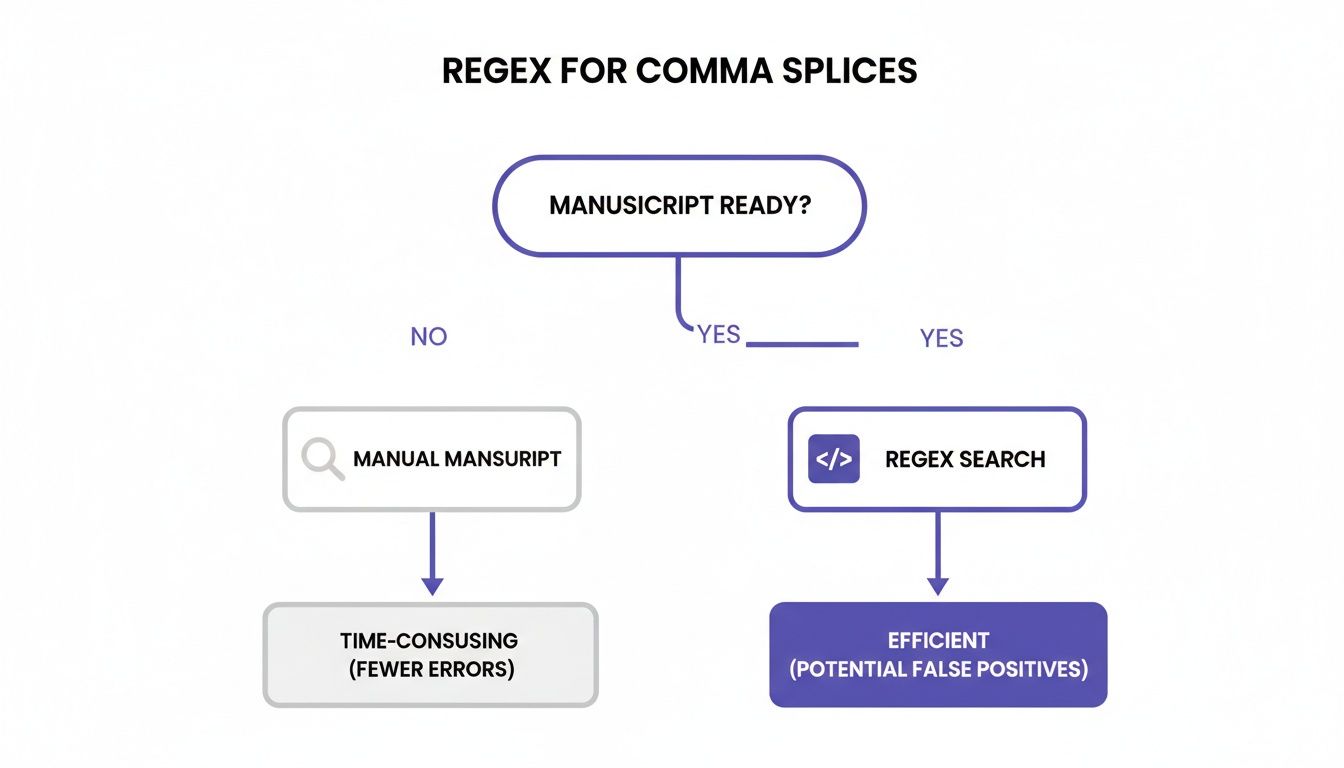
As you can see, while manual reviews are straightforward, regex offers a much more powerful, pattern-based approach for sprawling manuscripts where efficiency is everything.
Expanding Your Sentence Toolkit
Your third strategy is to pop in a coordinating conjunction (think and, but, so, or, for, yet). This is often the most natural-sounding fix because it clarifies the logical relationship between the two clauses. Adding "but" introduces contrast, while "so" establishes causality, adding a subtle layer to a character's thought process or a narrative observation.
Finally, you can completely restructure the sentence by subordinating one of the clauses. Turning one independent clause into a dependent one creates a more complex, elegant sentence. This is easily the most creative solution, allowing you to fine-tune the rhythm and emphasis of the entire line for maximum impact.
The right fix isn’t about being grammatically “correct.” It’s about choosing the punctuation or structure that best serves the tone, pace, and voice of that specific moment in your story.
This level of detailed sentence work is often overlooked, yet it’s what separates an amateur manuscript from a professional one. It’s no surprise that as more indie authors work to reduce editing costs, the Online Grammar Checker Market is forecasted to hit USD 408 million by 2031. Many of these tools are also branching into more advanced analysis, so it’s worth reading our guide on AI writing software for novelists to see where the technology is headed.
When to Hunt for Comma Splices in Your Workflow
Let's get one thing straight: hunting for comma splices while you're in the middle of a first draft is a terrible idea. It’s like stopping to polish the chrome on a car you're still building. Interrupting that creative flow to get bogged down in punctuation is the fastest way to kill your momentum.
Instead, splice-hunting is a specific, targeted mission that comes much later in the editing game. It needs its own dedicated phase.
You’ve already done the hard work. Your developmental edit is complete—no more gaping plot holes. Your character arcs land. You've gone through your line edits, and the prose is singing. Now, right before that final, exhaustive proofread, you put on a different hat.
Enter the Mechanical Pass
This is the moment you transition from artist to technician.
The goal here is brutally simple: find and fix structural sentence errors like comma splices. You’re not rewriting for voice, trimming word count, or rethinking a character's motivation. You are laser-focused on the grammatical scaffolding holding your story together.
This single-minded approach keeps you from getting distracted by big-picture story issues that should already be solved. By isolating this task, you can unleash your tools—whether a clever regex search or a manual pattern check—with ruthless efficiency. Your brain is tuned to spot one specific kind of error, making it so much easier to catch across tens of thousands of words.
A dedicated mechanical pass isn't just about cleaning up mistakes. It's a final quality check that ensures your sentence structure is as sound as your plot, preventing anything from tripping the reader as they race toward the climax.
This isn't a niche concern. The Online Grammar Checker Market was valued at USD 353 million in 2025 and continues to grow for a reason. Having the right workflow, powered by the right tools, helps you sidestep that mess. To get a feel for how specialized software can help, it's worth exploring the different types of writing software available to authors.
How to Brief Your Beta Readers
Your beta readers are your secret weapon in this final push, but only if you point them in the right direction.
Don't just give them a manuscript and ask them to "look for typos." That's too vague. Instead, give them a specific mission that gets at the feeling a comma splice creates.
Ask them to flag any sentence that feels confusing, breathless, or just seems to "run on too long." They don't need to know the grammatical term for it; they just need to tell you where the reading experience stumbles.
When a reader flags a sentence for being a run-on, there’s a good chance you’ve got a comma splice at the heart of the problem. This feedback gives you a highly targeted list of potential errors to investigate, turning their subjective experience into actionable data for your final polish.
Let's Talk About Comma Splices
You see them everywhere. You've probably been told they're a cardinal sin of writing. But what's the real story with comma splices, especially for a fiction writer? Let's get right into the questions I hear most often from novelists.
Can I Ever Use a Comma Splice on Purpose?
Absolutely. You just have to know you're doing it. In fiction, the "rules" are less like laws and more like really good suggestions. A well-placed, deliberate comma splice can be a powerful tool.
Think about a character whose thoughts are spiraling out of control, or two people firing dialogue back and forth so fast they’re tripping over each other’s words. A comma splice can capture that rushed, breathless, almost frantic feeling perfectly. The key is intention. A reader can feel the difference between a clumsy mistake and a stylistic choice that serves the character and the moment. If it strengthens your narrative voice, it's not an error—it’s technique.
Is a Comma Splice Just a Run-On Sentence?
Close, but not quite. They're related, like cousins who cause similar trouble.
A comma splice is when you join two complete, independent sentences with nothing but a flimsy comma. For example: He ran for the door, she blocked his path.
A true run-on sentence, sometimes called a fused sentence, is even more chaotic. It smashes two complete sentences together with zero punctuation between them: He ran for the door she blocked his path. Both can trip up a reader, but they're technically two different beasts.
What’s the Fastest Way to Spot One?
Easy. Use the period test. It’s my go-to diagnostic, and it works every time.
Just find the comma you're suspicious of and mentally swap it out for a period. Do you now have two perfectly good, grammatically complete sentences? If the answer is yes, you've found a comma splice. It's that simple.
My Two Cents: The period test is your best friend during edits. If you can split the sentence at the comma and both halves can stand on their own, you've got a splice. From there, you get to be the author and decide: fix it, or keep it for effect?
Will a Comma Splice Checker Ruin My Authorial Voice?
Only if you let it. A good grammar tool should work for you, not the other way around. Think of it as a diagnostic instrument, not a creative director.
My advice? Don’t run these tools while you’re in the creative flow of drafting. Save it for a dedicated editing pass. Let the checker flag potential issues, then put on your author hat and review each suggestion. You make the final call. This approach helps you catch genuine slip-ups without stamping out the intentional, rule-bending quirks that make your writing sound like you.
Ready to stop wrestling with your manuscript and start writing with confidence? Novelium's manuscript intelligence platform helps you track every detail, from character arcs to timelines, ensuring rock-solid continuity without ever compromising your voice. See what you've been missing at https://novelium.so.