Mastering the Comma Before Quote in Dialogue
Here's the simple rule that separates pros from amateurs: in American English, you use a comma before a quote when it’s introduced by a verb of saying. Think said, asked, or whispered. This isn't just a stylistic quirk; it's a hard-and-fast convention, and ignoring it is one of the quickest ways to signal to an agent or editor that your manuscript isn't quite ready for prime time.
Understanding The Core Rule For Dialogue
For a working novelist, this little comma is more than a punctuation mark—it's a critical piece of the machinery. It tells anyone reading your work that you understand the established language of fiction. It’s a tiny signal that carries a whole lot of weight, cleanly separating spoken words from the person speaking them.
This isn’t about being a grammar pedant. The comma creates a necessary pause, a beat that mimics the natural rhythm of a conversation. Think of it as the literary equivalent of a speaker taking a quick breath before delivering their line. It prevents the dialogue tag from awkwardly slamming into the quote itself.
Why This Comma Is Non-Negotiable
This rule is deeply baked into the American publishing world. It’s not a suggestion; it’s a foundational principle found in the style guides that shape millions of published words every year. The Chicago Manual of Style, the bible for most U.S. publishers, is explicit: a comma introduces dialogue when there's a verb of saying. And considering the U.S. book publishing industry pulled in roughly USD 28–30 billion in 2023, playing by its rules is your ticket to entry.
This flowchart breaks down the decision-making process into a simple question.
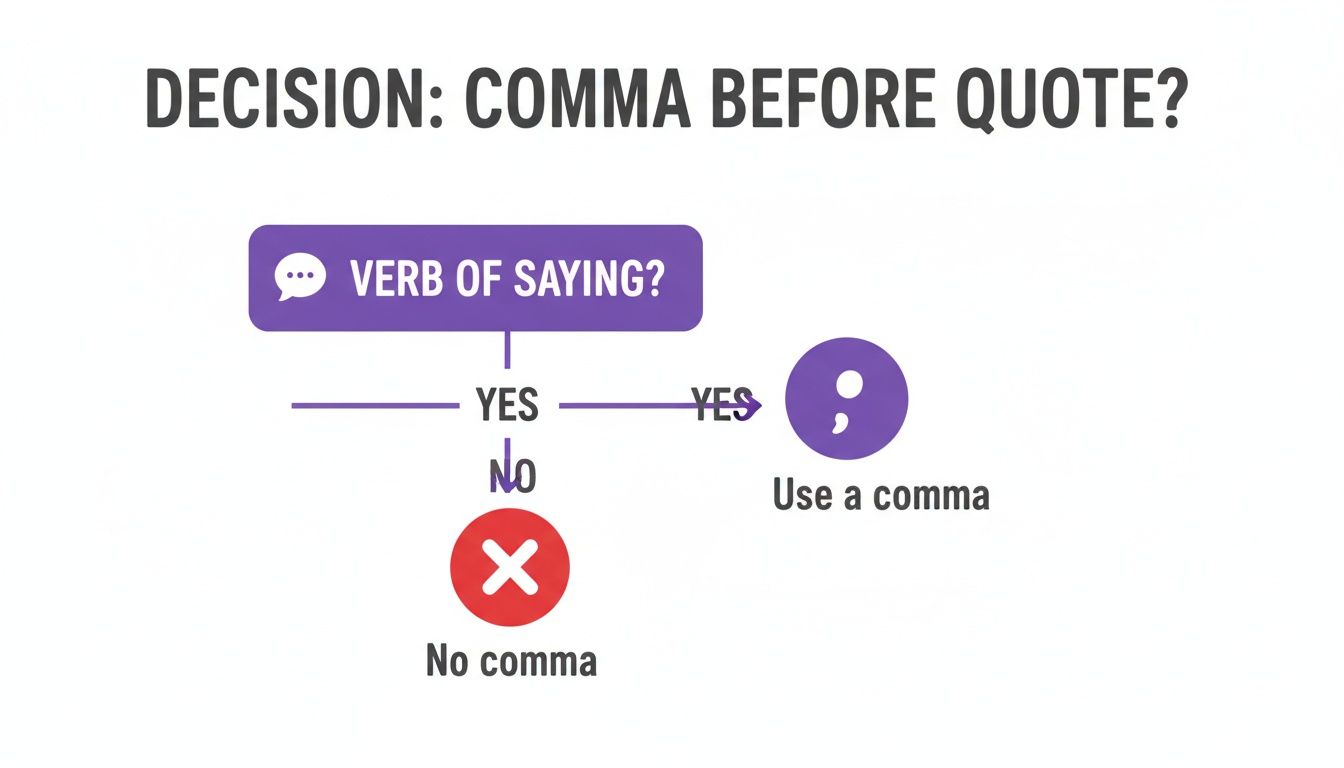
As you can see, it all hinges on that verb of saying. Getting this right is fundamental. It’s the kind of detail that purpose-built novel writing software is designed to help you track, ensuring your punctuation stays consistent across a 100,000-word manuscript. When you get this rule wrong, it often causes a ripple effect of other punctuation mistakes that bog down your story and create headaches for editors down the line.
To make it even clearer, here’s a quick-reference table covering the most common ways you'll see this comma rule applied in dialogue.
Core Scenarios For Commas With Dialogue
| Scenario | Correct Punctuation Example | Why It Works |
|---|---|---|
| Attribution Before Quote | Maria whispered, "I think someone's following us." | The verb of saying (whispered) directly introduces the dialogue, so it needs a comma. |
| Attribution After Quote | "I think someone's following us," Maria whispered. | The comma goes inside the quotation mark to separate the dialogue from the attribution that follows. |
| Attribution Interrupts Quote | "I think," Maria whispered, "someone's following us." | The interrupting phrase is set off by two commas, one before it and one after. |
Getting these patterns down will make your dialogue look clean, professional, and ready for publication. It becomes second nature once you’ve practiced it enough.
Navigating the American vs. British Style Divide
The comma before a quote is one thing. But the comma that comes after it—and specifically where it lands in relation to the closing quotation mark—is an entirely different beast. This isn't just a trivial grammar debate; for writers, especially novelists publishing globally, it's a strategic branding decision.
Get this wrong, and you're essentially signaling to a huge slice of your audience that you’re not from their corner of the world.
American style, which is driven more by old-school typographic tradition than pure logic, has a simple rule: commas and periods always go inside the closing quotation mark. It doesn’t matter if the comma was part of the original quote. That’s just the convention.
The Great Punctuation Split
Hop across the Atlantic, and you’ll find that British English often uses what’s called “logical punctuation.” It’s exactly what it sounds like. In this system, the comma only goes inside the quotation mark if it was part of the original speech or text. If the comma belongs to the larger sentence, it stays outside.
Here’s what that looks like in the wild:
- American Style: “I’m not going,” she said.
- British Style: ‘I’m not going’, she said.
See the difference? The American comma is tucked safely inside, while the British one hangs out on the other side of the quote. It might seem like a tiny detail, but in the publishing world, it’s a massive cultural signifier.
The choice between these two styles has real market implications. The US, UK, Canada, and Australia make up as much as 60% of global English-language book sales. Using the wrong convention can alienate half your potential readers or just make your manuscript look unpolished to editors in a specific market. You can read more about these punctuation differences to see just how deep this divide runs.
Making the Right Choice
So, which one is right for you? It all boils down to your primary audience.
If you’re writing for American readers or gunning for a U.S. publisher, put that comma inside the quotes. No exceptions. If you’re targeting the UK or other Commonwealth markets, placing it outside is likely your best bet.
Whatever you choose, the most important thing is consistency. Pick a style and stick with it through your entire manuscript. Jumping between the two is a classic rookie mistake and one of the first things a good editor will flag.
When to Deliberately Break the Comma Rule
Rules are there for a reason, but every seasoned writer knows that true mastery comes from knowing when—and how—to break them. The standard "comma before a quote" rule really only applies when you're introducing dialogue with a tag like said or whispered. In plenty of other situations, adding that comma isn't just unnecessary; it’s flat-out wrong.
Getting a handle on these exceptions is what separates writers who just follow the rules from those who make deliberate, powerful choices in their prose.
Action Beats vs. Dialogue Tags
The easiest and most effective way to ditch the comma is to swap out a dialogue tag for an action beat. Think of an action beat as a quick sentence describing what a character is doing right before or after they speak. It attributes the dialogue without explicitly saying so.
- Dialogue Tag (with comma): She said, “This is the last time.”
- Action Beat (no comma): She slammed the door. “This is the last time.”
See the difference? The action beat injects life and imagery into the scene. Because it’s a complete sentence, it ends with a period, which means you don't need a comma before the dialogue. This little trick is a workhorse in modern fiction, letting you show a character’s emotions and ground their words in the physical world.
Integrated Quotes and the Word 'That'
Another big exception pops up when a quote is woven seamlessly into the fabric of your sentence. If the dialogue flows as a natural part of your narration, you can skip the comma. This is almost always the case when you introduce a quote with the word that.
When you use “that” to introduce speech, the comma disappears entirely. The word “that” acts as the bridge between your narration and the character’s words, making a comma redundant and clunky.
For example, you’d write He insisted that “the evidence was planted” without any comma. The quote is essential to the sentence's structure, not a formal piece of dialogue that needs a grand entrance. Dropping a comma in there would just trip up the reader and ruin the sentence's rhythm.
It can be tricky to keep these straight while you’re in the flow of writing. Here’s a quick-glance table to help you spot when a comma is needed and when it should be left out.
When to Skip the Comma Before a Quote
| Situation | Correct Usage (No Comma) | Incorrect Usage (With Comma) |
|---|---|---|
| Action Beat Attribution | He picked up the phone. “We have a problem.” | He picked up the phone, “We have a problem.” |
| Quote Introduced by 'That' | The witness swore that “he never saw the car.” | The witness swore that, “he never saw the car.” |
| Flowing Integrated Quote | Her final words were “I’ll be back.” | Her final words were, “I’ll be back.” |
Recognizing these patterns will eventually become second nature, helping you punctuate your dialogue and narration with confidence and style.
Why Readers and Editors Expect This Comma
Your beta readers, your critique partners, and your future editor didn't just stumble upon the 'comma before a quote' rule; they've had it hammered into them for years. This isn't just some quirky publishing tradition. It’s a deeply ingrained pattern that, right or wrong, signals basic competence.
From the first essays we wrote in middle school to the term papers we turned in at university, the instruction was always crystal clear. This emphasis is so strong that most academic resources treat this comma as a baseline literacy skill, not an advanced stylistic choice.
What does that mean for you as a fiction writer? It means that just about everyone who picks up your draft has been conditioned by more than a decade of education to see a missing comma here as a flat-out mistake. You can get a sense of this educational standard from university writing guides and see just how deeply it shapes what your readers expect.
Triggering the Brain's 'Error Flag'
Because this pattern is so baked into our reading habits, its absence is jarring. When a reader sees dialogue without the expected comma, it triggers a subconscious ‘error flag.’ Their brain hits a tiny speed bump, registers the pattern as incorrect, and then has to restart.
This little moment of friction might seem insignificant on its own, but these things add up. Each missing comma is another small stumbling block that yanks the reader out of your story, reminding them that they’re reading a book instead of living inside a world.
The problem is that readers—and editors—don't see a missing comma as an artistic choice. They see it as an error. You're not breaking a rule to create a cool effect; you're just using the wrong tool for the job.
The Impact on Reader Trust and Your Editor’s Sanity
This perception of error quietly chips away at a reader’s trust. If the author gets something this fundamental wrong, what other, bigger things might be shaky in the manuscript? It’s a tiny crack in the foundation of your authorial authority, but it can widen quickly.
For an editor, the problem is far more practical. A manuscript riddled with these kinds of punctuation issues is a red flag. It signals a draft that's going to need a ton of tedious, line-by-line cleanup. It adds friction to the entire process and suggests the author hasn’t quite mastered the foundational mechanics of professional prose.
Getting this one comma right from the start is one of the simplest ways you can signal that you're ready for publication. It shows you’ve done your homework.
Punctuation Is Your Pacing Power-Tool
Getting the rules right is step one. But the real magic happens when you make them serve your story.
Punctuation isn't just about being grammatically correct. For a writer, it’s your toolkit for controlling rhythm, shaping a character’s voice, and twisting the emotional knife in a scene. The choice between a comma, a colon, or an action beat isn't just a technicality—it's a conscious, artistic decision.
Think of the comma before a quote as the default, the neutral gear of dialogue. It creates a standard, almost invisible pause that keeps the story humming along without drawing attention to itself. It’s clean, efficient, and exactly what readers expect to see.
Punctuation as a Narrative Lever
But sometimes, neutral isn’t what you need. Swapping that comma for something else fundamentally alters how a line of dialogue lands.
A colon, for example, adds a sense of formality or pronouncement. It creates a longer, more deliberate pause, as if the character is taking a breath before delivering a line that really matters.
He raised his glass: “To the ones we left behind.”
See that? The colon puts a spotlight on the words that follow, giving them a bit of weight and ceremony.
In contrast, replacing a dialogue tag with an action beat changes the entire sensory experience. Instead of telling the reader a character spoke, you show them doing something in the scene, grounding their words in a physical moment.
This is where technical skill bleeds into real narrative artistry. The subtle shifts in rhythm you create with these choices can be the difference between a flat scene and a dynamic one. It’s the difference between a character simply speaking and a character acting through their words.
Making these choices deliberately—understanding whether you are a plotter or pantser in your approach to prose—is what allows you to fine-tune every line for maximum impact. When you master these nuances, you move beyond just being correct and start using every single mark on the page to tell a better, more powerful story.
A Few Common Questions About Dialogue Punctuation
Even after you’ve been writing for years, you’ll run into a weird sentence that just looks… off. When you’re deep in the weeds of a manuscript, it's easy to second-guess yourself. Here are a few of the trickiest scenarios that trip writers up.
Do I Need a Comma Before a Quote That Is Only One Word?
Yes. As long as the quote is introduced by a verb of speaking (like said, whispered, shouted), the length of the quote doesn't change the rule.
The comma’s only job is to separate the attribution from the spoken words. So, She whispered, “Now.” is perfectly correct. It doesn’t matter if the quote is one word or one hundred.
How Do I Punctuate a Dialogue Tag That Interrupts a Sentence?
When you drop a dialogue tag right into the middle of a quoted sentence, you need to box it in with commas. Use one comma before the tag and another one right after it.
Think of it this way: “The plan,” he said, “is to leave at dawn.” Those two commas act like parentheses, setting the tag apart from the speech. This lets the reader’s brain cleanly separate the action of speaking from the words themselves without skipping a beat.
Is Using an Action Beat to Avoid the Comma a Good Technique?
Absolutely. In fact, it's one of the clearest signs of a writer who has moved beyond workmanlike prose into truly dynamic storytelling.
Instead of writing She said, “I’m not sure,” you can create a much stronger image with something like She shrugged. “I’m not sure.” The action—the shrug—attributes the speech just as clearly as a dialogue tag would, but now you don't need a comma. This technique makes your scenes more visual and engaging.
For writers thinking about the ethics of writing with AI, mastering these very human, show-don't-tell techniques is more critical than ever. It's what separates a real voice from a generated one.
Getting the punctuation right is just the start. When stories get complex, you need a system that tracks every character, object, and timeline detail for you. Novelium is a manuscript intelligence platform that finds continuity errors before your readers do, so you can focus on the story, not the spreadsheet. Stop tracking details by hand and let Novelium find the inconsistencies for you. See how it works at https://novelium.so.