Climax in literature: Mastering Peak Moments for Engaging Stories
Let’s get one thing straight: the climax isn’t just the most exciting part of your story. Forget the dusty classroom definitions. The climax is the structural heartbeat of your novel, the single moment of maximum pressure where everything you've painstakingly built—every character arc, every subplot, every thematic question—violently collides.
It's the point of no return.
The Structural Heartbeat of Your Novel
When we tear down manuscripts, we see stories fail not because the climax lacks a big explosion or a sword fight, but because it feels disconnected from everything that came before. A thrilling sequence is useless if it doesn't resolve the central conflict you introduced way back in the inciting incident.
Think of it as narrative debt. Every promise you make to the reader—every setup, every bit of foreshadowing—is a loan. The climax is where you make the final, high-stakes repayment. If that payment doesn't cover the full balance, the resolution will feel cheap, hollow, and unearned.
This is the fundamental journey: from the initial problem to the ultimate confrontation.
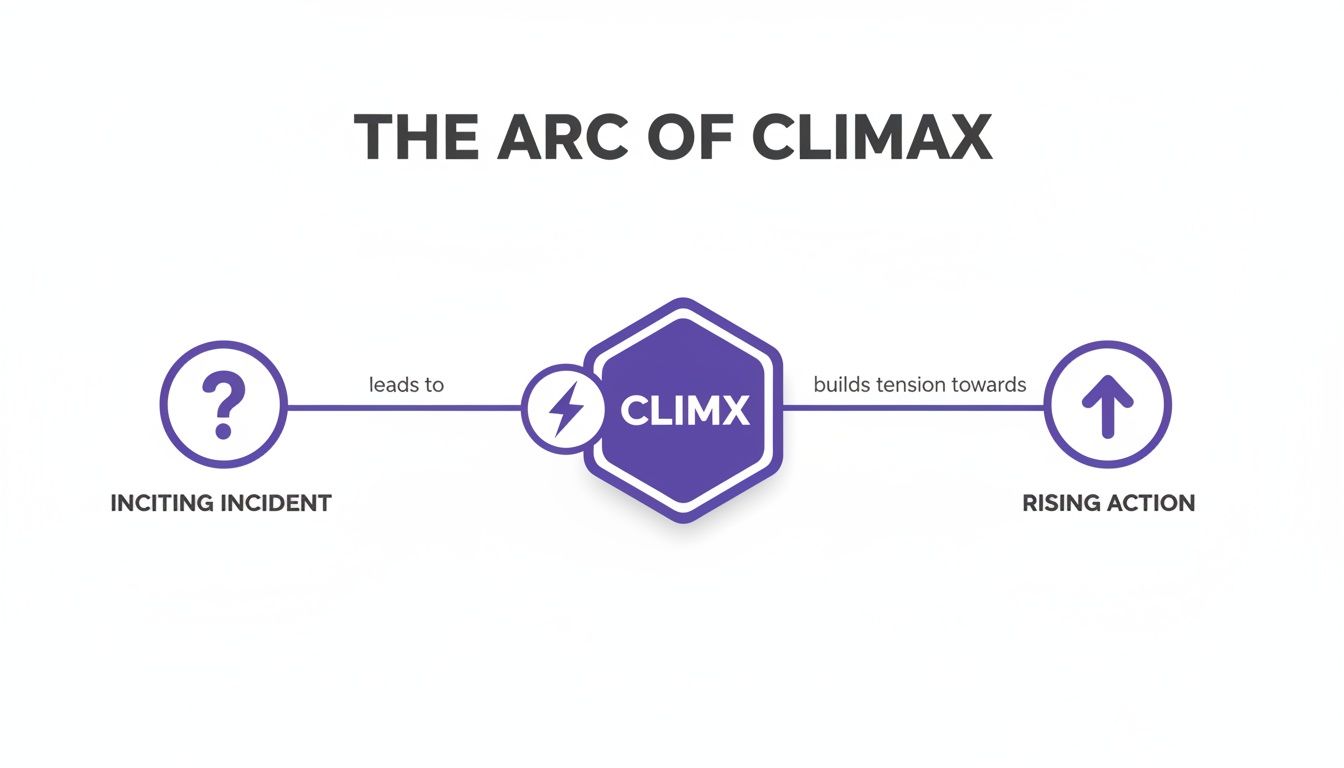
As the diagram shows, the climax isn't just some island of action. It's the logical, inevitable endpoint of the rising action, which itself grows directly from the story's core question.
The Mathematics of Pacing
The idea of a story having a "peak" is nothing new. Gustav Freytag's Pyramid from 1863 mapped the dramatic structure of plays, and that model still holds up with surprising accuracy. What's changed is where we place that peak.
When we analyze bestselling novels, a clear pattern emerges: the vast majority place their climax somewhere between the 75% and 90% mark of the total word count. This isn't an accident; it's a reflection of ingrained reader expectation and modern pacing. Manuscripts that get this wrong often feel rushed or, worse, drag on long after the real story has ended. We've observed that a significant percentage of manuscripts rejected for pacing issues suffer from peaks that hit too early or too late, killing the narrative momentum.
From Buildup to Breaking Point
The road to the climax is a calculated escalation. Every single scene in the rising action needs to tighten the screws on your protagonist, cranking up the pressure. This buildup isn't a random series of events; it's a meticulous chain of cause and effect that makes the final showdown feel both surprising and utterly inevitable.
A weak climax often signals a problem much earlier in the book. If the final confrontation doesn’t land, it’s rarely the scene’s fault. It’s because the narrative threads that were supposed to lead there were frayed from the start.
The real heavy lifting of crafting a powerful climax happens long before you ever type that scene. It’s done in the careful layering of stakes, the consistent application of character motivation, and the relentless march of causality that makes your story’s peak feel like the only possible way things could have ever ended.
Architecting the Point of No Return

The climax in literature is not a single, explosive scene. It’s a sequence. Think of it as a controlled demolition that starts with one final, unavoidable push and doesn't end until the dust has settled and the outcome is crystal clear. The real work isn't writing the explosion; it's architecting all the tiny triggers that make the final confrontation inevitable.
Causality is your best friend here. When we dig into manuscripts, a common failure point is a climax that feels totally arbitrary—like something that just happens to the main character. A great climax is one that is forced by the protagonist's choices. Every single event, every bad decision, every character flaw needs to funnel directly into this moment, sealing off all other escape routes.
Causality Over Coincidence
That handover from the rising action to the climax is the most critical moment in your entire story. This is where your protagonist, backed into a corner they built themselves, is finally forced to act. And that action has to be a direct consequence of everything they’ve been through.
If the villain just appears out of nowhere or a freak storm suddenly traps everyone, you've built your climax on coincidence, not character. That's a huge red flag.
The truly memorable climaxes are the ones that fuse the external plot with the character’s internal struggle. The bomb that needs defusing, the final courtroom showdown—that external event has to be the physical embodiment of the protagonist's inner battle. They can only win when they finally overcome their core flaw. This synthesis is what elevates a merely exciting scene into a deeply resonant, earned conclusion.
A climax that feels forced often means the character's agency was stripped away in the preceding chapters. If the protagonist has been a passenger for the last fifty pages, their sudden, decisive action in the finale will ring false.
Modern storytelling, especially with the three-act structure, has sharpened this focus on a late-stage, high-impact peak. This isn’t a new trend, either. The shift started in the late 19th century, pushing the climax dramatically closer to the end of the story. This change boosts reader retention by keeping tension high until the final pages. It’s no longer just an academic theory; it's a proven structural tool.
Differentiating Structural Turning Points
A common pitfall we see in manuscripts is confusing the climax with other big turning points. The midpoint, the "dark night of the soul," and the true climax each have a very distinct job to do. Mix them up, and you end up with weird pacing, a climax that feels like a false alarm, or worse, an anticlimax.
The protagonist's mindset and the questions being answered are completely different at each stage. This is especially true after they've clawed their way out of that devastating all-is-lost moment that comes right before the final push.
To clear things up, let's break down how these moments function.
Key Structural Turning Points vs The Climax
| Plot Point | Core Function | Character State | Common Placement |
|---|---|---|---|
| Midpoint | Recontextualizes the conflict, revealing the true stakes or enemy. | Reactive to proactive. Gains new, often flawed, understanding. | ~50% mark |
| All-Is-Lost Moment | Represents the lowest point, where the protagonist's initial plan has utterly failed. | Despair, surrender, internalizing the core flaw. | ~75% mark |
| Climax | Forces a final, irreversible confrontation with the central antagonistic force. | Active and decisive. Applies the new, hard-won belief to solve the external problem. | 80-95% mark |
Getting these distinctions right isn't about blindly following a formula. It's about making sure each major beat does its job, building the pressure and character growth needed to make your climax feel not just possible, but completely, emotionally, and logically necessary.
Using False Peaks for High-Stakes Misdirection
The false climax is one of the trickiest and most powerful tools a writer has. When it works, it’s a thing of beauty. But when it doesn’t, it can torpedo your entire third act. This isn't about pulling a cheap "gotcha!" moment out of a hat. It’s about building a sophisticated narrative trap, a deliberate misdirection that gets the reader to let their guard down right before you reveal the real danger.
When you nail it, a false climax feels like the end. The villain is caught, the lovers finally admit how they feel, the bomb is defused with one second on the clock. The reader takes a breath, thinking they’ve hit the peak. But it’s a setup. This supposed victory is designed to crack the story's foundation wide open, revealing a much deeper, more terrifying problem that was hiding in plain sight all along.
Your goal is to make the reader feel safe just before you pull the rug out from under them.
The Art of the Double-Cross
We see a lot of manuscripts where the false climax gives away the farm. It resolves the emotional conflict so completely that the real climax feels like an overlong, tacked-on epilogue. The secret is to resolve the immediate, obvious physical threat while leaving the core emotional problem hanging or, even better, making it ten times worse.
Pulling this off requires serious planning. You’re not just plotting one peak; you’re building a treacherous little mountain range in front of the real one. The events of the false climax can't just be another bad thing that happens. It has to be the direct cause of the final showdown, the one thing that makes the true climax absolutely unavoidable.
Think of it as luring your opponent and the reader into the perfect ambush.
The false climax pays off the reader's investment in the A-plot just enough to make them feel safe. Its real job, however, is to detonate the B-plot, transforming it into a new, more terrifying A-plot that demands a final, definitive answer.
This move is especially potent in thrillers and mysteries, where the whole point is to keep the reader guessing. A significant percentage of bestsellers in these genres use a false climax. It’s a way of training the reader for a bigger, more satisfying payoff. Take The Hunger Games: the berry standoff around the 85% mark looks like the end. It solves the immediate problem, but then the Capitol’s rule change yanks the rug out, triggering the true climax. You can discover more insights about how authors structure these crucial moments.
Constructing a Believable False Peak
To avoid sucking all the energy out of your finale, the false peak has to play by a few key rules. It needs to feel like a genuine win, but one with a crack in it somewhere. Here’s how to build one that works for your story, not against it:
- Offer a Plausible Solution: The resolution has to be one the reader could buy as the real ending. It solves the problem as we’ve understood it up to this point.
- Leave a Trailing Thread: After the “victory,” leave a tiny detail hanging. An unanswered question, a weird look from a side character, something that doesn't quite add up. That’s the thread the true climax will pull to unravel everything.
- Escalate the Stakes: The fallout from the false peak must immediately show that the protagonist, in solving one problem, has just unleashed a monster. The “win” has to come at a terrible, unforeseen price.
This is a game-changer for writers working on a series. Each book’s climax can act as a false peak for the larger, series-long conflict. It gives readers a satisfying end to that particular story while jacking up the stakes for the next installment. It's how you leave them desperate for book two.
Maintaining Continuity at the Breaking Point

Here's a hard truth: the climax is where the slightest inconsistency will shatter your entire story. All the careful plotting and character work you’ve poured into the last eighty thousand words can be undone in a single sentence if a character suddenly remembers something they were never told, or pulls out a weapon they lost three chapters ago.
This isn't some theoretical problem. It’s probably the most common failure point we see in complex manuscripts.
Your climax is the ultimate stress test for your story's internal logic. All the pressure you've been building finally erupts, and readers are paying closer attention here than anywhere else. They will notice if your magic system suddenly sprouts a new rule, if the grizzled detective’s limp conveniently vanishes for the chase scene, or if the villain forgets their own motivation mid-monologue.
Once you break a reader's immersion, it’s nearly impossible to get it back.
The Failure of Static Character Sheets
Let’s be honest, the classic character questionnaire you filled out before starting is useless for this. Knowing your protagonist’s favorite color doesn’t stop them from acting on information they don’t actually have. These static documents fail because they don't evolve with the story. They treat your character like a museum exhibit, not a living person whose knowledge, inventory, and physical condition are constantly changing.
The real challenge, especially in a full-length novel, isn't defining a character; it’s tracking them. A huge percentage of climactic inconsistencies come from a simple failure to track how a character’s state has changed. The mistake that torpedoes your climax was probably planted fifty pages earlier.
A character profile tells you who a person is at the start. A character tracking system tells you who they are—and what they know—at the start of scene 27. Only the latter can deliver a flawless climax.
This is the mental shift from "character development" docs to a "character tracking" system. One is a creative exercise you do at the beginning. The other is a logistical necessity for pulling off a logical and satisfying climax.
Dynamic Tracking for a Bulletproof Climax
So, what do you actually need to track scene-by-scene to make sure your climax holds up? Forget the fluff. You need to focus on the variables that directly impact your character's ability to act and make decisions when everything is on the line.
Here are the critical data points that have to be dynamic:
- Knowledge State: What does this character know, and more importantly, when did they learn it? A character can't act on information from a scene they weren't in. Tracking this simple fact prevents those frustrating, unearned epiphanies.
- Physical State: Are they injured? Exhausted? Poisoned? That stab wound from Chapter 12 better still be a factor in the final fight unless you've explicitly shown them healing from it.
- Emotional State: Their emotional arc has to make sense. A character who was terrified two scenes ago can’t just stride into the climax with newfound confidence unless a specific event caused that change. You have to show the work.
- Object Permanence: What are they carrying? Did they drop their sword? Do they still have the key they pocketed in the first act? Nothing kills tension faster than a character pulling a crucial item out of thin air.
This kind of granular, scene-by-scene tracking is what separates a professional, airtight manuscript from an amateur one that falls apart under pressure. It ensures that every action, every decision, and every consequence in your climax is a direct and logical result of everything that came before. It’s not just about writing an exciting scene; it’s about earning it.
Pacing the Climax for Maximum Reader Impact
The climax isn’t just another scene on the page. It’s a physiological event you’re engineering for your reader, and pacing is the tool you use to get their heart rate up. Everything leading to this moment has been a steady squeeze of pressure; now, it’s time to cut the brake lines.
This means you have to make a conscious, sometimes radical, shift in your prose. The long, winding sentences and thoughtful paragraphs that served you so well in the rising action will feel like dragging your feet through mud here. At the climax, narrative time needs to contract, slowing down to a frame-by-frame crawl while the reader’s pulse rockets skyward.
Shrinking the Prose to Amplify the Action
The single most effective way to slam the accelerator on your pacing is to shorten everything. Your sentences become fragments. Your paragraphs shrink to single, punchy lines. The white space on the page becomes a weapon, forcing the reader’s eye to race downward.
This isn't just a stylistic flourish; it's a direct reflection of your protagonist's mind. When adrenaline floods the system, perception narrows to a tunnel. The brain stops processing complex, abstract thoughts and dials in on immediate sensory input and pure, visceral reaction. Your writing has to do the same.
Forget the internal monologue about the thematic weight of the final fight. Ditch the flowery descriptions of the sunset behind the exploding building. Zoom your narrative lens in tight. Focus on the grit of sand on a trigger, the slickness of sweat on a steering wheel, the sharp intake of breath just before the lunge.
The Treachery of Exposition and Introspection
One of the most common mistakes we see in manuscripts is an author jamming backstory or an internal debate right into the middle of the climax. They suddenly realize they haven't quite set up the final confrontation, so they wedge in a flashback or a long-winded inner thought right as the action peaks.
This is narrative malpractice. The time for reflection is over. The climax is for action and consequence, not for the protagonist to suddenly recall a key piece of wisdom from their mentor or to ponder their life choices.
Any information absolutely crucial for the climax has to be seeded long before it. If the protagonist needs to remember a specific weakness, you should have planted that detail somewhere in the rising action. If they need to have a huge emotional epiphany, that breakthrough should happen in the moments leading up to the climax, not smack in the middle of it.
The only introspection that gets a pass during a climax is brief, reactive, and directly tied to the immediate physical action. A flash of a memory, a single curse, a gut-wrenching feeling—those work. A two-paragraph debate on the morality of their actions is a momentum killer. To really dig into this, you can find a deep dive into the mechanics of narrative speed in our guide to understanding pacing in your novel.
A Checklist for Diagnosing Pacing Issues
When you revise your climax, you need to be merciless. Read it out loud. If you find yourself stumbling over complex sentences or running out of breath, your readers will feel it, too. Your goal is a seamless, breathless experience.
Here’s a quick diagnostic to run on your own work:
- Sentence Length Variation: Is there a clear shift to shorter, more declarative sentences? Are you using fragments for impact?
- Filter Words: Hunt down and kill words like "he saw," "she felt," "he noticed." Instead of writing He saw the fist coming, just write The fist came. This closes the distance between the reader and the action.
- Authorial Intrusion: Are you explaining what’s happening instead of just showing it? Phrases like "in that moment, she realized" are dead weight. Let the character’s actions speak for themselves.
- Sensory Focus: Does your prose prioritize immediate sensory details—sound, touch, smell—over abstract thought? The experience should feel visceral, not analytical.
By tightening your prose and ruthlessly cutting anything that slows the forward momentum, you transform the climax from a simple plot point into a powerful, immersive event that will leave your reader breathless.
Evaluating and Rewriting Your Climax

Let’s be honest with ourselves for a minute. The climax you hammered out in your first draft probably needs work. A lot of work. It’s almost never a question of if it’s broken, but a question of finding the hairline fractures that are quietly undermining its power.
Rewriting a climax isn’t about swapping out a few adjectives or tightening up sentences. It's more like a structural stress test. You're taking the entire narrative machine you just spent a hundred thousand words building and pushing it until it either holds firm or shatters. The first pass is for getting the story out; the rewrite is where you make it mean something.
The Inevitability Test
Here's the one question that matters most: Does your climax feel both surprising and, in hindsight, completely inevitable? It's a tough needle to thread. You don't want readers to see it coming a mile away, but when the dust settles, they should feel like it was the only way the story could have possibly ended.
This is where you go on a hunt for the dreaded deus ex machina. Did a rich uncle suddenly appear with a will? Did the bad guy conveniently slip on a banana peel? Those are the obvious ones, but the sneakier version is when your hero pulls out a skill or a piece of knowledge that you, the author, never bothered to set up. The solution has to feel earned, growing directly from the character's journey, not just handed to them from your writerly toolbox.
The Protagonist Agency Audit
Next, you have to ask if the climax is something that happens to your protagonist, or if it's something they make happen. A passive hero is the fastest way to kill a good ending. The final outcome—win or lose—has to be a direct consequence of the choices they make in that final, breathless confrontation.
Your protagonist must be the one to make the final choice, throw the last punch, or offer the ultimate sacrifice. If a side character swoops in for the rescue or a random bit of luck saves the day, you've robbed your hero of their agency right when it counts the most. It basically invalidates their entire arc.
The climax must be the ultimate expression of the protagonist's transformed self. If the person they were in chapter one could have made the same choice, your arc has failed.
This is the moment where the internal journey slams directly into the external plot. The outer victory should be flat-out impossible without the inner change.
Gathering Usable Feedback
When you finally hand your draft over to beta readers, don't just ask if they "liked the ending." That's a useless question. You need specific, actionable intel. You need to know the exact moments their tension flagged, or where a character’s decision felt totally out of left field.
Get surgical with your questions.
- Pinpoint the Peak: "Tell me the exact sentence where you felt the most tension. Where was your heart pounding?"
- Track the Logic: "Was there any point where you thought, 'Wait, she would never do that'?"
- Question the Resolution: "Did the ending feel like a direct result of what the protagonist did in this scene, or did it feel like something else caused it?"
This kind of targeted feedback turns beta reading from an ego-stroking exercise into a powerful diagnostic tool. It helps you see beyond your own blind spots and perform a precise rewrite, taking your climax from a simple plot point to the thundering, resonant heartbeat of your entire novel.
A Few Lingering Questions
How Does the Climax Differ in a Series Versus a Standalone Novel?
In a standalone novel, the climax is the final payoff. It’s where every promise you’ve made to the reader gets settled, once and for all. The central conflict needs a definitive, all-encompassing resolution.
A series is a different beast. The climax in any given book has to do two jobs at once. First, it needs to wrap up that specific volume's major plot arc in a way that feels satisfying. But it also has to set the stage for the overarching series conflict, answering the book's immediate question while teeing up a bigger one for the next installment.
What Is the Relationship Between a Character's Internal Arc and the Plot Climax?
They have to be welded together. The external plot climax is the crucible that forces your protagonist to finally face their internal flaw, that false belief or deep-seated fear they've been wrestling with the whole time.
The external victory or failure should feel impossible without that corresponding internal shift. Think about it: a character who needs to learn to trust can only win the final battle by actually relying on their allies. If you disconnect the internal transformation from the external confrontation, the climax will feel hollow and unearned.
Your protagonist's final action in the climax should be one their initial self would have been incapable of making. This fusion of external action and internal growth is what creates a truly resonant conclusion.
Can a Quiet Scene Be a Climax?
Absolutely. A climax isn't defined by explosions or sword fights; it's defined by the peak of narrative tension and an irreversible change. The big action set pieces are optional. The thematic and emotional resolution is not.
Especially in literary fiction, a climax might be a quiet confession, a life-altering decision made alone in a room, or a sudden moment of profound realization that permanently changes the character's path. The real test is whether it resolves the story's central conflict and represents that point of maximum tension, no matter what form that tension takes.
A flawless climax requires bulletproof continuity, tracking every detail across hundreds of pages. Novelium is built to do exactly that, surfacing plot holes and character inconsistencies before they derail your story's most critical moment. See how it works at https://novelium.so.