Characters Point of View: A Guide for Pro Writers
In the 18th century, about half of fiction used first-person narration, while in the 19th century that share fell to about a quarter. The characters point of view problem isn't choosing first or third person, but preserving a stable knowledge boundary so readers always understand whose experience they're inhabiting.
That shift matters because POV has never been a fixed set of grammatical labels. It changes how readers process information, judge a narrator, interpret a silence, and decide whether a character's conclusion deserves trust. In a long novel, especially one with several narrators, POV is a reader-comprehension problem disguised as a style decision.
Professional manuscripts rarely fail because the author forgot what first person means. They fail because Mara knows about the murder three scenes before anyone tells her, because a close-third paragraph subtly reports the antagonist's private intention, or because a chapter break changes viewpoint without changing the language enough to orient the reader. Those are continuity failures. A character profile that records eye colour won't catch them.
Reframing Point of View as a Continuity Problem
The standard conversation reduces POV to a choice between I and he or she. That's useful at the sentence level, but it's a poor operating system for an 80,000-word manuscript. Grammatical person tells you who gets named. It doesn't, by itself, tell you what the reader can know, what the viewpoint character can infer, or which facts the narrative must withhold.
Narrative theory makes the distinction sharper. External POV limits the text to observable behaviour, while internal POV includes thoughts, beliefs, intentions, and emotions, as described in this analysis of character point of view and cognition](https://sci-hub.box/storage/twin/6343/3bd4990fca9fb62f0d7c89c0c8832c35/vanpeer2001.pdf). The practical question is “Who is telling this?” It's “What information is accessible through this consciousness at this exact moment?”

The boundary readers actually track
Suppose a detective sees a bloodstained coat. She can observe the coat, remember the suspect's earlier lie, and form a theory. She can't know that the suspect hid the knife unless the manuscript has supplied a legitimate route to that information. If the narration states the fact anyway, the author has crossed from the detective's knowledge into an unmarked external viewpoint.
That breach may look harmless in isolation. Across a mystery, however, it changes the contract. Readers stop knowing whether a detail is evidence, inference, or authorial disclosure. Suspense weakens because the narrative no longer has a dependable information architecture.
Practical rule: Track the viewpoint character's knowledge as a changing state, not as a permanent trait.
A static profile says that the detective is observant. A tracking system records that she saw the coat in chapter three, learned about the missing key in chapter six, and still believes the wrong suspect is guilty in chapter nine. Character development documents describe who someone is. Character tracking records what has changed, what they know, and what remains unavailable to them.
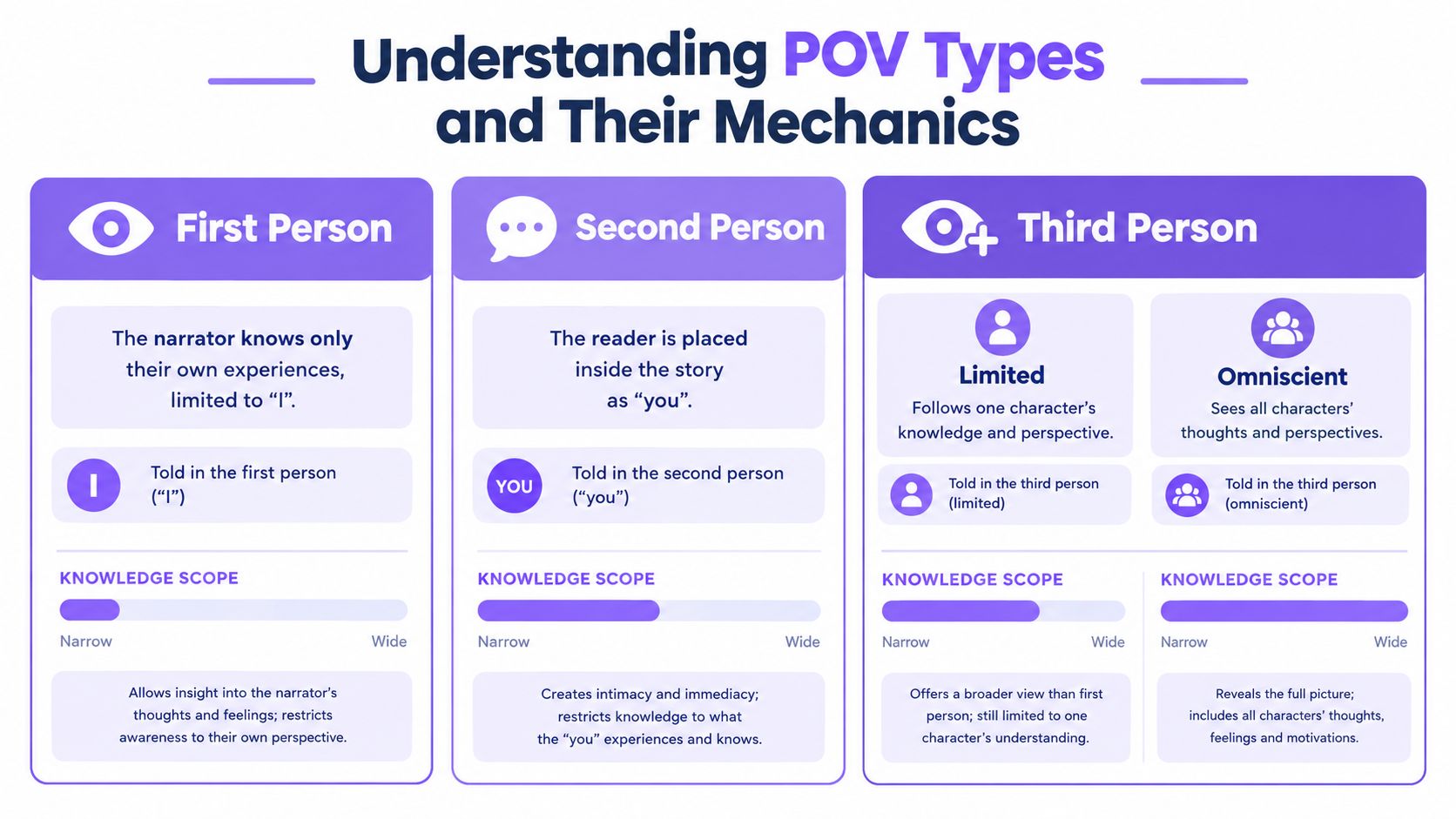
Understanding POV Types and Their Mechanics
First person gives the reader direct access to a character's account through I, but the restriction is severe and useful. The narrator can report personal experience, memory, interpretation, or information learned from another person. The narrator can't enter an absent character's thoughts. That limitation makes first person powerful for intimacy and unreliable perception, but punishing when the plot requires broad access.
Second person places the reader or addressed character inside the action through you. It creates immediacy, but it also narrows the writer's room to establish interiority without dictating the reader's identity. The form can be exacting in a long novel because every sentence must sustain the relationship between narrator, addressed figure, and reader.
Third person has a wider range. Third-person limited follows one character's accessible knowledge at a time, while third-person omniscient can move across characters, events, and levels of awareness through an authoritative narrator. Limited third offers closeness without the grammatical pressure of I. Omniscience offers breadth, but head-hopping becomes a risk when the text changes internal access without a clear transition.
For a closer treatment of interior access, see this deep point of view glossary entry. The useful distinction isn't which form sounds more polished. It's how each form controls the reader's evidence.
Literary history reinforces that POV is a structural instrument, not a timeless convention. A historical account traces the development of introspection and internalisation from early epistolary and first-person forms through Aphra Behn, Daniel Defoe, and Samuel Richardson, while noting the movement from about half of fiction in first person during the 18th century to about a quarter in the 19th century](http://www.aliciarasley.com/arthist.htm). By the early 20th century, authors were combining forms more aggressively.
Britannica's discussion of narrative perspective points to William Faulkner's The Sound and the Fury, published in 1929, with three first-person narratives followed by a third-person section, and Carlos Fuentes's The Death of Artemio Cruz, published in 1962, using all three grammatical persons](https://www-archiv.fdm.uni-hamburg.de/lhn/node/26.html). The lesson for contemporary writers is blunt: mixing POV isn't the problem. Unsignalled access is.
How POV Shapes Voice and Narrative Continuity
POV controls voice because consciousness controls selection. A first-person narrator doesn't merely replace “she” with “I.” The narrator notices different objects, misnames motives, compresses unimportant events, and gives emotional weight to details another character would ignore. Close third can achieve similar psychological proximity while retaining a little grammatical distance. Omniscient narration shifts responsibility toward the narrator's authority.
That authority affects continuity. If a chapter begins in close third through Elena, the reader expects the language to remain compatible with Elena's perceptions. She can recognise her brother's nervous gesture, misread his silence, and remember the argument they had last winter. She can't accurately describe the private shame he feels unless the narrator has deliberately established a wider access mode.
The distinction between internal focalisation and broader narration makes this operational. Internal focalisation presents only what is accessible to the viewpoint character, including the information the text withholds because that character can't know it](https://estetikajournal.org/articles/10.33134/eeja.364). That withholding isn't a defect to repair. It's often the engine of suspense, irony, and character interpretation.
Voice can conceal a continuity error
A polished voice can make an impossible sentence feel earned. That's why experienced writers miss these failures during revision. The prose sounds like the character, so the unauthorised knowledge passes unnoticed.
Free indirect discourse complicates the audit further. It merges third-person narration with a character's subjective vocabulary, judgements, emotional colouring, and deictic language without an explicit frame such as “she thought.” Research summarised in a journal chapter found that first-person narration and psycho-narration increased readers' tendency to adopt the protagonist's perspective, while free indirect discourse did not produce the same effect in that experiment](https://academic.oup.com/edited-volume/61883/chapter/547772880?guestAccessKey=). Form changes reader response, not just surface tone.
Writers working with speculative casts can also use fantasy AI character frameworks as a prompt for thinking about distinct character logic. The continuity question remains yours: does this character's language reveal what they know, or does it accidentally reveal what the author knows?
A viewpoint slip isn't merely a technical blemish. It changes the reader's model of reality.
The failure becomes more damaging when a manuscript alternates between narrators. Each narrator needs a separate knowledge boundary, emotional vocabulary, and interpretive bias. If all characters receive the same neutral access to facts, the novel may remain grammatically correct while losing the distinct pressure that makes multiple POV worth using.
Practical Tips for Maintaining Consistent POV
Start each scene with a viewpoint contract. Record whose consciousness governs the scene, what that character wants to understand, what they already know, and which relevant fact must remain outside their reach. This takes less space than a character questionnaire and produces information you can use during revision.
Then mark the scene's knowledge changes. If the viewpoint character hears a confession, sees a map, or correctly identifies a lie, record the event as a new state. If they only suspect the truth, preserve the distinction between suspicion and knowledge. Writers often flatten those categories during revision, especially when they move scenes or rewrite a reveal.
A reliable scene audit asks four questions:
- Access: Could this character perceive or learn every fact in the passage?
- Inference: Is the text presenting a conclusion as knowledge when it should be a guess?
- Language: Does the diction belong to this character's mind, or to an unmarked narrator?
- Transition: If access widens or shifts, has the prose signalled the change clearly?
The last question matters most in third person. A transition can be a chapter break, a new scene, a strong change in sensory focus, or an unmistakable narratorial cue. A paragraph break alone doesn't automatically transfer consciousness.
Track what stays unknown
Writers are good at recording revelations and bad at recording absences. Add a “cannot know yet” field to your scene notes. It prevents a later draft from giving a character information just because the author has become familiar with it.
Revision test: Cover the viewpoint label and ask whether the scene itself makes the governing consciousness obvious.
Read the manuscript in passes. One pass follows physical presence, another follows acquired information, and a third checks internal language. This is more effective than searching for pronouns. “He” can belong to a limited viewpoint, an omniscient narrator, or a sentence that has crossed into someone else's mind.

Common POV Consistency Failures and How to Avoid Them
The most common failure is impossible knowledge. A woman wakes after an attack and thinks about the attacker's regret, although she never saw his face and nobody has reported his reaction. The sentence may be emotionally apt, but the scene has supplied information unavailable to her. A knowledge-state record would flag the problem immediately: she can fear regret, infer it, or imagine it, but she can't know it.
Another failure appears when two characters share a scene and the prose enters both minds without warning. The viewpoint begins with Tomas noticing the cracked teacup, then reports Lena's private resentment, then returns to Tomas's interpretation of her silence. The author may call this omniscience, but if the rest of the novel uses close third, readers experience it as a broken boundary.
A third failure belongs to series fiction. In book one, a character learns the old password from a dying witness. In book two, a scene is revised so that the character has always known it. The profile still lists the password correctly, so a static bible offers no help. Only a chronology of who learned what, and when, exposes the contradiction.
The same problem affects objects and events. A narrator references a letter before the character has opened it, a supposedly dead witness appears in a later scene, or a character reacts to a conversation that happened off-page and was never reported. These aren't cosmetic slips. They tell readers that the manuscript's information rules aren't stable.
Novelium analyzes manuscripts for consistency issues and surfaces plot holes, timeline mistakes, character contradictions, and object or information inconsistencies in real time as you write](https://novelium.com). Its point of view break glossary entry gives the failure a useful name, but naming the problem isn't enough. The manuscript needs a record of scene-level access and change.
Implementing a Character Tracking System for POV Management
Replace the static character profile with a living record built around scenes. Keep the permanent facts, but give greater weight to changing information: who witnessed the event, who was told, who inferred it, who misunderstood it, and who remains excluded. That record should update as the manuscript changes, not sit untouched while the plot evolves around it.
A practical system has three connected layers. The Character Tracker follows traits, relationships, knowledge states, and events. The World Codex stores the facts that characters encounter, including locations, objects, institutions, and rules. The manuscript remains the authority for when each fact becomes available.
Automated extraction helps here. Novelium's Character Tracker and World Codex automatically extract and track character details across manuscripts, allowing writers to inspect continuity rather than rely on memory or a spreadsheet that was last updated during outlining. For a broader conceptual comparison, Dunia's guide to personality modeling in AI is useful when separating stable identity from changing behaviour. Your POV system still needs the additional layer of knowledge access.
Use the character bible glossary entry as a distinction, not a destination. A bible describes the cast. A tracking system tells you whether the cast can plausibly act on the information in front of them.
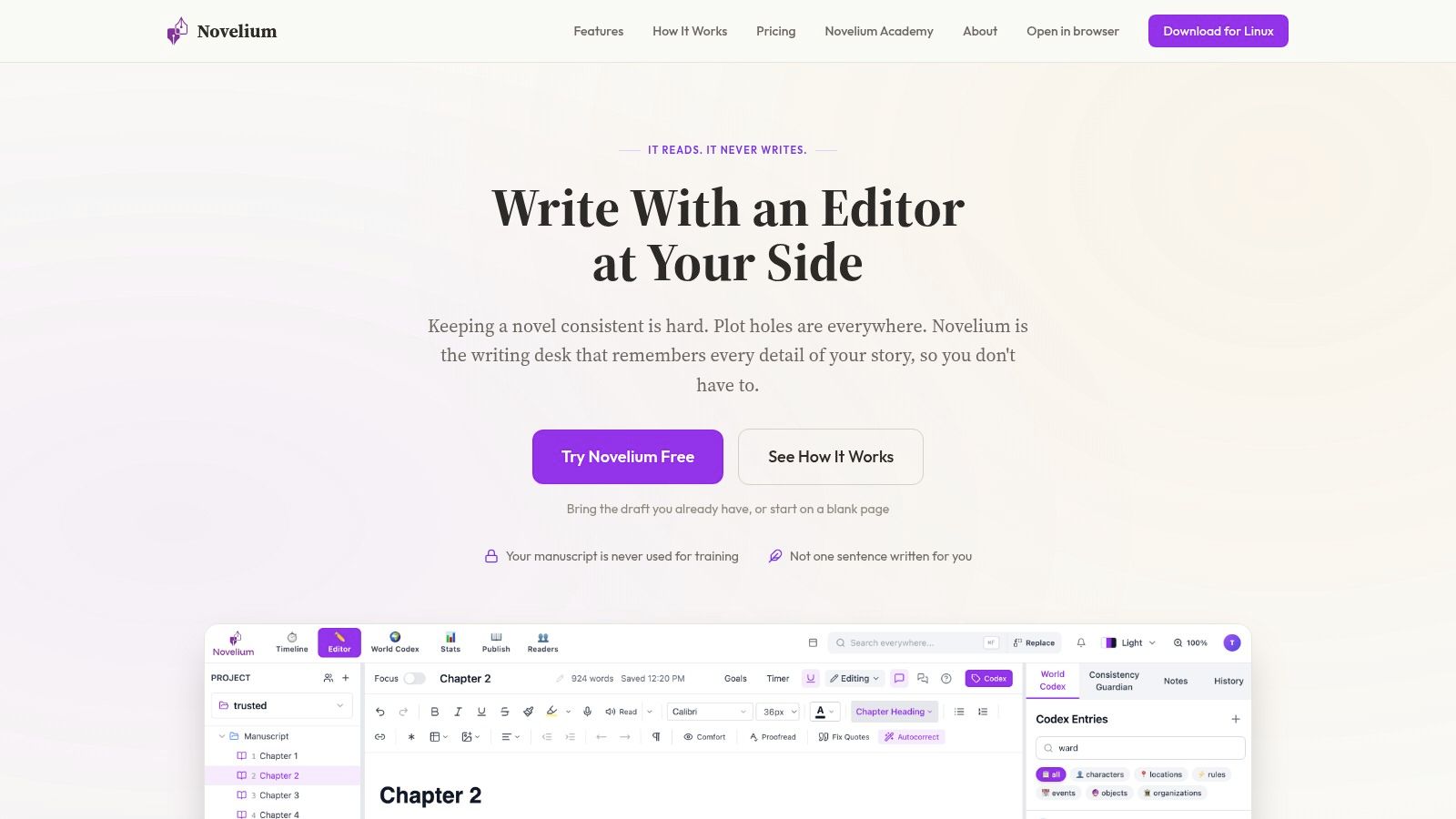
The workflow is simple. Import the manuscript, review extracted entities and scene events, then investigate flagged contradictions against the actual prose. Don't accept every flag blindly. Use the system to surface candidates, then decide whether a discrepancy is an error, a deliberate lie, or a controlled shift into a different narrative mode.
Novelium's Character Tracker and World Codex extract character details and track knowledge, relationships, events, and continuity across a manuscript. Visit Novelium to examine POV boundaries at scene level before an impossible fact reaches the final draft.