Character vs Society Examples: 8 Classics Worth Studying
Most discussions of character versus society stop at the villain and call it a day. That's the least interesting part. The central conflict lives in the changing pressure between scenes: what the protagonist knows, what the surrounding society permits, which private acts remain possible, and what obedience costs after each compromise. These character vs society examples are useful because they make those mechanics visible. Across eight novels and films, the social force shifts from surveillance and law to memory, class performance, gender expectation, and institutional contempt. Expect scene-level pressure, not theme summaries. The question is not just whether a character resists society. It's how the author makes resistance progressively harder, then makes the ending answerable to every choice that came before.
1. 1984 by George Orwell
Winston Smith's rebellion works because Orwell treats knowledge as the plot, not as background decoration. Winston begins with private doubts about the Party, but his access to history, language, and evidence is constantly restricted. He writes in a diary, remembers fragments of a pre-Party world, falls in love with Julia, and believes he's found a resistance movement. Each discovery changes what he thinks is possible, while the Party's surveillance ensures that private knowledge never stays safely private.
The social force here is unusually total. In 1984, the state controls public behavior and the boundaries of acceptable thought through surveillance, censorship, punishment, and information control, as this analysis of Orwell's conflict structure explains. Winston isn't merely arguing with an official. He's fighting a system that can alter records, language, memory, and the terms by which truth is recognized.
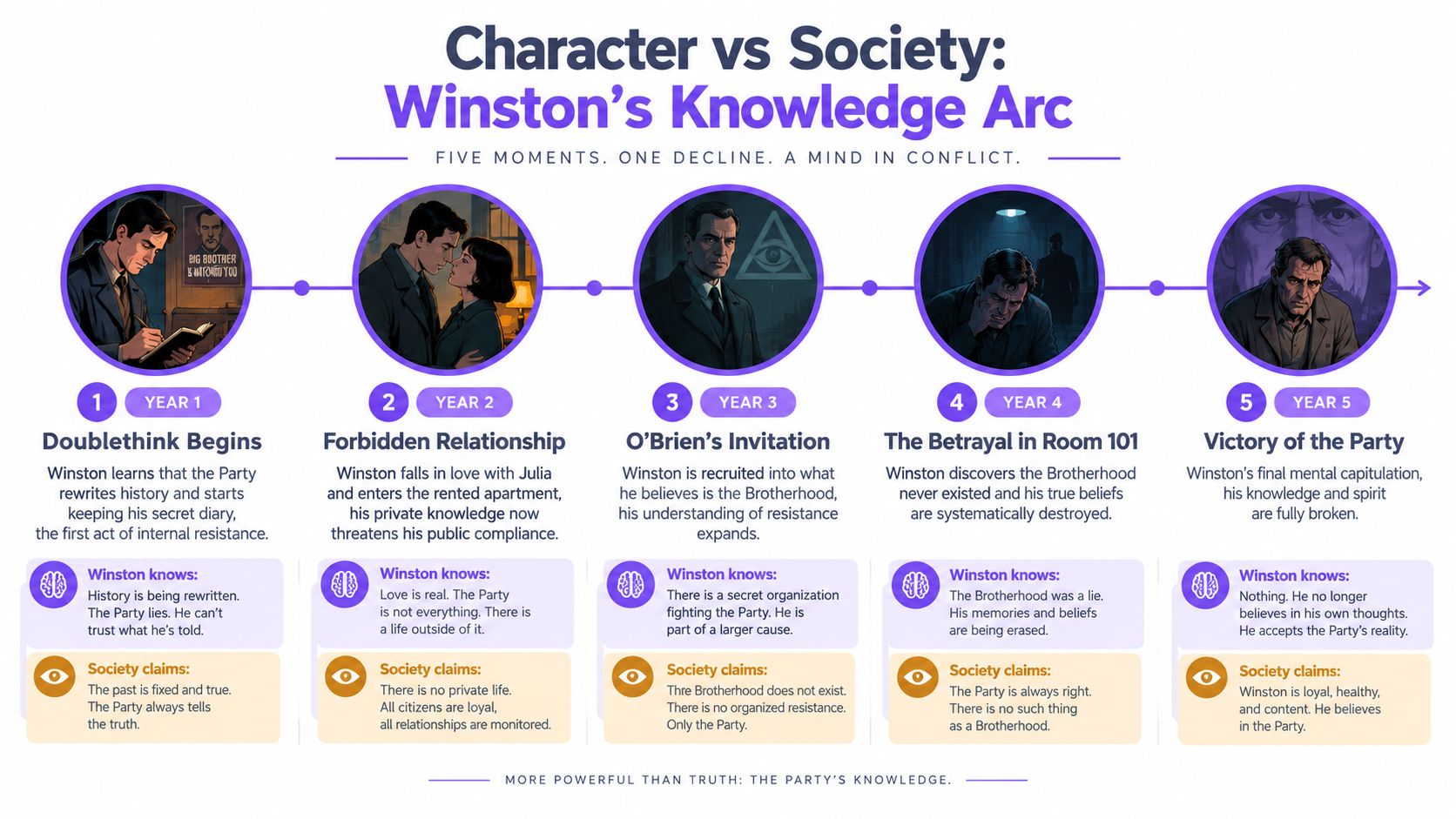
The pressure is informational
For a novelist, Winston's continuity problem is brutal. Track what he remembers, what Julia knows, what the Party suspects, and what the authorities can prove. Those aren't interchangeable states. A protagonist who remembers forbidden history before encountering the evidence, or forgets a detail that should alter his next decision, breaks the machinery of the conflict.
Practical rule: In a surveillance story, every revelation must change the character's available choices, not merely decorate the lore.
Orwell's resolution is devastating because Winston's resistance isn't defeated only physically. The Party reaches the beliefs he thought belonged exclusively to him. That's the escalation to study. Society doesn't just punish disobedience. It attacks the character's ability to identify a self that exists outside social permission. For a manuscript of any real size, a dystopia glossary is less useful than a scene-by-scene knowledge record showing exactly when each belief becomes vulnerable.
2. The Crucible by Arthur Miller
John Proctor's conflict with Salem begins as a reputational problem and ends as a demand for moral surrender. Arthur Miller places him inside the panic of the Salem witch trials of 1692, when accusations spread through a Puritan community and culminated in the execution of 19 people, with two dogs also reportedly killed. The historical pressure matters because the court doesn't need reliable evidence once accusation itself becomes proof of disloyalty.
Proctor knows Abigail's accusation is entangled with their affair. Elizabeth knows enough to understand the danger, but not every detail of the public machinery closing around them. Danforth treats the court's authority as a condition of order, while Abigail exploits the community's fear. The information changes from private shame to public testimony, and every attempt to control the truth creates a new liability.
Miller premiered the play in January 1953, during American McCarthyism, creating a deliberate parallel between Salem's accusations and the persecution of suspected Communists. Senator Joseph McCarthy had claimed in February 1950 that he possessed a list of Communists working in the State Department, with reported totals varying between 205 and 257 names. Miller later faced questioning by the House Un-American Activities Committee and testified on June 21, 1956, facts discussed in this historical reading of The Crucible and political persecution.
The refusal has to be earned
Proctor doesn't discover courage in the final act because the plot needs a noble exit. He begins defensive, bargains for survival, and only gradually recognizes that a signed confession would turn his private guilt into public cooperation with a lie. Elizabeth's final understanding matters because she stops asking him to perform goodness for her and lets him make the choice himself.
A useful man versus society framework must track the rule being enforced, the people enforcing it, and the cost of visible refusal. In a compressed play, a character-state error is obvious. In a long novel, the same error can hide for chapters before a late moral reversal exposes it.
3. Beloved by Toni Morrison
Sethe's conflict with society cannot be reduced to a woman defying a hostile community. Toni Morrison builds it from the moral catastrophe slavery creates, then makes memory itself unstable terrain. Sethe has fled enslavement, but she remains psychologically inside the conditions that shaped her most terrible decision. Her past is not a clean sequence of revelations. It arrives through suppressed memory, physical response, other people's accounts, and the supernatural presence of Beloved.
The novel's pressure depends on distinctions many manuscripts blur. What does Sethe consciously remember? What has she forced out of awareness? What does Denver understand? What does Paul D suspect before he knows the facts? Beloved's arrival changes the household's access to the past, but it doesn't deliver information in a tidy explanatory package.

Memory creates the social force
Morrison makes the community part of the conflict without making it a single mind. Black neighbors carry their own anger, grief, suspicion, and capacity for repair. Baby Suggs, Denver, and Paul D don't respond to Sethe from the same knowledge state, so each relationship changes as the buried history surfaces.
That structure gives writers a hard but valuable model. A traumatic past shouldn't be tracked only as an event in the timeline. Track who knows it, who misinterprets it, who refuses to name it, and what physical or relational behavior reveals it before the character can articulate it.
The past becomes dramatic when it changes what people can do in the present.
Morrison's resolution doesn't erase the harm or grant Sethe a simple victory over society. It redistributes the burden of memory. That's a sharper ending than revelation followed by emotional closure, because the community's response becomes part of the consequence. Your continuity system needs to preserve not only facts, but the different meanings each character assigns to them.
4. 12 Angry Men directed by Sidney Lumet
12 Angry Men confines a society-sized conflict to a jury room. Twelve men must decide whether a young defendant is guilty of murder, but the film's real pressure comes from how each juror handles doubt. Juror 8 doesn't claim certainty. He insists that the group examine the evidence rather than allow the room's initial consensus to become the verdict.
Lumet's craft is often mistaken for simple argument construction. It's a careful record of psychological movement. Juror 3's rage about his estranged son makes conviction serve a private emotional need. Juror 10's racism contaminates his reasoning. Juror 11's fear as an immigrant helps explain his initial passivity. Their positions shift because specific arguments collide with specific biases, not because the screenplay needs the vote count to change.
Doubt must follow pressure
The film also understands that a group isn't a uniform antagonist. The jurors disagree internally, form temporary alliances, and expose one another's motives. That makes the room a believable social mechanism rather than a wall of faceless opposition.
A corpus study of 170 contemporary Dutch literary novels, involving 2,137 annotated characters, modeled social conflict as networks that included both direct pairings and three-party relationships. The study found that lower-educated characters were more dominant in dyadic conflicts, while 65% of triadic conflicts were socially balanced, as described in the study's account of conflict networks. The useful lesson isn't to imitate those findings mechanically. It's to stop writing every institutional conflict as protagonist versus official. Add an intermediary, rival, or reluctant ally whose position can change the pressure.
In a large cast, track each person's public position, private motive, current evidence, and relationship to the last speaker. That prevents the common failure where a juror changes sides because the author has run out of objections.
5. The Handmaid's Tale by Margaret Atwood
Offred survives Gilead by splitting her visible behavior from her private consciousness. She performs obedience because the state controls women's legal identity, movement, sexuality, and access to information. Her resistance is often microscopic, but it isn't passive. A look, a memory, a forbidden word, or a carefully rationed trust becomes a decision inside a system designed to make independent choice dangerous.
Margaret Atwood parcels out Offred's knowledge through fragmented memory. The woman narrating has lived before Gilead, but the present-tense account remains shaped by fear, uncertainty, and incomplete information. She doesn't know the full structure of the resistance, what has happened to every person she loves, or which apparent ally is safe. The reader's access depends on those limits.
Compliance is an active performance
The danger in writing an internally resistant narrator is making her private thoughts too modern, too informed, or too consistently defiant for the conditions she inhabits. Offred's fear and hope must fluctuate with immediate evidence. A remembered life can offer comparison, but it can't function as an unlimited supply of courage.
Her choices also carry unequal risks. A secret relationship, a conversation, and a refusal to accept an official version of reality don't have the same consequences. Track those consequences as separate states, because “Offred is resisting” tells you almost nothing about what she can safely do in the next scene.
Controlled experiments on narrative perspective found no significant effect from changing between first-person internal, third-person internal, and third-person external focalization. The experiments included 258 participants and 262 participants, respectively, as reported in this study of fictional perspective and social cognition. The point for fiction writers is blunt. A close voice doesn't automatically persuade readers. The institutions, incentives, risks, and consequences have to do the work.
6. Invisible Man by Ralph Ellison
The unnamed narrator of Invisible Man isn't invisible because he lacks a personality. He's invisible because American institutions repeatedly refuse to see him as a person outside their projections. Ralph Ellison sends him through environments that demand different performances, then shows how each performance extracts something from his sense of self.
The narrator's continuity depends on separating what he believes from what he says to survive. At one moment, he can present himself as useful to an institution. At another, he can adopt its language while privately questioning its purpose. Those shifts aren't contradictions. They become contradictions only when the manuscript fails to preserve the pressure that produced them.
Institutions leave residue
The narrator's disillusionment is earned through encounters and betrayals across time. A later decision carries the residue of an earlier humiliation, even when the narrator doesn't summarize that connection for the reader. Track the institutional demand, the role he performs, the reward offered, and the rejection that follows. Otherwise, a long arc of adaptation gets flattened into a series of disconnected episodes.
The conflict also resists a convenient victory. Escaping one institution doesn't free him from the social habits that institution taught him. He has learned to anticipate other people's projections, and that anticipation shapes his next performance.
Track the performed self separately from the private self. The distance between them is often the character arc.
For complex manuscripts, this distinction belongs in scene records, not only in a character-development document. A development profile says who the narrator becomes. A tracking system shows what each room has trained him to hide.
7. Parasite directed by Bong Joon-ho
The Kim family's infiltration of the Park household looks like a class conflict disguised as a caper. Each family member enters under a false identity, but the deception works because their performances remain connected to genuine skills, relationships, and desperation. Ki-woo's tutoring role has to feel plausible as both a job and an extension of his intelligence. His sister's forged credentials, his parents' employment, and the family's private coordination all depend on shared information.
Bong Joon-ho makes class pressure physical. The families occupy different spaces, respond differently to smell and privacy, and interpret the same behavior through unequal assumptions. The Kims aren't just pretending to be rich. They're managing a cover while absorbing constant evidence that the wealthy family sees them as replaceable.
Deception fails through coordination
The consistency challenge is collective. Each Kim must remember what the others have claimed, who has met whom, and which details can safely be revealed. A small contradiction threatens the entire arrangement. The family's intimacy helps them improvise, but it also means stress travels quickly through the group.
The film's escalating pressure can be studied alongside the visual breakdown of its class and identity dynamics. The important turn isn't merely that the deception is discovered. The characters lose control over which social role they're performing, and genuine fear begins to override the script.
The image belongs near the beginning because clothing and presentation establish the social divide before the plot turns violent. The video works later, after the family's coordinated performance has started to fracture.
For a novel with aliases, infiltrators, or multiple covers, maintain a separate identity ledger. Record the lie, the audience for that lie, the supporting evidence, and the character's emotional investment in keeping it alive. A clever deception that nobody can consistently remember is just authorial fog.
8. The Awakening by Kate Chopin
Edna Pontellier's rebellion begins before she can name it. Kate Chopin doesn't give her a single ideological conversion scene. Edna notices discomfort through repeated contact with the roles expected of her, then tests small acts of refusal. Swimming, painting, declining social calls, and responding differently to Robert and Mademoiselle Reisz gradually expose the cost of a life organized around compliance.
The social force is domestic and polite, which makes it harder to dramatize badly. No villain needs to announce the rules. Marriage, motherhood, reputation, class expectations, and the habits of late nineteenth-century New Orleans do the enforcing. Edna's growing awareness changes how she interprets ordinary interactions, so scenes that once seemed harmless acquire pressure after she recognizes what they require from her.
Quiet conflict still needs escalation
Chopin tracks the difference between desire and agency. Edna can want freedom before she knows how to act on it, and she can act without having a durable alternative life prepared. That gap prevents the arc from becoming a slogan about awakening. Robert and Reisz don't merely deliver lessons. Their presence gives Edna contrasting models of attachment, art, and independence.
A character agency guide is useful here only if it stays attached to scene consequences. Record what Edna refuses, who notices, what social cost follows, and whether the refusal expands her options or merely isolates her.
The ending remains controversial because it doesn't resolve the conflict by making society enlightened. Edna reaches a choice within a world that still limits her. That's the trade-off of writing quiet character-versus-society fiction. If the social pressure stays invisible, the arc feels arbitrary. If every rule is explained aloud, the world loses its suffocating realism.
Character vs. Society, 8-Work Comparison
| Title | 🔄 Implementation complexity | ⚡ Resource requirements | ⭐ Expected outcomes | 💡 Ideal use cases | 📊 Key advantages |
|---|---|---|---|---|---|
| 1984 by George Orwell | High, minute-by-minute tracking of protagonist knowledge and memory shifts | Moderate–High, detailed timeline and scene notes required | Strong: coherent psychological decline and credible ideological manipulation | Dystopia or single-protagonist internal-resistance narratives | Prevents plot holes by strict control of what the protagonist knows |
| The Crucible by Arthur Miller | Moderate, compressed three-act pressure cooker needs scene-to-scene consistency | Low–Moderate, relationship maps and act-level beats suffice | Strong: intense moral stakes and believable transformation under social pressure | Stage plays, short dramas, works about mass hysteria | Tight pacing makes character choices feel earned and immediate |
| Beloved by Toni Morrison | Very High, non‑linear memory, trauma, and supernatural elements to reconcile | High, multi-timeline charts, memory/state tracking, trauma research | Strong: deep emotional resonance and layered ambiguity when consistent | Trauma narratives, fragmented chronology, magical realism | Enables credible portrayal of repressed/suppressed memories and trauma |
| 12 Angry Men (film) | High, ensemble of 12 requires distinct, believable internal logics and paced shifts | Moderate–High, detailed character profiles and dialogue beat sheets | Strong: convincing group psychology and emergent consensus | Ensemble dramas, confined real-time deliberations | Shows subtle psychological shifts and persuasion across multiple characters |
| The Handmaid's Tale by Margaret Atwood | High, first-person present tense with restricted knowledge demands tight POV control | Moderate, strict POV logs and chronology constraints | Strong: sustained claustrophobic authenticity and reliable unreliability | Restricted POV narratives, totalitarian/feminist fiction | Maintains immersion by policing what narrator can and cannot know |
| Invisible Man by Ralph Ellison | High, episodic, long timeline with multiple performed personas to reconcile | High, extended arc mapping and institutional context documentation | Strong: nuanced social critique with consistent inner identity | Social critique, identity adaptation across institutions | Tracks adaptive behavior while preserving a coherent inner self |
| Parasite (film) | Very High, coordinated deception across family members and class dynamics | High, knowledge matrices, cover-story tracking, inter-character dependencies | Strong: tension from proximity to exposure and believable collapse | Ensemble deception, class-focused dramas or satires | Demonstrates how authentic traits make coordinated lies plausible |
| The Awakening by Kate Chopin | Moderate, incremental psychological change requires slow, traceable development | Low–Moderate, emotional beat charts and relational timelines | Moderate–Strong: subtle psychological realism, open-ended interpretation | Interior transformation, period pieces, quiet rebellions | Builds authenticity through gradual, well-documented interior shifts |
Your Pressure Points Mapped
Every example above rests on one discipline. The author knows what the character knows, what society permits, and what changed between scenes. That sounds obvious until a series manuscript gives a supposedly secret fact to the wrong person, lets a disgraced character move through a room as if reputation never changed, or brings back an object that was destroyed three chapters earlier. Those aren't cosmetic slips. They alter the pressure system readers are relying on.
Most character profiles fail because they're static documents. They describe appearance, history, habits, and perhaps a polished arc, but they don't record the character's current knowledge, loyalties, injuries, public status, or available choices after each scene. A character-development document explains who someone is. A character-tracking system preserves who they are now, after the manuscript has done something to them.
Build a scene-by-scene map of three layers for your central conflict. Record what the protagonist knows, what the society or institution allows, and what consequence has changed since the previous pressure point. Then test every chapter where the conflict escalates, reverses, or appears to pause. The pauses matter. A character who publicly complies may be gathering information, protecting an ally, or losing the capacity to resist. You can't know which without tracking the state underneath the behavior.
Novelium's Character Tracker and World Codex automatically extract and hold character details across a full manuscript, including knowledge states, relationships, traits, events, objects, and timeline information. The platform is built for drafts handled as working systems, not inspirational questionnaires. Its local processing keeps manuscripts private while it surfaces contradictions, impossible sequences, and continuity failures during revision. Start with your most pressured character and map three scenes where the social cost rises. If the map can't explain what changed, the manuscript isn't ready to trust its own escalation.
Novelium's Character Tracker and World Codex track the knowledge states, relationships, events, and continuity details that make character-versus-society pressure hold across a long manuscript. Visit Novelium to check your draft locally, catch contradictions before readers do, and keep the social consequences of every scene intact.