Character vs Character Conflict That Actually Moves the Plot
Opposing goals won't fix your stalled confrontation scene. You've heard that advice for years, you've built two characters who want incompatible things, and they still argue in circles for nine pages. That's because character vs character conflict isn't an ideas problem. It's a state-tracking problem, and most drafts fail because nobody tracked what changed.
Why Most Character Conflicts Stall at the Argument
We flag the same pattern constantly. Two characters enter a scene hostile, trade sharp dialogue, raise their voices, and leave hostile. Trust didn't move. Leverage didn't move. Neither person learned anything, lost anything, or chose a tactic they can't take back. The scene feels heated and changes nothing.
That's not escalation. That's repetition with better insults. Dialogue convinces readers a relationship is conflictual, but it doesn't make them rate the story higher. In an experiment comparing high-conflict and low-conflict dialogue, readers judged the high-conflict relationships 1.06 rating points more conflictual, a large effect at Cohen's d = 1.05, yet they rated those passages slightly lower in overall quality and entertainment, as detailed in experimental research on conflictual dialogue and reader perception.
Read that correctly. Verbal aggression signals hostility. It doesn't do narrative work by itself. Your confrontation has to change a decision, expose a value under pressure, shift power, or alter the relationship in a way the next scene must honor.
If you can't name the relationship state before the scene and after it, you didn't write conflict. You wrote noise.
The test your static profiles fail
Character questionnaires make this worse. A static profile tells you eye color, childhood trauma, and favorite drink. It doesn't tell you what Mara knows in chapter fourteen, whether she still trusts Jonah after chapter nine, or whether she already conceded the point she's now debating again. That's a character development document, not a character tracking system.
Development docs describe who someone is at rest. Tracking systems record who someone is at each scene, given what they've learned, lost, promised, and broken. Conflict lives in the second record. At 80,000 words, your memory will lie to you about which version is current, and the scene will reset both characters to their starting positions.
Defining Character vs Character Conflict as Opposing Plans
Use a stricter definition. Character vs character conflict occurs when one character's intended action is thwarted by another character's action in the same story world. The formal model treats conflict as the thwarting of an intended action, whether the block comes from another plan, the environment, or a contradiction inside one character's own plans, as set out in the narrative conflict model of thwarted intended actions.
Mutual dislike isn't conflict. Incompatible values aren't conflict. They're tension, and tension becomes operative conflict only when both people commit to actions that can't both succeed. If either character can walk away and pursue the objective unimpeded, you have a disagreement scene wearing a conflict label.
The visual below maps the only question that matters here. Which plan blocks which?
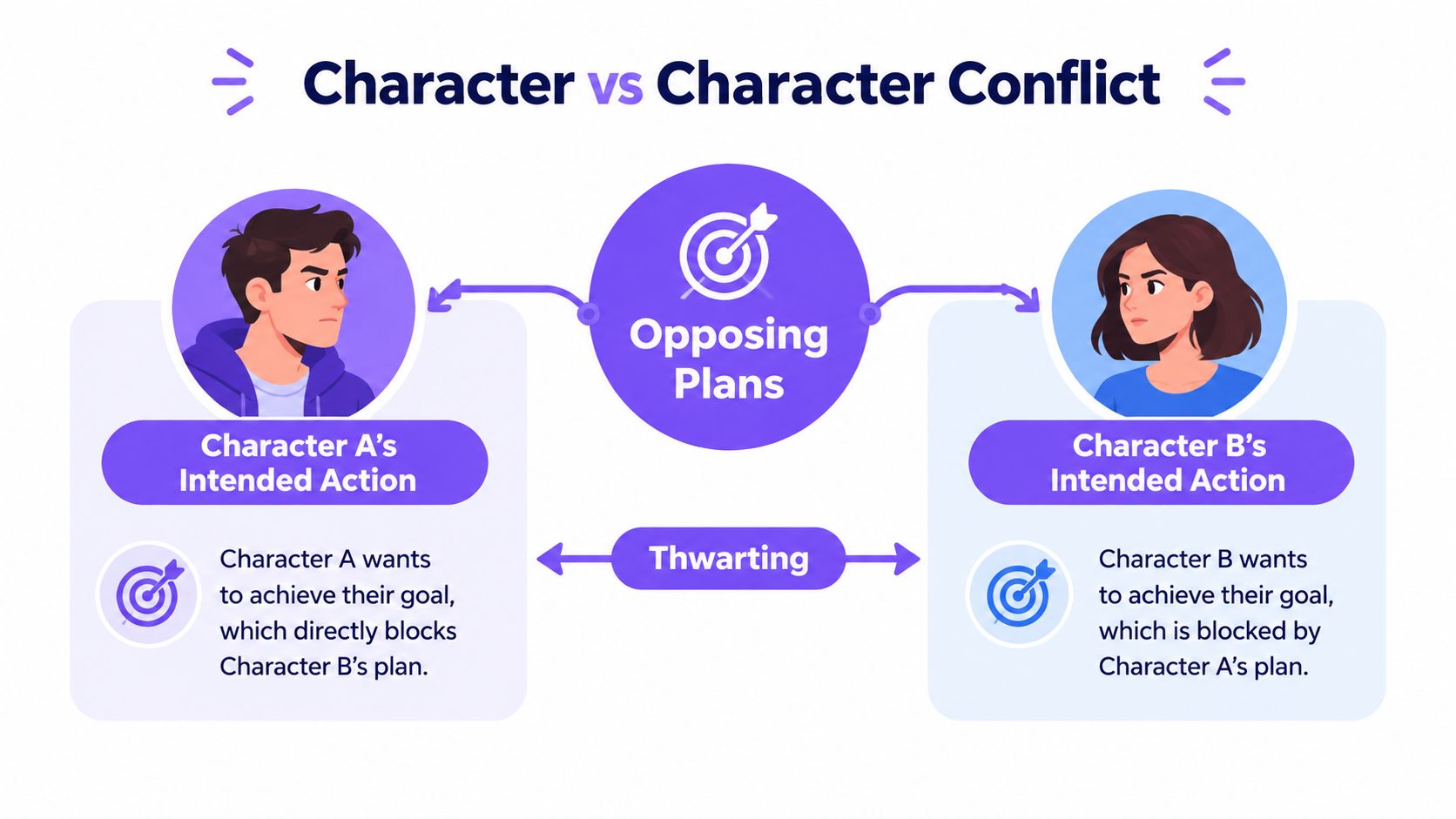
Take two sisters fighting over their late father's house. For thirty pages they can argue about sentiment and money without producing conflict. It becomes operative the moment one sister signs a listing agreement while the other files to block the sale. Now each action materially obstructs the other, deadlines attach, and a character goal stops being a stated preference and becomes a plan with consequences.
Run every confrontation through three checks before you revise a line of dialogue.
- Intended action: What is each character physically or socially trying to do in this scene, not just prove?
- Blocking action: What does the other person do that makes success impossible, costlier, or time-limited?
- Shared-world validity: Could both actions occur here, with the knowledge and resources each character has right now?
Fail the second check and the scene needs restructuring, not sharper banter. Fail the third and you've got a continuity error, usually impossible knowledge, disguised as drama.
Dyads, Triads, and Ensembles in Conflict Networks
Most craft advice pretends conflict is a clean one-on-one contest. Your cast doesn't work that way. A witness, mediator, child, business partner, or quiet beneficiary changes what a two-person feud means, what each party can say, and who pays for the outcome.
That isn't intuition. Researchers modeling literary fiction analyzed 2,137 characters across 170 novels submitted to the 2012 Libris Literatuurprijs and calculated conflict across individuals, pairs, and three-character groups. They found 69% of character triads were socially balanced and 31% were socially imbalanced, with lower-educated characters carrying significantly higher conflict scores than higher-educated characters, in the large-scale study of conflict networks in literary fiction.
Translate that into drafting terms. A balanced triad has a coherent pattern of ties. An imbalanced triad carries tension or asymmetry, and that asymmetry is where your scene energy comes from. Two allies who both distrust the same third person behave differently from two rivals competing for that third person's loyalty.
What the third chair does to the room
In romance, a friend who has heard both versions of a breakup stops being a sounding board and becomes an evidence holder. In political fiction, a junior staffer who benefits when two senior figures feud will feed each one a selective truth. In family drama, a sibling who mediates at dinner can force a private grievance into a public allegiance test.
That's why tracking only your protagonist and antagonist fails an ensemble cast. You need the state of each relevant tie, not a hierarchy of importance. Who's allied with whom today? Who owes whom? Who heard the accusation, and who only heard the apology?
Working rule: Adding a witness never just adds a person. It reclassifies the conflict, because now reputation, loyalty, and future testimony are in play.
Series writers feel this hardest. A minor character who watched a betrayal in book one carries that knowledge into book three. If your records only track the central dyad, that witness will eventually act on information your manuscript forgot they had.
Escalation That Earns Its Next Scene
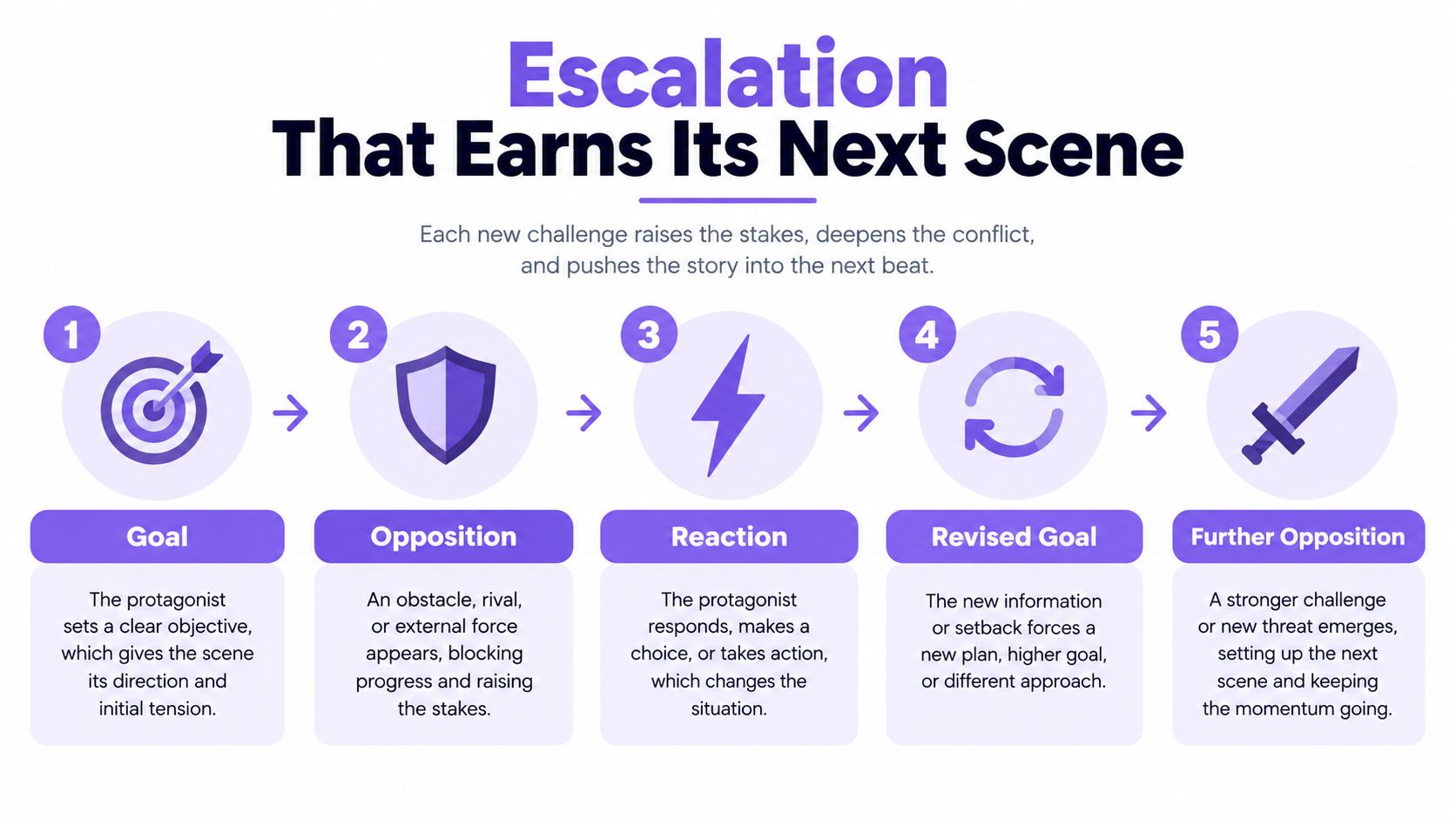
Strong scenes run a recursive chain. A character pursues a goal, hits opposition, reacts, forms a revised goal, and hits fresh opposition until they win, lose badly, or reach another decisive outcome. That goal, opposition, reaction, revised goal cycle is the engine, as described in the recursive model of scene goals and opposition.
The model alone isn't enough. Each loop must change something measurable, or you're restaging the same beat with new wording. We check six axes, and a confrontation must move on at least one.
- Information revealed: Someone learns, confirms, or loses a fact that changes the next decision.
- Social power: Status, authority, or credibility shifts between the parties.
- Material risk: Money, safety, property, or livelihood becomes exposed.
- Emotional intimacy: Trust, desire, or vulnerability increases or collapses.
- Public consequences: A private dispute gains witnesses or a record.
- Available options: A door closes, a deadline lands, or a new tactic becomes possible.
That's what raising the stakes means at scene level. Not louder. Narrower, costlier, harder to reverse. If you're outlining a long manuscript and want that discipline built into the plan rather than patched in during revision, this guide for independent authors is worth comparing against your current outlining process.
The opposition inside each loop also has to matter personally, arise from the goal itself, follow from the other character's motivation, and point toward a logical resolution or disaster. Skip the motivation test and your antagonist becomes a plot device who blocks scenes because the outline needs resistance.
This walkthrough shows the progression visually, beat by beat.
Apply the six axes in revision and circular arguments expose themselves fast. Two characters can meet five times if each meeting changes information, power, or options. They can't meet twice if both meetings only restate the original grievance.
Dual Validity and the Third-Party Problem in Practice
The hardest version of this problem has no villain. Both characters hold a position a reasonable person could defend, and the clash comes from incompatible values, not a misunderstanding you could clear up with one honest conversation. Current guidance on this kind of scene stresses that each side should be able to persuade a reasonable person, as argued in guidance on creating conflict between characters with good points.
That's the right instinct and an incomplete method. You need a dual-validity record for each side. Track the goal, the evidence they're relying on, the fear driving their urgency, the ethical boundary they won't cross, and their current interpretation of the other person. When those fields stay fixed across four scenes, your characters aren't principled. They're frozen.
Progression should come from new information or irreversible choices. A mother who wants her adult daughter to sell the family business for security and a daughter who wants to keep it for identity can both be right. The conflict advances when the daughter turns down a buyer without telling her mother, not when they restate security versus identity at another kitchen table.
Catching false equivalence before your readers do
Dual validity doesn't mean both positions are equally moral. That's false equivalence, and readers smell it. One character can be coherent, sincere, and still wrong about the harm they're causing. Test the asymmetry directly. Whose plan imposes costs on people who never consented? Whose evidence survives contact with a fact they didn't choose? Who updates when their interpretation of the other person breaks?
In a political thriller, two officials can both claim public safety while one suppresses evidence and the other risks exposure. Both arguments sound defensible in dialogue. Their actions aren't equivalent, and your tracking should record that gap instead of flattening it into balance.
Then add the third party and watch the dyad mutate. A colleague reinterprets the suppressed evidence, a spouse forces a choice between loyalty and honesty, a rival profits while the two principals exhaust each other. In a romance, that third person might be the friend who knows the apology happened before the accusation did. Sequence matters, and whoever controls the sequence controls the meaning.
Consistency at Scale Without Losing Your Voice
None of the above survives sloppy state records. Research on fictional relationships describes relational arcs, changes in alliance, kinship, romance, and enmity, as structural trajectories that shape how novels unfold, in research on relational arcs as narrative structure. If relationships organize plot, then relationship state isn't metadata. It's plot.
Your workspace should reflect that hierarchy.

For every major character entering a confrontation, you need five current fields, not a biography. Objective, perceived obstacle, information state, advantage, and relationship state. Update them after the scene using the state transition you wrote. Trust dropped. A secret moved. A promise broke. Power shifted.
That's also where tools separate cleanly. Spreadsheets store what you remember to type. Novelium's Character Tracker and World Codex extract and track character details, knowledge, and relationships across the manuscript itself, so the record comes from the draft rather than from your recollection of the draft. Use whatever system you'll maintain, but stop pretending a static profile is a system.
Readers judge whether actions look intentional and emotionally justified, and they update their model of each character as evidence arrives, a process examined in research on absorbed character engagement and perceived realism. When a character suddenly knows a fact they never acquired, or reverses a position without a cause, readers don't call it a continuity error. They call the character unconvincing. Track the state and the voice takes care of itself.
Stop revising arguments and start auditing state changes. Novelium reads your draft locally and tracks character knowledge, relationships, and contradictions across chapters, so you can catch the confrontation that resets itself before your readers do.