Character Profile Worksheet for 80,000-Word Manuscripts
The usual advice for a character profile worksheet is to add more detail. More childhood memories, more preferences, more psychological excavation. For a long manuscript, that's often the wrong fix. You don't need another fact about your protagonist's school years. You need to know whether she's learned about the forged will before she accuses her brother of forging it.
A development document helps you invent a character. A tracking system records what the manuscript establishes and what changes. Keep both if they're useful, but don't mistake a finished biography for continuity control.
The Worksheet Fields That Affect Continuity
| Field | What it locks down | Update when |
|---|---|---|
| Full name and aliases | Spelling and forms of address across chapters | A new nickname, title or name change appears on the page |
| Age or birth date | Timeline arithmetic and generational references | Time skips, flashbacks or revised dates |
| Physical identifiers | Scars, height, hair, eye color and other visible traits | Injury, aging, disguise or revision of an established detail |
| Speech pattern | Dialogue voice and recognizable habits | A deliberate change in voice or a new influence |
| Occupation and residence | Where the character can be and what they can plausibly do | A move, job change or new assignment |
| Key relationships | Who trusts, opposes or depends on whom, and current status | Any shift without an explaining scene |
| Goal and fear | Motivation driving choices in each scene | A milestone that resolves or replaces the goal |
| Status (alive, injured, missing) | Whether the character can act or appear | Death, injury, capture or recovery |
Start with identity, including occupation and narrative role, then record visible identifiers and checkable dialogue habits. A limp matters differently from an unmentioned preference: someone must carry that limp into the next scene.
The Bindercraft story-bible guide recommends separating established manuscript facts from speculative or discarded material and updating the record when canon changes. Keep residence, workplace and relationship status current rather than treating them as permanent biography.
For an existing long draft, begin with name, age and location. Those checks establish who's present, whether the chronology works and whether the character can physically participate.
A Copy-Ready Profile Layout
Paste this into a character document. Keep the reference profile compact; put the expanding ledger on a separate page.
Identity: Full name; aliases and forms of address; age or birth date; occupation; narrative role.
Physical details: On-page traits, each with its establishing chapter.
Changes: Injury or altered appearance; causing scene.
Speech: Checkable verbal habit or sentence pattern.
Location: Residence or workplace; last-changing scene.
Relationships: Person; current status; establishing scene.
Motivation: Current objective; fear; resolution or replacement milestone.
Status: Alive, injured, missing or unavailable.
Revelation control: Planned disclosures; who doesn't know what.
Use protagonist, antagonist, love interest, sidekick, staff, walk-on or cameo for the role field. Add backstory only when it explains an established action or constraint.
Keep discarded and speculative ideas outside the profile page, clearly labeled. For a separate chapter-planning scaffold, you can find chapter structures for your thesis, but keep that organizational resource apart from scene evidence.
Why Static Profiles Fail at Manuscript Scale
Childhood memories, favorite foods, clothing, secrets, job, family tree. Fill everything in before drafting, then never open it again. That's a brainstorming exercise with a filing system.
The Writers Helping Writers character-profile questionnaire illustrates the familiar emphasis on physicality, voice, employment, skills and family. Those categories help establish a person. They don't, by themselves, record how that person's situation changes.
Say an ally betrays your protagonist. The biography can still accurately describe their shared childhood while offering no answer to the useful question: Does she trust him when he offers her an escape route afterward?
Likewise, an arc summarized as guarded at the beginning and trusting at the end leaves the intervening choices unaccounted for. A complete-looking profile can't resolve a scene-level problem unless it preserves the relevant transition.
Replace the standalone questionnaire with a compact profile plus a chapter-by-chapter state ledger. Keep the biography. Stop asking it to do a timeline's job.
Canon Details Versus Worldbuilding You Can Skip
Track anything readers encounter, anything characters learn, and anything that constrains a later decision. Repeated dialogue details belong in the record too, even when they seem decorative.
Apply this test: If this detail changed during revision, would a reader notice, or would a later scene break? If neither happens, leave it in development notes.
A childhood pet doesn't need continuity tracking unless its name becomes a password. A favorite color doesn't matter until someone identifies a supposedly familiar room by it. An elaborate family tree becomes operational when inheritance, kinship or recognition depends on it.
Practical rule: Track consequences, not the amount of effort you spent inventing the detail.
Mark unfinished ideas speculative, and promote them to canon only when the manuscript establishes them. Don't let an abandoned outline become evidence against the draft.
For series work, separate durable facts from book-specific conditions. Birthplace belongs in the enduring record; a temporary posting belongs to the volume and scenes where it applies. Otherwise, a later appearance can inherit an obsolete situation because you copied the old profile.
Goals, Knowledge and Behavior Under Pressure
Record motivation as a cause chain, not an adjective collection. Connect the external outcome to the internal need, stakes, opposing force and decision trigger, then identify the coping strategy that produces the actual choice.
Purdue OWL's guidance on compelling characters treats personality through beliefs and thought patterns that produce action. Your character goal entry therefore needs enough context to explain a decision, including misconceptions and relationship pressures.
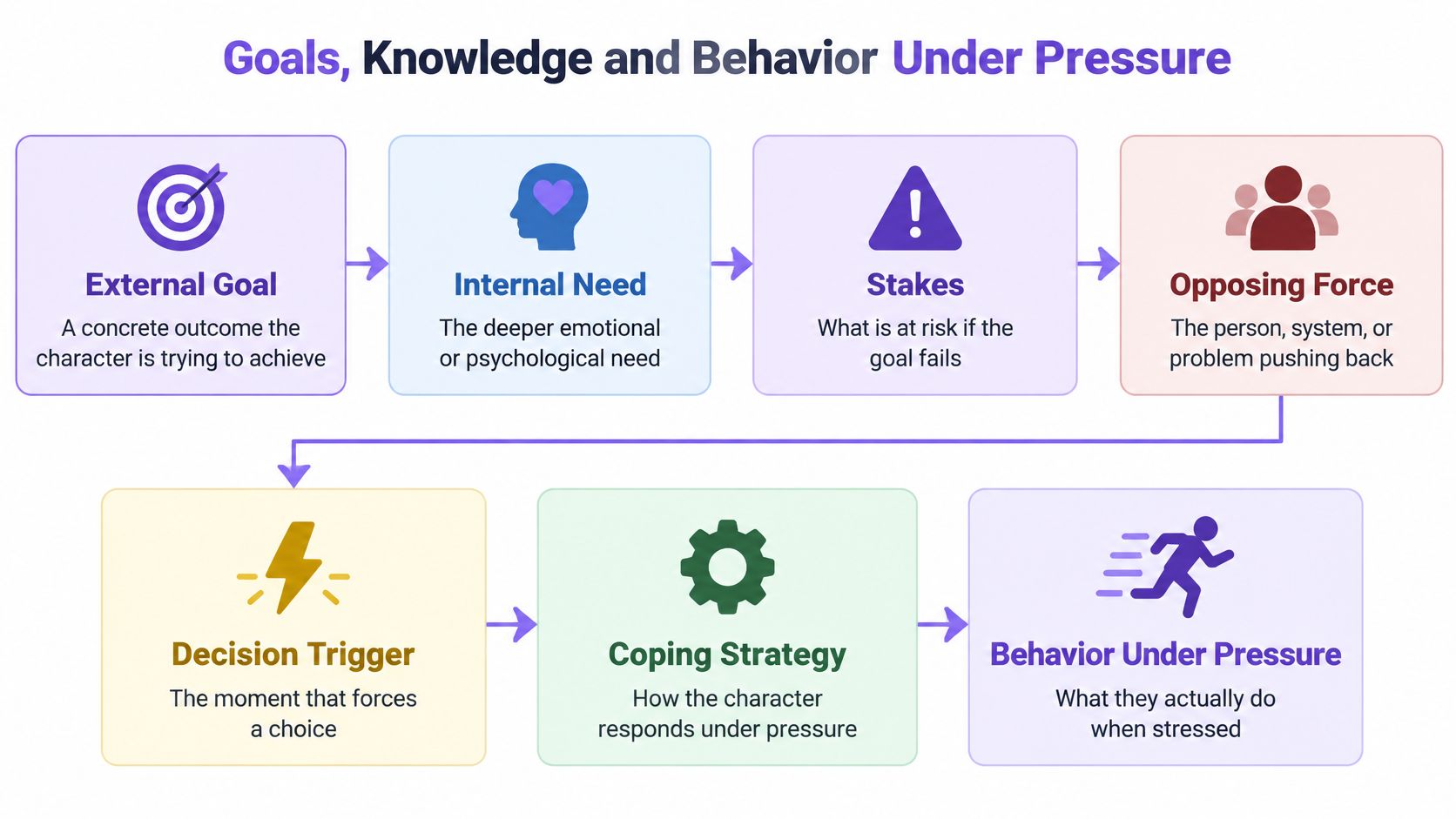
The Novel Kit's consistency guide identifies six dimensions to check across appearances: name and physical facts, knowledge, wants, fears, pressure behavior and voice. Development requires a believable cause and transition, not merely a different entry at the end.
Record what the character witnessed, inferred or was told, including the basis for an inference. Possessing a secret doesn't mean everyone else possesses it.
Nereo's guide to developing characters for animated shorts offers a cross-medium reference for character development; for manuscript tracking, retain the distinction between intended traits and demonstrated behavior. Test the major scene for a specific want, sufficient understanding, resistance and a motivated choice. Discovery during drafting is welcome. Update the record afterward.
Tracking Character State Chapter by Chapter
Give each significant character a row for each scene block. Use the scene identifier as the row label, with these state columns.
| Knowledge | Beliefs | Objective | Physical condition | Relationship status | Unresolved commitments |
|---|---|---|---|---|---|
| Has read the intercepted letter | Thinks the courier wrote it | Reach the courier before departure | Cut palm; carrying letter | Distrusts courier; relies on sister | Promised sister the truth |
| Has heard the courier's denial | Suspects sister planted it | Verify handwriting | Palm bandaged; letter surrendered | Courier provisionally useful; sister suspect | Promise remains unfulfilled |
This hypothetical sequence distinguishes new information from a changed interpretation. The letter's contents haven't changed, but the character's working explanation has.
Fill the row when the scene closes. Carry unchanged conditions forward, and attach the causing scene to every change rather than overwriting the previous value.
Pick a chapter, compare each character's entry with their previous entry, and read the connecting scene. An unexplained change means the record is wrong or the manuscript is missing something.
Attach scene identifiers to the manuscript chronology so you can distinguish a motivation problem from a timeline error. Don't reconstruct the sequence from chapter order when flashbacks or parallel viewpoints make that order misleading.
Cross-Referencing Characters, Places and Timelines
Build the scene-level timeline around where each significant character is and what they do. Vellam's character-consistency guide connects this approach to catching simultaneous appearances in incompatible places and reactions to information not yet received.
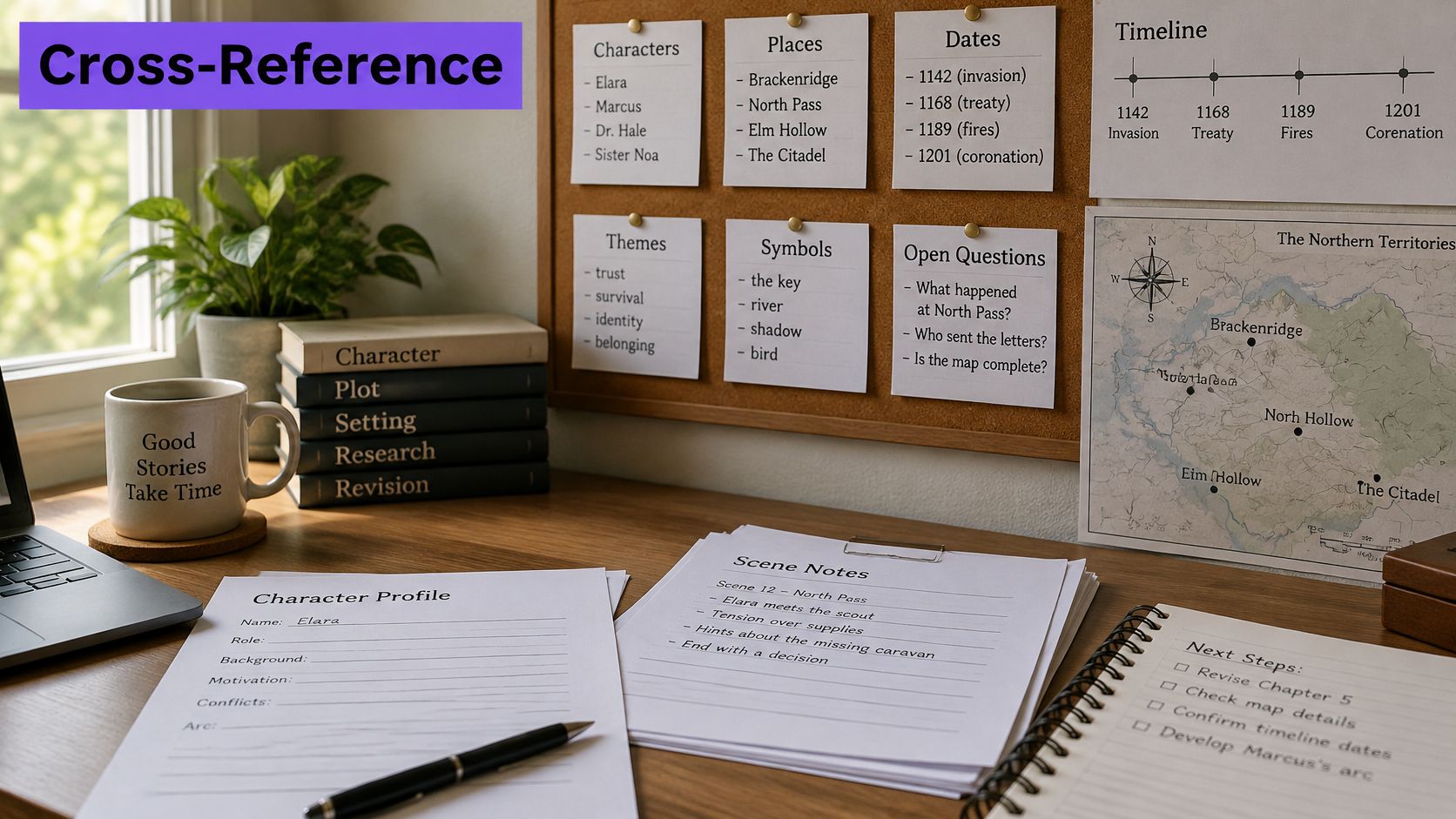
Link each character to inhabited places, witnessed events, secrets shared with others and establishing chapters. With parallel plotlines, you're maintaining a relational timeline, not a collection of portraits.
Before drafting dialogue, check the entering character's location and available information. If the informant is still aboard a ship, the detective can't casually refer to their completed interview.
When a relationship changes without an explanatory scene, inspect the linked event before changing the profile. A new relationship label isn't a repair for a missing encounter.
Keeping the Worksheet Accurate Through Revision
Revision creates a particular mess: you change the originating fact but leave its consequences intact. Moving an injury later can make an earlier bandage inexplicable.
Editor World's novel-editing checklist recommends recording established physical details, including eye color, hair color, height, distinguishing features and age, then comparing later references against that record. Apply the same reference-sheet discipline to chronology, checking time references against a timeline in days, weeks or months.
Before the pass, save a dated snapshot of the worksheet. During the pass, log changed facts and their chapters. Afterward, search for the old values and inspect dependent references, including paraphrases that a literal search won't find.
Revision check: Search for the consequences of a changed fact, not just its original wording.
Changing someone's height can affect blocking, recognition and comparisons with another character. Changing a departure date can affect travel, messages and alibis.
Treat the worksheet as a control document for synchronized facts. Cut fields you never consult; unused detail creates maintenance without providing a check.
Recurring Casts and Revelation Control
Sort the cast before deciding how much to record. The Writers and Publishers Network's character-bible guide distinguishes protagonists, antagonists, love interests, sidekicks, staff, incidental walk-ons and returning cameos, while explicitly including revelation control.
A recurring viewpoint character needs a full entry. A walk-on needs a reliable name and identifier, plus any consequential fact. An ensemble cast doesn't require equal paperwork for everyone.
Objective truth, individual knowledge and planned revelation are separate records. The murderer's identity can be settled in your notes while remaining unavailable to the detective.
Record what other characters won't initially, or ever, learn. A factually accurate scene still fails if someone acts on inaccessible information.
Before a returning character's opening scene, review their last established state. Preserve series-level facts while checking the new volume's elapsed time, affiliations and unresolved obligations.
Consistency Failures Good Tracking Prevents
Use the symptom to locate the missing control. Don't respond to every contradiction by expanding the biography.
| Symptom in the draft | Usual cause | Worksheet field that prevents it |
|---|---|---|
| Eye color changes after a revision pass | Old physical reference never searched after the change | Physical identifiers with a revision check |
| Character acts on a secret not yet revealed | Knowledge recorded as author knowledge | Knowledge state per scene |
| Character appears in two places at once | No scene-level location recorded | Location per scene in the timeline |
| Name spelled differently across chapters | Aliases and spelling variants not logged | Full name and aliases |
| Dead character speaks again | Status not updated after the death scene | Status (alive, injured, missing) |
| Injury disappears between scenes | Condition not carried forward into later chapters | Physical condition in the state ledger |
| Promise made earlier is forgotten | No column for unresolved commitments | Unresolved commitments in the state ledger |
Read each row as a diagnostic route, not an automatic verdict. A healed injury can be legitimate; the elapsed time and treatment must support it. A dead speaker can belong in a flashback, provided the chronology establishes that context.
Long gaps between appearances make these checks particularly useful. A spreadsheet works if it preserves sequence and evidence; a questionnaire completed before drafting doesn't provide either automatically.
Build the Worksheet Once, Then Let Tracking Hold It
Stop maintaining a static profile as though completeness were the objective. Build a state-based record you can check against the manuscript.
Take an existing draft and populate identity and physical details from the text, not memory. Start the ledger with your most frequently appearing characters, then expand where scenes expose dependencies.
Manual upkeep is the trade-off. A detailed ledger becomes unreliable when you postpone updates until after the next revision.
Novelium's Character Tracker and World Codex take on that upkeep through automatic tracking of characters, world details and timeline entries, without manual data entry. The Character Dashboard extracts characters from the text, tracks physical descriptions, personality traits, backstory and arcs, and shows what information each character has at every moment.
You still make the editorial decision. Review a flagged item, decide whether it's an error or a deliberate change, and correct the manuscript or record accordingly.
Try a cold check: choose a chapter and name what each major character knows upon entering it. If answering requires rereading half the book, your character profile worksheet isn't doing its operational job yet.
Novelium offers automatic character and story tracking so your continuity record can keep pace with revisions. Bring your draft to Novelium, check the character details and knowledge states it extracts, and investigate the contradictions before they reach your readers.