Book Title Capitalization: Chicago, MLA, APA and AP Rules
Capitalize the important words is the advice everyone repeats about book title capitalization. It's also incomplete enough to cause trouble. Important according to which style guide, and destined for a cover, a review, retailer metadata, or an academic reference?
For a novelist managing a backlist, the problem isn't remembering whether and gets a capital. It's preventing an editor, designer, citation tool, and distribution dashboard from producing competing versions of the same title. Treat casing as a controlled publishing decision, not a fresh proofreading exercise every time the book changes hands.
Style Guide Rules at a Glance
Title capitalization and formatting by style guide
| Style guide | Book title format | Capitalization rule | Long-work format |
|---|---|---|---|
| Chicago | Headline style | Capitalize first and last words and principal words; lowercase articles, coordinating conjunctions and short prepositions | Italics |
| MLA | Headline style | Capitalize first and last words and principal words, including principal words after hyphens; lowercase articles, coordinating conjunctions and to | Italics |
| APA reference list | Sentence case | Capitalize first word, first word after a colon and proper nouns | Italics |
| AP | Quotation marks | Capitalize words of four letters or more, plus principal words; lowercase shorter prepositions and conjunctions | Quotation marks |
The destination sets the rule. Chicago and MLA use headline-style capitalization for book titles, while APA reference entries require sentence case. AP uses quotation marks rather than italics, making formatting a separate decision from casing.
A style guide is an output specification, not a verdict on the author's taste. The Chicago Manual of Style provides a publishing framework, but a publisher's house style can control the submitted manuscript and production files.
That means a reference entry can legitimately look different from a cover. It doesn't mean an author should improvise a new spelling or subtitle for each destination.
Practical rule: Choose the required style before editing the title. Don't correct a valid reference form into a cover form.
For self-published work, select a default system for running text and use it throughout author-controlled assets. Record exceptions for citations, publicity outlets, and platform requirements. Consistency means applying deliberate rules, not forcing identical typography into places with different specifications.
Headline Style for Chicago and MLA
Headline style is a grammatical test, not a word-length filter. The MLA title guidance from Southern Connecticut State University identifies nouns, pronouns, verbs, adjectives, adverbs, and subordinating conjunctions as principal words.
Keep the grammatical check beside your reference materials.

Short verbs still take capitals. Subordinating conjunctions such as because, although, unless, when, and while do too. Words such as after and until require attention to their function in the actual title, not their appearance on a memorized stop-word list.
Take The Sound and the Fury. The opening The takes a capital because it begins the title; Sound and Fury are nouns. The coordinating conjunction and and the interior article the remain lowercase. That's a reproducible decision, unlike capitalizing whichever words look substantial.
Test the words, then the formatting
Under the Chicago Manual of Style, a book title also receives italics in running prose. Capitalization and typography are separate checks: getting one right doesn't excuse forgetting the other.
Scribbr's MLA title guide explains another easily missed requirement: MLA applies title case even when the source uses a different capitalization pattern. The cover designer doesn't control the bibliography.
Use the accompanying video as a supplementary reference while checking your chosen system.
Before accepting a title, classify every word by function, check its position, and then apply the formatting rule. If your capitalization tool can't explain why it changed a word, verify that change yourself.
Sentence Case in APA Reference Lists
Cover or running prose: The Left Hand of Darkness. APA reference entry: The left hand of darkness. The wording hasn't changed. The rendering context has.
APA's capitalization guidance distinguishes title case from the sentence case used for book titles in references. In a reference entry, capitalize the opening word, the first word after a subtitle-opening colon, and proper nouns; italicize the stand-alone book title.
This sentence-case treatment continues through APA's seventh edition. Don't interpret it as permission to lowercase a character's name, an invented country, or another proper noun just because a reference manager does so automatically.
A reference entry is a formatted representation of the title, not a replacement for its canonical record.
For the hypothetical The Left Hand of Darkness: A Novel, the reference form becomes The left hand of darkness: A novel. The subtitle's opening A stays capitalized, but novel doesn't.
Handle the conversion in a fixed sequence. First, copy the title into the reference template and apply sentence case without changing its words or punctuation. Next, check proper nouns and character names against the canonical record, especially invented names a citation tool won't recognize.
Finally, confirm that the cover and prose versions still use their intended display form. Never propagate the reference manager's lowercase version back into your production master. That's how a correct citation becomes an incorrect website heading.
Subtitles, Hyphens and Quotation Marks Done Right
Edge cases and how the rules handle them
| Edge case | Rule | Example |
|---|---|---|
| Subtitle after colon | Capitalize the subtitle's first word in Chicago and APA; apply the destination's remaining casing rules | Dreams from My Father: A Story of Race and Inheritance |
| Hyphenated compound in headline style | Chicago and MLA capitalize principal words after a hyphen | The Self-Made Man |
| Hyphenated compound in APA reference entry | Lowercase the component after the hyphen unless it's a proper noun | The self-made man |
| Title opening with a short word | Capitalize the first word in every style | A Tale of Two Cities |
| Story inside a collection | Chicago uses quotation marks for shorter works, not italics | “The Lottery” in a short fiction collection |
| Quoted term inside a title | Preserve quotation marks and capitalize the quoted word according to its position and function | Hypothetical: Why ‘Mother' Matters |
Search punctuation before polishing ordinary words. Colons, hyphens, and internal quotation marks deserve a dedicated pass because each can introduce another formatting decision.
Purdue OWL's Chicago guidance distinguishes italicized longer works from shorter works in quotation marks and applies headline capitalization to titles and subtitles. A fictional book mentioned inside your novel needs the same attention as a published book in an acknowledgments essay.
For compounds, don't assume every hyphen means capitalize everything after it. Self-Made is straightforward because both components qualify; compounds containing articles or prepositions require closer inspection. Prefix compounds and invented terminology belong in the project's style sheet when the selected guide doesn't settle the author's intended treatment cleanly.
Separate punctuation from presentation
A colon identifies a subtitle boundary; it doesn't decide whether the following words use headline or sentence case. For supplementary guidance on punctuation function, STE Guide's colon rules for technical documentation are useful, but they don't replace a publishing style guide.
Keep quoted terms intact when changing casing. Then check whether a nested title names a book, a story, or an article. The containing title and the work named inside it need separate formatting decisions. A global italicize-everything command won't handle that distinction.
Keeping Titles Consistent Across Channels
Deliberate lowercase is a branding choice. Undecided casing is a production problem. Don't flatten an intentional title treatment just to satisfy a generic capitalization tool.
A 2025 AuthorsWiki industry summary reported more than four million ISBN-registered U.S. titles, including over 3.5 million self-published print and ebook titles, with self-published volume up 38.7% year over year. Those figures describe publishing volume, not a measured capitalization effect. The practical concern is simpler: readers and production partners shouldn't have to reconcile competing versions of your book's name.
Use a canonical-title model with distinct records:
| Record | What to store |
|---|---|
| Canonical title | Approved wording, punctuation, subtitle, and casing, verbatim |
| Display variants | Approved cover, prose, advertising, and citation treatments |
| Override note | The house style, citation requirement, or platform rule authorizing a departure |
Treat all-caps cover lettering as a display variant, not an instruction to overwrite the stored title. Likewise, a sentence-case advertisement doesn't authorize changing the ebook record.
Check the cover, copyright page, ebook record, print metadata, retailer listings, ads, author website, and series pages against the approved records. Search the title's distinctive words, not just its exact capitalized string, so the audit catches competing forms.
For a series, record the series name separately from each installment's title. Use the same casing for that series name wherever it appears unless you've deliberately approved another treatment. Don't make that decision again during every launch.
A Printable Cheat Sheet to Keep Beside Your Manuscript
Use this as a release check, not another document to admire and forget. The visual is a quick headline-style reminder; the project checklist also covers citations, metadata, and channel exceptions.
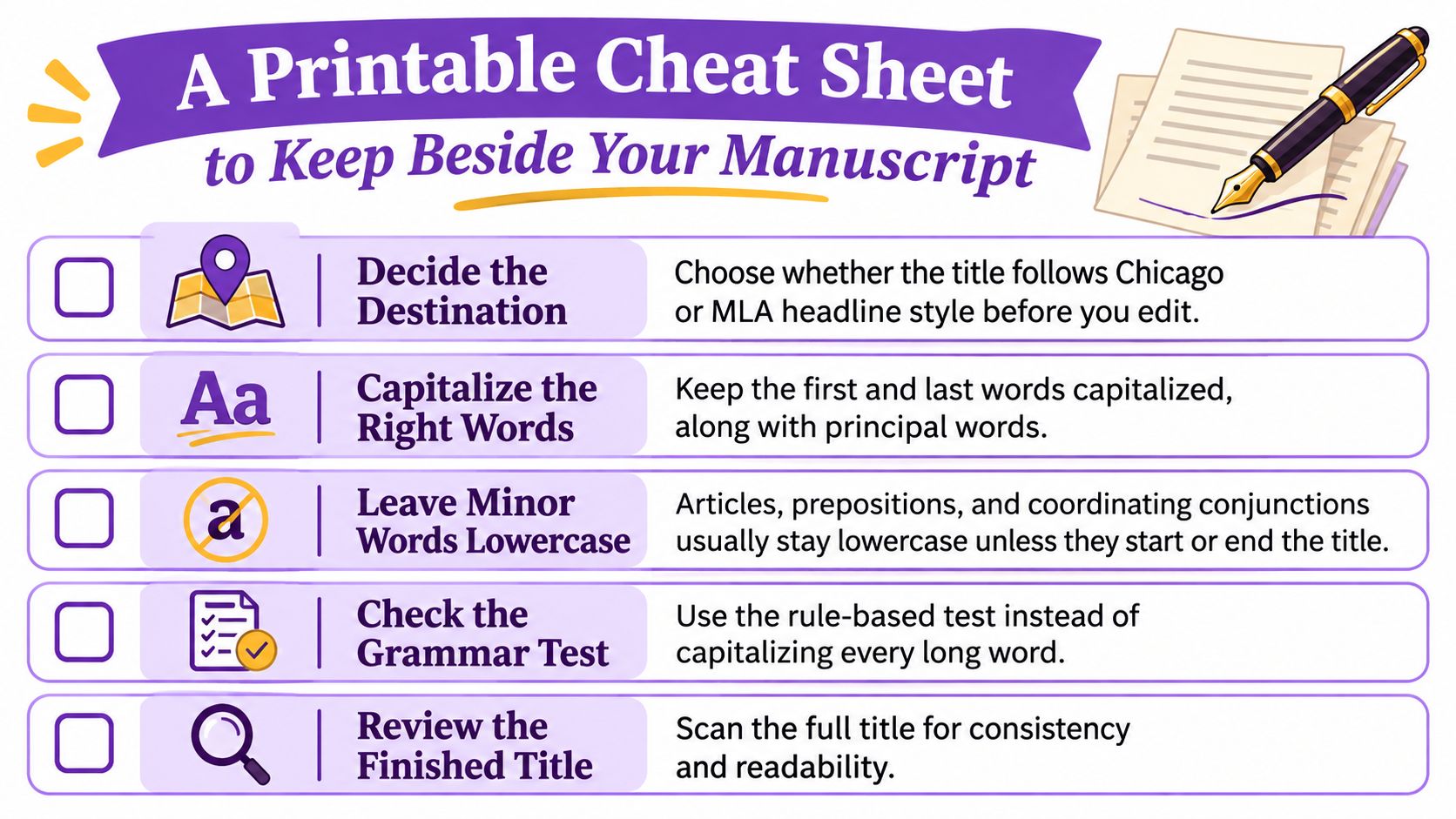
- Decide the destination: Identify running text, a citation, retailer metadata, or cover display before editing.
- Store the canonical title: Copy the approved wording verbatim into the project's master record.
- Choose the active system: Use the style comparison table to select the destination's casing convention.
- Apply long-work formatting: Use italics for Chicago, MLA, and APA, and quotation marks for AP.
- Check subtitle openings: Capitalize the first word after a colon that introduces a subtitle.
- Check the opening word: Keep its initial capital even when it's a short article or preposition.
- Inspect hyphenated components: Apply the active system using the edge-case table.
- Preserve internal quotations: Check quoted terms and nested titles independently.
- Audit every channel: Compare outgoing assets with the canonical title and approved display variants.
Keep the signed-off checklist with your book formatting notes so a formatter or publicist can follow the same decisions. Record an exception beside the relevant item instead of leaving someone to infer why two assets differ.
Editorial control extends beyond typography. For authors using assisted drafting workflows, Lumi Humanizer's guide to keep your voice in AI-assisted books addresses a separate concern: preserving the author's voice rather than letting tooling determine it.
Print this checklist once per project and tick it off whenever a new asset goes out. A checked manuscript doesn't automatically make a later advertisement correct.
Lock One Canonical Title Across Your Series
A title decision is only useful if every channel follows it. Record each book and series name's approved casing with the manuscript, where editors and production partners can find it. Keep the canonical form distinct from any display variation required by a specific destination.
Apply the same discipline to story facts across volumes. Development notes can explore a character's possible motives or history; continuity records should capture what is true at each point in the draft. Mixing possibilities with established facts can make later scenes inconsistent.
For example, if a protagonist learns an alias after an ambush, the preceding chapter should not show them using it. If an heirloom changes from a necklace to a ring during revision, later references must reflect the change. Track the facts that constrain the next scene: knowledge, location, relationships, possessions, condition, and timing.
Update those records as the manuscript changes. Keep speculative notes separate from established facts, and preserve when each fact becomes true rather than replacing earlier states.
Novelium automatically tracks characters, world details, and timeline entries from the manuscript, with no manual data entry. It analyzes the story for consistency without writing a sentence, paragraph, or chapter of it. The author retains control of the title and every creative decision.
Approve canonical casing for each book and series name, then check that active publishing channels use it consistently. Keep the record current so future volumes inherit the same title decisions and story facts.
Keep title decisions in an explicit publishing record, and let Novelium track story details that change across drafts and volumes. Visit Novelium to bring in a manuscript and build a continuity record without manually re-entering character and world details.