Backstory of a Character That Actually Drives Plot
A character suddenly knows the safehouse password, although the scene establishes that nobody told her. A childhood event that happened during winter in one draft has somehow moved to summer. A supposedly defining betrayal no longer explains the protagonist's behavior because the person responsible has been dead for three chapters.
These failures rarely come from bad imagination. They come from treating the backstory of a character as a finished profile instead of a living continuity system. At 80,000 words, memory becomes a poor database. In a series, it becomes actively treacherous.
I've seen strong manuscripts buckle because a writer tracked what a character was like, but not what the character knew, believed, feared, or had already survived at a particular point in the story. The biography looked polished. The novel still contradicted itself.
The useful question isn't “What happened before chapter one?” It's “Which earlier events continue to control present behavior, and where must those consequences remain consistent?” That shift determines what belongs in your notes, what earns page time, and what should stay buried until the plot can use it.
Introduction Why Your Backstory Keeps Breaking Your Novel
A character history often starts cleanly. You write down the formative loss, the failed marriage, the years in military service, the estrangement from a parent. Then the manuscript grows. A secondary character learns a secret in chapter twelve, forgets it in chapter twenty-seven, and reacts to it again near the climax as if the revelation were fresh.
The profile didn't prevent the mistake because it recorded facts without recording state. It said the character had a sister, but not that they hadn't spoken since the funeral. It said the protagonist feared water, but not that this fear had already been challenged in the previous book. It preserved biography while ignoring consequences.
Backstory is widely used in writing and performance to describe the events that precede the main action, and acting theory treats it as the fictional history a performer creates during role preparation. The practical value is causal. Earlier experiences explain present reactions, choices, fears, and desires, rather than decorating the character with trivia. The general definition and function of backstory supports that distinction.
Practical rule: If a past detail can't alter a present decision, relationship, risk, or interpretation, it probably belongs in your private notes, not on the page.
The solution isn't to invent less. It's to track better. A usable system separates the history you create from the history the reader receives, then follows every change across scenes, chapters, and books.
What Backstory Actually Is and What It Is For
Backstory is the pre-plot history that establishes a character's present situation. It includes the events, relationships, wounds, choices, and formative conditions that occurred before the story opens. That definition matters because backstory isn't a second plot running beneath the novel. It's the causal structure that makes the visible plot believable.
A biography tells you that Mara grew up in a coastal town, attended an expensive school, lost her father, and distrusts authority. A blueprint tells you what those facts do. Her father's disappearance taught her that official explanations conceal guilt. Her school experience taught her to perform competence around wealthy people. The coastal town gave her practical knowledge of tides. Now those details can predict behavior, create conflict, and constrain what she can plausibly do.
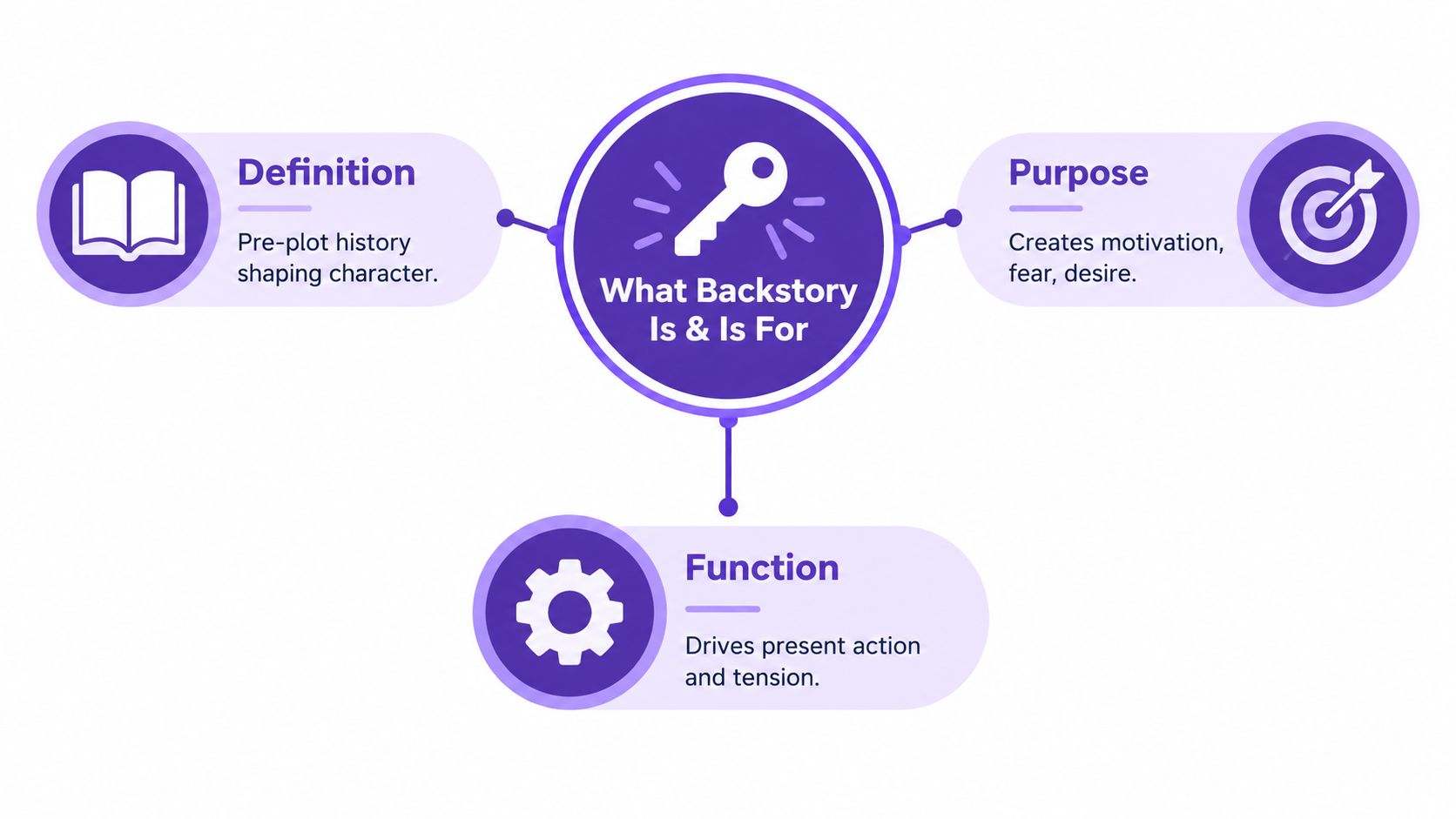
The distinction is load-bearing history versus decorative history. A favorite childhood food may humanize a character, but it doesn't need the same continuity treatment as the event that determines whether she trusts an informant. Store both if they help you write. Track the second with far greater precision.
The causal chain is the useful unit
The strongest backstory moves forward through a chain:
Prior event → resulting belief → coping strategy → observable behavior → present consequence
A betrayal can produce the belief that dependence is dangerous. That belief can produce a habit of withholding information. The habit can damage a current alliance, which forces the character to choose between safety and intimacy.
This model gives you something a static biography can't: a test. When a scene puts pressure on the character, you can ask whether the reaction follows the established chain. The answer doesn't have to be predictable. It has to be legible, even when the character surprises the reader.
Practical craft guidance often recommends specific biographical milestones, including childhood experiences, relationships, school history, trauma, and early-adult choices, because those details shape present motivation and behavior. Character-history guidance from Dummies is useful here, but the working novelist needs to go further. Record not merely what happened, but what changed afterward and when that change became visible.
Why Static Character Profiles Fail at Novel Length
The familiar questionnaire is good at generating material. It's poor at maintaining continuity.
A completed character sheet can tell you a character's childhood nickname, favorite drink, education, physical description, and private fear. It usually can't tell you whether the character still uses that nickname after a sibling's death, whether the education is known to the antagonist, or whether the private fear has changed after a specific scene.
That's the difference between a character development document and a character tracking system. Development documents help you invent the person. Tracking systems help you preserve the person while the manuscript keeps making new demands.
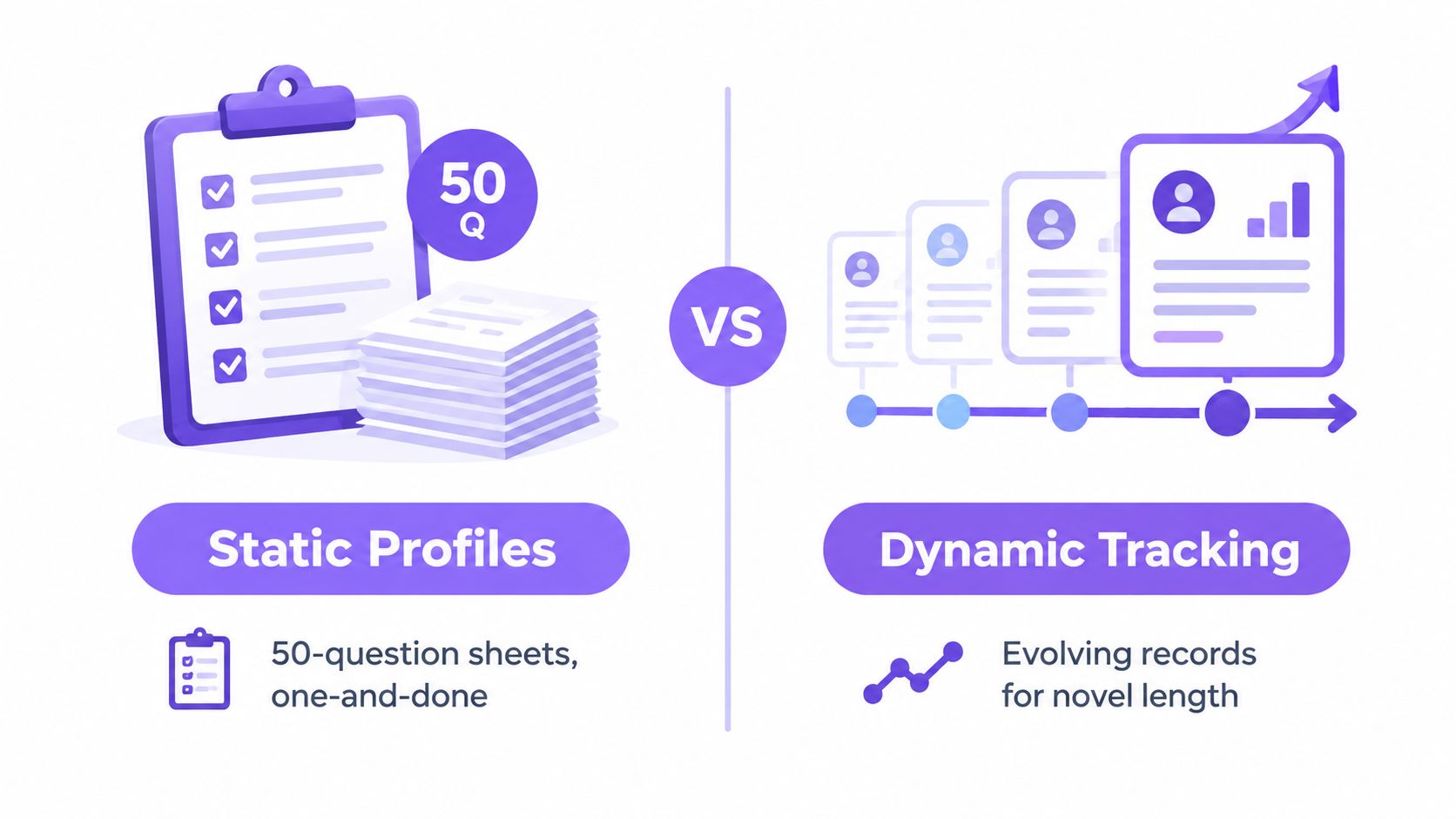
Track changes, not trivia
At scale, consistency depends on a smaller set of information:
- Knowledge state: What does this character know, suspect, misunderstand, or believe at each point?
- Relationship state: Who does the character trust, avoid, love, resent, or falsely believe is dead?
- Physical and emotional state: Which injury, addiction, pregnancy, grief, or recovery stage is active in the scene?
- Change points: Which event altered the character's behavior, allegiance, identity, or available choices?
- Backstory exposure: Which facts have the reader learned, and which remain known only to the character or author?
A character bible can centralize backstories, relationships, physical details, and planned revelations, making it a practical continuity tool for long manuscripts. Character bible guidance from Writers and Publishers Network describes that centralized function clearly. But a bible becomes stale if you treat it as a reference sheet rather than an evolving record.
The profile must change when the manuscript changes. If chapter nine moves the betrayal from childhood to early adulthood, update the consequences, not just the date. If a character confesses a secret, mark who heard it. If the confession is interrupted, mark what each listener knows. Otherwise the document becomes another fictional version of the novel.
The following video also addresses the difference between a static character record and ongoing development:
For a concise distinction between invention and maintenance, see this glossary entry on static characters. The point isn't to abandon questionnaires. Use them to generate pressure points, then convert those pressure points into trackable events and state changes.
What to Reveal What to Withhold and How to Weave It In
Backstory has a bandwidth problem. The reader is following the current conflict, so a long historical explanation asks them to stop investing in the immediate scene and process information that may not yet matter. Craft guidance often recommends selective disclosure through dialogue, flashback, and scene context, rather than releasing the entire history at once. The practical case for controlled backstory disclosure frames the issue as limited narrative space, with one guideline estimating that foundational character arcs should occupy only about 15% of a short story's word count.
The percentage isn't a quota for novels. The more durable rule is simpler: surface the minimum history that changes the present moment.

Let the scene trigger the past
A memory earns page space when something in the current scene activates it. The trigger might be a phrase, a smell, a gesture, a location, or a decision that resembles the original wound. Don't explain the entire childhood. Show the character refusing to sit with their back to the door, then let the reader discover why when that knowledge changes how they interpret the refusal.
Dialogue works when characters use the past to pursue something now. A sister mentioning the old house isn't automatically backstory. It becomes useful when she uses the memory to shame the protagonist into surrendering evidence, or when the protagonist realizes that her sister remembers the event differently.
Flashback is strongest when it creates a present-tense consequence. A recovered memory that merely clarifies personality is less valuable than one that reveals a false assumption, identifies a threat, or makes an earlier promise impossible to keep.
Use this decision filter before inserting a paragraph of history:
- Decision: Does the fact change what someone chooses now?
- Relationship: Does it alter trust, intimacy, or hostility?
- Risk: Does it increase danger or change what failure means?
- Contradiction: Does it force the reader to revise an earlier interpretation?
If the answer is no across the board, keep the detail in your timeline. Your notes can hold the full chronology. The scene only needs the piece that pays rent immediately.
Selective disclosure also creates suspense. Withhold the complete account, but don't withhold the causal logic forever. Readers can tolerate mystery when each fragment sharpens the present conflict. They get impatient when the author conceals information merely to manufacture a late twist.
Building a Backstory Timeline That Stays Consistent
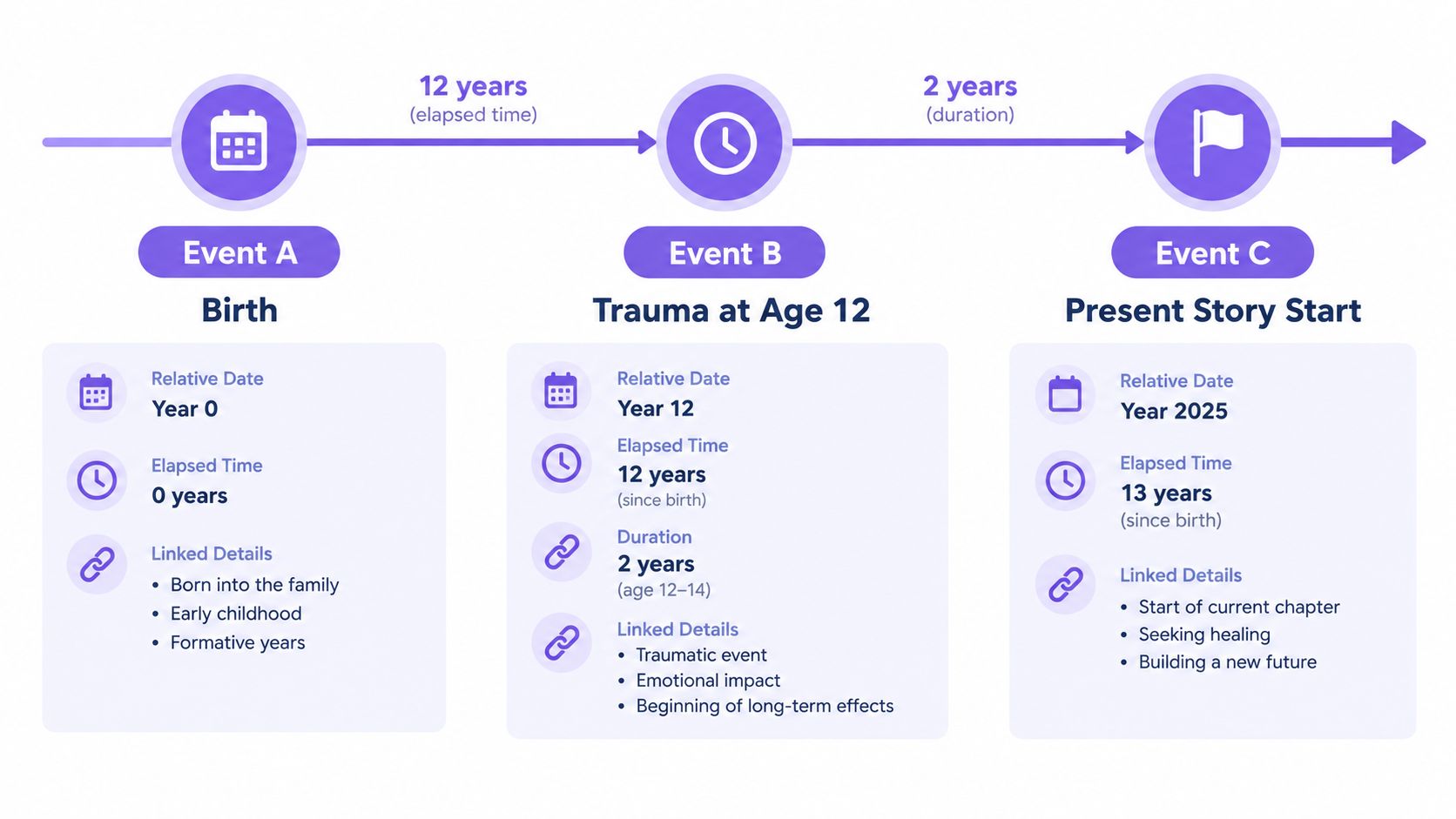
A backstory timeline turns biography into a continuity system. For every consequential event, record the date or relative day, the character's age, duration, location, participants, and dependent details. Store the full chronology here, then decide which facts the manuscript needs to surface.
Those dependencies expose failures that prose can hide. A character cannot travel between cities overnight if the route takes longer. An injury cannot heal before a later scene assumes it has. Two characters cannot remember a private conversation that occurred while one was elsewhere. Naming a weekday or writing “three days later” creates a calendar promise that must remain internally consistent, as explained in this glossary entry on timelines in fiction. Writers Digest on weaving backstory and maintaining temporal promises addresses the same continuity pressure.
Rebuild chronology before polishing prose
When a draft drifts, repair the chronology instead of patching the sentence that reveals the error. A timeline workflow should log each event with its date or relative day and elapsed duration, then update dependent details such as travel time, age, healing, weather, and parallel scenes. The Novelkit method for fixing timeline inconsistencies treats the repair as a mechanical reconstruction.
Run a separate continuity pass before style editing:
- Establish the story's anchor date or opening day.
- Place every backstory event relative to that anchor.
- Calculate age and elapsed time at each major change.
- Mark who was present and what each person learned.
- Check travel, recovery, seasonal details, and simultaneous scenes.
- Update the manuscript, then reread every dependent scene.
For a series, maintain one canonical record covering biography, attributes, voice, relationships, and the chapter where each fact changes. A documented character-consistency workflow from Journzy recommends a dedicated continuity pass before style editing. Keep that pass separate. Line editing can make an impossible timeline sound beautiful. It cannot make the timeline possible.
Backstory Snippets That Work Across Genres
A thriller protagonist once watched a trusted partner sell evidence to the enemy. The event creates a belief that every alliance has a price, so she withholds the location of a witness even when cooperation would keep him alive. The full betrayal can wait. The behavior is already doing narrative work.
In romance, a divorced character might have learned that conflict means abandonment. The result isn't a generic “fear of intimacy.” It's a specific coping strategy: she turns every disagreement into a logistical problem and starts packing before her partner has finished speaking. When the love interest notices, the backstory becomes a current relationship obstacle rather than an explanatory monologue.
Fantasy offers a different pressure point. A prince survived a succession purge because an older servant hid him under a grain cart. He now trusts servants more than nobles, but he also mistakes secrecy for loyalty. That contradiction can drive a political decision, expose him to manipulation, and make the old rescue relevant without narrating the entire royal childhood.
Literary fiction can work with quieter consequences. A woman who grew up managing a volatile parent becomes exquisitely attentive to other people's moods. She reads a friend's silence as anger and apologizes for something that hasn't happened. The past appears through a misinterpretation, not a flashback.
The useful structure remains consistent across genres: choose two to four high-impact prior events, connect each to a belief or coping strategy, then test that strategy against an observable choice. Savannah Gilbo's discussion of backstory as a causal blueprint supports this event-to-behavior approach.
Don't dump the whole history because the reader deserves a file. Reveal the fragment that makes the current choice more dangerous, more intimate, or more difficult to reverse.
Stop Memorizing Your Own Novel and Start Tracking It
Backstory isn't a document you complete before drafting. It's a system of prior events and present consequences that must remain coherent as the manuscript changes. The profile records invention. The tracker records what the story has done to the character.
That distinction protects more than continuity. It preserves momentum because you can keep history off-page without losing control of it. It also makes arc tracking practical across recurring characters, parallel timelines, and multiple books.
Novelium's Character Tracker and World Codex automatically extract character details, relationships, events, and continuity-relevant information across manuscripts, including what a character knows and when that knowledge changes. It's a systematic alternative to relying on memory, scattered spreadsheets, and a character sheet that stopped matching the draft several chapters ago.
Novelium tracks the backstory consequences that cause real manuscript failures, including knowledge states, relationships, events, and timeline changes across chapters. Visit Novelium to start tracking your character histories systematically instead of debugging contradictions from memory.