Author Platform Building for Multi-Book Novelists
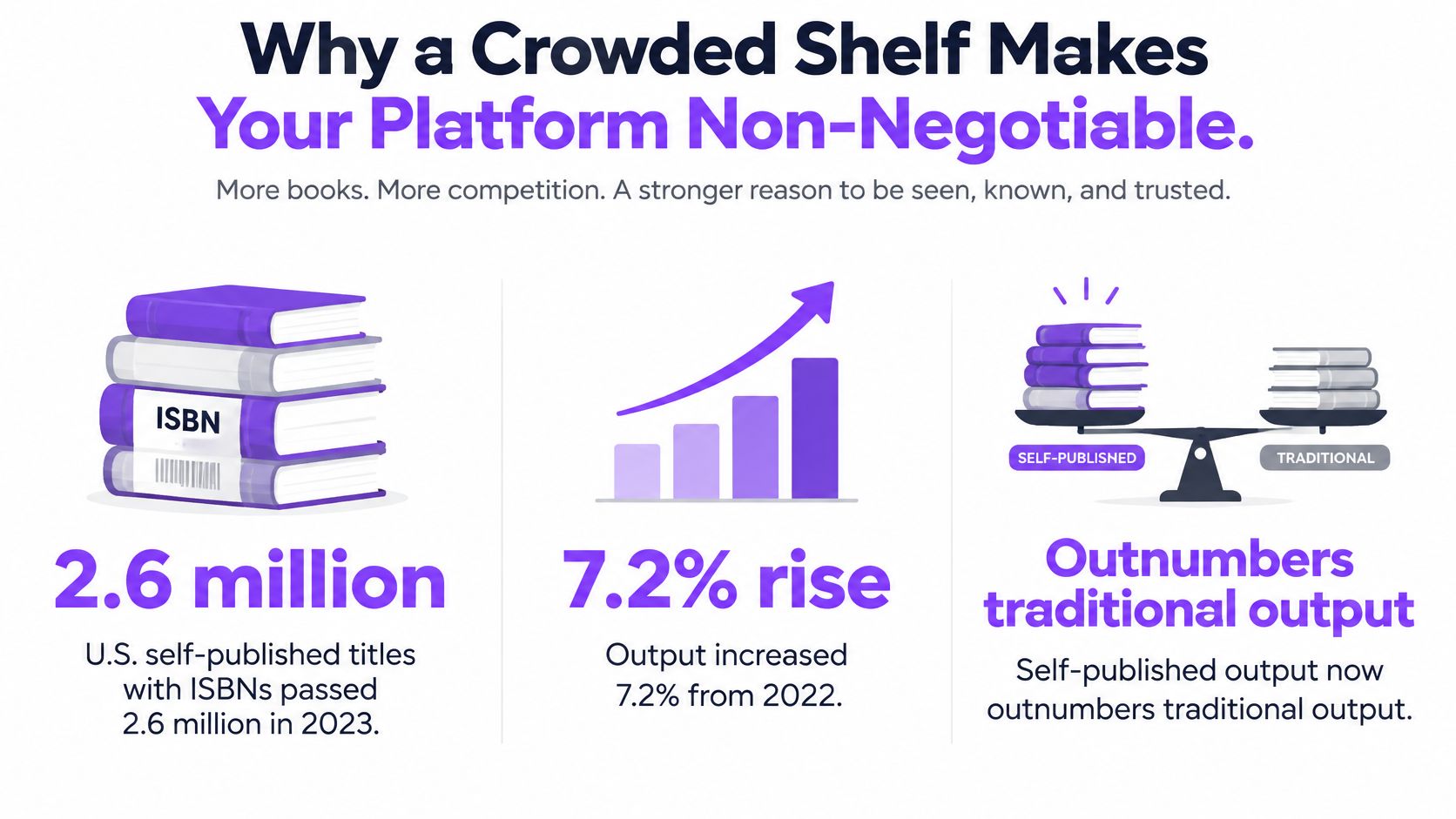
U.S. self-published titles carrying ISBNs passed 2.6 million in 2023, a 7.2% increase on 2022, according to Bowker data reported by Publishers Weekly. Nothing else in this business moves that fast. Supply climbs every quarter. The attention available to meet it doesn't.
So your fourth book doesn't compete against books like yours in the abstract. It competes with everything released that same week, plus the three titles the reader already has queued, plus whatever the retailer's algorithm decides to put in front of them.
That reframes the job. The question isn't how to be visible. It's who can you reach twice, and what does reaching them cost you in hours that belong to the manuscript. Multi-book novelists who survive several series run author platform building as a small owned audience with a written time budget attached, not as a posting obligation.
Why a Crowded Shelf Makes Your Platform Non-Negotiable
The fiction line should worry a novelist more than the total. 335,428 fiction ISBNs were registered in 2021, making fiction the largest self-publishing category that year, and self-published output exceeded traditionally published output by more than two million titles in both 2022 and 2023, per the same Bowker reporting. That isn't a market with room for a quiet launch.
Now put yourself in the position of a writer with three books out and a fourth on preorder. Your sales page for book one and your sales page for book four are the same rectangle with a different cover. Neither one tells a reader who you are, what you write, or whether book two is where they should start. A retailer listing resets with every title. The platform is the only part of the business that carries a reader from book one to book four, which is why backlist discovery is a structural problem long before it's a marketing one.
For a novelist, a platform is three concrete things: an owned audience you can contact without an algorithm, a recognizable author identity across covers, site and voice, and a repeatable way to tell readers about the next book. Follower counts and posting streaks are scaffolding around those three, and scaffolding is the part you're allowed to skip.
Run this audit in thirty minutes. List every place a reader can find you. List every place you can contact them. Mark which of those you own outright, meaning you can export the addresses and walk away whenever you like. Most multi-book writers find the second list is one line long and sits on a platform that could suspend them tomorrow.
Audit rule: if you can't export it, you don't own it, and if you don't own it, it can't carry a reader to book four.
The 12-Month Build Plan at a Glance
Experienced writers rarely start from zero. They start with three half-built channels, a decaying Facebook page and no order of operations. Sequence matters more than tactics here, because a launch sequence aimed at a list of forty people is a week of your life you don't get back.
| Phase | Months | What to Build | Proof It Works |
|---|---|---|---|
| Baseline | Month 1 | Record sales and signups with no promotion | One month of clean baseline numbers |
| Foundation | Months 1-2 | Reader promise, author site, one signup form | Signup form converts on two pages |
| Owned core | Months 2-3 | Reader magnet, back-matter links, welcome sequence | Subscribers tagged by entry source |
| Cadence | Months 3-6 | Fixed newsletter day and one recurring content series | Open and click rates stable by cohort |
| Community | Months 6-9 | Reader group, two partnerships, beta-reader pipeline | Repeat readers traced to each partnership |
| Launch | Months 9-12 | Series launch sequence and post-launch review | Launch conversion compared with the baseline month |
Baseline exists because a number without a comparison is an opinion. Four weeks, no promotion, no discount, no new release.
Foundation is the promise plus the plumbing: one sentence naming genre, tone and series, a site with a signup form in two places, nothing else. Resist building a five-page site first.
Owned core converts passers-by into contacts through the magnet, the back-matter call to action and the three-email welcome.
Cadence is where plans die. A fixed newsletter day plus one recurring content series, either craft material for other writers or series material for readers, is the entire requirement.
Community widens the top without adding a platform: a reader group, two partnerships with authors in adjacent genres, and a beta-reader pipeline you'll need for the next book regardless.
Launch is a phase, not the finish line. The sequence runs to the list first, then the wider audience, and the post-launch review tells you which cohort bought.
Two rules keep it honest. Every phase ends with a proof metric, and no phase begins until the previous proof exists. Without that, cadence just adds noise to a list nobody joins.
By month six, signups should arrive from named sources every month, a click rate should hold steady by cohort, and at least one channel should repeat without extra effort. If you can't name the source, you don't have a channel. You have a habit.
How to Set Up the Owned Core Step by Step
The owned core is where both the money and the hours sit, so build it before you touch anything social. The commercial case is blunt: in 2024, 96.08% of authors earning $10,001 to $20,000 a month had an email list, according to Written Word Media's 2024 Indie Author Survey. That's selection as much as causation, since established authors are likelier to have built one. The direction of travel still matters if you're planning a fifth book.
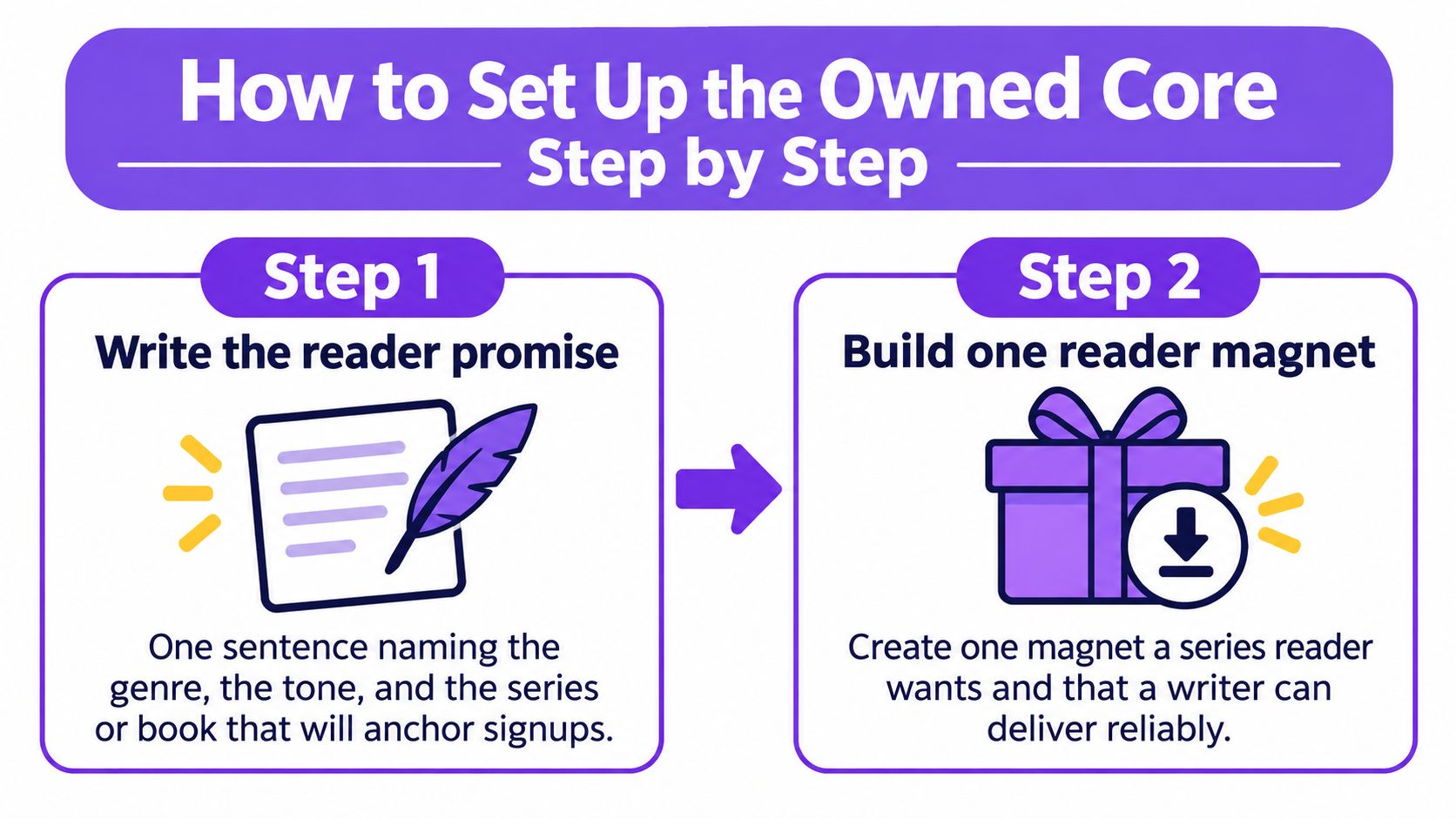
The six steps, in order
Write the reader promise in one sentence. Name the genre, the tone, and the series anchoring signups. "Tense police procedurals with a burned-out detective and a long memory" filters. "Stories about people" doesn't. The slip: a promise broad enough to attract readers who will never buy book two.
Build one reader magnet a series reader actually wants. A character index for book one, a timeline of the events that set up book two, a cut chapter that answers a question the series leaves open. The slip: a magnet suited to a stand-alone title, which fills the list with one-book readers who churn on the second send.
Put one form above the fold and a second on the about page. Use the same link in the back matter of every book you have in print, and point it at a dedicated page rather than your homepage. A homepage asks the reader to go looking. The slip: a generic "sign up for my newsletter" link that drops people on a page with eleven other things to click.
Write three welcome emails over about ten days. Deliver the magnet, restate the promise using a real story from your own series, then ask a question that invites a reply. Replies train inbox providers far better than opens do. The slip: a five-email sequence that lands before the reader has finished the free thing.
Pick a newsletter day and keep it for a year. Predictability beats frequency every time. A monthly send on the first Tuesday that always arrives outperforms three irregular bursts and a silence. The slip: skipping a month because the draft is going badly, which is exactly when a short honest note does the most work.
Tag every subscriber by entry source at signup. Not later, and not in a spreadsheet you assemble in a panic before a launch. The slip: no tag at all, which turns every report in the next section into guesswork.
If you'd rather see a welcome sequence assembled end to end before writing your own, this walkthrough is worth the fifteen minutes.
The core is working when new subscribers arrive from at least two named sources inside the first quarter. One source is a funnel with a single point of failure, and it's usually the one you control least. The mechanics of the automation, from the opt-in to the delivery, are covered in this guide to newsletter setup for authors if you don't want to build the sequence from scratch.
Measuring Cohorts Instead of Follower Counts
Start with a month of nothing. No promotion, no discount, no new release, no paid push. Record sales, signups and clicks for four weeks. Every change you make afterwards gets compared against those numbers, which is the only way to know whether the thing you changed did anything at all.
Why the count lies
A large unsegmented list can post weak engagement, damage your sender reputation and produce almost nothing at launch. A smaller list aligned to one genre can carry a launch by itself. Subscriber count tells you how many people once clicked something. It doesn't tell you how many will buy in week one.
The staged model runs signup growth first, engagement second, sales third. If signups arrive from named sources and the welcome sequence completes, you have a platform. If they arrive from nowhere in particular and nobody reaches email three, you have a number.
Cohorts keep you honest. Compare readers who joined in the same month rather than the list as a whole, because a big old subscriber base will happily hide a new source that produces nothing. Test one variable at a time, subject line or magnet, never both, or the result teaches you nothing.
Open rates have stopped being a reliable read on a list. Privacy features in mail clients now distort them, so clicks, replies, downloads and purchases carry the weight.
The distinction between reach and response in this breakdown of engagement metrics that move applies to your inbox as neatly as to social accounts, since both fail in the same ways. Then set a removal rule and keep it. Any contact who neither opens nor clicks after one re-engagement attempt comes off the list. Removing them lifts the numbers you report, improves deliverability for readers who do want you, and costs you nothing you were using.
| Metric | What It Tells You | Check When |
|---|---|---|
| Signups by entry source | Which back matter, site page or partner brings readers | Monthly |
| Welcome sequence completion | Whether new readers reach the second and third emails | Monthly |
| Click-through and replies | Whether readers act on what you send | Every send |
| Non-promotional sales | Whether the list still sells books in a quiet month | Quarterly |
| Launch conversion by cohort | Whether older subscribers buy on launch day | Every launch |
| Inactive contacts | Who needs re-engaging and who comes off the list | Quarterly |
Choosing Channels and Protecting Your Writing Time
Platform time is a budget with a ceiling. Treat it as an open-ended duty and the manuscript pays the bill, usually in a year of stalled word counts nobody can point to afterwards.
The pattern shows up plainly. A 566-author BookBub survey found that among authors working full-time outside their author businesses, 72% spent five or fewer hours a week on marketing, while 62% of full-time authors spent six or more (BookBub's data on what writers do). More than 70% of authors grossing at least $10,000 a month spent six or more hours a week on marketing, including 34% who spent more than ten, against roughly 40% of authors earning under $10,000 a month.
The lesson isn't market more to earn more. It's that at volume, marketing turns into a recurring weekly function rather than a launch-week scramble, so the budget has to be written before the volume arrives.

Low contact beats high contact more often than the advice admits
The channels that ask least of you do more discovery work than the ones that ask most. In a 2025 survey of 3,589 active readers rounded up by Best Writing, 64% found books through email newsletters and 42% through social media, with Amazon at 68% and author websites at 30%. Email, a channel you write once a week, roughly matches the largest retailer and comfortably beats the feed you'd have to post to daily.
So cap it. Two or three channels in active production, each with a written weekly hour limit. For a writer with three books out, I'd write the budget down like this: three hours on the newsletter and site, two on the reader group and partnerships, one on reviews and retailer metadata, zero on daily posting. Batching is what makes that survivable, and cutting your posting time in half covers the mechanical side of it. As for BookTok, study it once so you can decide with your eyes open whether it's your channel or somebody else's.
Operating policy: a channel earns a weekly slot only if you can name the cohort it produces.
Three rules I'd write down and keep. Refuse unpaid labour dressed up as exposure, including guest posts that cost a drafting day for a link nobody clicks. Set a fixed reply window, one hour a week at a stated time, so reader mail gets answered without becoming a permanent open door. Keep your private life on a separate handle or behind a pen name, because a series with a devoted audience will consume everything you're willing to publish about yourself.
Confirm Your Reader Promise Before Your Next Launch
Write the reader promise for the series rather than for yourself. One sentence, genre, tone, and the promise the fourth book keeps as well as the first. That sentence decides the magnet, the back-matter wording, the newsletter topics and which partners are worth approaching, so it's the cheapest decision to get right and the most expensive to get wrong.
The trap series writers hit is drift between the public face of the series and the manuscript. A companion page lists an eye colour that contradicts book two. A timeline on the site disagrees with the one in the draft. A newsletter announces a death that hasn't happened yet at the current point in the story. None of those are marketing failures. They're tracking failures that surfaced in public.
Novelium's Story Bible is built for exactly that problem, letting you assemble a character's history once, reference it while drafting, and reuse the same details when you write the companion page or the reader-facing timeline.
Then run the thirty-day checklist:
- Reader promise written, one sentence, series level.
- Author site live with two signup placements.
- Back-matter links audited in every book, print and digital.
- Baseline month started, with no promotion running.
- One cohort tag added to the signup form.
Novelium reads your draft locally on your device and tracks character traits, knowledge states, relationships and timeline events across chapters, so the version of the series you promote keeps matching the version on the page. Bring in a manuscript from Word, Scrivener or Google Docs, or start on a blank page, and let the tracker hold the history your companion pages and reader material depend on. Visit Novelium to start free, and its Academy's guides, free to read with no account needed, cover the five stages from idea to publishing if you want a map before you begin.