8 Sequence Structure: Using It to Keep Novels Consistent
The most popular advice about the 8 sequence structure misses the useful part. Novelists borrow the film tool, mark eight blocks on an outline, then treat those blocks like oversized beats. At 100,000 words, that's a lot of scaffolding with no guarantee the character's choices, knowledge, or resources make sense from one block to the next.
The better use is less glamorous and more practical. Treat each sequence boundary as a continuity checkpoint: what changed, what does the protagonist know now, and what can they do that they couldn't do before?
What the Eight-Sequence Structure Actually Is
The 8 sequence structure is a film tool novelists keep borrowing, usually without its mechanics. It's associated with Frank Daniel, who developed the framework while leading the Graduate Screenwriting Program at the University of Southern California. Its roots reach back to early cinema, when technical limits encouraged films to be divided into reels of roughly 10 minutes. The modern approach turns that production constraint into eight narrative units, generally 10 to 15 minutes each. In a conventional two-hour film, that amounts to roughly 80 to 120 minutes of structured story, with the actual total affected by credits, transitions, and scene length, as described in this film editing theory document.
Each sequence works like a mini-movie. It pursues a short-term objective, develops conflict, reaches a turning point or culmination, and leaves the protagonist in a new situation. That last part is the mechanism novelists tend to lose. A sequence isn't useful just because it contains a dramatic event. Its ending needs to create the conditions that make the next sequence necessary.
For a working novelist, then, the structure is a set of checkpoints to test, not a list of beats to hit. It's a planning heuristic, not a law. Films vary widely, and novels have even less reason to obey a neat timing grid. The framework earns its keep when it helps you find a continuity gap in the long middle of a manuscript, not when it makes an outline look orderly.
Try the simplest test on your own book: can you state, in one sentence, the objective each sequence pursues? If you can't, the problem may not be a missing beat. The unit may have no clear dramatic job, or its objective may have changed without an event that justifies the change.
Mapping the Eight Sequences Onto a Novel
A 100,000-word novel divided into eight equal spans gives you 12,500 words per sequence. Treat that figure as a locating tool, not a quota. A sequence may cover several short chapters or one long chapter, depending on where its dramatic question turns. The 2–4–2 allocation places two sequences in Act I, four in Act II, and two in Act III. That corresponds to a 25%, 50%, and 25% act split, as outlined in the 2024 Plottr guide to the eight-sequence structure.
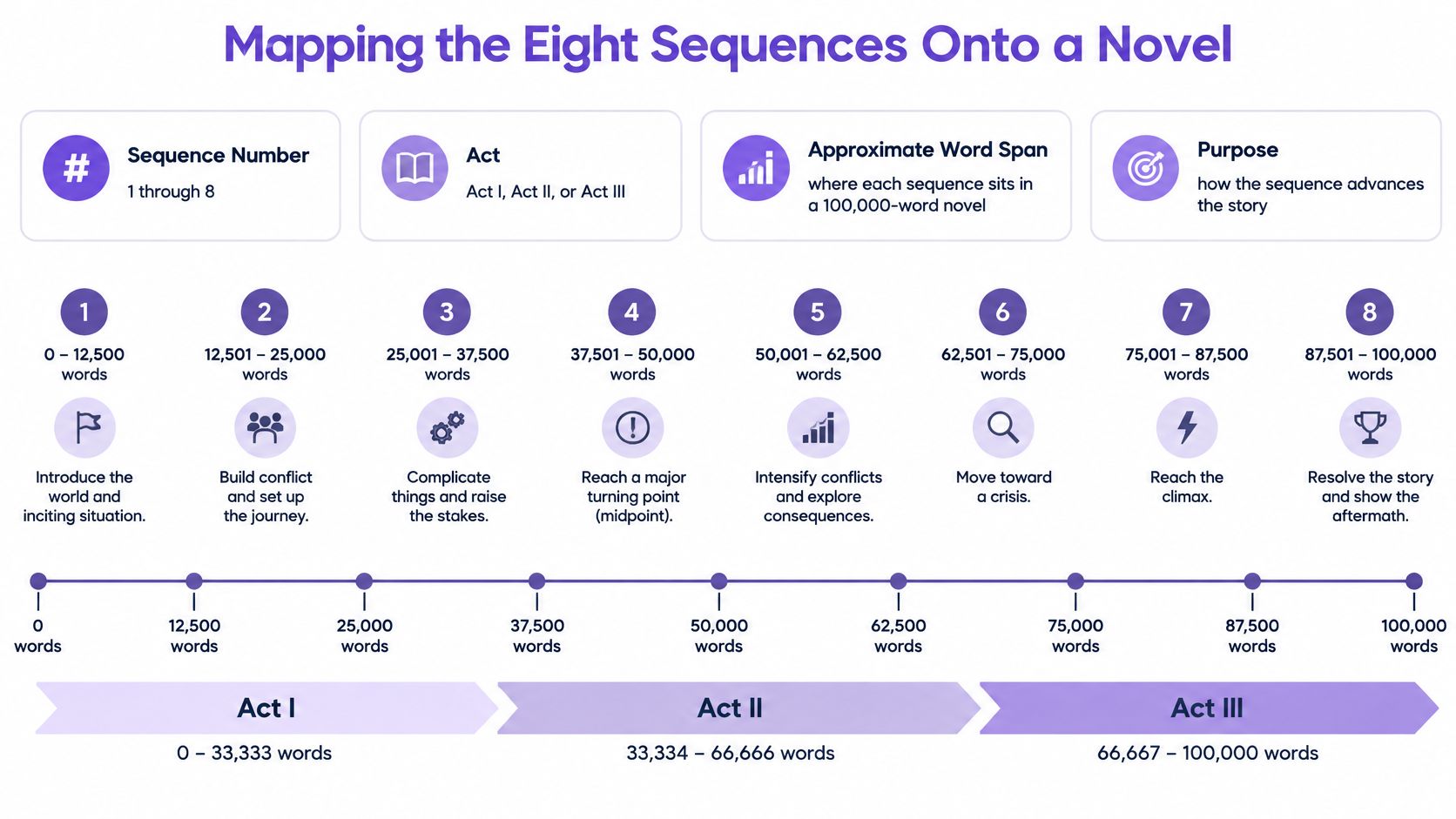
Table A. The eight sequences in a 100,000-word novel
| Sequence | Act | Approximate word span | Dramatic job |
|---|---|---|---|
| Sequence 1 | Act I | 0–12,500 | Establishes the status quo and ends on the inciting disruption |
| Sequence 2 | Act I | 12,501–25,000 | Failed attempt to restore normality, leaving a worse predicament |
| Sequence 3 | Act II | 25,001–37,500 | Confronts the new problem and tests the first strategy |
| Sequence 4 | Act II | 37,501–50,000 | First culmination or midpoint reversal that exposes the strategy |
| Sequence 5 | Act II | 50,001–62,500 | Processes ramifications, subplots, and new opportunities |
| Sequence 6 | Act II | 62,501–75,000 | Second culmination after easier options are exhausted |
| Sequence 7 | Act III | 75,001–87,500 | Complicates the apparent solution and raises the stakes |
| Sequence 8 | Act III | 87,501–100,000 | Final confrontation and resolution |
At novel length, word spans help you locate continuity problems that chapter counts can conceal. A chapter may cross a sequence boundary; assign it to one side for the audit so the state snapshot captures a single point in the story. Then check what has changed by the end of that span: the protagonist's knowledge, options, resources, relationships, or immediate objective. If those remain unchanged, the sequence may be taking up space without altering the conditions for what follows.
Why Each Sequence Must Hand Off Cleanly
A strong scene isn't enough if the next sequence ignores what it changed. Sequence boundaries are causal, not merely chronological. The standard account has Sequence Two ending with the protagonist in a worse predicament; Sequence Three must begin from that predicament, not from a convenient reset. A description of Frank Daniel's sequence method frames the handoff as cause and consequence, with each unit's dramatic question, attempt, reversal, and resulting condition available for inspection.

Take a detective novel. The detective finds an incriminating letter at the end of Sequence Four. Sequence Five opens with her pursuing the case exactly as before, asking the same questions and trusting the same suspect. The prose may be sharp, but the handoff is broken: the discovery should change what she knows, what she suspects, or what she does next. When it doesn't, readers feel a motivation gap even if they can't name it.
Boundary test: What new problem, decision, revelation, or escalation does this ending give the next unit?
If the answer is “none,” you may have an inert transition. That doesn't automatically mean the sequence needs more action. It means the ending hasn't changed the protagonist's available choices in a meaningful way. The same test works on a cluster of chapters: if the situation is unchanged at the end, the cluster may be doing the next sequence's job too early, or it may not be doing a job at all.
At every boundary, identify the unit's dramatic question, the protagonist's attempt to answer it, the reversal or resolution, and the concrete condition passed forward. Then ask: what does the protagonist have now that they lacked at the start of this unit?
Tracking State at Every Sequence Boundary
Character profiles describe who someone is. A boundary record shows what has changed: what the protagonist wants, knows, can use, and stands to lose. I recommend tracking five fields at each sequence boundary: objective, knowledge, resources, relationships, and stakes. Together, they show whether the next sequence begins from the condition the previous one created.
Table B. What to record at every sequence boundary
| State element | What to record at each boundary | Typical drift in drafts |
|---|---|---|
| Objective | The goal the protagonist is pursuing, with its deadline or cost | The goal changes between sequences with no event that caused the change |
| Knowledge | What each POV character knows, suspects, and has been told | Characters act on facts revealed in a later scene |
| Resources | Money, tools, allies, injuries, and possessions in hand | Items reappear or vanish without a recorded handoff |
| Relationships | Current trust, debts, and open conflicts with each major character | Reconciliations happen off-page, or the wrong ally turns up |
| Stakes | What is lost if the objective fails at this point | The prose keeps stakes high while the cost is never restated |
A development document isn't a tracking system
A development document answers, “Who is this character?” A tracking system answers, “What does this character know at the end of this sequence?” Those records serve different purposes. Across a long novel, each sequence boundary creates another point where revisions can break continuity, especially when several POV characters carry different information. A spreadsheet can hold the snapshots, but it stays useful only if you update it when the draft changes.
Knowledge drift can subtly break a scene. A character may act on information revealed later, or react to a secret they have not been told. Visual references serve a different purpose: reference images for consistent AI characters concern appearance, while a novel's boundary record tracks what each character knows and when they learned it.
Skip details that do not affect a character's choices or condition at a boundary. Eye color, favorite food, and unused backstory may belong in a character profile, but they do not need a place in this record. Use this consistency-check glossary entry to distinguish a continuity problem from a detail that remains consistent. Revise each snapshot when the draft changes the state passed forward. An outdated record can make the next revision preserve a contradiction instead of fixing it.
Outlining Against the Eight Sequences Before You Draft
Build the sequence map before drafting, while changing a choice is still cheaper than rewriting a long run of chapters. The outline is not there to certify that the novel fits a formula. It's there to expose a broken handoff before you've built scenes around it. If you're sorting and narrowing possibilities at this stage, this practical guide to qualify ideas before drafting can help keep the outline focused on viable story choices.
Write eight sequence cards. Give each one a dramatic question, an attempt, a reversal, and the state handed forward. Set a target word span using Table A, but don't force chapter lengths to match.
Read the cards as one chain. If Card Five can't name a choice the protagonist makes that Card Four created, the outline has an inert handoff. Fix the causal link before drafting.
Track each POV character's state alongside the cards. Record what each viewpoint character knows at each boundary, so later scenes can't casually give them information they haven't received.
Make the midpoint reversal specific. Sequence Four should expose a failure or limit in the strategy tested in Sequence Three. Put that change on the card, rather than leaving the middle with a vague promise to “raise the stakes.”
For a series, add a closing card that records the state the final sequence leaves for the next book. Check it against the prior book's last boundary snapshot, not your memory of it. Outlining methods work best when they preserve those concrete decisions and transitions; this guide to outlining a novel offers another way to organize the work. Spend particular attention on Sequences Two and Four. That's where outlines often announce a change in choice without showing what caused it.
Where the Structure Bends and Where It Breaks
Flexible counts are fine. Broken handoffs aren't. The nominal 2–4–2 split is a useful map, but real films vary from it, and novels have no obligation to place the midpoint reversal at an exact percentage. The structure bends when the unit lengths shift; it breaks when the reader can't trace why the protagonist acts differently now.
The opening sequence has a specific information burden. It needs to establish who, what, when, and under what conditions the story operates, with the inciting incident usually arriving by its end, according to this study of the opening sequence's role. In a novel, that's no excuse for several chapters of atmosphere that leave the protagonist's choices untouched. If the inciting event changes nothing available to the protagonist, Sequence One hasn't completed its job.
| Variation | Where the boundaries shift | What the state fields carry |
|---|---|---|
| Standard single-POV novel | The midpoint may land earlier or later than the nominal midpoint | Objective and stakes change only through a recorded event |
| Multi-POV novel | Each viewpoint runs its own arc, with boundaries aligned where threads cross | Knowledge per POV and relationships shared across threads |
| Series | Each book is a full structure nested in a larger arc, with the last sequence handing state to book two | Stakes, relationships, and resources carried across the book break |
| Literary novel | Sequence Two may fail internally, with the status quo itself under examination | Knowledge and belief fields carry the weight the external plot usually carries |
In multi-POV work, don't force every character into identical beats. Align boundaries where threads cross, so one viewpoint's revelation doesn't arrive before another character has a plausible way to learn it. In a series, make the last sequence's handoff explicit: the next book inherits a state, not a vague sense of unfinished business. Literary novels can put the pressure inside the character, where belief or knowledge changes instead of the external objective.
When a midpoint feels soft, I'd check whether Sequence Four is still doing Sequence Three's work. A second attempt that repeats the first with more noise isn't a reversal. The count can bend, but the handoff cannot.
Run a Sequence Audit on Your Manuscript
Audit the draft on the page, not the cleaner version in your head. Treat each sequence as a checkpoint: record the protagonist's state at its start and end, then check whether the ending changes what can happen next.
Mark the eight boundaries by word count. Treat the spans as working locations, not hard limits. Divide the draft into eight usable stretches and keep the boundaries visible.
Write one line for each sequence. Name its dramatic question, the protagonist's attempt, the reversal, and the handoff. If the handoff is unclear, a chapter summary won't fix it.
Test each handoff for cause and consequence. Does the next sequence begin with a problem, decision, or changed condition created by the previous one? If not, the transition may be hiding a missing step.
Snapshot each POV character at every boundary. Record objective, knowledge, resources, relationships, and stakes. These fields expose continuity breaks, such as a detective acting on a letter she has not found or an ally arriving with an object they never acquired. For a practical framework, see arc tracking across a manuscript.
Flag sequences that leave the protagonist with the same options. Another scene won't fix an inert sequence. Change the ending so its consequence alters the choices available in the next one.
Repeat the audit after substantive revisions. A changed reveal can make knowledge snapshots inaccurate several sequences later. Across a long draft or a series, manual records can go stale as edits ripple through the manuscript.
Start with the boundary you trust least. A strong scene can disguise a missing change in state, but the next sequence will expose it.
Novelium's Character Tracker and World Codex track character details, knowledge states, and relationships across a manuscript, helping keep boundary snapshots current as the draft changes. Check sequence handoffs against whole-book continuity with Novelium.