7 Point Story Structure: Plotting a Novel Beat by Beat
The usual advice is to line the seven beats up in reading order, park the midpoint at the halfway page, and call the novel plotted. That produces a clean diagram and a middle that never changes anyone. The 7 point story structure earns its place only as a causal audit. Each beat has to alter what the protagonist knows, decides, and can still do. A beat that only marks a page range is scenery.
Where the Seven Points Came From
Novelist Dan Wells presented the modern seven-point model in a 2010 Brigham Young University lecture. Accounts of that lecture trace the logic to Syd Field's three-act model and to a seven-point structure in the Star Trek role-playing game's Narrator's Guide. Wells's contribution was compression, a version small enough for one page, plus reverse planning that starts with the resolution and sets the opening as its opposite.
The model is a modern outlining framework, not a law of storytelling, and it works as a diagnostic.
Treat the seven points as a fixed template and the middle marches through milestones without changing anyone. Use the beats to test causality and the gaps show up in an afternoon. What follows is the job of each beat, where the midpoint belongs, the planning order that holds, how genre changes the events, and why the checklist fails past 80,000 words.
The Seven Beats and the Job Each One Does
| Beat | Position | Structural job | Test question |
|---|---|---|---|
| Hook | 1 | Establishes the protagonist's starting state | What does the protagonist want before anything goes wrong? |
| Plot Turn 1 | 2 | Forces entry into the central conflict | What makes staying out of the conflict impossible? |
| Pinch Point 1 | 3 | Applies pressure before the protagonist has agency | Who shows their power here, and what do they take? |
| Midpoint | 4 | Shifts the protagonist from reacting to acting | What does the protagonist decide to pursue on purpose? |
| Pinch Point 2 | 5 | Escalates pressure toward an apparent low point | What is lost that the old plan cannot recover? |
| Plot Turn 2 | 6 | Supplies the information, tool or ally for the climax | What new knowledge or capability makes the final attempt possible? |
| Resolution | 7 | Shows the changed or opposing final state | Does the ending settle the change the Hook set up? |
The seven checkpoints create six transitions between states. Those transitions, not the labels, are the model. A causal reading of the beats fails any beat you cannot write as cause and effect. Because X happens, the protagonist chooses Y, which creates Z.
Atmosphere does not qualify. If the sentence has no choice and no new story state, cut the beat or rebuild it.
Practical rule: Answer the test question from the manuscript text, not from memory of what the scene was supposed to do.
Check the prerequisites inside that same sentence. What the protagonist knows, where they stand, and how much time has passed. Wells's handout treats the mechanics as directional moves between specific states, not as interchangeable tags.
Why Midpoint Placement Is a Function, Not an Address
No, the midpoint does not have to sit in the middle of the manuscript.
It is the fourth of seven ordinal slots, about 57.1% of the sequence when you count positions, and it is not fixed at 50% of the word count. Martin Stellinga's account of the seven checkpoints is clear that function beats arithmetic. Before the beat, the protagonist mostly answers events. After it, the protagonist pursues a plan on purpose.
Move the beats like cards, not like ticks on a ruler.

Count who starts the scene
Mark the scenes on each side of the midpoint. On the left, most scenes should push the protagonist. On the right, more scenes should start because the protagonist chooses to act. If the counts do not flip, you placed a scene on a schedule. You did not change the operating mode of the book.
Pressure has to get more expensive
Pinch Point 1 shows the opposing force while agency is still thin. Pinch Point 2 has to cost more, usually by driving a low point the old plan cannot survive. A mystery can hit a working midpoint early, when the detective accepts the case, well before the halfway word count. Writing Excuses on the seven-point model notes that the midpoint need not be the literal center.
A midpoint that lands on schedule and changes nothing about the next decision is a calendar event.
A late midpoint is fine when the agency shift is visible on the page. An early one is fine when the decision is irreversible.
Hearing the turns in lecture form still helps once the cards are on the desk.
Reverse-Planning the Beats Before You Draft
Readers meet the beats in chronological order. You should not build them that way. Wells's planning sequence runs Resolution, then Hook, then Midpoint, then the two plot turns, then the two pinches. Destination first. Route second.
The opening move is the ending, before you invent a single obstacle.
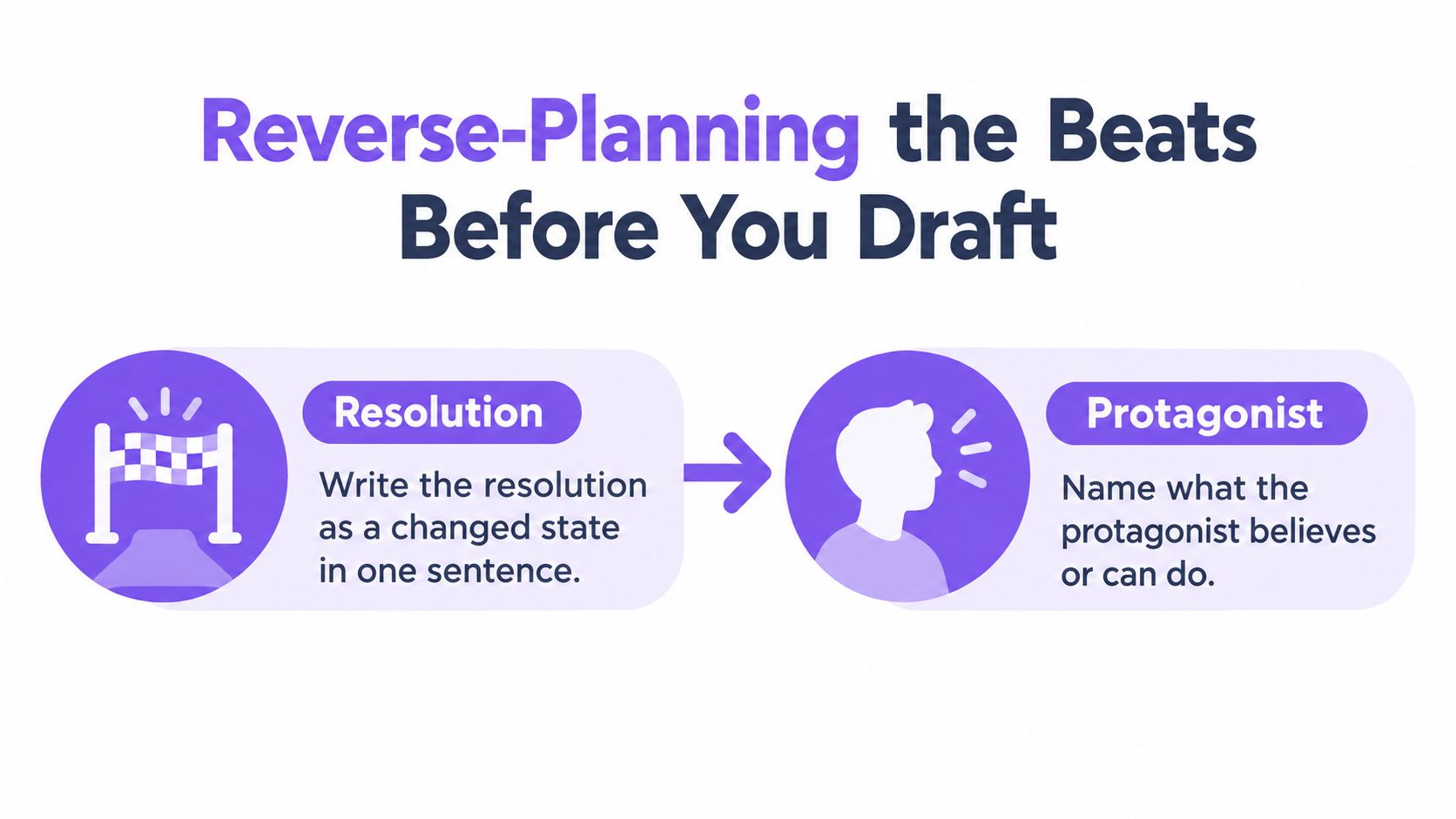
- Write the resolution as a changed state. One sentence. Name what the protagonist believes or can do when the story is over. Without that sentence, earlier beats are decoration.
- Set the hook as the contrast. The distance between start and end is the size of the novel. If they are almost the same person, you don't have a long book. You have a vignette.
- Lock the midpoint decision. This is the commitment to act on purpose. Obstacles invented before that decision turn into incidents, not pressure on a plan.
- Design both plot turns against that decision. Plot Turn 1 makes staying out impossible and aims at the midpoint. Plot Turn 2 supplies what the climax needs and must not solve the conflict by itself.
- Build the pinches as a pair. Pinch Point 1 pressures someone who still lacks agency. Pinch Point 2 hits the midpoint plan harder. The same threat repeated is not escalation.
- Add prerequisites to the cause-and-effect line. What they know, where they are, how much time has passed. If a prerequisite is missing, the beat is early.
- Only then fill the scenes. Log goal, opposition, decision, and consequence. Scenes come after the architecture.
If several consecutive scenes repeat the same goal and opposition with no decision and no irreversible consequence, the manuscript is stalling between beats. That stall is the sagging middle, and this order shows it before draft ten.
Distributing Scenes Between the Landmarks
A landmark owns a range, not a page number. Pacing notes on the seven functions put the Hook near the opening, Plot Turn 1 after the baseline is clear, Pinch Point 1 before the midpoint, the Midpoint near the middle of the word count, Pinch Point 2 in the latter half, and Plot Turn 2 shortly before the climax.
- Place landmarks as ranges. Leave the gaps unassigned. Don't pre-count chapters per beat.
- Fill gaps with state changes. Each scene carries the protagonist from one state to the next. Scenes that only pass time don't belong there. A working scene list makes the empty gaps obvious.
- Test position against cause. The scene comes before the beat that needs it, or after the beat that causes it. A Plot Turn 2 solution can't appear before the scene where the character learns the component.
- Tag one function. Pressure, decision, information, or consequence. A scene with none of those is a cut, or it folds into a neighbor. Pinch Point 2 sits later than Pinch Point 1 and costs more, so the scenes between them escalate instead of replaying the same pressure.
Genre Variations Where the Beats Shift
Popular guides assume an antagonist. Pinch Point 2 displays the villain's power, and Resolution is defeat. That frame fits a thriller and misleads almost everything else. Reedsy's guide to the seven-point story structure still describes the beats in that antagonist-friendly way, which is why the external form has to be translated.
| Genre | Pinch Point 2 usually takes the form of | Plot Turn 2 usually supplies | Resolution must answer |
|---|---|---|---|
| Thriller | A reversal that exposes the antagonist's reach | Information that makes the final confrontation winnable | Whether the threat is defeated or the cost is paid |
| Romance | A rupture between the leads that looks permanent | A revelation about the other lead's motive | Whether both leads have changed enough to commit |
| Mystery | A suspect or working theory collapses | A reinterpretation of evidence already on the page | Whether the truth is exposed and what exposing it costs |
| Literary family saga | A decision that breaks a relationship | Understanding of a parent's or sibling's reasons | Whether acceptance or loss is irreversible |
| Multi-protagonist ensemble | One character's choice undoes a shared plan | A link between two arcs the reader has not seen connected | Whether each arc resolves its own central change |
Pressure, changed understanding, proactive choice, and consequence survive every row. Only the external event changes. A rupture can carry Pinch Point 2. A new reading of evidence already on the page can carry Plot Turn 2. A moral decision can be the climax when nobody is physically beaten.
The seven points are changes in agency and story information, not a mandatory fight card.
If the book already thinks in acts, a five-act structure can hold the same functions without forcing a single villain into every turn. A relational novel or an ensemble can satisfy the structure with no villain at all, provided the midpoint still changes what the protagonist does next. Each arc in a large cast still needs its own commitment, or the shared plot is just traffic.
Why Beat Profiles Break Across a Long Manuscript
In one manuscript we audited, a daughter learned her father's hidden identity in chapter 11 and, two chapters later, planned dinner as if the letter had never arrived. The beat list said Pinch Point 1 had landed. The knowledge state had not.

A static profile records who a character is. Traits, history, a flaw you already know how to write. It almost never records what that person knows on a given page, where they are, what they were told, or who still believes the lie.
Two documents, two jobs
A development document answers who this person is. A tracking system answers what this person knows and can do as of chapter 19. Most consistency failures past 80,000 words live in that gap, not in a missing quirk.
Three failures show up again and again.
The forgotten revelation. Someone learns a hidden identity, then behaves as if that chapter never happened.
The early solution. The tool, ally, or fact reserved for Plot Turn 2 gets used before the scene where anyone could know it.
The speaking corpse. A messenger dies at Pinch Point 1 and has dialogue later. Funny in a read-through. Fatal once a series bible is involved.
For each beat, record goal, opposition, decision, and consequence, plus knowledge state, location, and elapsed time. Version the profile at the midpoint and at each pinch. One file written in week one goes stale the moment the plot turns.
A profile that cannot change between Pinch Point 1 and Pinch Point 2 isn't tracking. It's décor.
Recurring characters multiply the problem, because state has to survive the book break. Novelium's Character Tracker and World Codex extract those details from the manuscript and keep them current, which is the difference between a questionnaire and a check that notices chapter 22 contradicting chapter 14.
Run the Beat Audit Before Your Next Revision Pass
Run this against the current draft, not the outline you wish you had written. A reverse outline is the fastest way to see the book you have.
- Write the cause-and-effect sentence for each of the seven beats from the manuscript text.
- Check prerequisites in the text. Knowledge, location, elapsed time, and what the protagonist carries.
- Flag empty beats. Atmosphere standing in for an event, a Pinch Point 1 that changes no choices, a Plot Turn 2 with no setup in earlier chapters.
- Count initiated scenes on each side of the midpoint. Confirm the agency shift instead of assuming it.
- List the states that must carry into the next pass. People, objects, secrets, clocks.
A spreadsheet can hold the seven beats. It can't check that chapter 22 respects what chapter 14 established. Novelium's Character Tracker and World Codex extract and track character and world details across the manuscript, so the knowledge, location, and timing you just audited stay attached to later scenes.
If the beats only work when knowledge, place, and time stay consistent across a long draft, the audit shouldn't live in a folder of stale notes. Novelium reads the manuscript and keeps character and world state tied to the scenes where your plot turns happen. Start with the draft you have at Novelium.