3 Act Structure Template for Long Fiction
The popular advice is to divide your manuscript into quarters, drop a reversal in the middle, and trust the shape. That's how you get a beautifully proportioned novel in which a detective acts on evidence she hasn't found and an estranged ally keeps receiving confidential briefings.
A useful 3 act structure template isn't a screenplay costume for a long novel. It's a continuity sheet for irreversible change: what becomes impossible, what someone learns, and which subsequent decisions that knowledge permits. Keep the word targets. Stop treating them as proof that the book works.
Word Targets for a Three Act Outline
Put the marks on a single sheet before opening the chapter outline. Use approximately 25% setup, 50% confrontation, and 25% resolution, the working allocation described by Filmmaker Genius. The unequal duration matters: reserve substantial space for sustained confrontation, not just arrival and cleanup.
For the early disruption, Infinite Library's guide places the inciting incident at approximately 10%, before the first-act commitment. The table translates those planning proportions into hypothetical manuscript targets, not deadlines.
Three-act word marks by manuscript length
| Beat | Share | 80,000 words | 90,000 words | 120,000 words |
|---|---|---|---|---|
| Inciting incident | About 10% | 8,000 | 9,000 | 12,000 |
| Act I break | About 25% | 20,000 | 22,500 | 30,000 |
| Midpoint | About 50% | 40,000 | 45,000 | 60,000 |
| Second turn | About 75% | 60,000 | 67,500 | 90,000 |
| Act III resolution block | Last 25% | 20,000 | 22,500 | 30,000 |
For the hypothetical 90,000-word line, that's roughly 9,000 words to the inciting incident, 22,500 to the first break, 45,000 to the midpoint, 67,500 to the second turn, and 22,500 words of resolution. Read the beat rows as cumulative positions, but the resolution row as a block of manuscript space. Act III includes the final confrontation, not merely an epilogue after everything important has happened.
Copy the marks, not the film convention
The historical connection is Syd Field's Screenplay, published in 1979: his conventional 120-page model used approximately 30, 60, and 30 pages, with major turns around pages 25 to 27 and 85 to 90, as described in Grantland's retrospective. Those page counts belong to a film convention. They aren't instructions for chapter length.
In a novel, the first break is where the lead's course makes the central problem unavoidable and changes what later scenes must accomplish. Accepting the investigation isn't enough if she can abandon it without consequence. Destroying her professional cover to protect the suspect is a commitment.
Working rule: Missing the count can work. Missing the directional change cannot.
Keep the audit session bounded. If games are your particular escape hatch when structural revision gets uncomfortable, TiedSiren offers a way to lock games during work hours; use that boundary to finish the sheet rather than reorganize your desktop.
Copy one manuscript-length column onto a single page. Leave room beside each mark for the actual scene and its consequence.
How to Fill Each Beat on the Sheet
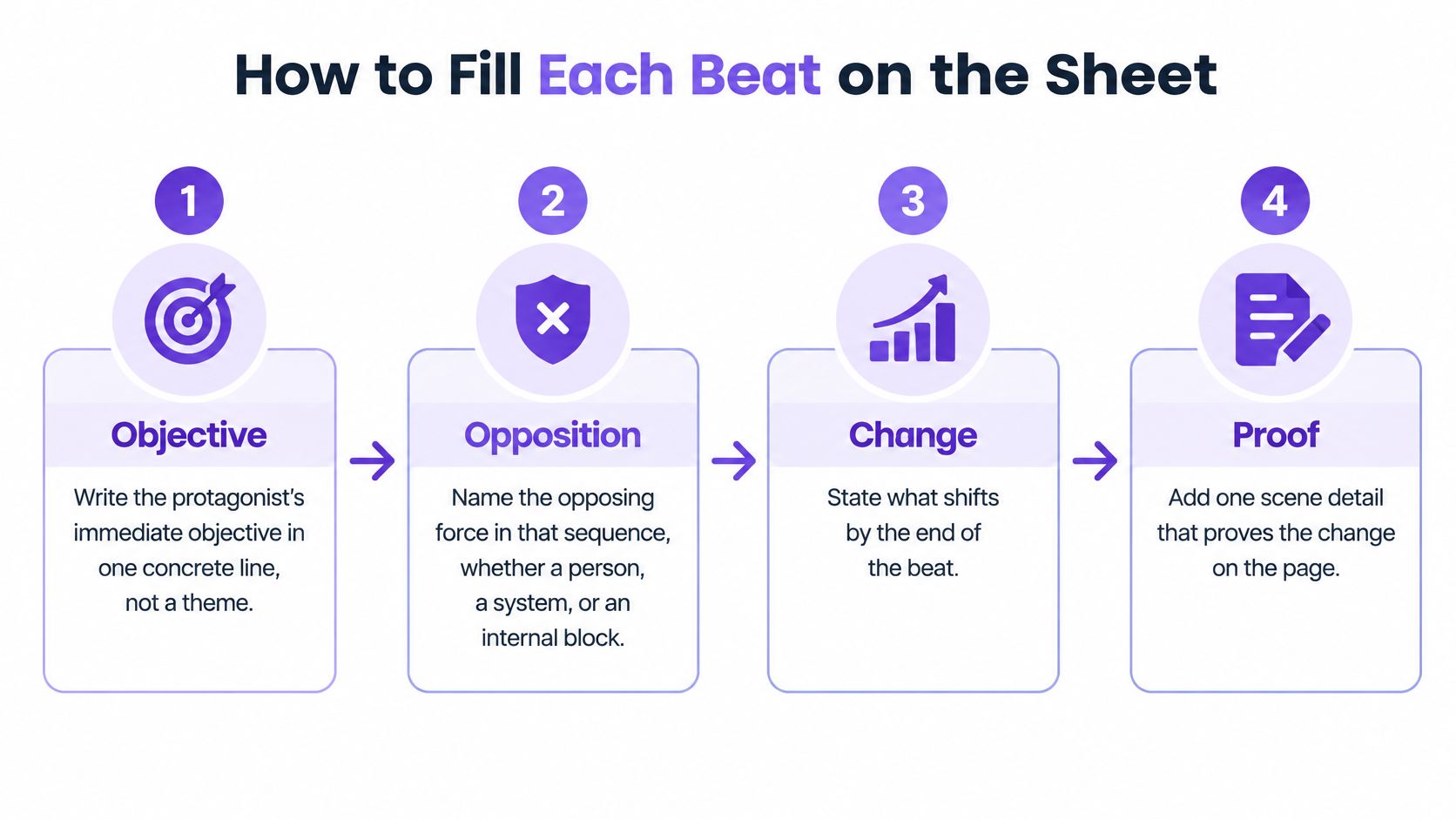
Set up one row per beat, with the same fields across the page. A beat sheet earns its space when you can use it during revision, not just admire it before drafting.
The Editing and Dramatic Structure teaching document defines plot points as reversals that redirect the story into a new act. Make that redirection explicit rather than hiding it behind a scene summary.
- Immediate objective. Write what the protagonist intends to accomplish in this sequence, in one concrete line. Not the theme, and not the eventual ending.
- Opposing force. Name the person, clock, secret, system, or conflicting duty that blocks this particular objective.
- Irreversible change. State which option, relationship, or stake is gone afterward. Record the new state, not just the event.
- New question. Write what the next sequence must answer because of that change. Include the scene detail that proves why the question now matters.
Use the visual prompt to keep the process concrete, then record the forward question in the final column.
A midpoint with consequences
Say your series lead discovers that her ally has been feeding the antagonist information throughout the previous books. Her immediate objective is to authenticate a stolen dispatch without exposing the archive. The opposing force is the ally's access to both the dispatch network and the archive keys.
The irreversible change isn't that she feels betrayed. Her waiting-for-proof strategy is finished, the alliance breaks, and the antagonist can now anticipate the investigation. The new question is whether she can reach the archive before the ally does.
Prove it on the page: she finds the ally's cipher in an intercepted order, then discovers the archive key missing. That supplies evidence for her decision and a practical reason to move immediately. A paragraph of suspicion without either consequence leaves you with the old investigation wearing a darker mood.
After the scene, options, knowledge, relationships, or stakes must be different. Otherwise, you've labeled an unchanged situation.
Apply those fields to the inciting incident, Act I break, midpoint, second turn, and climax before decorating them with subplots. A mood shift, a travel chapter, or another demonstration of an established trait doesn't qualify on its own.
Keep the first version on one page. Add a consequence page only when a beat creates downstream changes that need their own rows, and revise those rows whenever you move the scene.
Tests for a Middle That Only Looks Full
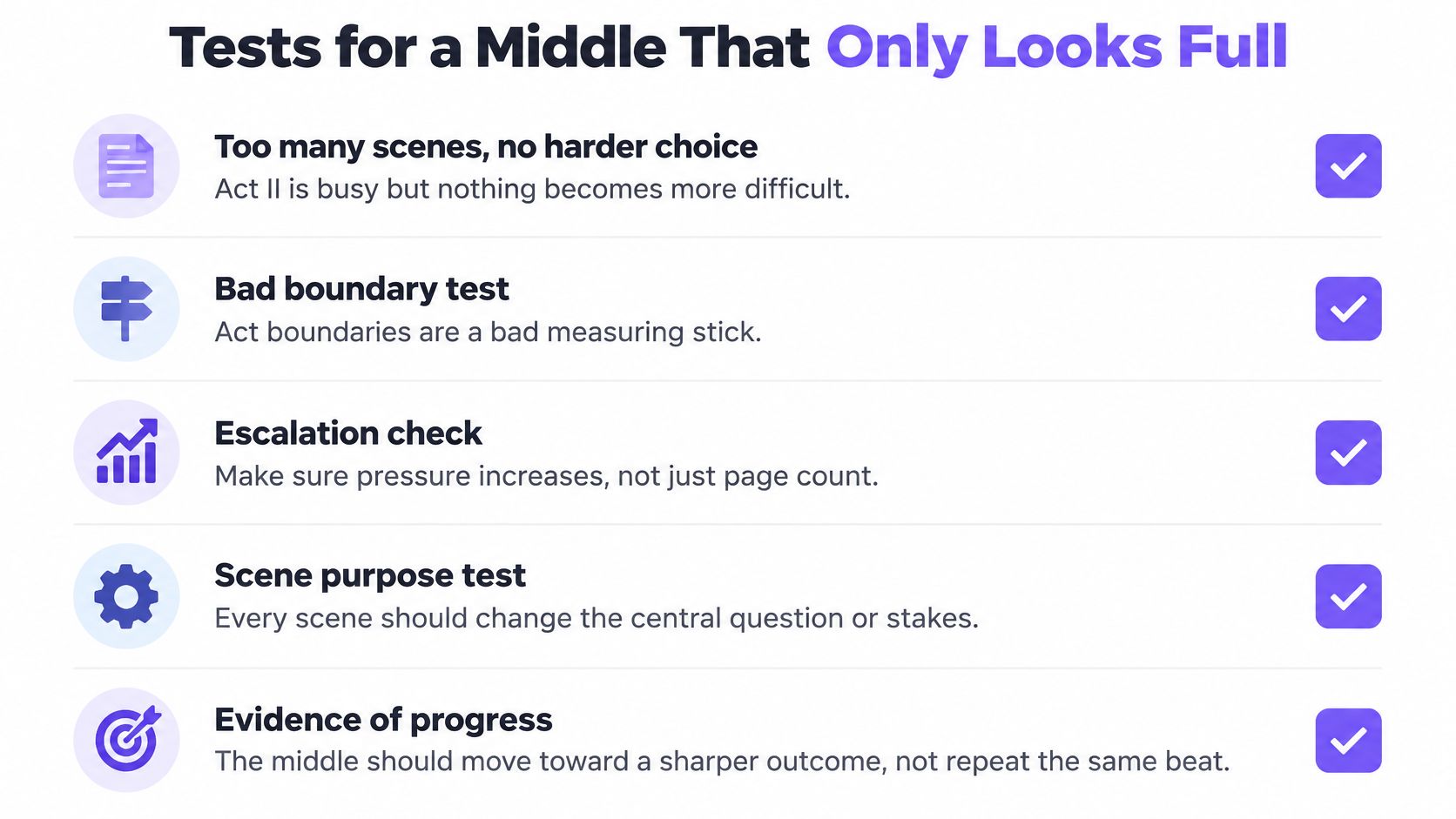
The long-draft failure worth catching is brutal: Act II is full of scenes, and nothing is harder. The cast travels, argues, investigates, and survives another skirmish, but the protagonist retains the same plan at the same price.
Act boundaries are a bad measuring stick. A peer-reviewed comparison in the Journal of Screenwriting found surprisingly low agreement about where acts begin and end, attributing the inconsistency to vague definitions of acts and plot points. Audit causal function instead of percentage compliance.
Use this checklist against the actual manuscript, not the outline you intended to write.
Require a different next scene
Build a scene table with timeline position, goal, conflict, decision, consequence, and unresolved question. Flag scenes where none changes, then inspect each proposed turn: the lead's available choices must change permanently, failure must become more expensive, and the next objective must follow logically.
Check the continuity at that exact junction. A character can't decide on a fact they haven't learned, and a consequence can't precede its cause. A recognized betrayal qualifies only if the protagonist can no longer execute the old strategy.
Structural symptoms and the revision move
| Symptom | Wrong diagnosis | Revision move |
|---|---|---|
| Opening still explaining past the quarter mark | Act I is the wrong length | Cut until the commitment makes the problem unavoidable |
| Act II repeats the same skirmish | The book needs more complications | Change the plan, the price, or who knows the secret |
| Quiet midpoint, same strategy after | A midpoint must be a loud set piece | Keep it quiet only if the lead's plan is now impossible |
| Climax answers a new question | The ending is too short | Force the climax to settle the Act I question |
| Last quarter is aftermath and retries | Act III started late | Move the decisive turn back so the resolution has a job |
For that last symptom, distinguish the turn into the final confrontation from the confrontation's decisive outcome. Bring the necessary commitment earlier if it arrives too late, but cut retries after the outcome is already settled. Don't preserve dead pages to protect a proportion.
Treat pacing issues as problems of changed pressure, not merely scene speed. A miss of several thousand words is noise; a turn that doesn't change the next scene's job is the break.
Where the Template Bends
Don't give every viewpoint character an inciting incident, midpoint, and climax at identical manuscript positions. You'll manufacture synchronized drama instead of a convincing ensemble. Use one macro shape for the central question, with character arcs nested inside it.
Keep the whole manuscript visible while separating the plotlines.
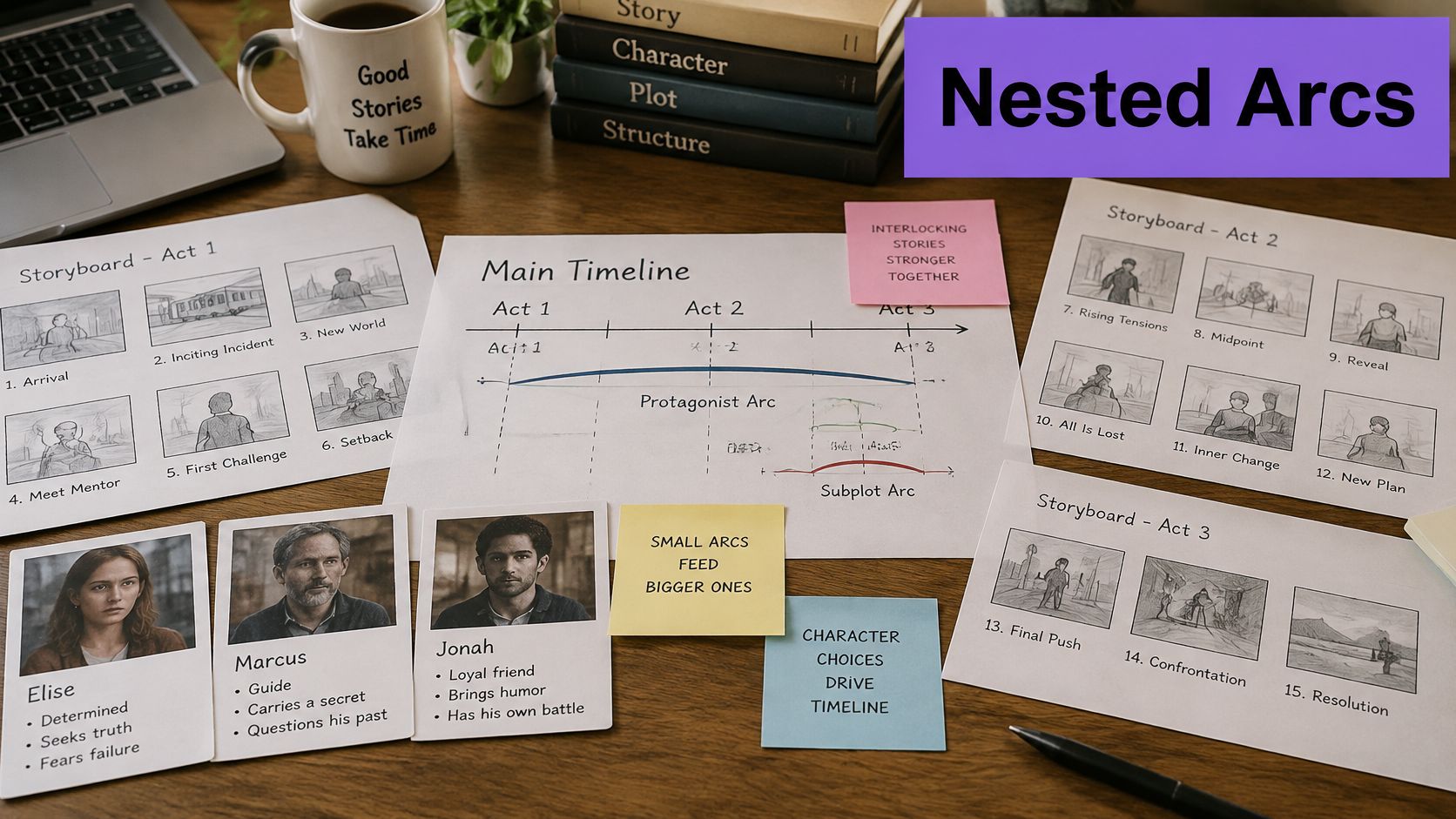
The useful extension to the single-protagonist model is to map plotline dependencies, an approach discussed in Flashboards' three-act guide. Separate global turns, which alter what every plotline can do next, from character turns, which alter one person's options.
A romance confession belongs early if the main investigation needs the resulting alliance. Delay it if reconciliation would remove pressure the final confrontation still requires. At each global turn, record who knows the new fact, who's still acting on the old version, and whose next move depends on someone else.
Track state, not personality
This is why static character profiles fail as continuity tools. A document describing someone as loyal, suspicious, and afraid of abandonment won't tell you whether they've learned about the betrayal. Favorite drinks and childhood anecdotes are useful development material, but they don't authorize decisions.
Character development documents explain the person. Character tracking systems record their changing state. Track knowledge and its source, location, injuries, access, relationship changes, and current commitments. Update those records when revision moves a disclosure or removes the scene that established access.
Otherwise, your skeptic warns the group before hearing the confession, or your injured courier crosses the city on a schedule written before you broke his leg.
A structural diagram can help you inspect the broad shape, provided you keep those dependencies attached.
Make one deliberate exception
For mystery, withhold the solution without withholding the investigator's commitment. For a two-lead romance, share the outer breaks while allowing each lead's internal reversals to arrive separately. In epic or political fiction, extend the confrontation only if the central reversal still invalidates the original strategy; in shorter books, use fewer scenes rather than miniature versions of every subplot.
Scriptlix's account of Field's model treats the page conventions as pacing diagnostics, not universal requirements. Deviate because the causal job belongs elsewhere, not because a genre rumor gives the middle permission to wander.
Map the macro question, the global turns, and each subplot's dependency on them.
If five-act structure makes a particular arc easier to inspect, use it. Changing labels won't excuse a missing dependency.
Audit the Turns Before the Next Draft
Stop collecting structure diagrams and mark the manuscript you have. Choose the target-length column, find the major beats, and record the irreversible change and the new question beside each. If a beat changes nothing, revise it instead of reaching for another template.
Then check who can act on each disclosure. Which subplot depends on it? Does a character still drive a later scene with information they no longer have, or appear in a scene after you've made them absent? Those are continuity breaks, not small outline errors.
Keep the continuity layer current
A static outline records the plan. Revisions can change what the manuscript establishes about a suspect's whereabouts or when an ally learns the truth. Keep those facts current as you revise.
Users begin with Novelium by bringing in manuscripts, outlines, character sheets, and notes. Novelium automatically tracks character traits, knowledge states, relationships, and events across chapters. Check each marked turn against what the characters know, and whether the revised sequence still holds.
Run the structural audit on your sheet, then check the changed scenes and their consequences against the manuscript. Pay closest attention when a revision moves information from one character to another.
Novelium's continuity features help you check structural revisions against character knowledge, relationships, and events across chapters. Bring your draft and working notes to Novelium, mark the turns you're revising, and check that each character's decisions still fit what they know.